PART 6 (THE END): The Name Beneath the Platform 041
Part 6 – A Promise Renewed
“If the crown has returned to ask what it is entitled to keep, let the people hear what the crown promised to give.”
My mother’s voice filled the ballroom, gentle and steady, as if she were speaking to me across the years.
The dark glass beneath the broken seal glimmered, and her testimony appeared in lines of gold.
No image of her formed, no ghostly figure rose from the platform; only her words were made visible, each sentence shining long enough for the court to read.
The king’s promise is not ownership of the realm, Elena had written.
It is stewardship, freely entrusted and freely questioned.
A murmur moved through the nobles, but no one interrupted.
The platform continued, revealing the account of the old pact, the late king’s attempt to cover its central inscription, and the part my mother had played in preserving the truth.
Her testimony named no villain.
It recorded the choices made, the people affected, and the responsibility that followed.
When the final lines appeared, I saw the words she had written for me, words I had first read in the quiet chamber beneath the ballroom.
Let my daughter decide for herself whether the pact should be heard again.
The gold faded.
For several breaths, the court remained silent.
I could still feel Julian’s hand in mine, warm and steady, but he did not hold me as though I belonged to him.
He stood beside me because he had chosen to stand beside my choice.
Master Orren approached the platform and studied the dark glass.
“The testimony has been received,” he said. “The mechanism has completed its sequence.”
The broken pieces of the royal seal lay in the groove, dull and harmless.
The platform did not blaze again.
It did not announce who should rule or turn my mother into a legend larger than the life she had lived.
It had done what she asked: it had let her words be heard.
The king removed his crown.
His movements were slow, deliberate, and free of ceremony.
He placed it on the table beside the fragments of the seal.
“I allowed silence to stand in place of judgment,” he said, facing the court. “I knew the platform had been altered before I inherited the throne, and I chose not to uncover what my father had hidden.”
No one spoke.
“I believed preserving the crown would preserve the kingdom. I understand now that a crown kept by silence is not the same as a kingdom kept in trust.”
His gaze found mine, but he did not ask me to forgive him.
“I will answer to the court and to the provinces for what I failed to do.”
The announcement did not sound like a victory.
It sounded like the first honest step after a long refusal.
Julian released my hand, then turned toward the gathered nobles.
“My succession cannot be treated as settled while the pact that gives the crown its purpose remains unrenewed,” he said. “I will not ask the court to confirm me tonight.”
A ripple of uncertainty passed through the room.
The king looked at his son.
“You may lose your claim.”
“I know.”
“And you still choose this?”
Julian looked at the words fading on the glass.
“I choose not to inherit an authority I have not yet learned how to hold.”
I turned toward him.
There was fear in his face, but no retreat.
The prince who had once asked hundreds of women to prove themselves on a platform had changed, not because the mechanism chose him, but because he had finally understood that no mechanism could make his choices for him.
The court did not settle the matter that night.
Instead, it appointed a council to hear the testimony in full and compare it with the surviving records.
Mistress Vale brought forward the damaged archive pages, and Master Orren provided his account of the platform and the seal.
The king gave up his crown until the council could decide what form the renewal should take.
No one was sent away for questioning the old order, and no one was asked to swear loyalty before the truth had been considered.
For the first time in many years, the palace let uncertainty remain in the room without trying to hide it.
In the weeks that followed, the council listened to petitions from the provinces and invited representatives of the people to speak beside the court.
The old pact was not restored in its original form without question.
It was examined, clarified, and renewed in language that the people could understand and the crown could not quietly set aside.
The platform remained closed while the work was done.
I returned home for a time, not to flee the palace, but to remember who I was when no one was asking me to become the answer to a kingdom’s mystery.
I mended the loose hem of my mother’s burgundy gown and placed her pendant on the table beside me.
Its gold had cooled, but when I held it, I could still remember the warmth of the chamber and the sound of her voice.
I missed her most in the ordinary moments, when I wanted to ask whether she had liked the spring rain or whether she had ever regretted leaving.
There were no answers in the pendant.
There was only the life she had given me, and the trust she had placed in my judgment.
Julian did not ask me to return to the palace.
He wrote instead, telling me what the council had decided and what remained uncertain.
His letters contained no grand promises.
He told me when he had been wrong, when he was afraid, and when he had changed his mind after listening to someone whose life differed from his own.
I answered when I wished.
Sometimes my replies were long.
Sometimes they were only a few lines, and he accepted both without complaint.
The council eventually concluded that the platform had not chosen a bride or an heir.
It had exposed a truth the crown had failed to honor.
The royal seal could not be restored, and the old rite of succession had to be reconsidered.
Rather than claim the throne by inheritance alone, Julian agreed to stand before the court and representatives from each province.
He spoke about the pact and the responsibilities it placed on a ruler.
Then he invited those gathered to name the duties they expected their next sovereign to uphold.
The court, for once, did not answer for the people.
After months of debate, a new charter was approved, establishing shared oversight between the crown, the court, and the provinces.
Julian was recognized as ruler only after he renewed the pact publicly and accepted its limits.
When the day came, I stood among the invited witnesses, wearing my mother’s burgundy gown.
It had been mended at the hem, and the velvet fell softly around me.
I did not wear the pendant as a royal emblem.
I wore it because it was mine, and because my mother had placed it in my care.
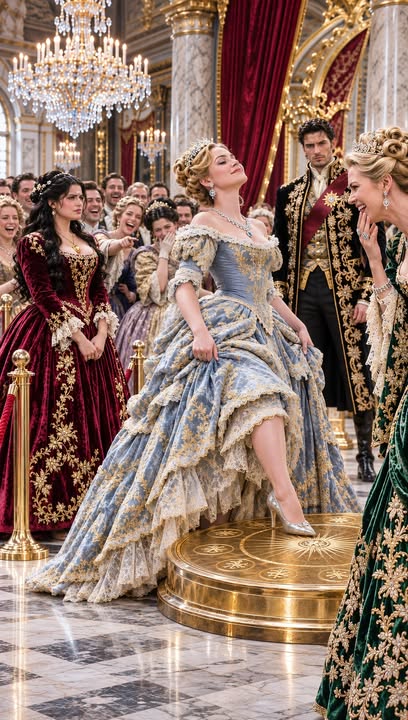
The Golden Platform had been moved from the center of the ballroom to the open courtyard, where sunlight could reach it.
Its gold had been cleaned, but the old inscription remained visible beneath the glass.
The crown is held in trust.
No ruler may claim what the people have not entrusted.
Julian stood before the platform without a crown.
He made his promise in his own words, then listened while representatives of the provinces answered with theirs.
No one knelt to be chosen.
No one was asked to prove they belonged.
When the ceremony ended, the people stood with the court beneath the open sky, and the platform held no secret from them.
The king, no longer wearing his crown, stood among the witnesses.
He had begun the work of answering for his choices, not through a single apology, but through years of listening and helping restore the protections he had once neglected.
I did not know whether time would make us close.
I only knew that he had stopped asking me to ease his regret.
That was a beginning I could respect.
Later, Julian found me beside the courtyard fountain.
“Are you glad you came?” he asked.
“I’m glad I chose to.”
He smiled, then glanced at the pendant at my throat.
“Do you ever wish your mother had told you everything?”
“Of course,” I said. “But I understand why she wanted me to have a life before I inherited her questions.”
“And now?”
“Now I have both.”
The smile he gave me was quiet, touched with affection and something like relief.
“I have been hoping you might stay near the palace,” he said. “But I don’t want you to think you owe me that.”
“I don’t.”
“I know.”
“And I don’t want to be made into a symbol every time I walk into a room.”
“I would never ask that of you.”
“You might not have to ask. People will try.”
“Then I will remind them that you are Clara before you are anything else.”
I studied him, remembering his first question in the ballroom and the way he had once seen a mystery before he saw the person standing inside it.
“You have learned a little,” I said.
“I hope I have.”
“So have I.”
I chose to remain at court for part of each year, working with the council to restore the old family lands in my mother’s name.
They were not grand estates, and many had fallen into disrepair.
We began with the village records, the neglected wells, and the boundary disputes that had gone unanswered for generations.
My mother had once helped people bring their petitions to the crown.
I helped make sure they no longer needed a hidden mediator to be heard.
The work took years, and Julian remained part of it without trying to take it over.
He listened when I disagreed with him.
I listened when he asked for my thoughts.
Trust did not appear all at once, like the platform’s golden light.
It grew slowly, through choices repeated until neither of us had to wonder whether the other would be there.
We married only after that trust had become a life we had chosen together.
The ceremony was held in the restored courtyard, beneath the branches of an old tree that had once shaded the village hall on my family’s land.
The court attended, but so did the people from the provinces who had helped renew the pact.
There was music, and bread made by the village baker, and flowers gathered from the fields near the home where my mother had raised me.
I wore a simple gown of burgundy velvet.
My pendant rested at my throat.
When Julian took my hand, he did not kneel to a symbol or ask me to solve a mystery.
He looked at me, and I looked back, both of us free to say yes.
Years later, the Golden Platform still stood in the courtyard.
Rulers used it to renew their vows of stewardship before the court and the people, but no one called it a test for brides again.
Children sometimes ran their fingers over the old inscriptions, tracing the letters beneath the glass.
When they asked who Elena had been, I told them she was a mediator, a mother, and a woman who believed a promise mattered most when keeping it was difficult.
I told them she had protected the truth without asking for a crown.
And I told them that the kingdom had become stronger when it finally listened.
At home, I kept my mother’s pendant beside her mended gown.
Sometimes, in the late afternoon, sunlight caught the gold and made it glow.
Then I would remember the ballroom, the laughter that had once greeted my arrival, and the moment the platform opened beneath my feet.
I had entered that palace believing I was keeping a promise to my mother.
I left understanding that the promise had never been about becoming worthy of a crown.
It had been about helping the crown remember who it was meant to serve.
**–THE END–PLEASE
Share your thoughts or feedback to motivate us to create more stories ♥️
* * *
[PREVIOUS: PART 5](https://echoesofstories.idolsgift.com/blog/part-5-the-name-beneath-the-platform-041)
✓ Lynn R. Adams
Part 6 – A Promise Renewed “If the crown has returned to ask what it is entitled to keep, let the people hear what the crown promised to give.” My mother’s voice filled the ballroom, gentle and stea…