PART 6 (THE END): The Name Beneath the Oak 058
Part 6 – The Song Beneath the Oak
The investigator turned the photograph beneath the office lamp, careful not to touch its edges.
“An old staff coat,” Damiano said. “But that could have belonged to anyone.”
“Yes,” the investigator replied. “The image can give us a lead, not an identity.”
Elena looked down at Sofia, who was still asleep against her shoulder.
“Could the watch in the picture be yours?” she asked Damiano.
He took the silver watch from his pocket and laid it beside the photograph.
The cases were alike in size and shape, though the image was too blurred to show the small crescent mark beneath the hinge.
“My father’s watch was found in his study,” Damiano said. “This could be another one.”
“Or the same model,” Enzo said. “Your father may have owned more than one.”
Renato studied the picture with a troubled expression.
“I remember the old staff uniforms. Several of the senior household workers wore watches like that, issued for keeping track of their rounds.”
Damiano looked at him.
“Who had access to them?”
“The head housekeeper kept the records. The watches were returned when someone left.”
“Do you remember who wore one that night?”
Renato shook his head.
“Not clearly. I remember the night as a blur of phone calls, the physician, the police, and a house full of people waiting for someone to tell them what had happened.”
The investigator placed the photograph into a protective sleeve.
“We’ll compare the uniform details with the personnel records and ask the former staff members to identify it. We should also have the negative examined if we can locate it.”
“No one goes looking alone,” Damiano said. “We do it through the proper channels.”
His eyes shifted to Elena, who held his gaze for a quiet moment before nodding.
The photograph had arrived as a warning, but Damiano refused to let it become a reason for hurried accusations.
There was a time when a blurred figure and an old key would have been enough to make him choose a target.
Now he understood that being certain was not the same as being right.
The investigator took custody of the image and the envelope, then left with a promise to follow every lead.
For the next several days, the estate seemed to live between two kinds of time.
There was the present time, measured in calls with the lawyer, interviews with former employees, and careful conversations with Elena.
And there was the old time, buried in ledgers, recordings, and the moments each person had spent deciding whether silence was safer than the truth.
The approved locksmith was the first person they interviewed.
He was an elderly man with a clear memory for his work, though he needed his daughter to help him find the right files.
He remembered repairing the study lock two days before Domenico died.
He also remembered the person who had arranged it.
“Mr. Bellandi’s office called,” he told the investigator. “They said Mr. Domenico wanted the lock adjusted before an evening meeting.”
“Did you speak to Mr. Domenico?” the investigator asked.
“No. I was told he was busy.”
“Who gave you access to the study?”
“A man from the company.”
The locksmith could not remember the man’s name, but he remembered the office he had worked from and the distinctive signet ring he wore.
A former Bellandi employee later identified the ring as belonging to Adriano Bellandi himself.
The repair had been arranged at Bellandi’s request, and the work had left the study lock easier to open with the duplicate key.
That did not, by itself, prove what had happened inside the study.
The recording, Domenico’s note, the accounting records, and the misleading maintenance entry together gave the authorities enough to move forward.
The old photograph provided one more piece.
The investigator located its original negative among boxes stored at a former housekeeper’s home.
It showed the figure more clearly than the copy.
The person at the service entrance was not Renato or Enzo, but a junior office clerk who had worked for Bellandi.
When investigators interviewed him, he admitted he had delivered the duplicate key to Bellandi’s driver and later helped create the false return entry.
He said he had been told that Domenico had approved a private security adjustment.
He had not known what Bellandi intended.
For years, he had kept quiet because he feared he would be blamed for a decision made by people far above him.
He agreed to provide a statement and the remaining business records he had kept.
Those records connected Bellandi to the fraudulent transfers and to the deliberate tampering with the study lock.
More importantly, they showed that he had arranged for an outside physician to make a false report about Domenico’s death.
The physician was no longer alive, and several details could never be recovered with certainty.
But the evidence established that Domenico had not died from the natural cause recorded at the time.
His death had been made to look ordinary so the theft could continue unnoticed.
The discovery did not arrive with a dramatic revelation or a single piece of perfect proof.
It came through the patient work of people comparing what they remembered against what the records showed.
Each new fact made the next one harder to deny.
When the investigator finally explained the findings to Damiano, he did not feel triumph.
He felt the ground beneath an old grief shift.
For twenty years, he had believed his father’s death might have been caused by someone close to the family.
The fear had taught him to treat trust like a door that had to remain locked.
Now he knew that the truth had been concealed by a man his father trusted in business, while people inside the household had made frightened choices that allowed the lie to endure.
The family had not killed Domenico.
But silence had kept the truth from his son.
And that truth was painful in a different way.
Renato asked to speak with Damiano alone in the west garden.
They stood by the path Elena and Sofia had taken on their first day at the estate.
“I’ve given the authorities everything I had,” Renato said. “I’ve also agreed to answer their questions about what I kept from you.”
“You should.”
“I know.”
Renato’s expression carried none of its old composure.
He looked tired, and older than Damiano remembered him being.
“I told myself I was protecting people,” Renato continued. “I told myself that if I kept the matter small, it would pass without hurting the household.”
“And it gave Bellandi more time.”
“Yes.”
“Do you regret not telling me?”
“I regret every year I let you believe there was nothing to learn.”
Damiano looked toward the oak, where the branches moved softly in the late-summer breeze.
“Regret can be useful,” he said. “If it makes you honest now.”
“I don’t expect you to forgive me.”
“I’m not sure forgiveness is something I can give on demand.”
Renato lowered his eyes.
“But I’m willing to let you earn back trust,” Damiano said. “That starts with telling the whole truth, even when it costs you.”
“I will.”
“Then we’ll begin there.”
Enzo had his own conversations with the investigators.
He provided records from the security reviews and admitted that he had heard the study door close that night without checking it.
He had believed Domenico was safe, and the belief had been reasonable.
Still, he did not use that reasonableness as a shield.
“I should have followed up on the lock,” he told Damiano afterward. “I was so certain the argument with Renato had been about paperwork that I stopped asking what else might matter.”
“You didn’t know what Bellandi was doing.”
“No. But I could have asked more questions.”
“So could I.”
Enzo studied him.
“Do you blame me?”
Damiano considered the question before answering.
“I’m angry that so much was hidden. I’m angry that my father was taken from us. But I don’t believe you knew what Bellandi intended.”
“That isn’t the same as forgiving me.”
“No,” Damiano said. “It isn’t.”
Enzo accepted the distinction.
They had built their friendship on loyalty so old neither of them had thought to examine it.
Now they were learning that loyalty was not a promise to defend one another from every consequence.
It was the willingness to stand beside each other while the truth was spoken.
The authorities arrested Adriano Bellandi at his home after the evidence had been reviewed.
The news reached the estate on a cool morning in September.
Damiano was at his desk when the investigator called.
Bellandi had not resisted.
His lawyer was present, and the case would take months to move through the courts.
The charges included fraud, tampering with evidence, and arranging Domenico’s death.
The investigator cautioned Damiano not to mistake an arrest for a final judgment.
There would be hearings, testimony, and public scrutiny.
The Vitale business records would be examined.
The family’s past would be discussed in rooms Damiano could not control.
When he ended the call, he looked out at the garden.
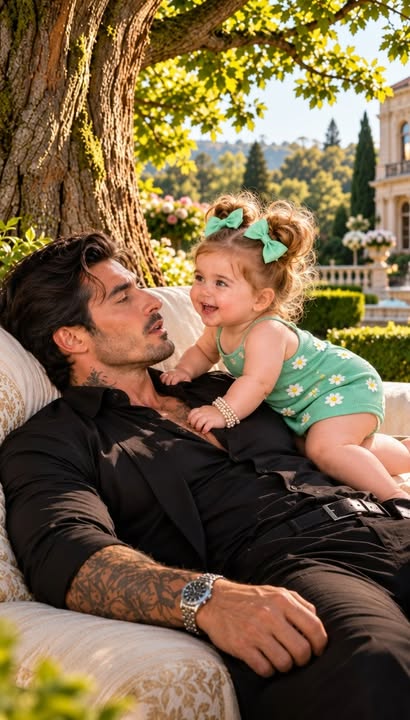
Elena was beneath the oak with Sofia, who was attempting to gather fallen leaves into a small basket.
They had come for an afternoon visit, one Elena had chosen herself.
Damiano went outside without calling for them.
Sofia spotted him first.
“Sleepy man!”
She ran toward him, her short legs carrying her across the grass with an uneven determination.
Damiano crouched before she reached him, and she wrapped both arms around his neck.
“Hello, little expert.”
“I got leaves.”
“I can see.”
She held up the basket.
“They’re for you.”
“What am I supposed to do with them?”
“Keep them.”
He accepted the basket with solemn gratitude.
“Then I’ll keep them.”
Elena approached at an easier pace, her expression soft but watchful.
“You heard?”
“Yes.”
“Are they sure?”
“They have enough evidence to make the arrest. The case will take time.”
She nodded, absorbing the answer.
“And the business records?”
“They’ll be examined too.”
“That could bring a lot of attention.”
“It will.”
“Are you frightened?”
Damiano considered giving her the confident answer people expected from him.
Instead, he looked at Sofia, who had begun arranging leaves by color.
“Yes,” he said. “But I don’t want fear deciding what I do anymore.”
Elena’s eyes held his.
“Neither do I.”
The wind moved through the branches overhead.
For a moment, the estate seemed to rest in the same quiet that had surrounded them beneath the oak the first day they met.
“Do you still want us here?” Elena asked.
“I want you both here whenever you want to be.”
“That isn’t what I asked.”
Damiano understood.
She was not asking whether he wanted to keep them close.
She was asking whether he could accept their closeness without claiming it.
“Yes,” he said. “I want you here. But I won’t ask you to stay because I’m afraid of being alone.”
Elena looked down at Sofia.
“I don’t know what I want yet.”
“Then you don’t have to decide today.”
“Your family has a way of making every kindness feel like a debt.”
“I’ll try not to.”
“Trying matters,” she said. “But it isn’t the same as succeeding.”
“I know.”
She studied him for a moment, then sat beside him on the low stone bench.
“I want Sofia to know where I worked,” she said. “I want her to know something about your father that isn’t only the story of how he died.”
Damiano looked at the oak.
“He used to sit beneath this tree when he wanted to think.”
“Did he?”
“After business meetings, sometimes. He said it was easier to tell the truth outside.”
Elena smiled faintly.
“That sounds like something you could learn from.”
“I’m trying.”
“What was he like with you?”
Damiano searched through the years for a memory that had not been flattened by the story of his father’s death.
“He was patient,” he said. “Not soft exactly. He expected me to keep my word, and he never let me pretend I didn’t understand the cost of a choice.”
“That must have been difficult.”
“It was. I thought being like him meant becoming impossible to surprise.”
Elena glanced at him.
“And now?”
“Now I think he would have preferred that I knew how to listen.”
Sofia came over with a broad golden leaf and pressed it against Damiano’s sleeve.
“For your coat.”
“Thank you.”
She climbed onto the bench between them and leaned her head against Elena’s arm.
The ease of it made something in Damiano ache, but the ache no longer felt like an injury.
It felt like a place where tenderness might grow.
The weeks that followed were not simple.
The investigation moved slowly, and the estate’s old records drew more attention than Damiano wanted.
He answered questions through his lawyer and provided every document he had.
He did not threaten witnesses, interfere with the case, or use his resources to silence the past.
Some business relationships ended.
Others remained, though with new conditions and a more careful account of who had authority over what.
Renato stepped down as estate manager while the inquiry continued.
He gave a full statement and accepted responsibility for concealing records.
The authorities found no evidence that he had known Bellandi intended to kill Domenico.
Even so, Renato had to answer for his silence and for the choices he had made after the death.
He did not ask Damiano to spare him the consequences.
Enzo remained at Damiano’s side, though their friendship changed.
They talked more honestly than they had before.
Sometimes the conversations were awkward.
Sometimes one of them misunderstood and had to begin again.
Neither pretended that trust could be restored simply because they wanted it.
One afternoon, Damiano found Renato in the records room, carefully labeling a box of documents for the investigators.
“You can take a break,” Damiano said.
“I’ve been avoiding enough work for one lifetime.”
“That’s not the same as making yourself useful.”
Renato gave him a tired smile.
“No. It isn’t.”
Damiano stood beside him.
“I’m not asking you to disappear from the estate.”
Renato’s hands paused over the label.
“You’re not?”
“I’m asking you to stop deciding what the rest of us should know.”
“That’s fair.”
“And when this is over, we’ll talk about what comes next.”
Renato nodded, accepting that the future could not be promised in advance.
“Thank you.”
Damiano left him to the work.
He did not feel the old satisfaction of having control.
He felt something less certain and more sustaining: the possibility of repairing a relationship without pretending it had never been damaged.
By the time the leaves began to turn, the great dining room had been opened for a small family gathering.
It was not a celebration of the arrest.
The case against Bellandi was still moving through the courts, and no one knew exactly when it would end.
The gathering was for Domenico.
Elena had agreed to come with Sofia after Damiano promised there would be no speeches and no crowd of strangers.
They invited a few former household staff members who had known Domenico, along with Enzo, Renato, and the people closest to the family.
The long table held soup, bread, roasted vegetables, and a pear tart made by the estate cook.
The windows were open to the evening air.
For the first time in years, the house felt inhabited rather than guarded.
Damiano stood near the doorway as people arrived.
Elena came last, holding Sofia’s hand.
“You can leave whenever you want,” he said.
“I know.”
“And no one will ask you to explain.”
“I know that too.”
She looked around the room.
“It feels different when the door is open.”
Damiano followed her gaze.
“I used to think a locked door kept everyone safe.”
“Did it?”
“No.”
She squeezed Sofia’s hand.
“Then perhaps an open one is worth trying.”
At dinner, Enzo told a story about Domenico getting lost on his own property after taking a wrong turn during a walk.
Renato corrected the details, insisting Domenico had known exactly where he was and had only pretended to be lost so the younger men would stop arguing about the map.
The old staff members laughed.
For once, the laughter did not feel like a denial of grief.
It made room for it.
Sofia sat between Elena and Damiano, drawing shapes on a paper napkin.
She had decided the pear tart was “too sticky,” but accepted a small piece after Damiano promised not to call it cake.
When the meal ended, Damiano opened the doors to the garden.
The group followed him to the oak.
The night was clear and mild.
Lanterns hung from the low branches, and the grass beneath the tree had been swept clean of fallen leaves.
Damiano had brought the silver watch with him.
He had not worn it for several days, but it rested in his palm now, its case cool beneath his fingers.
The pocket watch had once seemed like the only thing left of his father.
Now it was also the object that had brought a child to his chest, a mother back to the estate, and a hidden truth into the light.
He turned its crown.
The delicate chime sounded.
Sofia looked up.
“Mommy’s song.”
Elena’s eyes softened with recognition.
Damiano opened the watch’s inner cover.
The tiny folded note had been preserved and returned to its hidden place after being photographed and examined.
He looked at the words his father had left.
The lock was changed at Bellandi’s request.
It was not a farewell.
It was a warning, and a plea to keep asking.
For years, Damiano had carried the watch as a reminder that the most important question had never been answered.
Now the answer had led him somewhere he had not expected to go.
Toward honesty.
Toward people he had nearly mistaken for enemies.
Toward a life that did not need to be ruled by suspicion.
He closed the watch.
Elena watched him.
“Does it still hurt?” she asked.
“Yes.”
“Does that surprise you?”
“A little.”
“It should be allowed to hurt.”
He nodded.
“I think my father would have said the same.”
Sofia pressed one hand against the oak’s trunk and looked up at Damiano.
“Are you sleepy?”
“Not tonight.”
“Good.”
She took his hand and pulled him toward the tree’s broad roots.
“Sit with me.”
Damiano looked at Elena.
She gave a small nod, not permission exactly, but an invitation.
He sat on the grass beside Sofia.
The other guests remained nearby, talking softly beneath the lanterns.
Elena settled on the bench behind them.
No one was guarding a door.
No one was watching the gate for danger.
For the first time in many years, Damiano heard the sound of the watch without thinking of a locked room.
Its ticking blended with the wind through the leaves, the low murmur of familiar voices, and the small contented hum Sofia made as she leaned against his shoulder.
He had spent half his life believing that safety depended on keeping everyone outside.
Now, beneath his father’s oak, he understood that some doors opened only when he stopped standing in front of them.
**–THE END–PLEASE
Share your thoughts or feedback to motivate us to create more stories ♥️
* * *
[PREVIOUS: PART 5](https://storyly.idolsgift.com/blog/part-5-the-name-beneath-the-oak-058)
✓ Lynn R. Adams
Part 6 – The Song Beneath the Oak The investigator turned the photograph beneath the office lamp, careful not to touch its edges. “An old staff coat,” Damiano said. “But that could have belonged to …