PART 6 (THE END): The Name Beneath the Lie 041
Part 6 – A Name of Her Own
For a long moment, no one spoke.
Grace kept her eyes on the second name beneath my father’s signature, as if the ink might change if she looked away.
Then she read it aloud.
“Richard Hayes.”
Across the table, Richard lowered his head.
The council members exchanged quiet glances, while my mother’s fingers folded tightly together in her lap.
“That’s why he brought Lily to the gala,” Grace said.
Richard looked up.
“Yes.”
“Why?”
“I didn’t carry her there,” he said. “I arranged for a trusted driver to bring her to Alexander’s security entrance. I knew the child was safe with the neighbor, but I also knew Grace would come looking for her.”
Grace’s face went pale with anger.
“You took her from the house?”
“I did not enter your home, and I did not take her from your care. The driver believed she had permission to bring Lily. I should have made certain that was true.”
“You put her in a car without my consent.”
“Yes.”
Lily had been sitting between Grace and me, sleepy and quiet, but now she lifted her head at the tension in our voices.
Grace immediately reached for her hand.
“No one’s angry with you, sweetheart.”
Lily leaned against her.
Richard waited until she had settled again before he continued.
“I wanted Alexander to see the ring and ask about the name,” he said. “I believed the records would come to light sooner or later, but I was afraid the council would find them first and decide what Lily meant before any of you could.”
“You could have come to us,” I said.
“I should have.”
“You could have told us the truth.”
“I should have done that too.”
His answers carried none of the old certainty.
They did not undo what he had done, but at least he no longer seemed to be hiding behind the word protection.
Grace’s eyes remained on him.
“You used Lily to create a meeting you wanted us to have.”
“Yes.”
“You thought you knew what was best for her.”
“Yes.”
“Then don’t call it protection again.”
Richard drew a breath.
“I won’t.”
The room was quiet enough that the low hum of the video call seemed unusually loud.
Elias Voss held my father’s letter carefully, waiting.
“May I read the rest?” he asked.
Grace glanced at Lily, then at the page.
“Yes.”
Voss continued.
“‘Richard was the person I asked to keep the name safe, but he was never given authority to choose what would happen to the child. His task was to preserve the record until Alexander, Grace, and the child could decide together.’”
Richard closed his eyes.
“‘I trusted him to guard the truth, not to bury it. If he has mistaken silence for safety, I hope he will find the courage to correct that mistake.’”
Richard looked at the table.
“I didn’t,” he said.
Grace held Lily closer.
“No,” she replied. “You didn’t.”
There was pain in her voice, but not surprise.
She had already learned that good intentions could still leave a person alone with the consequences.
Voss read the final lines.
“‘The child should never be expected to carry my hopes simply because I had them. If she chooses the name Lily, let her have it. If she wants another life, let her choose that too. Whatever the family decides about its old rules, she is not a remedy for them.’”
My gaze moved to Lily.
She was tracing a small circle on the table with one fingertip, her attention drifting toward the cup of water in front of her.
My father had made a place for her before she existed, but he had also understood that a place could become a burden if it was not offered freely.
“Did your father name Grace as guardian because he trusted her?” I asked Voss.
“That is what the letter says.”
“Did he expect her to accept?”
“No. The instruction gives her the right to refuse. It also says no person named in it should be pressured to serve.”
Grace’s expression softened, but only slightly.
“He didn’t know me,” she said.
“He had met you,” I replied.
“Once.”
“Once was enough for him to see you.”
“That’s a very generous interpretation.”
“It might be.”
She looked at my father’s letter again.
“I don’t know whether I could have accepted something like this.”
“You don’t have to answer today.”
“I know.”
The council had heard the document.
The record was clear: my father’s intention was not a command, Richard’s promise had been to preserve the truth, and Grace’s name had been written down as the person who could protect Lily’s right to decide.
None of it made the choice easy.
Pritchard leaned forward.
“The council can acknowledge the document’s authenticity and preserve it in the family record,” he said. “We can also postpone any discussion of succession until Lily is old enough to understand the question.”
“Without announcing her as heir?” I asked.
“Without announcing her as heir.”
“And without making her identity public?”
“The council has no need to disclose a child’s private life.”
Grace watched him.
“Then write that into the resolution.”
Pritchard paused, then nodded.
“We can include it.”
The council spent the next hour working through the language.
The resolution would recognize my father’s instruction without declaring Lily a claimant.
It would suspend the succession dispute and preserve the documents under restricted access.
No public statement would be made about Lily’s status, and no council member could use her name to challenge my position or to secure their own.
The family’s affairs would continue under the existing structure while we reviewed the rules that had allowed one child’s future to become a contest among adults.
When the final document was ready, the council members signed it one by one.
I signed last.
Grace declined the offered pen.
“I’m not signing a decision I didn’t ask for,” she said.
“That’s understood,” Pritchard replied.
She studied him, then looked at the document.
“I will accept the restriction on the records,” she said. “I will not accept anyone claiming authority over Lily because my name appears in a letter.”
“Understood.”
“My role is only what I choose it to be.”
“Yes.”
“That needs to be in the record too.”
Voss added the sentence.
Only after Grace read it and approved the wording did she allow the document to be filed.
When the meeting ended, my mother waited near the door.
Grace saw her but did not move closer.
“May I speak with you?” my mother asked.
“Not here,” Grace replied.
“Of course.”
“And not alone.”
My mother nodded.
“I understand.”
Grace looked down at Lily, who had started rubbing her eyes.
“Not today,” she said. “I need time.”
“I’ll give you time.”
“You’ve said that before.”
My mother absorbed the words without defending herself.
“Then I’ll show you,” she said. “I won’t ask you to believe me.”
Grace’s face stayed guarded.
“That’s better.”
My mother looked at Lily.
“May I say goodbye?”
Grace hesitated, then crouched so Lily could choose for herself.
“Grandma wants to say goodbye,” she said. “Would you like that?”
Lily studied my mother’s face.
“Bye, Gamma.”
My mother’s eyes glistened.
“Goodbye, Lily.”
She did not reach for her.
She let Lily’s small wave be enough.
Outside, the winter air had softened into a pale, gentle afternoon.
Grace walked beside me with Lily between us, holding one hand in each of ours.
For the first block, we said nothing.
Then she looked up at me.
“You didn’t ask me to take the guardianship.”
“No.”
“You didn’t tell me what your father would have wanted me to do.”
“No.”
“Why?”
“Because it’s your choice.”
She studied me, looking for the answer beneath the answer.
“What if I had refused?”
“Then we would have found another way to keep Lily’s life her own.”
“And what if the council had removed you?”
“Then I would have dealt with that.”
“Would you have blamed me?”
“No.”
The reply came without hesitation.
Grace looked ahead again.
“I believe you mean that.”
“I do.”
“That doesn’t mean I can trust you the way I used to.”
“I know.”
“But I can believe what you did today.”
For me, that was more than she had promised.
It was something real to build on.
We did not return to the family townhouse that afternoon.
We went back to Grace’s home, where Lily asked for toast and a picture book, and where the small ordinary rhythms of her day continued without ceremony.
I took my coat off and sat at the kitchen table while Grace made dinner.
Lily brought me a wooden block and asked me to build another house.
This one fell three times before we found a shape that pleased her.
When Grace glanced over, she was smiling.
It was not the same smile she had once given me without thinking.
It was more cautious, but it was hers.
After dinner, Lily brought the cloth pouch from the shelf where Grace had put it.
“Ring,” she said.
Grace knelt beside her.
“Would you like to see it?”
Lily nodded.
Grace took the engraved ring from the pouch and placed it in her palm.
For the first time, I held it beside the ring Richard wore.
The two bands matched in size, shape, and engraving.
Marian later confirmed what the family papers suggested: both rings had been made as companion pieces when my father reserved the name Lily for a child he hoped might come.
One was kept with the private archive.
The other had passed from my father to my mother, then from my mother to Richard, who had returned it to the family shortly before arranging for Lily to find it.
He had meant the rings to reveal the record.
He had not understood that the way he chose to reveal it would cost Grace another piece of trust.
The engraved date was not a birth date.
It marked the night my father’s family had met to discuss the succession rules and the name he wanted protected from them.
The mystery had been a message from an earlier generation, but it had never been proof that another little girl had lived and died.
Richard gave a full statement to the family counsel about his part in the concealment.
He acknowledged that he had let us believe he was dead, hidden my father’s letters, and arranged for Lily to be brought to the gala without Grace’s permission.
He surrendered the records he had kept and stepped away from the council while they reviewed his conduct.
I did not pretend his confession erased the years he had taken from us.
Grace did not ask me to forgive him.
Neither did he ask her.
He wrote a letter instead, one that began without explanation.
**I was afraid, and I chose secrecy over your right to know. I will not ask you to call that protection. I am sorry.**
Grace kept the letter.
She did not reply.
My mother began in a quieter way.
She did not send gifts or ask to visit.
She wrote to Grace once a month, always with the same question at the end:
**Would contact be welcome now?**
Grace did not answer the first two letters.
She answered the third with a request that my mother send no more money, no more explanations, and no messages through me.
My mother agreed.
Months later, Grace allowed her to bring a picture book to Lily’s preschool gathering.
My mother sat at the back of the room and waited until Grace invited her to join them.
She did not hurry Grace.
She did not ask for gratitude.
She read Lily the book when Lily climbed into her lap, and afterward she thanked Grace for letting her be there.
It was a small beginning.
That was all Grace could offer, and my mother learned to accept it.
I kept visiting the townhouse.
At first, I came when Grace asked me to.
Then she began asking me to stay for dinner, or to take Lily to the park while she finished work.
I never assumed the next invitation would come.
When I made mistakes, Grace told me.
When I listened, she noticed.
We learned to speak about the years I had missed without pretending they could be given back.
Some nights, Grace would tell me about Lily’s first words, her first steps, and the fever that had frightened them both.
I listened without trying to place myself in those memories.
Some nights, she asked what had happened in my life while I was away from hers.
I answered honestly, even when the truth made me look smaller than I preferred.
Months passed.
The council’s temporary suspension became a lasting agreement, and I began restructuring the family’s affairs so Lily would never have to appear before a room full of people in order to prove that she belonged.
The records remained private.
Her childhood remained hers.
When she was old enough to understand, she would learn what her grandfather had hoped and what her family had hidden.
She would not be given a choice as a test.
She would be given one because it was always meant to be hers.
Grace and I did not return to the life we had once shared.
We made a different one, carefully.
We went to parent meetings together.
We disagreed about bedtime and vegetables and whether Lily needed another bedtime story, and the disagreements belonged to us instead of to our parents, our secrets, or a family council.
Grace kept her own apartment for a long time.
I kept my own, too, and never treated her independence as a sign that she loved me less.
The first time she reached for my hand in public, it was outside Lily’s school, on a bright spring morning.
She held on only for a moment.
I let the moment remain what it was.
A year later, we stood together in a small garden ceremony, surrounded by the people who had earned a place in our lives.
There was no press, no family crest, and no grand announcement.
Only a few close friends, Marian, and the two families beginning to learn how to be honest with one another.
Richard sat near the back, invited by Grace after she had decided she was ready.
My mother sat beside him.
Neither of them asked to stand with us.
They were there because Grace had chosen to let them be.
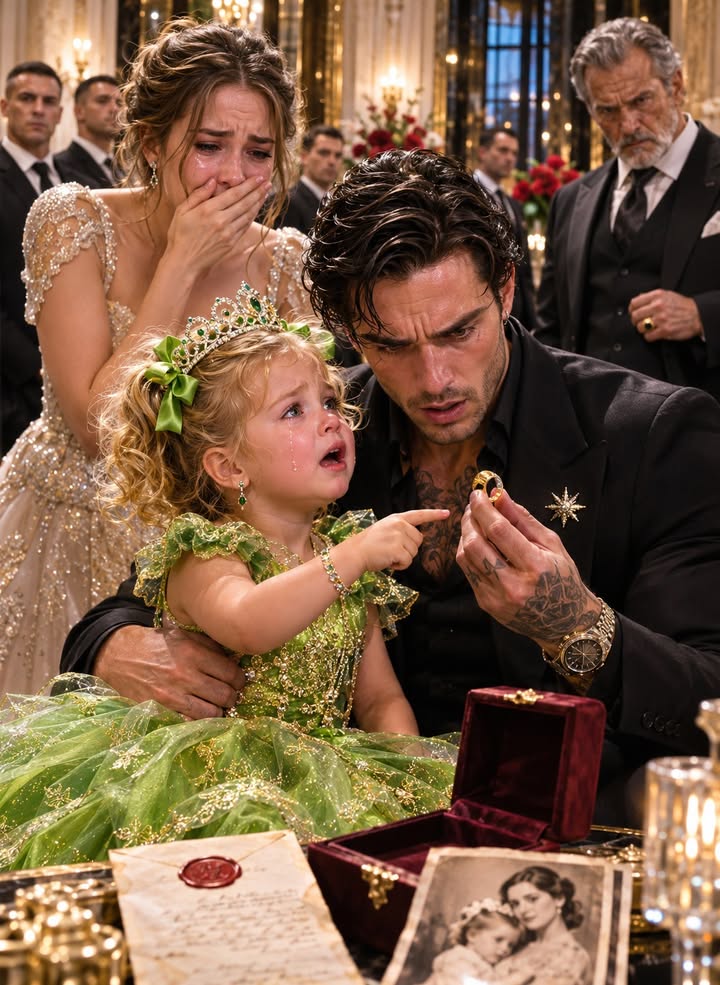
Lily wore a sparkling green princess dress with satin bows in her hair.
She carried the small velvet pouch in both hands, solemn with the importance of her task.
When we reached the garden table, she opened the pouch and set the two gold rings side by side.
“Two rings,” she said.
“Yes,” I told her.
She pointed to the engraving.
“Lily Hayes.”
“That’s your name,” Grace said.
Lily looked from one of us to the other.
“Because Grandpa picked?”
“Because Grandpa hoped for you,” I said. “But you don’t owe him anything because of it.”
“And you don’t owe our family anything,” Grace added. “You get to grow up and decide who you want to be.”
Lily considered this with the seriousness only a child can give an idea she does not yet need to understand.
Then she took my hand and Grace’s.
“I Lily,” she said.
“You are,” I replied.
“And you are loved for being exactly who you are,” Grace told her.
Lily smiled, satisfied, and went back to the garden, her green skirt shining in the sunlight.
I watched her run toward the others, free of the stories we had once tried to make her carry.
My father had chosen a name for a child he hoped would come.
My mother had hidden the truth because fear made control seem like care.
Richard had buried it because he believed silence could prevent a family from breaking.
And I had once believed a lie because it let me avoid the harder truth that I should have gone looking for Grace.
We could not return to the years we had lost.
But we could stop asking love to hide the truth.
Grace stood beside me, her shoulder resting against mine.
I turned toward her, and she reached for my hand.
Not as a promise that nothing would hurt again.
As a choice, made freely, with the truth between us and the future still open.
**–THE END–PLEASE
Share your thoughts or feedback to motivate us to create more stories ♥️
* * *
[PREVIOUS: PART 5](https://echoesofstories.idolsgift.com/blog/part-5-the-name-beneath-the-lie-041)
✓ Lynn R. Adams
Part 6 – A Name of Her Own For a long moment, no one spoke. Grace kept her eyes on the second name beneath my father’s signature, as if the ink might change if she looked away. Then she read it alo…