PART 6 (THE END): The Name Beneath the Gold 041
Part 6 – A Kingdom Chosen
The voice from beneath the platform was quiet, but every person in the ballroom heard it.
“Clara.”
My mother had spoken my name.
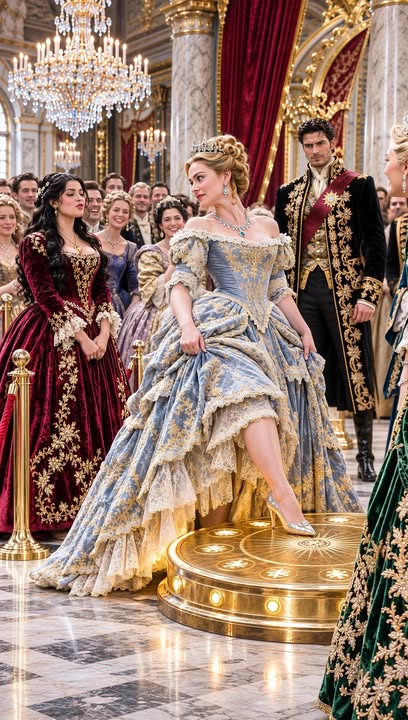
I froze, one hand still hovering over the document, while the gold beneath my feet shone like a pool of dawn.
Julian moved no closer than before, though I felt the steadiness of him beside me.
The king stared at the open compartment.
The engineer’s face had gone pale with recognition.
“It is a recording,” he said, finding his voice at last. “A speaking mechanism, preserved in the platform.”
I lowered my hand toward the document.
The voice sounded again, warm and unmistakable, softened by years held inside the gold.
“If you hear this, then you have come back by your own choice.”
My breath caught.
The court had vanished from my thoughts.
For one impossible moment, I was a little girl listening to Elena read beside the window, her voice turning ordinary words into places I could enter.
“I cannot tell you what to do, my dearest,” the recording continued. “That is the one thing I have always hoped you would be free to decide for yourself.”
I pressed my lips together, fighting the ache rising in my throat.
“The treaty was entrusted to its keepers so no crown could claim it as property, and no keeper could claim it alone. I hid the key when the king I served tried to set the agreement aside. I did so because I believed the people must not lose the protections they had built together.”
The room remained utterly still.
“I do not ask you to defend me,” my mother said. “The record will show what I did. I ask you to look at what happened and choose what should follow.”
The golden light held steady beneath the platform.
“If the crown has learned to listen, let it share authority willingly. If it has not, then let the houses and people decide how the treaty should be restored. Whatever happens, Clara, remember this: you are not the key. You are the person who carries it.”
The recording fell silent.
No one applauded.
No one whispered.
The words had left the room with something more precious than surprise: the space to understand.
I looked down at the new document.
The first lines bore the names of the original treaty’s witnesses, followed by my mother’s account and the surviving council statement.
The narrow strip missing from the old page had been preserved here, complete with the names of the houses that had agreed to the limits on royal authority.
The final line had been written in the king’s hand.
I will not suspend this treaty without the consent it requires.
The king read the words in silence.
Then he stepped away from the platform and faced the gathered nobles.
“I wrote that sentence after Elena refused to surrender the key,” he said. “I meant it then, but I did not keep faith with it.”
His voice did not ring through the hall like a royal decree.
It carried because no one interrupted him.
“I tried to rule through necessity and called the treaty an obstacle. I allowed the court to turn the platform into a spectacle, and I let my son believe that its purpose was to find a bride rather than guard a shared agreement.”
Julian lowered his eyes, but he did not turn away from his father.
“I will answer for those choices under the law of the treaty,” the king continued. “I will not decide the matter myself.”
A noblewoman rose from the front row.
She was the duchess who had laughed when I first approached the platform, though now her face held no trace of that earlier amusement.
“Your Majesty,” she said, “the council must review the testimony before judgment.”
“Yes,” the king replied. “It must.”
“And the houses must be permitted to examine the archive.”
“Yes.”
“And the crown must not control what may be read.”
The king looked toward the open floor.
“No.”
His answer was plain.
The engineer began to speak about securing the documents, but the duchess raised a hand.
“The assembly should hear the keeper’s testimony first,” she said. “Then the council can consider the record together.”
I had not expected her to support me.
I had not expected to feel gratitude toward her, either.
“I will read what my mother left,” I said, “but I will not ask you to accept her account simply because she was my mother. The archive must be opened, the treaty reviewed, and the king’s actions judged by the same laws as anyone else’s.”
A murmur of agreement moved through the hall.
The king bowed his head.
“Agreed.”
The old mechanism gave a soft hum.
The hidden compartment opened wider, revealing one more sheet beneath the document.
The engineer bent to look at it.
“This appears to be the procedure for the council,” he said.
He unfolded the page and read the first lines aloud.
The crown’s authority was to be suspended until the houses could meet, review the treaty, and determine whether the ruler had acted against its terms.
The council would oversee the transition, with the heir serving only as a witness until a lawful decision was reached.
There was no need for a royal command, no need for a dramatic accusation, and no need for anyone to seize the throne.
The treaty already contained a way forward.
Julian took a step toward the council table, then stopped.
“I will serve as a witness,” he said. “Not as judge, and not as heir demanding his rights.”
His father looked at him.
“You would accept that?”
“I would accept the law you should have followed.”
The king’s expression softened, though grief remained in it.
“You are asking the council to judge your father.”
“I am asking the council to judge the crown.”
No anger sharpened his words.
That made them harder to evade.
The king bowed to his son.
It was not the bow of a ruler indulging a younger man.
It was the acknowledgment of one person hearing another.
The nobles formed the council before the evening ended.
They did not render judgment in the ballroom; the treaty required time for the evidence to be examined and the houses to gather in full.
But they secured the archive, appointed representatives from each house, and accepted the king’s agreement to step aside while the review continued.
The documents were copied in the presence of witnesses.
Elena’s testimony was read aloud.
The altered accusation was laid beside the original council statement, and the difference between them became plain.
Over the following weeks, the archive yielded the rest of the account.
It showed that Elena had not stolen the key for her own advantage.
She had kept it from the crown when the king sought to act without the consent the treaty required.
She had then hidden it beyond the palace, trusting that her daughter would return when she was old enough to decide what the truth should become.
The record also showed how the court’s accusation had been altered after Elena fled, changing a request for inquiry into a charge of theft.
The clerk responsible had been long dead, but the document made clear that Elena had been blamed for protecting an agreement the crown had once promised to uphold.
The council found the king had acted against the treaty, though it also recognized that he had later signed a commitment to honor it.
He was lawfully removed from power by the houses whose consent he had tried to bypass.
The decision was neither swift nor easy, but it was made openly, according to the very agreement the platform had protected.
The king accepted the council’s ruling.
He left the palace without ceremony, carrying only a small case of books and the plain gold ring he had worn before his coronation.
When I spoke with him the day before he went, he stood in the old garden beneath a tree Elena had once helped plant.
“I cannot ask you to forgive me,” he said.
“I know.”
“I would like to believe your mother might have understood why I acted as I did.”
“She might have understood,” I replied. “That is not the same as agreeing.”
“No,” he said. “It isn’t.”
He looked toward the palace windows.
“I hope you will make something better than what I left behind.”
“So do I.”
He gave me a small, tired smile.
Then he departed, not as a monster defeated by a heroine, but as a man finally subject to the law he had once treated as an inconvenience.
Julian never claimed the throne unquestioned.
When the council gathered to decide how the kingdom should be governed, he stood before them without his crown and supported a new arrangement in which the houses shared authority with the ruler.
The nobles debated for many days.
Some wanted the old customs restored exactly as they had been.
Others believed the treaty needed clearer protections and a greater voice for the towns and villages beyond the court.
I sat with them as keeper, not because I held a seat by royal favor, but because the treaty required the archive to remain open to those it protected.
I listened more than I spoke.
When I did speak, I asked whose lives a decision would touch and whether they had been given a chance to answer.
It was not always the easiest question.
It was often the necessary one.
By the time the council finished, the kingdom had a new charter grounded in the old treaty, with shared authority between the crown, the houses, and representatives chosen from the towns.
The platform was no longer presented as a test for noblewomen.
It became a place where citizens could petition the crown and the council, with their requests recorded in the archive and answered in public.
On the day it opened again, people came from across the city.
Some carried written petitions.
Others brought questions they had rehearsed on the road, or concerns they had been afraid to raise before.
An old baker asked for repairs to the market well.
A seamstress spoke about fair measures for guild workers.
A child came forward holding his grandfather’s hand and asked whether the palace garden could be opened once a month.
Each person stood on the gold, not to prove they were worthy of the kingdom, but because the kingdom had promised to hear them.
The twelve symbols glowed beneath the platform, steady and welcoming.
Julian stood beside me near its edge.
He wore no crown.
His clothes were simple, and his hands were clasped loosely before him as he listened to a farmer describe a road that flooded each spring.
When the farmer finished, Julian did not make a grand promise.
He asked which villages were affected and whether the council had recorded the matter before.
It was a small beginning.
It was also an honest one.
After the last petitioner left, the ballroom emptied slowly.
The engineer returned to the platform to check the lights, humming under his breath as he worked.
The duchess who had once laughed at me stopped before she went.
“I was wrong about you,” she said.
I met her eyes.
“You were wrong to think the platform could tell you who mattered.”
She lowered her head.
“Yes.”
It was not an apology made to win anything.
I accepted it as the beginning of a different understanding and let her go.
Julian waited until the hall was nearly empty.
“I have something to ask you,” he said.
The carefulness in his voice made my heart beat faster.
“You may ask.”
“Would you have supper with me tomorrow?”
I searched his face for the prince who had once turned a search for a lost key into a reason to place women on a golden floor.
He was still there, but changed by what he had learned, and still learning.
“Are you asking because the council expects us to marry?” I asked.
“No.”
“Because I’m the keeper?”
“No.”
“Because you think it would make the court feel settled?”
“No.”
He took a breath.
“I’m asking because I would like to spend time with you when neither of us has to speak for a crown, a treaty, or a family secret.”
The answer warmed me more than any grand declaration could have.
“Then yes,” I said. “Supper tomorrow.”
His smile came slowly, touched with relief.
“Thank you.”
“But I’m not promising anything beyond supper.”
“I would not ask you to.”
“And if we ever decide we want more, we decide it together.”
“Yes.”
“I will not be a prize for the platform, a key for the palace, or a symbol to reassure the court.”
“No,” Julian said. “You are Clara.”
He said my name as if it were enough.
For a long while, it was.
The months that followed brought their own disputes, difficult meetings, and small disappointments.
A shared government was not a perfect one, and trust did not appear simply because a treaty had been restored.
But the council kept meeting.
The platform stayed open.
Julian learned to ask before deciding, and I learned that sharing the truth did not mean surrendering every part of myself to it.
We met for supper, and then for walks through the garden, where neither of us needed to pretend the palace had no shadows.
Sometimes he asked about my mother.
Sometimes I told him stories of her that had nothing to do with the court: the way she sang under her breath while mending, the biscuits she always burned on the first cold day of winter, and how she could make a small room feel like a place worth coming home to.
Julian listened.
He did not treat her memory as a riddle to solve.
When, years later, he asked if I would marry him, he did so in the garden beside the tree Elena had helped plant.
There was no court waiting to witness my answer.
There was no platform beneath our feet.
There was only Julian, offering me a small ring and the freedom to say yes, no, or not yet.
I said yes because I wanted the life we had made, and because the choice was mine.
On our wedding morning, I entered the archive alone.
The room smelled of paper, cedar, and the quiet endurance of things kept safe.
I found the place where the first testimony rested and took my mother’s pendant from around my neck.
For the first time, I lifted it free without fear.
I laid it beside Elena’s name in the keeper’s book.
“You were meant to return when you were old enough to choose for yourself,” she had written.
I understood at last that the key had never been the most precious thing she left me.
It was the choice.
When I stepped back into the light, the palace bells began to ring, and Julian waited in the garden with his hand open.
Beyond him, the golden platform stood ready to hear the next person who came forward.
I crossed to him by my own will, carrying my mother’s love, the kingdom’s restored promise, and a future no one else had chosen for me.
**–THE END–PLEASE
Share your thoughts or feedback to motivate us to create more stories ♥️
* * *
[PREVIOUS: PART 5](https://echoesofstories.idolsgift.com/blog/part-5-the-name-beneath-the-gold-041-2)
✓ Lynn R. Adams
Part 6 – A Kingdom Chosen The voice from beneath the platform was quiet, but every person in the ballroom heard it. “Clara.” My mother had spoken my name. I froze, one hand still hovering over the…