PART 6 (THE END): The Money Beneath My Bed 070
Part 6 – The Song We Chose
Daniel inspected the car?
Elena’s voice was barely above a whisper.
Roman shook his head, still holding the phone.
“The log says he signed off on the inspection, but it doesn’t say he performed it.”
“Could someone have used his name?” I asked.
“The investigator thinks that’s possible,” Roman replied. “The garage records are incomplete, and the mechanic who supposedly did the work isn’t listed in their surviving staff files.”
“Then we don’t know,” Elena said.
“No,” Roman told her. “We don’t know yet.”
She looked at him, searching his face for the comforting certainty he might once have offered.
He gave her none.
Instead, he came back to the piano and sat beside her.
“We’ll find out what we can,” he said. “And we won’t pretend we know more than we do.”
Elena nodded, her hand hovering above the keys.
“Stay here while I practice.”
“I will.”
The investigator’s discovery opened another careful review, not an instant answer.
For weeks, officials traced the old vehicle records, compared the signature on the inspection log with verified samples, and contacted the garage’s former employees.
The results were complicated.
Daniel’s signature was genuine, but the entry had been made after the inspection date, and there was no reliable proof he had ever seen the car.
A former office assistant remembered Carlo asking for a missing service form to be “reconstructed” after the crash, though she could not say who filled it in.
Carlo did not deny asking for a replacement document.
He said he had been trying to complete the file after the garage failed to provide its copy, and that he had not understood the importance of the missing information.
The investigators found no evidence that he had arranged the crash, and no evidence that Daniel had inspected the car.
They did find that Carlo had altered the maintenance records afterward, replacing an incomplete file with a version that made the inspection appear properly documented.
His decision had concealed the negligence of the garage and obstructed the inquiry into the crash.
The original cause of the accident remained painful and ordinary: a driver had lost control on a wet road, and the car’s worn steering component had not been caught in time.
The records could not bring Elena and Roman’s mother back.
They could, at least, stop the family from living inside a story built to hide what had happened.
Carlo cooperated with the investigation.
He provided the remaining account books and admitted that he had moved company money into temporary service accounts, intending to restore it before the withdrawals were noticed.
Some of the money had been repaid.
Some had not.
He had not taken it for himself, but he had used it without permission, concealed the transfers, and blamed the disarray on incomplete bookkeeping.
Daniel had found the discrepancies and helped their mother copy the pages that proved it.
The money connected to the accounts was not the same as my debt.
The amount written beside Daniel’s signature in the torn ledger page was a reference to the forged loans he had arranged in my name, not a sum missing from Roman’s company.
He had used my identity to conceal his own part in moving the evidence, believing that a debt attached to me would keep anyone from looking too closely at the records he had copied.
It was a cruelly tangled choice, though not one made to leave me with the burden forever.
He had meant to return and explain.
He had not.
The reason he vanished was not noble enough to make the harm disappear, and not simple enough to fit in a single sentence.
He had panicked when the records went missing, feared Carlo would accuse him of stealing the company’s money, and feared the forged loans would expose what he had done to me.
He chose flight over honesty, then made the distance between us larger each month he stayed away.
The investigators found him in a small town in another state, living under his own name and working at a repair shop.
He had been following the news about the review, and when authorities contacted him, he agreed to return and testify.
I met him in a quiet room at the courthouse, with an investigator present and Roman waiting outside.
Daniel looked older than I remembered.
His hair had thinned at the temples, and his hands were rough from years of work.
For a few seconds, neither of us spoke.
Then he said, “I’m sorry.”
I had imagined hearing those words many times.
In every version, they either healed too much or mattered too little.
In the room, they were just words, spoken by a man who had finally stopped running.
“You forged my name,” I said.
“Yes.”
“You let me spend years thinking I’d ruined my own life.”
“Yes.”
“You knew I was struggling.”
“I knew.”
“Why didn’t you come back?”
He looked down at his hands.
“At first, I was scared the records would get me charged. Then I was ashamed of the loans. Then every month I stayed away made coming back harder.”
“That explains the fear.”
“It doesn’t excuse what I did.”
“No,” I said. “It doesn’t.”
He nodded, accepting the difference.
“I thought the debts would be temporary. I thought I could settle them once I replaced the money and the company accounts were safe.”
“You made a plan with my life in it without asking me.”
“I know.”
“You turned my name into a place to hide.”
His eyes filled, but he did not ask me to comfort him.
“I did.”
I thought of the tiny room I had rented, the brace around my knee, the bills I had opened with shaking hands.
I thought of the stranger’s money beneath my bed and the suspicion it had planted in me.
Then I thought of the years before all of that, when Daniel had been my husband and I had believed we were building a life together.
“I’m not ready to forgive you,” I said.
“I understand.”
“I don’t know if I ever will.”
“You don’t have to.”
“I’m going to make sure the authorities get every document I have.”
“You should.”
“And I don’t want you contacting me again unless I ask you to.”
He swallowed.
“All right.”
The investigator asked him to confirm the details of the forged applications and the records he had copied.
He answered each question.
When the meeting ended, I walked out without looking back.
Roman was waiting in the hall.
He did not ask what I had said.
He did not ask whether I felt better.
He simply fell into step beside me.
Outside, the sky was bright and cold, and the courthouse steps were crowded with people going about lives that had not changed.
“I’m glad you got to say what you needed,” he said.
“I don’t know if I did.”
“You said what you knew.”
“That’s not the same as feeling finished.”
“No.”
I looked at him.
“You’re getting better at not pretending there’s an answer for everything.”
“I have good teachers.”
“Don’t make me responsible for your personal growth.”
“I’ll try to manage it myself.”
That earned the smallest smile from me.
The legal work took months.
The loan documents were examined alongside Daniel’s records, and the forged signatures were confirmed by independent specialists.
The lenders withdrew their claims once the evidence was formally reviewed, and a court order cleared the debts from my name.
When the confirmation arrived, I read it twice, then set it on the table and began to cry.
Not loudly.
Not dramatically.
I cried because the number that had sat in my life like a locked door was finally gone.
Elena found me there and placed her hand over mine.
“Is it over?” she asked.
“The debt is.”
“Does that feel good?”
“It feels strange.”
“Can it feel good and strange?”
“I think so.”
“Then we can let it be both.”
She had become skilled at offering comfort without trying to tell me how to feel.
Her physical therapy continued.
Some weeks brought visible progress, and others seemed to give back almost nothing.
She learned to hold a cup with less help, then spent several days frustrated when her fingers weakened again.
She learned to move across more piano keys, though playing an entire song remained beyond her.
She never stopped trying, but she stopped measuring every day against the one before.
Roman changed in smaller, quieter ways.
He started telling Elena when a difficult meeting was coming instead of leaving her to discover the tension in the house.
He began asking before making arrangements on her behalf.
He asked me, too, and learned that sometimes I wanted help and sometimes I wanted to find my own way.
The first time he offered to have a car take me home, I said no.
He accepted it.
The next week, when rain made my knee ache badly, I asked if the offer still stood.
He arranged the ride and did not mention that I had changed my mind.
The money he had sent remained a complicated matter between us.
I gave him a written amount based on the records I could verify and told him I would repay it in installments as I was able.
He suggested we call it a loan.
I said I would agree only if the terms were mine.
We wrote them down together.
There would be no interest, no deadline that threatened my rent, and no payment taken without my choosing it.
When I made the first repayment, he accepted the transfer without turning it into a gesture.
That mattered.
After Carlo’s cooperation, the company reorganized its accounts and submitted the full record to the authorities.
The business survived, though it changed hands in part and no longer operated under the same structure.
Roman’s family name did not vanish from the past.
He simply stopped treating that name as a reason to hide from it.
Elena chose to hear the complete account of their mother’s final days.
She asked the investigator to explain what was known, what had been disproved, and what would probably remain uncertain.
When the explanation ended, she sat quietly for a long time.
Then she asked Roman to tell her something their mother used to say when they were children.
He told her about a summer afternoon when Elena had hidden in the garden because she did not want to practice piano.
Their mother had searched the house, then found her behind a hedge with a book on her lap.
“She asked if I was going to make you come inside,” Roman said.
“What did you say?”
“I said no.”
“Why?”
“You told me the hedge was a better teacher.”
Elena laughed, surprised by the memory.
“She was right.”
“She said the hedge had better patience than I did.”
“She was right about that, too.”
The laugh stayed with Elena after Roman left the room.
She asked me to sit beside her at the piano.
“Do you remember the melody?” I asked.
“I remember enough.”
“Would you like to try?”
“Yes.”
She placed her fingers over the keys.
Roman came in carrying a mug of tea, saw her poised there, and stopped.
Elena looked over her shoulder.
“Don’t just stand there.”
“I wasn’t.”
“You were.”
“I was trying not to interrupt.”
“You can join us.”
He set the mug down and sat on her other side.
Elena played the first few notes of the melody.
Roman found the next note by listening.
I joined in with a soft hum when the tune wandered beyond what her hands could manage.
It was not a polished performance.
The rhythm faltered, and Roman missed a note badly enough to make Elena laugh.
But the melody was no longer something trapped inside a damaged recording or a half-remembered argument.
It belonged to the room again.
By the time spring came, Elena could move both hands across the piano with growing control.
She still needed rest.
She still had days when the keys seemed far beyond her reach.
But music had returned in pieces, and she had learned to welcome a piece without demanding the whole.
I remained at the mansion because I chose to.
My work changed gradually.
Elena asked for help with her practice, then with her schedule, then with the small details of the days she wanted to make her own.
I never became her therapist or her keeper.
I became someone she trusted to sit beside her without turning every hard moment into a lesson.
Roman and I grew closer just as gradually.
He told me when he was worried instead of disguising worry as a decision.
I told him when his silence felt too much like the old secrecy.
Sometimes we disagreed.
Sometimes we did not know what to say.
We learned that honesty was not a promise to make every truth painless.
It was the promise not to make the other person guess where the pain was coming from.
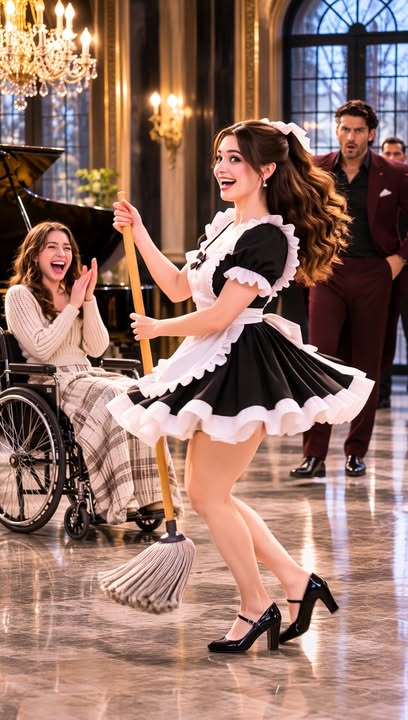
One mild evening in early summer, I went to the music room to find Elena waiting beside the piano.
A mop rested against the wall.
I raised an eyebrow.
“Does it know it’s being watched?”
“He’s over his stage fright.”
“That’s encouraging.”
Roman appeared at the doorway.
He wore no suit jacket, and his sleeves were rolled to his forearms.
“Elena says we’re having a dance lesson.”
“I didn’t say we,” Elena replied. “I said Maya and the mop.”
“You both look underprepared.”
“I have excellent rhythm,” Roman said.
“You have confidence,” I replied. “That’s not the same thing.”
Elena grinned.
“Then prove it.”
I took the mop and gave it a careful spin across the floor.
Roman started to clap along, then lost the beat.
Elena laughed and tapped the rhythm against the piano.
“Again,” she said.
I turned the mop toward Roman.
“Your partner is waiting.”
“I don’t know the steps.”
“That never stopped the mop.”
Roman took the handle with exaggerated seriousness.
He was awkward, but he listened when I showed him how to turn.
Elena played the opening notes of the old melody, her hands moving slowly but steadily across the keys.
I danced with the mop.
Roman danced with the mop after I passed it to him.
Elena laughed so hard that she had to stop playing.
When she caught her breath, she pointed at the piano.
“One more time.”
“We’ll need a better partner,” Roman said.
“You’re the partner,” Elena told him.
“I thought the mop was.”
“Don’t start arguing with a mop, Roman.”
“I would never.”
The tune began again, soft and uneven and bright.
Roman moved across the floor with careful, ridiculous steps.
I laughed.
Elena laughed with me.
And in the music room where so many silences had settled, no one tried to keep the laughter small.
**–THE END–PLEASE
Share your thoughts or feedback to motivate us to create more stories ♥️
* * *
[PREVIOUS: PART 5](https://storyly.idolsgift.com/blog/part-5-the-money-beneath-my-bed-070)
✓ Lynn R. Adams
Part 6 – The Song We Chose Daniel inspected the car? Elena’s voice was barely above a whisper. Roman shook his head, still holding the phone. “The log says he signed off on the inspection, but it …