PART 6 (THE END): The Messages Hidden in a Blink5 025
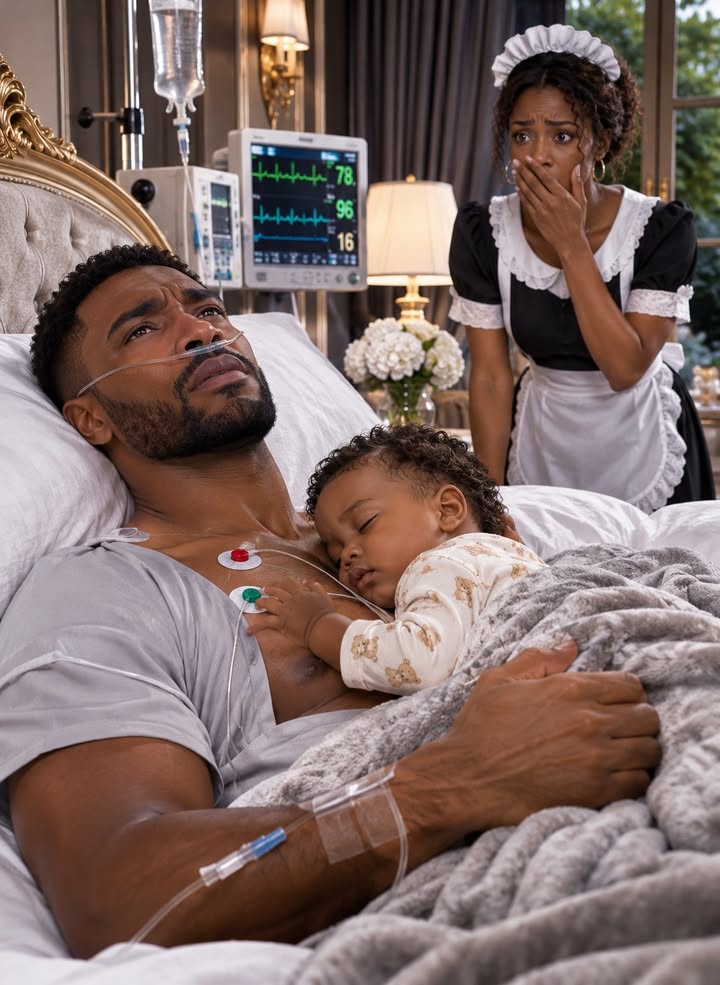
Part 6 – The Heartbeat We Kept
I looked at the pharmacy record again, my eyes moving over the two names until the letters blurred.
The compound had been prepared three weeks before Grant lost the ability to move.
Dr. Barragan had approved the first dose.
Julian had been listed as the person authorized to collect it, but that did not mean he had known what it contained.
The distinction mattered, though I could not yet tell how much.
“He’s here,” I told the patient safety officer. “Julian is in the house.”
“Please don’t confront him with the record,” she said. “The specialist is on the way, and we’ve notified the appropriate authorities. For now, keep the patient comfortable and follow the emergency instructions we discussed.”
When the call ended, I stayed at the desk with the phone in my hand.
Grant watched me from the bed.
“Barragan approved the first dose,” I whispered. “Julian picked it up.”
His eyelids lowered once, then lifted.
Yes.
“Did Julian know what it was?”
Grant’s eyes closed.
For several seconds, I waited, careful not to mistake exhaustion for an answer.
His eyes opened again.
One slow blink.
He didn’t know.
The answer made the room feel more complicated, not less.
I heard the soft click of a door downstairs, followed by Julian’s voice speaking to someone in the hall.
My first instinct was to hide the phone.
Instead, I put it beside the notebook and went to Grant’s bed.
“An independent doctor is coming,” I said. “The hospital has also contacted the authorities. I’m not going anywhere.”
Grant’s eyes held mine.
His fingers remained still, but something in his face eased.
The words I’m not going anywhere had been meant for him.
I realized they were meant for myself, too.
Julian appeared in the doorway a minute later.
His attention went first to Grant, then to the open laptop and the phone beside my notebook.
“Was that the hospital?” he asked.
“Yes.”
“Did they say when the specialist will arrive?”
“Soon.”
He looked at the screen.
I did not move to cover it.
“Did they find something?”
“The pharmacy record lists Dr. Barragan as the prescriber. Your name is listed as the pickup contact.”
Julian stared at the record.
For a moment, he seemed unable to take in the words.
Then he walked closer, reading the details without touching the phone.
“I picked up a sealed package for Barragan,” he said. “He told me it was a specialized supplement and that the pharmacy couldn’t deliver it to the estate.”
“Did he tell you what was in it?”
“He gave me the name, but I don’t remember it.”
“Did you ask why it wasn’t on Grant’s regular chart?”
Julian’s face changed.
“No.”
The answer came out quietly.
He sat on the chair near the window, his shoulders bent forward.
“I thought I was helping,” he said.
“I believe you.”
He looked at me, startled.
“I don’t know that you understood what you were carrying,” I continued. “But the records have to be reviewed by someone who can determine what happened.”
“I know.”
His gaze moved to Grant.
“Uncle, I’m sorry.”
Grant’s eyes were open.
Julian stood and came to the bedside.
“I should have asked more questions,” he said. “I should have insisted on seeing the order, and I should have brought in another doctor when you got worse.”
Grant blinked once.
Julian lowered his head.
“I thought the only way to protect the family was to keep the old secrets buried,” he said. “I was wrong.”
Grant’s fingers trembled beneath the blanket.
Julian noticed and reached for his hand, stopping just short.
“May I?”
Grant’s eyes closed, then opened.
One blink.
Julian took his uncle’s hand gently.
“I don’t expect you to forgive me just because I’m sorry,” he said. “I only want you to know I didn’t understand what Barragan was giving you.”
Grant managed a faint movement of his thumb against Julian’s palm.
It was not forgiveness made simple.
It was a beginning.
Before either of them could say more, a car pulled into the drive.
The specialist arrived with a hospital nurse and a small team carrying equipment.
They introduced themselves quietly, explaining each step before they began.
I stayed by the bed while they reviewed the chart and examined Grant.
Julian remained in the room, but he did not interfere.
The lead specialist, Dr. Naren, asked me to describe what I had seen from the beginning.
I spoke about the first time Grant blinked, the words he had whispered, the way his breathing changed after Barragan’s visits, and the torn label I had found under the bed.
I showed her my notebook.
When I reached the part about Leo sleeping on Grant’s chest, my voice caught.
“That was when I first saw his hand move,” I said.
Dr. Naren looked at the baby monitor beside the bed, then at Grant.
“Sometimes a person’s ability to respond can be hidden by the very condition that is supposed to explain their silence,” she said. “We’ll take this one step at a time.”
She asked Grant simple questions, leaving long pauses between them.
He answered with blinks, and once, after several minutes, with a slight movement of his right finger.
Each response cost him.
No one rushed him.
The nurse checked the medication line and compared it with the records the hospital had received.
When Dr. Naren found the compound name, her expression remained controlled, but her attention sharpened.
She asked Julian whether he had any remaining packaging or instructions.
Julian gave her the pharmacy receipt and the box Barragan had left in the locked medication room.
The items were carefully sealed and labeled for review.
Dr. Naren did not announce what they meant.
She explained that the compound could have contributed to Grant’s paralysis and breathing problems, but that the team needed laboratory confirmation and a full review of the dosing history before reaching a conclusion.
For the first time, someone had said the possibility plainly without pretending the answer was already known.
They moved Grant to the hospital for monitoring and treatment.
I rode with him in the ambulance, holding Leo against my chest while the nurse kept a steady hand near the bed.
Julian followed in his own car.
At the hospital, the hours passed slowly.
Tests were taken.
The medication line was replaced.
Dr. Naren and the intensive care team began a carefully supervised treatment plan, adjusting it according to Grant’s response.
No one promised that he would recover quickly.
They promised only that he would be watched closely and that every decision would be explained.
I slept in a chair beside his bed that night.
Leo slept in a portable crib near the window, his blanket tucked around him.
Around dawn, I woke to the sound of the monitor and found Grant watching me.
“Are you comfortable?” I whispered.
One blink.
“Do you know where you are?”
One blink.
“Are you afraid?”
Grant’s eyes closed, then opened.
Two blinks.
No.
A breath escaped me that I hadn’t known I was holding.
“Neither am I,” I lied gently.
His eyes stayed on mine, knowing better.
I rested my hand beside his.
“I’m here.”
His finger shifted against the sheet.
It was only a small movement, but this time there was no blanket for him to grip and no one in the room who could mistake what it meant.
The investigation unfolded slowly, through records and careful interviews rather than dramatic accusations.
The pharmacy confirmed that Barragan had ordered the compound and provided instructions that did not match Grant’s approved treatment plan.
The medication had been designed for a different use and required strict oversight.
Grant had received it repeatedly without the proper safeguards.
The investigators also found that Barragan had adjusted the household’s medical records, describing Grant’s worsening immobility as evidence that his illness was progressing.
Julian had collected the package but had not been told what it truly contained.
He had signed for it because Barragan said it was prescribed and needed for Grant’s comfort.
That did not erase Julian’s failure to question what he was asked to do.
He understood that without being told.
When investigators asked him to explain his part, he gave them the pharmacy receipts, the messages from Barragan, and the names of everyone involved in the household’s medical decisions.
He did not ask them to protect the family name.
Nia cooperated, too.
She told the investigators about letting Julian into the medication room, about the money he had sent for her son’s treatment, and about the questions she had been afraid to raise.
She admitted what she had done without minimizing it.
She brought her bank records and the old letter from Evelyn, and she agreed to answer every question put to her.
Her son was recovering well from his treatment.
When I saw her in the hospital corridor a few days later, she looked as if she had not slept.
“I keep thinking about how one decision led to another,” she said. “I thought accepting Julian’s help would let me keep my son safe. Then I thought staying quiet would keep his life stable. I was afraid of losing the little control I had.”
“I understand why you were afraid,” I said. “I’m glad you chose to speak now.”
“I should have chosen it sooner.”
“Yes,” I said softly. “But you chose it.”
Nia looked toward Grant’s room.
“Is he improving?”
“Slowly.”
“Tell him I’m sorry.”
“I will.”
She nodded and walked away, not asking me to absolve her.
That honesty was a kind of repair.
The laboratory results confirmed that the compound Barragan had administered was not part of Grant’s prescribed treatment and had contributed to his profound paralysis and respiratory weakness.
The hospital’s review found no evidence that Julian had selected or understood the drug’s purpose, but it did find that his unquestioning cooperation had helped Barragan obtain it.
Julian accepted that responsibility.
Barragan and Julian were arrested after the investigators completed their interviews and gathered the pharmacy records.
There were no cameras or reporters waiting outside the hospital.
There was only a quiet morning, a pair of officers speaking with the family, and Julian leaving with them after he had made arrangements for Leo and me to remain at the estate.
He looked back once from the doorway.
“I’ll answer everything they ask,” he said.
“I know.”
“I can’t ask you to tell them I’m innocent.”
“I won’t tell them anything I don’t know.”
He nodded.
“That’s fair.”
Then he turned and went with them.
I felt no satisfaction as the door closed.
Only the heavy relief of knowing the right people were finally asking the right questions.
Grant’s recovery began in the smallest ways.
First, his breathing became steadier without the extra support.
Then he regained enough control of his eyelids to keep them open for longer periods.
A few days later, he moved one finger on purpose.
The nurse called Dr. Naren, who came quickly but remained calm.
“Can you do that again, Mr. Sterling?” she asked.
Grant concentrated, his face taut with effort.
His index finger lifted a fraction from the sheet.
I covered my mouth with my hand.
Leo, sitting on my lap, clapped once at the movement as if his grandfather had just performed a wonderful trick.
Grant’s eyes brightened.
“Again,” I whispered.
He tried.
This time the finger moved farther.
The room filled with quiet congratulations from the nurse and the doctor, but I could not speak.
I leaned down and kissed the back of Grant’s hand.
He managed a faint squeeze around my fingers.
After that, progress came unevenly.
Some days he could lift his hand.
Other days, exhaustion left him with only a blink.
His first clear words were not about the investigation or the business.
They came one afternoon as I was telling him Leo had learned to pull himself upright by holding on to the crib rail.
“Show me,” he whispered.
His voice was rough, but unmistakable.
I brought Leo to the bedside and held him where Grant could see.
Leo reached for Grant’s hand and patted his knuckles.
Grant smiled.
It was not the small, almost invisible change I had seen in the bedroom.
It was a real smile, tired and crooked and full of wonder.
“There you are,” I said.
Grant looked from Leo to me.
“I’m sorry,” he whispered.
“For what?”
“For all of it.”
There were many answers I could have given.
I could have mentioned my mother, the years of silence, the way he had paid for her care without staying to know what she needed beyond the bills.
I could have told him that I did not know whether forgiveness was something I could hand him in a single moment.
Instead, I took his hand and said, “You don’t have to make it right all at once.”
His eyes filled.
“I should have called her.”
“Yes,” I said. “You should have.”
He nodded, receiving the truth without trying to soften it.
“And I should have come to see you,” he said. “I knew your mother was gone, and I still kept telling myself there would be a better time.”
“I wish you had.”
“So do I.”
I looked down at his hand in mine.
“My mother never told me you helped her.”
“She didn’t want to owe anyone.”
“She didn’t owe you.”
“No,” he said. “She didn’t.”
A long silence followed.
Then he added, “I thought paying for her care was enough.”
“It helped her,” I said. “But she wanted a person, not only a payment.”
Grant closed his eyes briefly.
When he opened them again, he did not ask me to excuse him.
“Thank you for telling me,” he said.
“I’m telling you because I want us to be honest if we’re going to know each other.”
“I want that, too.”
“You’ll have to let me decide what kind of relationship I want with you.”
“I will.”
“And Leo is not a debt you can settle.”
Grant’s gaze shifted to the child in my arms.
“No,” he said. “He’s a person I hope I’ll have the privilege of knowing.”
That answer made something in my chest loosen.
Weeks later, after Grant had regained enough strength to return home, he asked Julian to meet him in the sunroom.
The case against Barragan continued, and Julian remained responsible for answering questions about the pharmacy order and his role in the household.
Grant did not ask me to leave the room.
Julian stood beside the window, his hands clasped behind his back.
“I want to tell you the truth about your father,” Grant said.
Julian’s face tightened, but he stayed.
“Arthur did take money from the company,” Grant continued. “I discovered it years before you were old enough to understand what had happened. I chose not to bring charges because I believed protecting the family would spare you both.”
“You never told me,” Julian said.
“No.”
“You let my father tell me you had ruined him.”
“I did.”
“Why?”
“Cowardice, perhaps,” Grant said. “I thought the secret would keep the scandal contained. I didn’t realize it would become the story you grew up with.”
Julian looked down at the carpet.
“You could have corrected him.”
“I could have.”
“You could have told me.”
“I should have.”
For a moment, the two men stood inside the silence that had shaped their family.
Then Grant reached for the edge of his chair and steadied himself.
“I won’t ask you to forgive me for it.”
Julian looked up.
“I don’t know if I can,” he said.
“I understand.”
“I also don’t know if you’ll forgive me for picking up that package.”
“I know you didn’t understand what it was.”
“I should have asked.”
“Yes.”
Julian’s gaze dropped again.
“I’m sorry.”
Grant nodded.
“I believe you.”
It was not a declaration that everything was repaired.
It was a willingness to begin without hiding the damage.
The business passed through an independent review, and Grant ordered the household’s medical procedures to be overseen by people outside the family.
He also arranged for the old family records to be examined and corrected where he had allowed silence to distort the truth.
But when he spoke with me, he did not begin with money or property.
He began by asking what I wanted.
We sat together on the covered terrace while Leo played on a blanket at our feet.
The garden had turned gold with late-afternoon light.
“I’ve been thinking about what you said,” Grant began. “That Leo isn’t a debt I can settle.”
“He isn’t.”
“I know.”
Grant’s voice had strengthened, though a trace of rasp remained.
“I want to offer you a home here, if you’d feel comfortable staying. I can also help with Leo’s education and make sure you have the support you need to continue your own training.”
I watched him carefully.
“Is it a gift?”
“Yes.”
“Does it come with a job?”
“No.”
“Does it mean I have to forgive you?”
“No.”
“Does it mean you’ll be part of Leo’s life whether I want it or not?”
Grant considered the question.
“Only if you allow it.”
I looked at Leo, who was pulling a cloth book across the blanket and laughing at the sound it made.
For much of my life, every form of help had felt temporary, as though I had to earn the right to keep it.
Grant was offering me something different, but I needed to know the choice was real.
“I don’t want to stop working,” I said.
“You shouldn’t.”
“I love caring for people, but I want to take classes. Maybe become a licensed nursing assistant.”
“I’ll help you find a program.”
“I want to pay for some of it myself.”
“Then we’ll make a plan that lets you.”
“And if I decide I’d rather move into a smaller place?”
“I’ll help you move.”
“If I need time before I call you anything other than Mr. Sterling?”
“You can call me whatever feels honest.”
I studied his face.
He did not look offended.
He looked like a man who understood that being offered a second chance did not mean he could demand its shape.
“I’d like you in Leo’s life,” I said at last. “But slowly.”
Grant’s eyes shone.
“Slowly is good.”
“And I want you to know my mother through the stories I remember, not only through the promise you failed to keep.”
“I would like that.”
I told him about her terrible singing, her handwritten recipes, and the way she used to fold Leo’s tiny clothes before he was born.
I told him how she had kept an old, cracked blue bowl because she said it was the only one that made soup taste right.
Grant listened without interrupting.
Sometimes he smiled.
Sometimes he looked toward the garden and blinked away tears.
When I finished, he said, “I wish I had known her better.”
“So do I.”
We did not pretend that wish could fill the years that were gone.
We let it be a wish, and began from there.
The next months were not perfect, but they were honest.
Grant’s movement returned by degrees.
He learned to sit up without help, then to stand with a physical therapist beside him.
His speech came more slowly, with pauses when fatigue caught him.
Every gain mattered.
Julian continued cooperating with the investigation and the business review.
He also began visiting without bringing papers or asking me what Grant had said.
The first time he brought Leo a wooden train, he placed it on the rug rather than making a fuss over it.
Leo immediately tried to chew one of the wheels.
Julian laughed in surprise.
“I suppose I should have checked whether it was baby-proof.”
“You’ll learn,” I said.
He looked at me, uncertain whether I meant the train or something else.
“Thank you for giving me the chance,” he said.
“I’m giving you the chance to show me who you are now.”
He nodded, accepting the difference.
Nia returned to the house once, at my invitation, to bring back the original letter from Evelyn.
She had decided the family should keep it, but Grant asked her to hold on to it until she felt comfortable giving it up.
“You kept it safe when I couldn’t,” he told her.
Nia lowered her eyes.
“I also kept quiet when I should have spoken.”
“Both things are true,” Grant said.
Nia’s son was doing well.
She had begun working at a community clinic, where she said she could use the experience she had gained without living under the weight of old secrets.
When she said goodbye, she hugged me carefully, then touched Leo’s small hand.
He grabbed one of her fingers and held on.
Nia smiled through tears.
“Tell him to keep that grip,” she said.
“I will.”
On the anniversary of the night I first entered Grant’s room, we sat together in the sunroom after Leo’s bedtime.
The house was quiet, but not the tense quiet it had once held.
A fire burned low in the hearth.
The photograph of my mother and Evelyn stood on the shelf beside a newer picture of Grant, Julian, Leo, and me in the garden.
Grant had insisted the newer one include the old photograph in the background.
“Do you remember that night?” I asked.
“I remember thinking I’d dreamed it,” he said. “A baby’s heartbeat against my chest.”
“You weren’t dreaming.”
“No.” He looked down at Leo, who was asleep in my arms. “I’m grateful you came in.”
“I only wanted somewhere quiet.”
“Sometimes that’s enough to change a life.”
I shifted Leo gently.
Grant reached out, then paused.
I nodded.
He laid his hand against the baby’s back.
Leo stirred, made a small sound, and settled again.
Grant closed his eyes, feeling the steady warmth beneath his palm.
For a moment, the room held all the things we had lost and all the things we had chosen to keep.
My mother’s song.
Evelyn’s letter.
The truth about Julian’s father.
Nia’s difficult honesty.
Grant’s slow return to the world.
And Leo, sleeping peacefully between us.
I rested my hand over Grant’s.
“His heartbeat is steady,” I whispered.
Grant opened his eyes.
“Yes,” he said. “It is.”
Leo’s hand slipped from my collar and came to rest over Grant’s chest.
This time, Grant placed his own hand gently over it.
There was no fear in the room, no warning shadow beneath the door, and no silence asking to be mistaken for peace.
Only the quiet rhythm of a living heart beneath a sleeping child’s palm, and the family we were choosing, one honest day at a time.
**–THE END–PLEASE
Share your thoughts or feedback to motivate us to create more stories ♥️
* * *
[PREVIOUS: PART 5](https://puretales.idolsgift.com/blog/part-5-the-messages-hidden-in-a-blink5-025)
✓ Lynn R. Adams
Part 6 – The Heartbeat We Kept I looked at the pharmacy record again, my eyes moving over the two names until the letters blurred. The compound had been prepared three weeks before Grant lost the ab…