PART 6 (THE END): The Message She Carried 052
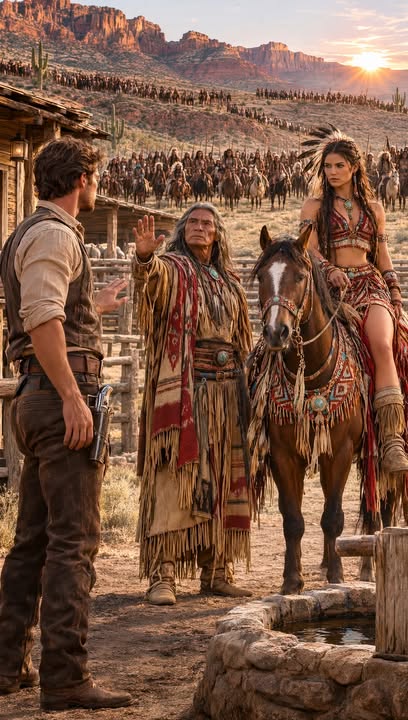
Part 6 – Water Freely Given
For one suspended moment, Corvin could only stare at the scout.
The road to town lay behind him, the ledger tied to his saddle, and the valley stretched dark and quiet beneath the stars.
Then he turned his horse toward the river.
Nantan was already mounted.
“Take the main track,” she told him. “The lower path will be quicker.”
“The lower path is rough.”
“So is waiting.”
Taza raised a hand to the scout, who rode ahead to guide them.
Corvin looked once at the oilcloth bundle behind his saddle.
The evidence could wait a little longer.
Luta could not.
They crossed the valley at a steady pace, following the scout past the cottonwoods and down toward the river bend.
The night smelled of damp earth and willow leaves, and the sound of running water grew clearer as they descended.
A few lanterns glimmered among the homes.
People stood near them in small groups, speaking softly, their belongings gathered in blankets and baskets.
No one appeared to be fleeing.
They were waiting.
At the edge of the largest cottonwood, a woman stood with a shawl around her shoulders.
She was older than Corvin remembered the people in the blue blanket, though time had given him no clear face to compare with hers.
Beside her stood a young woman with a pale scar crossing the back of her left hand.
Nantan stopped so suddenly that her horse lifted its head.
The young woman turned.
“Nantan,” she said.
The name came out uncertainly, as though it had traveled a long way to find her.
Nantan dismounted.
For several breaths, neither woman moved.
Then the young woman stepped forward, and Nantan met her halfway.
They embraced carefully, at first, as if each feared the other might vanish.
The older woman turned toward Corvin.
“I am Sani,” she said. “I was Ishta’s sister.”
Corvin slid from his saddle.
“You knew Luta?”
“I helped raise her after the raid.”
He looked toward the young woman, who had pulled away from Nantan but kept hold of her hands.
“Is she—”
“She is Luta,” Sani said.
Corvin had imagined this moment many times since finding the name in the ledger.
In some versions, he had been able to speak clearly.
In others, he had offered an apology that seemed large enough to cover the years.
Now, standing before the living person whose name had survived in a few faded marks, he found he could do neither.
Luta studied him.
“You were the man who led us away,” she said.
“I was.”
“You carried my aunt’s bundle.”
“I remember the bundle.”
“It had a red ribbon tied around it.”
Corvin saw the night again: the small procession moving through the scrub, the blue blanket, the child held close to a woman’s shoulder.
“I remember a blue blanket,” he said. “I thought you might have been under it.”
“I was.”
His breath caught.
“I was told everyone I led out survived,” he said. “I never knew where you went.”
“We reached the river settlement,” Sani replied. “Ishta was wounded, and the others helped us. The patrol came through the homes before we could return.”
“I’m sorry.”
Sani’s expression did not harden.
“I know you are.”
Corvin lowered his eyes.
“I should have come back.”
“Yes,” Sani said. “You should have.”
The plainness of her answer left him no place to hide.
Then she continued, “But you were not the one who changed the route, and you did bring the children away from the patrol. Both things are true.”
Luta let go of Nantan’s hands and looked at Corvin.
“I remember you telling us to keep walking,” she said. “I was afraid, and you told me the stars would stay above us even if the trail disappeared.”
Corvin swallowed.
“I said that?”
“You did.”
“I don’t remember.”
“I do.”
The valley around them seemed to quiet further, though the river kept speaking over the stones.
Nantan held Luta’s hands again.
“Why did you never come back to us?” she asked.
Sani answered, “We tried to return after the soldiers left, but the paths were watched, and the families scattered. We went farther west to stay with relatives. By the time we returned, the settlement had changed. We thought Nantan’s family had gone north.”
“We searched for you,” Nantan said.
“We searched too,” Sani replied. “We heard different things from different people. After a while, we stopped knowing which road to trust.”
Luta reached up and touched Nantan’s cheek.
“We were children,” she said. “We could not find our way back alone.”
Nantan closed her eyes briefly beneath that touch.
For years, she had carried the absence as a death, not because she had chosen to believe it, but because no other answer had reached her.
Now the loss did not vanish.
It changed shape.
Corvin stood nearby, feeling the past rearrange itself without becoming any less painful.
Sani turned toward him.
“The man who wrote that note came to us after the raid,” she said. “He had found Luta near the western path.”
“Voss?” Corvin asked.
“Yes.”
“He knew she was alive?”
“He did.”
“Why didn’t he bring her back?”
Sani considered the question before answering.
“He said the patrol was still searching the area and that she would be safer with us. He gave us supplies and told us to leave by the western trail.”
“That was kindness,” Corvin said, uncertainly.
“It may have been,” Sani replied. “He also told us not to speak of what we had seen.”
Nantan’s face tightened.
“What had you seen?”
“Men on horseback near the eastern pass before the patrol came,” Sani said. “We saw them changing the signs and moving people away from the lower homes. We did not know who they were, but we knew the patrol had followed the wrong path.”
“Voss knew you had seen him,” Corvin said.
“I think so.”
“Was that why he sent you west?”
“He said it was to keep us safe. I cannot tell you what else he wanted.”
Sani did not make the uncertainty into an accusation.
It was an answer grounded in what she knew, and no more.
Corvin nodded.
“Would you be willing to tell that to the territorial officials?”
Sani looked at Luta, who stood close beside Nantan.
“If the telling can help keep people from being pushed out again, yes.”
“It may mean a long ride and difficult questions.”
“We have had difficult questions for years,” Sani said. “We can answer them now.”
Nantan rested her forehead briefly against Luta’s.
Corvin stepped back, giving them room.
He had come expecting to ride away with evidence, and instead had found the living part of a story no page could settle by itself.
The ledger was still important.
So were the people who could say what the ledger could not.
By dawn, Taza had sent word through the valley that Luta had returned.
The news traveled from household to household, carried in low voices and answered by a growing murmur of relief.
No one made a celebration of the pain that had brought her home.
They simply made room beside the fire and brought food and blankets, as if welcoming her back were the most natural thing in the world.
Corvin remained near the river until the first light touched the hills.
When Nantan finally came to stand beside him, her eyes were tired but peaceful.
“Are you still going to town?” she asked.
“Yes.”
“Then I will go with you.”
Corvin looked toward the homes.
“Your people may need you here.”
“Taza will remain, and Sani has her family around her.”
“You have been riding while injured.”
“My side is healing.”
“That is not what I asked.”
“It is the answer I have.”
He accepted it.
They would not go alone.
Taza chose two riders to accompany them, and Sani agreed to travel with Luta as a witness, though they would take another horse so the young woman could rest.
Before they left, Corvin returned to the ranch and brought the ledger out of its chest.
The morning light made the worn pages look almost gold.
He placed it in a leather case and secured it beneath his saddle.
The well stood in the center of the yard, its rope swaying slightly in the breeze.
For a moment, he remembered Nantan leaning against the fence, too weak to stand, her lips cracked from thirst.
He remembered the three ladles of water, and the quiet way she had pushed herself upright afterward.
“What are you thinking?” she asked.
“That I thought I was giving water to one stranger.”
“And now?”
“Now I know I was giving myself a reason to open the door again.”
Nantan looked toward the well.
“Water does not ask who deserves it,” she said.
“No,” Corvin replied. “But people often do.”
“Then perhaps we can teach them to ask a better question.”
The territorial town took them two days to reach.
Corvin had expected a clerk who would wave them away, an officer who would ask more of the papers than of the people, and a judge who might see only the years Corvin had waited before speaking.
Some of those fears were not entirely wrong.
The first official they spoke with listened carefully but did not promise a result.
He asked for the ledger, the route copy, and the brass disc.
He asked when Corvin had served as a guide, why he had left the patrol, and why he had not returned to report the altered route.
Corvin answered each question without trying to make himself appear better than he had been.
“I trusted men I should have questioned,” he said. “And afterward, I let fear and shame keep me away.”
The official wrote that down.
Nantan gave her account plainly, explaining that her people had homes and families in the valley long before the claim papers were filed.
Sani described the night of the raid and the days afterward.
Luta told what she remembered, including Corvin’s words beneath the stars.
Their testimony did not erase the gaps.
It gave the gaps edges, dates, and names.
The territorial office found a copy of the patrol report in an old box of records.
The original route entry named the eastern trail around the settlement.
A later correction had redirected the patrol through the low pass.
The mark beside the correction matched the one in Corvin’s ledger and on Voss’s map papers.
There was also a letter from Voss to a land agent, written weeks before the raid.
It referred to the valley as “likely to be cleared once the patrol has passed through.”
The letter did not prove every decision that had been made that night, but it made the purpose of the alteration difficult to deny.
The official investigation took time.
Corvin and Nantan returned to the valley while it proceeded, carrying copies of the records and waiting for the next request.
Voss’s claim was put on hold.
The land agent who had filed the papers was questioned, and the territorial officers found that the boundaries described in the claim did not match the actual use of the valley.
After further testimony from families who lived there, the claim was rejected.
Voss and two associates were arrested for filing false claims and altering official records.
No one cheered when the news arrived.
The people of the valley had not wanted a victory built on ruin.
They wanted to know that they could remain in their homes without waking each morning to find new papers declaring them gone.
The agreement that followed took many weeks of careful discussion.
It recognized the homes and customary lands of Nantan’s people, protected the grazing routes their families had used for generations, and recognized Corvin’s ranch without granting him authority over the river settlements.
The arrangement was written in clear terms, with local witnesses present and copies kept in the valley as well as the territorial office.
Corvin did not receive everything he might have claimed for himself.
He did not ask to.
When the agreement was finally signed, he placed his name beneath the ranch boundary and added no mark beside the land that belonged to the people who had lived there before him.
Nantan watched him finish.
“That is a small line,” she said.
“It took me a long time to draw it.”
“A line can protect what it does not own.”
He nodded.
“And a well can bring people across it.”
That was what they built next.
The work began with a shallow trench and a disagreement about where the water would rise cleanest.
Corvin favored a place near the old trail.
Nantan preferred a patch of firmer ground beyond the cottonwoods, where the bank would not wash away in a heavy rain.
They argued over the slope, the stones, and the height of the wooden frame.
Neither won every point.
The well stood where both had agreed it would serve the most people.
Luta helped paint a small sign for the path.
Sani brought a woven cover to keep leaves from falling into the water.
Taza arranged for a shelter nearby, with benches and a shaded roof where travelers could rest without being asked which side of the valley they came from.
Corvin gave a portion of his ranch boundary for the trading place.
In return, the families brought baskets, dried herbs, blankets, and pottery to exchange.
The first time the market opened, only a handful of people came.
They stood apart at first, watching one another across the new well.
Then a child dropped a cup.
Corvin picked it up, rinsed it, and filled it from the bucket.
He handed it back.
The child drank and ran to find her mother.
The smallness of the moment made it feel true.
After that, people came more often.
Some arrived to trade.
Some came to mend a tool, share news, or sit beneath the shade while their horses drank.
The well became a place where no one had to explain why they were thirsty.
On the first anniversary of Nantan’s arrival at the ranch, she rode there with Luta and Sani.
Corvin had been repairing the water trough when he heard their horses.
He stood and wiped his hands on a cloth.
“You are early,” he said.
“We are not late,” Nantan replied.
“That is a healer’s answer.”
“It is a leader’s answer.”
Luta laughed.
The sound surprised Corvin, not because he had never heard it before, but because the child in his memory had been silent beneath a blue blanket.
She was no longer that child.
She had her own horse now, a steady gray mare, and a way of speaking that made the people around her listen.
Sani brought bread wrapped in cloth.
Nantan drew a small bundle from her saddlebag and placed it on the well’s stone rim.
Inside was a wooden ladle.
Its handle had been polished smooth from years of use.
“I made this for the well,” she said.
Corvin lifted it carefully.
“Thank you.”
“It is not a gift only for you.”
“I know.”
“It belongs here.”
He dipped it into the water and passed it to Luta.
She drank, then offered it to Sani.
Sani drank and handed it to Nantan.
Nantan took one ladle, then another, and finally the third.
Corvin watched her lower the cup.
“Still measured,” he said.
“Still enough,” she replied.
He looked across the valley.
The ranch was no longer a quiet house surrounded by empty land.
There were voices near the trading shelter, horses tied beneath the trees, and smoke rising from cooking fires along the river.
The land remained wide and rugged.
The mountains still held their silence, and the evenings still cooled quickly after the sun went down.
But Corvin no longer mistook silence for loneliness.
He and Nantan had never tried to make the past gentle.
They had learned instead to speak of it without letting it decide every future choice.
Some grief remained.
Some questions would never be answered.
Yet Luta was alive, the valley’s families had kept their homes, and the truth had reached people who could record it where others might find it.
Corvin set the ladle beside the well.
A traveler appeared on the southern road, leading a tired horse beneath the afternoon sun.
The stranger slowed when he saw the gathering place, uncertain whether he should approach.
Corvin picked up the ladle and filled it.
“You’re welcome here,” he called.
The traveler came closer.
Nantan stood beside him, and Luta moved aside to make room.
Corvin offered the water without asking the traveler’s name.
The man accepted it with both hands.
Around them, the well reflected the bright sky, holding enough for everyone who had come thirsty.
**–THE END–PLEASE
Share your thoughts or feedback to motivate us to create more stories ♥️
* * *
[PREVIOUS: PART 5](https://storyly.idolsgift.com/blog/part-5-the-message-she-carried-052)
✓ Lynn R. Adams
Part 6 – Water Freely Given For one suspended moment, Corvin could only stare at the scout. The road to town lay behind him, the ledger tied to his saddle, and the valley stretched dark and quiet be…