PART 6 (THE END): The Message Beneath the Glass 034
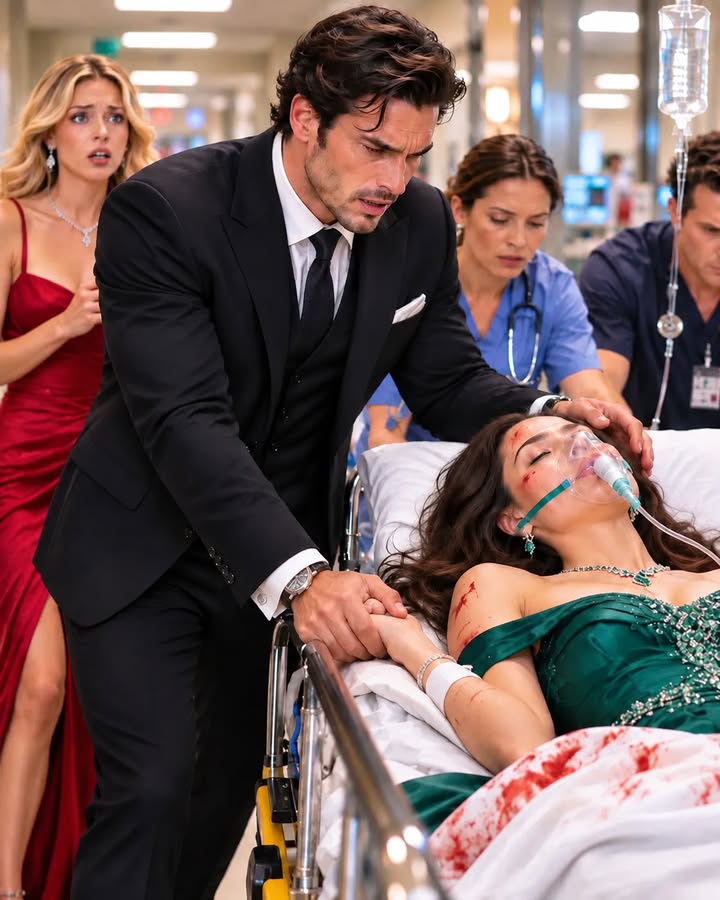
Part 6 – The Promise Between Us
“The person who called from my phone is still in the hospital.”
Claire’s whisper barely reached me, but the fear in her eyes made every word unmistakable.
I glanced toward the closed door, then back at her.
“Do you know who it is?”
She tried to answer, but exhaustion pulled her eyelids shut.
The nurse was beside us at once, checking Claire’s pulse and speaking gently as she drifted back into sleep.
I stepped away when asked, though every part of me wanted to stay close.
Matt was waiting outside.
“What happened?”
“She said the person who called from her phone is still in the hospital.”
His expression sharpened, then steadied.
“Did she say who?”
“No.”
“We should tell Rowan, but we shouldn’t start looking through the staff or questioning visitors ourselves.”
“I know.”
I had spent too much of my life confusing urgency with permission.
This time, I would let the people trained to investigate do their work.
Matt called Detective Rowan, who arrived within the hour with an investigator from the hospital’s security team.
They listened carefully as I recounted Claire’s words, making clear that she had been weak and may not have been able to explain further.
Rowan asked whether Claire could have meant someone in the intensive care unit, someone visiting another patient, or someone who had been there earlier.
“I don’t know,” I said. “I don’t want you treating a guess as proof.”
“We won’t,” he assured me.
The hospital reviewed access logs for the floor and checked the visitor records from the evening of the crash.
Because Claire’s statement was brief and her condition remained fragile, no one questioned her again that night.
I went back to her room and sat beside her until dawn.
I told her the police were looking into it and that she did not have to carry the answer alone.
When morning came, Rowan returned with news.
The call listed beside the altered vehicle report had been placed from Claire’s mobile account, but the device itself had not been located in the archive.
The number had been active for only a few minutes that day.
The call had gone to a records office, where a clerk had logged an authorization using my name.
“Can you identify who made it?” I asked.
“Not yet,” Rowan said. “We have a likely lead, but we need to verify it.”
“What about the person Claire saw?”
“We’re checking the visitor logs and the staff assignments. We’ve asked the hospital to preserve the relevant records.”
I nodded.
“Thank you for taking it seriously without assuming what it means.”
Rowan studied me for a moment.
“Your wife’s statement gave us a place to start. It doesn’t give us a conclusion.”
That distinction had become a kind of anchor.
Over the next two days, Claire grew stronger in small, uneven increments.
Sometimes she woke for a few minutes and recognized me.
Sometimes she slipped back into sleep before I could finish a sentence.
I learned not to ask questions simply because I was afraid of what I did not know.
Instead, I read to her, told her what the doctors had said, and listened when she had enough strength to speak.
On the third morning, she woke while rain traced thin lines down the window.
“Daniel,” she murmured.
“I’m here.”
“Did you give them the records?”
“Yes.”
Her eyes searched my face.
“All of them?”
“Everything Elias had. The police have the copies and Michael’s letter.”
Her shoulders eased against the pillow.
“Good.”
“You were right to ask me not to give anything to Ronan.”
She closed her eyes briefly.
“I was afraid you’d try to make a deal.”
“I was afraid too,” I admitted. “But I won’t bargain away the truth to feel safer.”
For a while, the monitors made the only sound in the room.
Then Claire whispered, “I’m sorry I didn’t tell you.”
I leaned closer.
“You don’t have to apologize while you’re still recovering.”
“I thought I could find proof first.”
“I understand why you wanted that.”
“I didn’t want you to go to Ronan with nothing but guilt and suspicion.”
Her words touched the exact place she had feared I would take them.
“I might have,” I said. “I can’t promise I wouldn’t have.”
Claire watched me in silence.
“I’m sorry I made you believe you had to protect me from the truth,” I continued. “I should have been someone you could bring it to.”
She reached for my hand.
This time I took it gently.
“I didn’t hide everything because I didn’t trust you,” she said. “I was trying to protect you from being pulled into something before I knew what it was.”
“I know.”
“And I should have told you when I became afraid.”
“Yes.”
There was no easy absolution in either of our voices.
There was only the beginning of a conversation we had postponed for too long.
“I also need to tell you something,” I said.
Claire’s fingers tightened faintly around mine.
“I know about Serena.”
Her gaze lowered.
“I told her,” I said. “I told her I had been unfaithful for a year, and that it was my choice. I didn’t make an excuse.”
Claire looked out at the rain.
“I heard you say it,” she whispered. “Before I could answer.”
The confession sat between us without disguise.
“I’m sorry,” I said. “Not because you might leave me. I’m sorry because I betrayed your trust and let you believe the marriage was something it wasn’t.”
Claire took a slow breath.
“I don’t know what happens next.”
“You don’t have to decide now.”
“I may not be able to forgive you.”
“I understand.”
“I may need time.”
“You can have all the time you need.”
Her eyes came back to mine.
“I don’t want you to promise what you can’t deliver.”
“I won’t.”
The answer seemed to settle something in her.
She had been through enough to know that love could not be proved by a vow spoken at the right moment.
It would have to show up in the ordinary days that came afterward.
When Claire was strong enough, Detective Rowan visited her with her permission.
He explained what the investigation had established and what remained uncertain.
The original vehicle inspection notes had been authenticated against the archive’s dated copies and the inspector’s personal work records.
They confirmed that Michael’s brake line had been damaged before the crash.
A specialist’s examination of the surviving maintenance photographs and vehicle records found signs that the line had been weakened during work performed shortly before Michael died.
The garage supervisor, Paul Dwyer, had agreed to speak with investigators.
Dwyer told them that Ronan Bell had contacted him through an intermediary and asked for Michael’s car to receive an additional inspection.
He said he had been told the request was routine, but later realized the brake work billed to the company had never been completed.
Dwyer had not damaged the line, he insisted.
He had seen the evidence afterward and kept a copy of the maintenance log, but fear and shame had kept him silent for years.
His account was not enough by itself.
Together with the verified records, Michael’s letter, and the recovered dispatch documents, it gave investigators a clear path to the truth.
Rowan also explained the strange authorization recorded under my name.
The call from Claire’s number had been placed by Ronan’s office administrator, using Claire’s phone after it had been left in a conference room during a family meeting.
The administrator had been instructed to confirm a review under my name, though I had never approved it.
The records had been altered afterward to make the false authorization appear legitimate.
The call was not evidence that Claire had helped change the report.
It was evidence that someone had borrowed her phone to make the deception look like mine.
“Did she know?” I asked Rowan.
“The administrator says Claire was not present when the call was made,” he replied. “We’ve confirmed that through the hospital’s own timing records and two independent witnesses from the meeting.”
Claire looked toward the window, breathing carefully.
For years, I had believed my brother died because of what I said in one argument.
The evidence did not erase that argument.
It did not turn our last conversation into something kinder than it had been.
But it made clear that my temper had not caused the car to fail, and that the guilt I had carried had been used by someone else to keep the questions quiet.
Michael’s death was not my doing.
The grief was still mine.
The blame was not.
When Rowan left, Claire rested with her eyes closed.
I sat beside her, holding the copy of Michael’s letter the investigator had brought for her to read.
The original remained in police custody, but Rowan had given us permission to review a secure copy.
“Would you like me to read it?” I asked.
Claire nodded.
I read Michael’s words slowly, letting his familiar voice return through the careful lines of ink.
When I finished, she was crying quietly.
“So was I,” she whispered. “When I found it.”
“I wish you hadn’t had to carry this alone.”
“I thought I was helping you.”
“You were trying to.”
“I was wrong about what you could bear.”
“I was wrong about how much you were already bearing.”
We sat with that truth together.
Ronan Bell was arrested several days later after investigators matched his office’s records to the dispatch request for the armored SUV involved in Claire’s crash.
The driver was also arrested.
He admitted he had been paid to force Claire’s car off the road, though he claimed he had not been told who she was or that she would be hurt.
The investigation found that the job had been arranged through a contractor tied to Ronan’s security company.
Ronan’s attorney issued a statement denying the allegations, but the evidence did not rest on one statement or one frightened witness.
The authenticated files, the falsified records, the dispatch logs, and the driver’s account formed a chain that could be examined in court.
The police also confirmed that Victor Moretti had no connection to the attack.
He had been a convenient explanation because I was already looking for danger in the places I understood.
I called his attorney and gave a brief statement acknowledging that I had mistaken the location for proof.
It was not an apology that erased our history, but it mattered to me to correct the accusation before it hardened into another convenient story.
In time, the courts confirmed Ronan’s role in the fraud and in arranging the attack.
The findings cleared Michael of wrongdoing and established that the official account of his crash had been deliberately altered.
The records did not answer every question about Michael’s final hours.
They answered the one I had spent nine years asking myself.
I had not caused his death by leaving an argument unfinished.
For a while, when I returned home, I still woke from dreams in which rain shone on the road and headlights vanished beyond a turn.
Then I would remember the verified records, the careful report, and the letter in Michael’s hand.
Grief stayed.
Blame loosened its hold.
Claire’s recovery was slower than either of us wanted.
She needed weeks of rehabilitation and months of rest.
Some days she grew frustrated by how tired she was.
Some days I found it difficult to watch her struggle with tasks that had once been effortless.
I learned to help without taking over.
When she wanted to walk across the room, I stayed beside her rather than carrying her.
When she asked me to leave her alone, I did.
When she wanted to talk about Michael, I listened without trying to close the conversation with a lesson.
A counselor helped us learn how to speak about the affair without turning every answer into a defense.
Claire asked questions that hurt.
I answered them as fully as I could, even when the honest answer made me look worse.
She made no promises about forgiveness.
She also did not pretend that the truth had settled everything.
Serena sent Claire a brief letter through me, saying she was sorry for the part she had played and hoped her recovery continued.
Claire read it, then asked me to thank her.
She did not ask me to reopen contact.
I did not.
Serena had ended the affair with clarity, and I respected her enough not to turn her decision into another negotiation.
Before leaving Chicago, she sent one final message.
She said she hoped I would become the man Claire had once defended.
I kept the message for a time, then deleted it without answering.
The work ahead belonged in the life I had damaged, not in the past I had used to hide from it.
When Claire was well enough to come home, she paused just inside the front door.
The house looked as it always had, but she stood there quietly, taking it in as if she needed to decide whether it still belonged to her.
I did not hurry her.
“You can change anything you want,” I said.
“I know.”
“I mean it.”
“I know,” she repeated.
She looked toward the living room, where the lamp stood near the window.
“You never did move it.”
“No.”
“Do you like it there?”
“I like that you chose it.”
A small smile touched her face.
“That isn’t the same thing.”
“No,” I said. “It isn’t.”
We moved the lamp together that afternoon.
Neither of us made a point of what the gesture meant.
It was only a lamp, and that was why it mattered.
The following spring, I created the Michael Valente Safety Initiative with an independent board and a public annual review.
Its work focused on vehicle inspections, transparent maintenance records, and training for people who wanted to report safety concerns without losing their jobs.
I funded it from my own assets and kept my name off the entrance.
Michael’s name belonged there, but the purpose was not to make a monument out of my guilt.
It was to make something useful from what we had learned.
Claire attended the first small gathering at the program’s office, still walking carefully but no longer needing a hand at every step.
She placed Michael’s photograph on a table beside the original inspection record, now displayed as part of the initiative’s history.
“I think he’d like this,” she said.
“He’d have asked why the coffee was so bad.”
“It is pretty bad.”
We both laughed.
The sound surprised me.
It was the first time in a long while that happiness had come without needing to prove anything.
Our marriage did not return to what it had been.
That was not possible, and neither of us wanted to pretend otherwise.
We built something more honest, with counseling, patience, and difficult conversations that were not always finished in one sitting.
Claire sometimes needed space.
I sometimes needed to be reminded that silence was not an invitation to invent an answer.
We learned to ask.
We learned to wait.
We learned that love was not the same as keeping someone from pain, and that protection without trust could become another kind of distance.
One year after the crash, on a clear evening in early autumn, I asked Claire to meet me in the garden behind our house.
There were no guests, no cameras, and no hidden arrangement.
I had written a few lines on paper because I knew I would not say them well if I trusted myself to improvise.
Claire looked at the small table between us, then at me.
“What is this?”
“I want to make a promise,” I said. “Only if you want to hear it.”
She considered me for a moment, then nodded.
I took the paper from my pocket but did not read it.
“I used to think a promise was something I could make once and rely on forever,” I said. “I understand now that it has to be made again in the ordinary moments, especially when telling the truth is uncomfortable.”
Claire listened without looking away.
“I promise not to use silence as a hiding place,” I continued. “I promise to ask instead of assume, and to hear your answer without trying to control it.”
My voice faltered, but I went on.
“I can’t promise I’ll never fail you. I can promise I won’t call my failure love, or make you carry the cost of it alone.”
The evening breeze stirred the leaves above us.
“I love you,” I said. “And I want to keep earning the chance to love you honestly.”
Claire looked down at her hands.
For a moment, I feared I had asked for too much.
Then she lifted her gaze.
“I can’t promise I’ll never be hurt again,” she said. “I can’t promise I’ll forget what happened.”
“I wouldn’t ask you to.”
“But I can promise to keep telling you when I’m afraid, instead of deciding alone what you can survive.”
Her eyes shone.
“And I can promise that if we keep choosing each other, it will be because we’re honest about what that choice costs.”
I nodded.
“That’s more than I deserve.”
“It isn’t about what you deserve,” she said. “It’s about what we’re willing to build.”
She reached for my hand.
I took it, feeling the warmth of her fingers and the familiar ring against my palm.
We exchanged vows quietly, not to erase the years behind us, but to acknowledge the future we were choosing with open eyes.
When we finished, Claire rested her forehead against mine.
For the first time in a long while, I did not feel the need to promise that nothing bad would ever happen again.
I promised only that when it did, I would meet it beside her, without hiding, without deciding for her, and without asking her to mistake fear for love.
Behind us, the house held every unfinished conversation and every ordinary day still waiting to be lived.
Ahead of us, the evening opened wide and calm.
We stepped into it together, not certain of everything, but finally certain of the truth we meant to carry.
**–THE END–PLEASE
Share your thoughts or feedback to motivate us to create more stories ♥️
* * *
[PREVIOUS: PART 5](https://puretales.idolsgift.com/blog/part-5-the-message-beneath-the-glass-034)
✓ Lynn R. Adams
Part 6 – The Promise Between Us “The person who called from my phone is still in the hospital.” Claire’s whisper barely reached me, but the fear in her eyes made every word unmistakable. I glanced …