PART 6 (THE END): The Memory Inside the Crystal 041
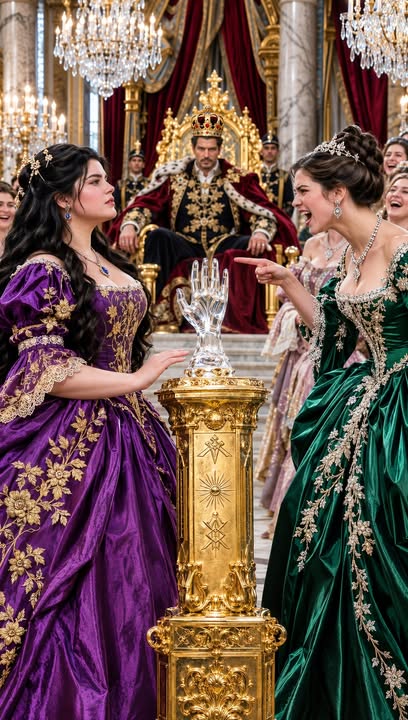
Part 6 – A Kingdom Remembers
The woman who had carried the sealed letter was Queen Elara herself.
The vision held, luminous and still, while the court watched in silence.
Then Queen Elara turned toward the cradle.
The shadow that had hidden her face fell away, revealing not a second woman, but the same queen from the first vision, older by only a few years and pale with exhaustion.
She looked toward the doorway, where a younger Tomas Vale stood with a blanket in his arms.
My father.
The crystal showed him looking down at the sleeping infant, then up at the queen.
Elara placed one hand over his.
“Keep her safe,” she said.
Her voice seemed to pass through the crystal and into the room around us.
“Let her be loved before she is asked to be anything else.”
My knees weakened.
Victor steadied me, his hand light against my arm.
The vision shifted once more.
A narrow gate stood beneath a sky bright with firelight.
Queen Elara watched as my father carried the child beyond it, while a boy of eleven stood beside her, his small hand clasped in hers.
Gabriel.
The queen turned toward him and crouched to meet his eyes.
“You must remember what we chose,” she told him. “Not the crown. The child.”
The vision dissolved into blue light.
For a few seconds, the throne room remained silent.
Then the crystal dimmed, not dark, but peaceful, as though it had said what it had waited generations to say.
Gabriel lowered his head.
“I remember now,” he whispered.
He looked toward the empty space where the vision had been.
“My mother brought me to the northern gate. She told me a child’s life mattered more than the claims adults might build around her.”
“You were there,” I said.
“I was.”
“You saw my father carry me away.”
“Yes.”
His eyes met mine, and there was no evasion in them now.
“I forgot the details,” he said. “Or perhaps I learned to forget them. My mother told me the child had died, and I accepted it because I was afraid to ask what had been done.”
The admission did not make the years of silence harmless.
But it placed his silence in the hands of the boy he had been, and left the man he had become responsible for what he chose next.
“What did your mother mean when she said she had chosen an heir?” Victor asked.
Gabriel looked at the crystal.
“I think she chose the child’s life over the crown.”
The words settled in my heart with the quiet weight of truth.
Queen Elara had not chosen me to rule.
She had chosen me to live.
The crystal had not revealed a commandment or a destiny, only a mother’s love and the courage of those who had carried it through the dark.
Lady Victoria stepped forward from the court.
Her expression was solemn, but her voice remained clear.
“If the old history was changed to protect the crown, then my family has benefited from that lie,” she said. “I will help restore the records, wherever the truth leads.”
She did not ask to be forgiven, and she did not offer an excuse.
I looked at her and saw the woman who had once believed the Trial would prove her worth.
Now she was choosing to help undo the harm her family’s ambition had caused.
“Thank you,” I said.
Her eyes shone, though she kept her chin lifted.
“I cannot change what my ancestors did,” she replied. “But I can refuse to let their choices remain hidden.”
The court began to stir, not with laughter or accusation, but with the uncertain, searching murmur of people who understood that their history had changed.
Gabriel stepped onto the low platform before the crystal.
For a moment, he stood beneath the crown he had worn for most of his life.
Then he removed it.
He held it in both hands, not as a surrender to me, but as an acknowledgment that the old story could no longer make his choices for him.
“I will not ask Sofia to claim a throne,” he said. “The crystal has shown her descent, but descent alone cannot decide what this kingdom should become.”
His gaze moved across the court and then beyond it, toward the open doors where the people of the palace had begun gathering.
“I will answer for my silence, and the royal records will be restored. The names of those involved in the purge will be made known with the evidence we possess, not to invite revenge, but so no one has to live beneath a history built on omission.”
I listened, my father’s pendant warm against my chest.
“The people will decide what justice requires,” Gabriel continued. “Not the crown alone.”
He looked at me.
“Will you help us do that?”
I had once imagined that learning I was royal might explain every closed door in my life.
Instead, the truth had given me a choice.
“I will help,” I said. “But not as a monarch above the people.”
A faint smile touched his face.
“As what, then?”
“As someone who serves them.”
The first public gathering took place in the great hall three weeks later.
People came from the city and the surrounding villages, filling the benches beneath the high windows.
Some arrived curious, others wary, and many carried questions the palace could not answer for them.
The restored records lay on a long table beside copies of my father’s letter, the archive ledger, and Queen Elara’s message.
Nothing was hidden behind a curtain.
Nothing was presented as unquestionable.
Master Ren described how the documents had been found and examined, while Gabriel spoke of what he remembered and what he had failed to ask.
He did not excuse the regent’s choices.
He did not excuse his own.
When his voice faltered, he paused, gathered himself, and continued.
Then I stepped forward.
I wore a simple gown of deep purple, the same color as the dress I had worn on the day I touched the crystal.
At my throat, my father’s sapphire pendant gleamed in its silver clasp.
“I will not tell you that one name or one bloodline can make a kingdom just,” I said. “The crystal recognized where I came from, but it cannot decide what we owe one another now.”
The hall was quiet enough that I could hear the breeze stirring the banners.
“My father carried me away from the palace because he loved me and feared for my life. He raised me as his daughter, not as a claim to anything. I will honor that before I honor any title.”
I looked toward the people gathered before me.
“The records must be restored, and the harm done must be acknowledged. But the future should not belong to a family simply because the past once belonged to them.”
The people listened.
Some nodded.
Others looked uncertain, and I welcomed that, because a decision made honestly should have room for questions.
“I will serve as the first protector chosen by a council elected by the people,” I said. “The council will guide the kingdom, and I will answer to it. No crown will place me above those whose trust I am meant to earn.”
When I finished, there was no immediate roar of approval.
There was something better.
A pause in which the people considered what they had heard, and then a slow rising of voices, questions, and thoughtful conversation.
The decision was not made that day.
It took months of open meetings, careful debate, and patient work to create the council.
There were disagreements, and there were families who struggled to accept what the restored records revealed.
But no one was asked to carry the blame for every choice made by an ancestor.
No one was asked to pretend the choices had never happened.
Gabriel appeared before the council and answered its questions.
He supported the restoration of the royal records and agreed that the people would choose their leaders.
When the council was formed, he gave up the authority he had held alone and took his place among its members as a former king, without a crown.
He did not ask for praise.
He learned to listen.
Victoria devoted herself to helping families affected by the purge recover their histories and names.
She sat with Master Ren over dusty registers, wrote to distant villages, and helped organize the records that had once been scattered or concealed.
The first time she brought me a bundle of restored family papers, she hesitated before setting them on my desk.
“I thought I understood what it meant to be chosen,” she said. “I believed it meant being declared more worthy than someone else.”
“And now?”
“Now I think it means being trusted with a responsibility.”
I smiled.
“That is a better thing to understand.”
She smiled back, a little uncertainly, but without the old sharpness.
Victor remained beside me through the long days of meetings and the quiet evenings afterward.
He never called me his queen.
When we disagreed, he argued with me as an equal, and when the room turned its attention toward the pendant at my throat, he made sure the conversation returned to my voice.
One evening, after a council session that had lasted until the lamps burned low, we walked together through the palace gardens.
The roses were beginning to bloom.
“You could have claimed the throne,” he said.
“I could have.”
“Do you regret not doing it?”
I thought of Queen Elara’s face in the crystal and my father’s words in the hidden letter.
“No,” I said. “I wanted the truth. I never wanted a throne to prove I mattered.”
Victor looked at me, his expression warm.
“You mattered before the crystal ever knew your name.”
The simple certainty of his words reached me more deeply than any grand promise could have.
“I know that now,” I said.
He offered his hand.
I took it.
There was no court watching, no title between us, and no expectation that either of us should rule the other.
We walked beneath the roses as the first evening stars appeared.
On the day the council formally chose me as its first protector, the royal records were returned to the palace gallery.
The portrait of Queen Elara was hung beside the new records, not above them.
Her expression was thoughtful, her hands resting on the arms of a plain chair.
At her throat, the painter had captured the sapphire pendant.
I stood beneath the portrait with my father’s pendant resting against my own heart.
Gabriel stood among the council members.
Victoria stood beside the archivists who had spent months restoring the names.
Victor stood beside me, not as a prince commanding the room, but as the person who had learned to remain when the truth became difficult.
The crystal rested on its pedestal at the far end of the hall.
For generations, it had been treated as a judge.
That afternoon, no one asked it to choose a ruler.
No one placed a hand against it.
Sunlight crossed the stone, and the crystal began to shine.
Its light was soft and steady, the color of a clear sky after rain.
The people watched, but no one bowed.
I thought of my father humming beside my bed, of the child he had loved before he knew her name, and of the queen who had chosen her life over the certainty of a crown.
The crystal shone peacefully.
For the first time in generations, it did not seem to be searching for a rightful ruler.
It seemed to be remembering a promise.
And together, we began building a kingdom worthy of the people who would inherit it.
In the weeks that followed, the restored records traveled beyond the palace, copied and carried to the villages whose names had been struck from them.
Some people found proof of a lost relative; others found only the confirmation that a part of their family’s story had vanished.
We could not return what had been taken, but we could stop pretending it had never mattered.
The council opened a public office where anyone could ask to see the records or challenge an account that seemed incomplete.
Master Ren taught younger archivists how to preserve each document and how to mark uncertainty honestly, rather than filling gaps with convenient guesses.
Gabriel attended the first gathering, sitting among the people instead of at the head of the room.
When an elderly woman asked whether his silence had protected the kingdom or merely protected the crown, he listened before answering.
“I believe it did both,” he said. “And I cannot pretend the good result cancels the harm.”
No one applauded.
The woman nodded once, as if she had expected no easier answer, and returned to her seat.
Afterward, Gabriel remained to hear more questions.
I watched him from the doorway and understood that taking responsibility did not make him innocent.
It gave him a way to keep choosing what he would do with the truth.
At the end of the season, the council held a quiet remembrance for those who had died in the palace fire and for those whose lives had been altered by the purge.
There were no speeches about rightful blood or destiny.
People read aloud the names recovered from the archives, pausing whenever a name had been lost beyond recovery.
When my father’s name was spoken, I held the pendant in my hand.
For the first time, it did not feel like a question I had to answer.
It felt like a promise he had kept.
Victor stood beside me, his shoulder warm against mine.
“You don’t have to be brave every moment,” he murmured.
“I know,” I said. “I’m learning that, too.”
He took my hand, and I squeezed his.
The ceremony ended without a grand declaration, just people lingering to speak with one another beneath the restored records.
That was how the kingdom began to heal: not with one perfect decision, but with room for people to remember, disagree, and return.
Later, as we crossed the palace courtyard, the evening sky deepened above the towers.
I thought of the girl who had once entered the throne room expecting laughter and found a secret instead.
She had not needed a crown to prove she belonged.
She had needed the truth, and the courage to let others decide what to do with it.
The kingdom still had work ahead.
But its history was no longer locked beneath the palace, and its future no longer rested in one person’s hands.
With my father’s sapphire close to my heart, I walked forward beside the people I had chosen—and who, in time, chose to walk beside me.
**–THE END–PLEASE
Share your thoughts or feedback to motivate us to create more stories ♥️
* * *
[PREVIOUS: PART 5](https://echoesofstories.idolsgift.com/blog/part-5-the-memory-inside-the-crystal-041)
✓ Lynn R. Adams
Part 6 – A Kingdom Remembers The woman who had carried the sealed letter was Queen Elara herself. The vision held, luminous and still, while the court watched in silence. Then Queen Elara turned to…