PART 6 (THE END): The Mark in the Oak 046
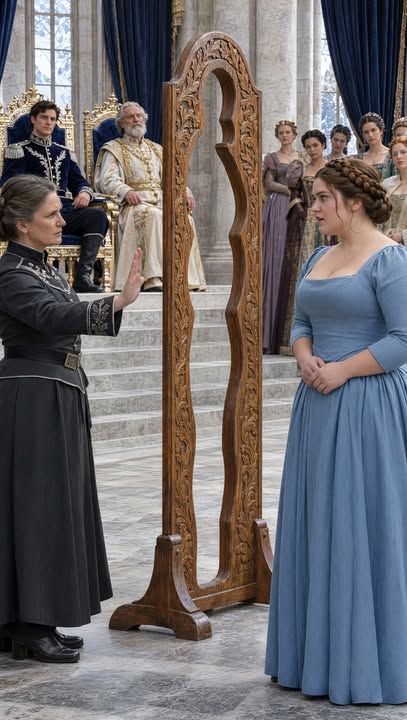
Part 6 – The Flower We Choose
The name on the record was Lord Harrow’s.
For a heartbeat, the courtyard seemed to lose every sound but the soft fall of snow.
Alexander read the entry once more, as if the words might change when he looked at them again.
Then he turned toward the palace doors.
“I need to speak with my father.”
“Wait,” I said.
He stopped.
The messenger stood nearby, hands clasped, while the footman kept his gaze lowered.
I looked at the page, at the queen’s handwriting beside the name of the man who had let my mother carry the suspicion of his own wrongdoing.
“Don’t make this about punishing him,” I said.
Alexander met my eyes.
“I won’t.”
“Make it about the truth.”
“I will.”
He folded the record carefully and held it against his coat.
“Will you stay?”
I glanced at the waiting carriage.
My first instinct was to leave before the palace could take anything more from me.
But Beatrice’s name sat in the king’s letter, offered as a substitute in a plan she had never chosen.
And somewhere inside the palace, the truth about my mother was still waiting to be spoken aloud.
“I’ll stay until Beatrice knows,” I said. “And until your father hears what the queen wrote.”
Alexander gave a small nod.
“Then we’ll go together.”
We crossed the courtyard beneath the snow and entered the palace.
The king was still in the blue salon, standing beside the table where the reliquary had been placed.
Lord Harrow had returned as well, and Mr. Vale was there with the copied letter in a protective folder.
The king looked up when we came in.
“Alexander, I have not changed my position.”
“I know,” his son replied. “But the record has changed what we understand.”
He handed his father the page.
King William read it in silence.
His face grew still as he reached the queen’s handwriting.
Lord Harrow did not move.
“I can explain,” he said.
The king raised one hand, asking him to wait.
When he finished reading, he lowered the paper and looked at Harrow.
“Did you take the reliquary?”
“No, Your Majesty.”
“Did you instruct your assistant to remove it from the cabinet?”
“I told him to keep the items from the west wing together during the renovations. I did not know he had put the reliquary in the tool chest.”
“But Queen Eleanor believed you knew it was missing.”
“I learned it had been moved after the inquiry began.”
The king’s gaze remained steady.
“And when Margaret Carter told you what she had seen?”
Harrow’s shoulders lowered.
“I should have searched the chest immediately.”
“That is not what I asked.”
“No,” Harrow said. “It is not.”
He looked down at the record.
“I believed the matter would disappear if we waited. My assistant was already ill, and I thought the reliquary would turn up when the renovations were finished.”
“And when it did not?”
“I let the inquiry close.”
“While an innocent girl was blamed.”
“Yes.”
“And Margaret Carter was dismissed after she tried to protect her.”
Harrow closed his eyes briefly.
“Yes.”
The king took in the answers without haste.
“Why was her name left beside the loss?”
“I cannot give you a good reason.”
“Can you give us the true one?”
Harrow opened his eyes.
“I was afraid the household would see that I had failed to supervise my assistant and the records. I let the entry stand because correcting it would have exposed my part in the confusion.”
The confession was neither dramatic nor complete, but it was plain.
It carried the weight of a man finally naming the choice he had made.
“You did not steal the reliquary,” the king said.
“No.”
“But you allowed suspicion to fall on people with less power to defend themselves.”
“Yes.”
I watched Lord Harrow as he spoke.
He did not ask for forgiveness.
He did not try to make his fear sound noble.
That did not undo what had happened, but it was the first time he had stood beside the truth rather than behind a closed file.
“Can the record be corrected?” I asked.
The king turned to me.
“It will be.”
“Not only in a private ledger.”
“No,” he said after a moment. “Not only there.”
Alexander looked at his father.
“The original entry should remain preserved, with a formal correction beside it. The letter from Queen Eleanor should be included in the household archive, along with the account of how the reliquary was recovered.”
The king considered this.
“And Lord Harrow?”
“He should be allowed to take responsibility for his part without the palace turning this into a spectacle,” I said. “People should know my mother was innocent. They do not need to be invited to watch someone suffer for being wrong.”
Harrow’s face shifted, a quiet gratitude appearing before he lowered his gaze.
The king looked back at me.
“You are asking for a difficult balance.”
“I know.”
“You want the truth made public, but not used to humiliate anyone.”
“I want my mother remembered as she was. Not as a name beside a missing object, and not as a reason for someone else to be shamed.”
For a long moment, no one spoke.
Then the king nodded.
“That is fair.”
He turned to Mr. Vale.
“Prepare a corrected account for the household records. Include Margaret Carter’s letter, Queen Eleanor’s response, and the recovered reliquary.”
“Yes, Your Majesty.”
“And send word to the former kitchen maid’s family, if we can find them. They deserve to know that she was not to blame.”
Mr. Vale bowed.
“I will begin at once.”
The king’s attention returned to Lord Harrow.
“You will provide the records in your keeping and give Mr. Vale a full account of the inquiry.”
“I will.”
“And while that review is underway, you will step back from decisions concerning the west wing and the royal household archives.”
Harrow accepted the instruction with a quiet inclination of his head.
“I understand.”
There was no cheering in the room, no sudden ease that could make the past disappear.
There was only the first honest account of what had happened, and the beginning of a repair that should have begun years ago.
The king turned to Alexander.
“Tomorrow’s dinner will not proceed as planned.”
The prince’s expression remained composed, but I saw the effort it took him not to look toward me.
“Are you certain?” he asked.
“I am.”
“Father, the alliance—”
“I know what the alliance means,” the king said. “I have not forgotten the people whose safety depends on it.”
He rested both hands on the table.
“But I also know that asking you to accept an engagement you do not want, in order to keep the palace from answering for its own failure, would be a poor foundation for any alliance.”
Alexander looked at his father with open surprise.
The king’s mouth softened.
“I have spent too many years treating your marriage as a solution to a map.”
A quiet breath left Alexander.
“It would have been easier if you had said that sooner.”
“It would have.”
The king did not ask his son to excuse him.
Instead, he turned to me.
“Miss Carter, I owe you an apology for how this palace treated your mother, and for how it treated you during the proceedings.”
I stood still, receiving the words without making them easier than they were.
“Thank you,” I said.
“I know an apology cannot return the years she spent carrying this alone.”
“No.”
“I will see that her name is formally cleared. I will also see that the palace offers what it can to repair the harm done to the families involved.”
“I don’t want her courage turned into a prize.”
“Nor should it be.”
The king looked at the oak frame, visible through the open doors in the next room.
“The children she helped are part of this history too. Mr. Vale tells me she cared for them during the winter the west wing sheltered families.”
“She never told me.”
“Perhaps she thought kindness needed no record.”
“Perhaps.”
The king’s gaze rested on the flower stitched into the linen beside the letter.
“Perhaps we have learned that it does.”
The following weeks did not make everything simple.
The household records took time to review, and the corrected account required careful work.
The palace wrote to the family of the kitchen maid, who had since settled far from the capital.
A reply arrived three weeks later, thanking the king for the truth and asking that her name be included in the record alongside my mother’s.
The recovered reliquary was returned to the family chapel, where it belonged.
Lord Harrow gave a written account of the inquiry and stepped down from his role overseeing household records.
He did not leave the palace in disgrace, nor was he made into a public villain.
He remained to help Mr. Vale sort the papers, this time without deciding which truths were convenient enough to keep.
When the formal correction was entered, my mother’s name was written clearly.
Margaret Carter, who brought the queen evidence concerning the misplaced reliquary and protected an innocent member of staff from a false accusation.
It was a small line.
It could not contain the whole of her.
But it was true.
The king invited me to the ceremony when the record was placed in the palace archive.
I almost declined.
I did not want my mother’s name spoken as part of a court event arranged to make the palace appear gracious.
But Mr. Vale told me the people who had worked in the west wing would be there, along with the kitchen maid’s family.
So I went.
Alexander met me at the entrance to the restored corridor.
He wore no uniform, only a dark coat and a simple silver pin shaped like a flower.
“I’m glad you came,” he said.
“I’m glad you asked me.”
We walked together through the west wing.
The rooms had been opened again, their old stone walls cleaned and their windows restored.
The garden beyond them was still winter-bare, but light filled the corridor in a way it had not before.
At the far end, the oak frame stood in a small room where children had once gathered with Queen Eleanor.
The old notch and carved flower were visible in the grain.
A new mark had been made farther down the frame, small enough to belong to a child who had stood there recently.
Beside it, someone had carved a fresh five-petaled flower.
“Who made that?” I asked.
“The children from the palace school,” Alexander said. “They wanted to add their own mark.”
The new flower was a little crooked.
I smiled.
“It looks like the old one.”
“I thought you’d say that.”
Mr. Vale stood nearby with a folder of records, while the king spoke with the kitchen maid’s granddaughter.
Beatrice had arrived as well, wearing the same steady smile she had given me on the first day.
She came to my side.
“I’m glad your mother’s name is here,” she said.
“So am I.”
“I’m also glad I didn’t have to stand in for Alexander at dinner.”
I laughed, and her smile widened.
“Your father withdrew the suggestion before it became an announcement,” I said.
“He did,” Beatrice replied. “And I told him I would rather be asked what I wanted before anyone decided what I should stand in for.”
“That sounds like you.”
“It took me a while to learn how to say it.”
She looked across the room at Alexander.
“He listens differently now.”
“He does.”
“And you?”
I looked down at the handkerchief in my hands.
“I’m still learning what I want.”
Beatrice nodded as if that were a complete answer.
It was.
The ceremony began with no fanfare.
The king spoke briefly about the limits of old records and the responsibility of those who kept them.
He acknowledged that the palace had failed Margaret Carter and the kitchen maid, and that the truth should never have been left to hide inside a piece of furniture.
Then he read the corrected entry aloud.
Hearing my mother’s name spoken in that room made my throat tighten.
I did not cry, though I came close.
When the king finished, he asked me whether I wished to say anything.
I looked at the people gathered around the oak frame.
“I don’t know everything my mother carried from this place,” I said. “But I know she did not believe kindness was only owed to people who could repay it.”
The room was quiet.
“She protected someone who had less power than she did, even when she knew it might cost her the work she depended on. I wish she had been able to tell me the whole story. I also wish the palace had made it easier for her to be heard.”
The king lowered his eyes.
“I hope this record is a beginning,” I continued, “not a way of pretending the truth has only now become real.”
“It is a beginning,” he said.
When the ceremony ended, people gathered in small groups around the frame.
The kitchen maid’s granddaughter stood beside the new mark, her fingers tracing the flower without quite touching it.
Mr. Vale told her how Queen Eleanor had measured the children who stayed in the west wing, and how my mother had sewn flowers onto handkerchiefs for them.
She listened closely.
Then she looked at me.
“Did your mother make the first flower?”
“I think she helped.”
“Would you show me how to stitch it?”
The question caught me by surprise.
“Yes,” I said. “I’d like that.”
In the weeks that followed, I returned to the palace several times.
At first I went to help Mr. Vale sort through the old records.
Then I went because the west wing had become a place where the past could be spoken of without turning every answer into a defense.
And, before long, I went because Alexander was there.
We did not make a promise in the blue salon.
We did not pretend that the choices between us were easy, or that affection could erase the difference between a prince’s duties and a woman’s freedom.
We talked.
Sometimes in the garden, where the snow gave way to patches of dark earth.
Sometimes in the old corridor, beneath the frame that had brought us together.
He told me about his mother’s laugh, which he remembered more clearly than her face.
I told him about the way my mother hummed while she sewed, always losing the tune when she reached the hem.
He listened when I spoke of her.
I listened when he spoke of the years he had spent being turned into a solution for other people’s plans.
Neither of us asked the other to be less complicated than we were.
One afternoon, as the first green leaves appeared in the west-wing garden, Alexander walked with me beneath the old stone arch.
“I have been thinking about what you said,” he told me.
“Which part?”
“That a promise matters most when keeping it is inconvenient.”
I looked at him.
“I thought you might.”
“The alliance will need work. My father and I have begun speaking with Lady Helena’s family about a different agreement, one that does not depend on marriage.”
“That sounds difficult.”
“It is.”
“Will it work?”
“I don’t know yet.”
His answer did not pretend certainty, but it no longer sounded like hesitation hiding behind duty.
“I also know what I want,” he said.
I waited.
“I want to share my life with you, Emily. Not because of the letter, or the frame, or what the court might think your courage is worth.”
He paused, searching for words that belonged to him rather than to the palace.
“I want it because you challenge me to look at what I would rather leave unquestioned. Because you tell me when I am being careful in a way that feels like doubt. Because I like who I am when I am with you.”
My heart had begun to beat faster, but I kept my gaze on his.
“Are you asking me to marry you?”
“No.”
The answer startled me.
He smiled gently.
“Not today. Not before you have had time to decide what you want, separate from what the palace expects or what the story of our meeting might suggest.”
I felt something in me ease.
“What are you asking, then?”
“I’m asking whether you would keep choosing to build this with me. Slowly. As my equal. And when the time is right, if you still want it, I’ll ask you properly.”
The gentleness of the question moved me more than a grand declaration would have.
He was not offering a reward.
He was offering a life that would have room for both of us to choose.
“I would like that,” I said.
His smile came slowly, brightening his whole face.
“So would I.”
The year that followed did not transform the palace into a perfect place.
It did, however, change the way its people spoke about what had happened.
The corrected record remained open for the household staff to read.
The reliquary returned to the chapel.
The kitchen maid’s family visited the west wing, where her name was written beside my mother’s in the account of the winter the children were measured.
Lord Harrow completed his service to the archive and left the palace with a letter from the king acknowledging both his failure and his later cooperation in setting the record straight.
The king and Alexander reached an agreement with Lady Helena’s family through trade and a shared winter relief program, rather than an engagement.
Lady Helena herself was relieved to be consulted about the arrangement and became one of Beatrice’s closest friends.
As for me, I stayed in the capital long enough to help establish a small sewing room in the restored west wing.
It was open to the families of palace staff, and every child who came in could choose a cloth, a thread, and a place for a flower.
I taught them the simple blue stitch my mother had used.
Some flowers turned out crooked.
We kept every one.
When Alexander asked me to marry him, it was not in a crowded hall or beneath the gaze of the court.
He asked me in the west wing on a quiet morning, beside the oak frame.
A new mark had been added for a child who had visited the day before.
Beside it was a tiny blue flower, stitched onto a square of linen and tied to the wood with a soft ribbon.
Alexander stood with my mother’s handkerchief in his palm.
“I asked Mr. Vale to help me find the oldest cloth your mother left in the palace,” he said. “This was tucked into a sewing box with the winter records.”
I touched the faded flower.
It matched the stitch I had carried all my life.
For a moment I could not speak.
Then Alexander took a small ring from his pocket.
“I won’t ask you to answer because you stayed,” he said. “Or because the palace finally learned your mother’s name. I’m asking because every day I know you, I want to meet the next one beside you.”
He looked at me with no title between us.
“Emily Carter, will you build a life with me?”
I thought of the girl who had stood at the oak frame while strangers decided she did not fit.
I thought of my mother, who had left the palace without being heard and had still chosen kindness.
I thought of Alexander as a child, waiting to be measured beside a doorway, and of the man who had learned that listening was not the same as agreeing, and that a promise could not be kept in secret forever.
“Yes,” I said.
His eyes brightened.
“Yes, I will.”
We were married the following spring in the restored west wing.
The king gave no grand speech about destiny.
He simply welcomed me into the family and thanked my mother for the kindness she had given his.
Beatrice stood beside me, smiling through tears.
Mr. Vale kept the records close to his heart, as if they were finally in the hands of someone who understood what they were for.
The old oak frame remained at the end of the corridor.
The marks were still there: children’s heights, small dates, uneven flowers made by hands long gone.
Beside the oldest carved bloom, Alexander and I placed a new one, cut carefully into the grain.
It was not perfectly even.
One petal leaned farther than the others.
I liked it that way.
When the ceremony ended, children from the sewing room gathered around the frame, eager to see where their own marks might go.
Alexander stood beside me as they took turns, one by one, adding their names and flowers.
My mother’s handkerchief rested in my pocket.
The old oak held all our marks without asking who was royal, who was staff, or who had once been told there was no room.
And as the children laughed beneath the windows, I understood what the palace had taken years to learn.
A family was not made by a title, a record, or a perfect match.
It was made by the people who kept choosing to see one another.
**–THE END–PLEASE
Share your thoughts or feedback to motivate us to create more stories ♥️
* * *
[PREVIOUS: PART 5](https://echoesofstories.idolsgift.com/blog/part-5-the-mark-in-the-oak-046)
✓ Lynn R. Adams
Part 6 – The Flower We Choose The name on the record was Lord Harrow’s. For a heartbeat, the courtyard seemed to lose every sound but the soft fall of snow. Alexander read the entry once more, as i…