PART 6 (THE END): The Mark Beneath the Tear 057
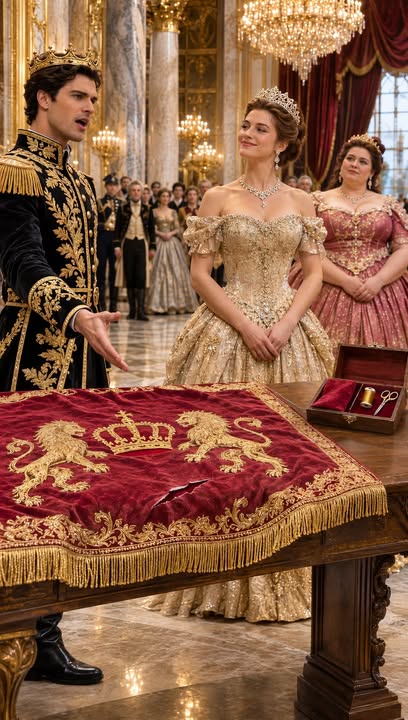
Part 6 – The First Stitches
“The maker’s request is to be reconsidered when the banner is presented before the court.”
The prince read the words once more, as though the second reading might reveal what the first had not.
Around him, the assembled guests waited in silence.
Mara stood beside the table with her grandmother’s sewing box held close, feeling the past draw near without yet knowing whether it would offer comfort or another wound.
Master Iven accepted the page from the prince and examined its faded ink.
“The handwriting matches the late king’s,” he said.
“But the order itself does not tell us why the request was never reconsidered.”
“Could there be another page?” Mara asked.
The archivist carefully turned the sheet over.
A faint line showed through from the other side, nearly lost beneath the paper’s discoloration.
“There is more writing,” he said.
He carried the page to the nearest lamp and angled it until the letters emerged.
The prince joined him, while the crowd remained quiet behind them.
Master Iven read slowly.
“‘The maker is to be invited to the presentation, and her proposal placed before the household council.’”
Mara’s fingers tightened around the sewing box.
“Was there a record of an invitation?” the prince asked.
“Not on this page.”
The archivist studied the ink.
“There may have been a separate notice.”
“Or it may never have been sent,” Celeste said.
No accusation entered her voice.
She was naming the possibility everyone else seemed afraid to speak.
The prince looked down at his father’s handwriting.
“If the invitation was never sent, then my father’s order was not carried out.”
“Or the record was lost,” Master Iven replied.
“We should not assume either without evidence.”
Mara appreciated the care in his answer, though the uncertainty still hurt.
Her grandmother might have waited for an invitation that never came.
She might have believed the palace had changed its mind, or that the request had been forgotten.
And all the while, the banner she had repaired had been carried into ceremonies without her name.
“What happened to the council?” Mara asked.
Master Iven checked the bottom of the page.
“It was scheduled to meet the week after the presentation.”
“Is there a record of its meeting?”
“There should be minutes.”
The prince looked toward the archivist.
“Can you search for them?”
“I can.”
“Then we will.”
A steward stepped forward from the edge of the platform.
“Your Highness, the guests are waiting, and the banner is ready to be raised.”
The prince looked at the record in Master Iven’s hands, then at the crimson cloth.
He might have delayed the ceremony again.
He might have kept the banner covered until every question had an answer.
Instead, he turned to the room.
“We have found enough to know that Isolde Venn’s request was not meant to end with a refusal,” he said.
“We do not yet know why my father’s order was never fulfilled, and I will not pretend that we do.”
He paused, allowing the uncertainty to remain visible.
“The archivist will continue searching for the council minutes and any record of an invitation.”
“Meanwhile, the need Isolde spoke of is still here, and it will not wait for the past to become perfectly clear.”
He turned toward Mara.
“With her permission, the repair fund will be established now, with local craftspeople guiding its work.”
Mara’s throat tightened.
She had feared a promise made for applause, something bright enough to appear generous and brief enough to disappear.
This was still only a promise.
But the prince had made it without claiming the mystery was solved or the harm made right.
“You have my permission,” she said.
“Provided the fund serves the people it was meant to serve.”
“It will.”
“And that the craftspeople who guide it are paid for their work.”
The prince nodded.
“They will be.”
Mara looked around the hall, where the fine clothes and polished ornaments seemed suddenly less important than the people gathered beneath them.
“Then I hope you will let the first decisions be made by the people who know what is needed.”
“I will.”
The prince returned to the banner.
He did not call for music or a speech to soften what had been said.
He simply placed the newly found page beside the earlier record, making no effort to conceal either one.
Then he took hold of the banner’s supporting ropes.
Mara stood near the front with Celeste and Master Iven.
When the prince lifted, the crimson fabric rose slowly above the platform.
The golden lions caught the light.
Near the lower border, the repaired tear remained visible as a slight change in the cloth, held by the fine gold stitches and the silk beneath them.
It was not a flaw to be hidden.
It was not a scar for the court to admire.
It was proof that something precious could be cared for without pretending it had never been hurt.
The banner settled into place above the hall.
For several heartbeats, no one applauded.
The prince looked up at it, his face quiet and unguarded.
Then Mara’s eyes found the repair, and she felt her grandmother’s presence in the careful work, in the remembered turn of each stitch, in the patience that had never asked to be praised.
A few people began clapping.
The sound grew gently, not as a celebration of the palace, but as an acknowledgment of the woman whose name had finally been spoken.
Mara did not look toward the court.
She looked at the banner.
When the ceremony ended, she stayed behind while the guests filed out.
The prince joined her beneath the raised cloth.
“I can’t make the past fair,” he said.
“No.”
“But I can make sure the fund is not only a promise spoken in a hall.”
“That is where it will matter.”
He glanced up at the repair.
“Would you help us decide how to begin?”
Mara considered the question.
She could hear her grandmother’s old lessons in it: take your time, look before you touch, and never mistake a grand offer for useful help.
“I’ll help,” she said.
“But I don’t want the fund named after me.”
“I wouldn’t suggest that.”
“Or named after my grandmother without asking what she would have wanted.”
The prince nodded.
“Then we’ll ask the people it will serve.”
The answer pleased her more than any title could have.
For a moment they stood together beneath the banner, with the noise of the departing guests fading through the doors.
“I used to think choosing someone meant discovering who was most impressive,” he said.
“And now?”
“Now I think I have been asking the wrong question.”
Mara looked at him.
“What question should you ask?”
“Whether we can make honest decisions together, even when the answers are difficult.”
She felt warmth in his words, but no pressure.
“I would like to see whether we can,” she said.
“So would I.”
He did not reach for her hand or speak of a wedding.
Instead, he asked whether she would walk with him through the gardens after the court had gone.
Mara said yes.
They began at a measured pace, speaking first of ordinary things: the weather, the long search through the archives, and the prince’s unfortunate childhood attempt to sew his riding coat.
Mara laughed when he admitted that he had once stitched a button to the wrong side of a vest and worn it that way through an entire lesson.
The prince laughed too, and the sound seemed to surprise him.
Their conversation turned, little by little, toward the questions neither of them had yet answered.
Mara told him she wanted to return to her village before deciding what a life at court might mean.
He said he would not ask her to set aside her work or her home to make his future easier.
“I don’t want to become a story people tell about the prince who chose a clever bride,” she said.
“I wouldn’t want that for you.”
“I want to keep mending things.”
“Then I would hope to learn how to help, without taking the work away from you.”
They reached the fountain, where the evening light rested in the water like a scattering of small stars.
The prince stopped beside the stone rim.
“I would like to know you as Mara,” he said, “not as a contestant or an answer to a question about the crown.”
“I would like that too.”
“Then we can begin there.”
She looked at him and saw the lonely person beneath the formal confidence, the man who had discovered that inherited stories could leave people out.
She also saw someone who had not yet proved what he would do when honesty became inconvenient.
That was not a reason to turn away.
It was a reason to take their time.
They returned to the library the next morning to continue the search for the council minutes.
Master Iven had spent much of the night reviewing the household catalogues.
Celeste arrived with her grandmother’s pattern book and a small parcel wrapped in linen.
Inside was an old child’s coat, carefully patched at one elbow.
“My grandmother made this for my cousin,” she explained.
“I brought it because the inner seam carries her usual maker’s mark.”
Mara studied the stitching, then the photograph Master Iven had taken of the banner’s hidden work.
The turns at the ends of the lines were similar, but not identical.
“That helps us understand how work was recorded,” Mara said.
“But it doesn’t prove who stitched the banner.”
Celeste nodded.
“I know.”
Her willingness to accept an incomplete answer felt like its own small change.
Master Iven placed the coat beside the old repair record, then examined the hidden mark again.
“The marks were used by the household office, not by one maker,” he said.
“They identify the work as officially accepted, while the individual name should have been entered in the maker’s register.”
“Which is missing,” Mara said.
“Or misfiled,” he corrected gently.
They searched through the older catalogues and transferred inventories, following each reference as it led them to another shelf, another box, another uncertain date.
The search took several days.
The prince returned whenever his duties allowed, and he learned to read the archivist’s indexes without asking for a summary.
Celeste began practicing simple stitches on scraps of linen, undoing each one when it pulled too tightly.
Mara showed her how to keep the thread relaxed.
Celeste showed Mara how her grandmother had marked embroidery patterns with colored chalk.
Their lessons were cautious, but the rivalry that had once separated them began to give way to curiosity.
On the fourth afternoon, Master Iven found a ledger misfiled among household inventories.
Its cover had been repaired with plain brown paper, and no title remained.
He opened it near the back, where a strip of ribbon marked an entry.
“There,” he said.
The page recorded the council meeting held after the banner’s presentation.
The first lines listed the matters discussed, including Isolde Venn’s proposal for a fund to repair essential garments.
Beneath it appeared the decision.
The council had approved a small trial fund, to be supported by the royal household and administered through the town’s local workshops.
Mara read the line twice.
“It was approved?”
“Yes,” said Master Iven.
He turned the page.
“The fund was to begin after a household officer delivered the notice to the eastern road district.”
The next entry named the officer assigned to carry the message.
A final notation, written weeks later, said that the notice had been returned unopened because the village address could not be confirmed.
Mara felt a familiar ache rise, but it was different from the old hurt.
Her grandmother had not been denied a second time.
The council had approved the request, yet the decision had never reached her.
“Was the address wrong?” Celeste asked.
Master Iven compared it with the address on the petition.
“It appears to have been transcribed incorrectly.”
“Only a few letters,” he said, “but enough to send the notice to another district.”
The prince studied the entry.
“Then my father did reconsider the request.”
“He did,” Master Iven replied.
“But the decision never reached Isolde.”
The prince’s shoulders lowered, though the discovery did not bring relief without sorrow.
“My father tried to correct the refusal, but the palace failed again.”
Mara kept her eyes on her grandmother’s name.
The story was not simple.
The palace had said no.
Then, after her grandmother’s request was brought before the king, it had changed course.
But an error in the palace’s own records had kept that answer from reaching the woman who had asked.
“Would she have known?” Mara asked.
“I don’t believe so,” said Master Iven.
“There is no record of another message or payment.”
Mara thought of her grandmother folding the refusal letter into the lining of her sewing box.
Perhaps she had believed that was the final answer.
Perhaps she had gone on mending coats and sleeves, never knowing that the council had agreed to help.
The discovery could not return the years when the fund might have served her neighbors.
But it changed the shape of her grandmother’s story.
She had asked.
The palace had first refused, then reconsidered.
And the failure afterward had not been a grand conspiracy or a deliberate punishment, only a small error that no one had cared enough to correct.
Small errors could still shape entire lives.
The prince sat beside Mara at the table.
“I am glad we found the full record,” he said.
“So am I.”
“I wish it had reached her.”
“Me too.”
He did not tell her that everything happened for a reason.
He did not say that the palace had meant well.
He let the sorrow remain what it was.
Celeste read the line again.
“My family’s records show that a repair workshop opened in the eastern district years later,” she said.
“Not a public fund, just a private effort supported by several households.”
Mara looked at her.
“Do you know who organized it?”
“No.”
Celeste reached for the archive index.
“But I can look.”
Master Iven checked the dates.
“That effort began several years after Isolde’s petition.”
“It may have grown from her work,” Mara said.
“Or it may have been an independent effort.”
She did not want to claim a connection without proof.
Still, she felt a quiet pride in imagining that her grandmother’s request might have helped someone think differently, even if the promised support had never reached her.
The prince closed the ledger carefully.
“We can tell the story accurately,” he said.
“The refusal, the reconsideration, the lost notice, and the years of work Isolde did without any royal fund.”
“And then what?” Mara asked.
“Then we begin the fund now, with no pretense that it settles the old debt.”
Mara looked at him.
“Good.”
The prince kept his promise.
A month later, he traveled with Mara, Celeste, and Master Iven to the eastern road district.
The fund was established in a renovated workshop near the market square, in a building that had once been used to store carts.
The windows were wide enough to admit morning light, and the worktables were sturdy rather than grand.
Local craftspeople helped design the space.
They chose the kinds of repairs the fund would support, set fair rates for skilled work, and created a simple process for families to ask for help without having to explain themselves before a crowd.
No portraits of royalty were hung above the doors.
There was only a modest plaque beside the entrance, listing the workshop’s purpose and the names of the craftspeople who had shaped it.
Mara’s grandmother was remembered in the opening book, not as a symbol created by the palace, but as a mender who had made a request because she had seen a need.
The prince spoke briefly at the workshop’s opening.
He acknowledged that the palace had refused Isolde’s first petition and that, even after reconsidering, it had failed to deliver the answer.
He did not ask anyone to admire his honesty.
He explained what the fund would do, who would guide it, and how the work would continue beyond the ceremony.
Then he stepped away from the doorway and let the local craftspeople speak about what families actually needed.
Celeste stood among them, wearing a plain dress she could move in.
She had begun spending her afternoons at the workshop, learning repairs from the older menders.
Her first attempts were careful and slow.
She still sometimes pulled a stitch too tight, but now she noticed when the cloth resisted.
She would pause, unpick the work, and try again.
One morning, she brought Mara a child’s jacket with a clean patch at the elbow.
“I did the stitching,” she said.
“I thought you might want to inspect it.”
Mara turned the sleeve over.
The stitches were small and patient, though one line curved slightly toward the cuff.
“It will hold,” Mara said.
Celeste let out a breath.
“That is the highest praise I’ve received all week.”
“You’ve earned it.”
Celeste smiled, no longer needing the smile to protect her.
“I’m beginning to understand that perfect work and good work are not always the same.”
“Sometimes good work is simply the work that helps someone keep going.”
Celeste looked across the room, where a mother was helping her child choose a patch for a worn schoolbag.
“Your grandmother would have understood that.”
Mara thought so too.
The prince came to the workshop whenever his schedule allowed.
He was not always useful with a needle, but he proved useful with shelves, ledgers, and deliveries.
He carried bundles of cloth, listened to the craftspeople, and learned not to turn every practical need into a royal announcement.
Mara and the prince kept walking together after work.
They spoke about the kingdom, the palace, and the quiet lives each of them had once imagined they would have to hide.
He asked her what she wanted before he asked whether she would remain.
She asked him what he feared before she asked what he hoped to become.
Neither promised that affection would make their differences disappear.
They chose to learn how to meet them honestly.
When the court later asked whether Mara would accept the prince’s proposal, she answered that there would be no proposal yet.
The prince agreed without protest.
They would build their relationship as equals, with time to discover what they could offer one another beyond titles and expectations.
Celeste, who had once entered the competition certain she would win, began visiting the workshop without her jewels or her practiced courtly composure.
She and Mara did not become inseparable.
They became something better suited to who they were: two women who had learned to speak plainly, to apologize when needed, and to keep making room for one another.
On the first morning the workshop opened to the public, the worktables were bare.
By noon, they were not.
A man brought a work coat with a split seam.
A girl arrived with a school dress that had grown too short at the hem.
A grandmother carried a bundle of shirts for her grandchildren, each with a missing button or a worn cuff.
Some people asked for help.
Others offered their own skills, bringing needles, thread, and time.
Mara stood at the central table and helped sort the garments according to what each one needed.
The prince carried a basket of mending to the far end of the room.
Celeste sat beside an older craftswoman, carefully stitching a patch into the elbow of the child’s jacket she had inspected the day before.
Above the workshop doorway, a framed photograph showed the royal banner after its restoration.
The repaired tear could be seen if one looked closely.
It did not diminish the cloth.
It showed where care had been given.
Mara paused beneath it, her fingers resting on the small wooden sewing box her grandmother had left behind.
The prince came to stand beside her.
“Do you think she would have liked the workshop?” he asked.
“She would have said the tables were too clean.”
He laughed softly.
“And then?”
“Then she would have found someone who needed a coat repaired and made sure we had work.”
At the nearest table, a child’s small coat waited beside a spool of golden thread.
Mara took her place, and the prince joined her, awkwardly threading a needle while Celeste showed him how to keep the thread from tangling.
Outside, the morning light moved across the market square.
Inside, the workshop filled with the gentle sounds of people beginning again: scissors closing, fabric unfolding, a chair pulled close, a laugh released without ceremony.
The banner hung above them in the palace, its careful mend visible against the crimson silk.
And here, beneath its remembered work, the first garments of the new fund waited to be repaired—not for a court, or a crown, or a story about what the palace had once done, but for the people who needed warmth to last a little longer.
**–THE END–PLEASE
Share your thoughts or feedback to motivate us to create more stories ♥️
* * *
[PREVIOUS: PART 5](https://storyly.idolsgift.com/blog/part-5-the-mark-beneath-the-tear-057)
✓ Lynn R. Adams
Part 6 – The First Stitches “The maker’s request is to be reconsidered when the banner is presented before the court.” The prince read the words once more, as though the second reading might reveal …