PART 6 (THE END): The Mark Beneath the Gold 046
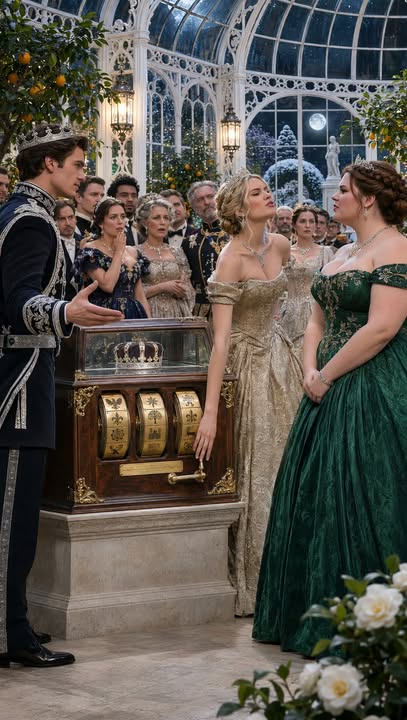
Part 6 – A Choice Made Freely
If you are reading this, the choice is finally yours.
Emma read the words once, then again, her father’s familiar hand steady on the yellowed paper.
The carriage rolled along the snowy road, but for a moment she was back in his workshop, sitting beside the bench while he taught her that a mechanism could be understood only when she stopped trying to force it.
Her fingers trembled as she unfolded the letter.
My dear Emma,
If this note has found you, then the chest has opened, and you have seen the mark I left beside its middle wheel.
I wish I had told you about the work I did for Queen Elara.
At the time, she asked me to keep her purpose private, and I promised I would. I believed that promise mattered more than my own wish to share the story with you. I may have mistaken silence for protection.
The chest was never meant to choose a husband for a queen’s son. It was made to remind him that wisdom, justice, and compassion are worth more than a name or a crown.
The lower catch holds a letter from the queen. I helped preserve it, but I never knew when it would be read, or by whom.
If you are reading this, then you have opened the chest in your own way. You noticed the mark because you were patient enough to see what others passed over. That has always been your gift.
But the choice that matters now is not the chest’s, or the court’s, or mine.
It is yours.
You do not owe anyone a life because they admire the way you solve a problem. You do not have to stay where you are not free, and you do not have to leave merely because someone expects you to.
Take your time.
Whatever you choose, I am proud of the person who makes it.
Love,
Dad
Emma pressed the letter to her chest and closed her eyes.
The grief that rose in her was not new, but it was changed by the words.
Her father had been part of the mystery all along, yet he had not left her a test to pass or a path to follow.
He had left her permission to make her own.
By the time the carriage reached the town, the snow had thinned to a soft mist.
Emma asked the driver to take her to the small hotel where she had planned to stay before deciding what came next.
She spent that evening with her father’s letter beside her on the table, reading it whenever the room grew too quiet.
The next morning, she wrote to Alexander.
She told him she had found the note.
She told him she understood why her father had kept his promise to the queen, even if she wished he had trusted her with the story sooner.
Then she told Alexander she hoped he would read his mother’s letter publicly, not as a weapon against the council, but as the truth she had entrusted to him.
She did not ask him to come for her.
She did not tell him she was ready to return.
She signed her name and sent the letter by courier.
Across the palace, Alexander had spent the night with his mother’s words folded on the desk before him.
He had read them alone first, then with Victoria, and finally with the keeper of the royal collection, who confirmed that the original letter had been preserved exactly as Queen Elara intended.
He had asked the council to meet again.
This time, he arrived without a prepared speech.
The advisers gathered around the long table, Lord Harrow among them.
Victoria sat at the end with a written account of what she had been told before the contest.
The curator and keeper were present as witnesses to the queen’s letter and the records that had accompanied it.
Alexander placed a certified copy before the council.
“My mother’s letter is clear,” he said. “The chest was not a marriage contract, and the challenge was not her plan for choosing my wife.”
Lord Harrow studied the paper.
“We should have verified the wording before presenting the event as a royal tradition,” he said at last.
“Yes,” Alexander replied. “We should have.”
The admission was not a victory.
It was the first honest ground on which they had stood together.
Another adviser asked whether Alexander meant to cancel all future discussions about his marriage.
“No,” he said. “I mean that no contest, public or private, will be used to make another person’s consent seem automatic.”
The council listened.
“A royal partnership affects the country,” he continued. “That is true. But the person asked to share my life is not an instrument of policy. Nor should anyone be led to believe that solving a puzzle binds them to a future they have not chosen.”
The senior adviser folded his hands.
“Then what do you propose?”
“A new protocol for royal courtship and marriage. Any person involved must know what is being asked of them, and may decline without consequence to their position or reputation. The council may advise me, but it may not promise another person on my behalf.”
“And if the council believes a match would best serve the country?”
“You may tell me so. I will listen. The choice will remain mine, and consent will remain theirs.”
The room was quiet for a long moment.
Then Victoria spoke.
“I believed the contest was official because I was told it carried the queen’s wishes,” she said. “I accepted that explanation without asking for proof. I suspect others did the same.”
Her admission carried no flourish, but it changed the meeting.
The advisers could no longer treat the misunderstanding as the prince’s alone.
Lord Harrow looked at her.
“You are saying the information we gave the contestants was misleading.”
“I am saying it was incomplete enough to make them believe something that was not true.”
The curator set the original event records on the table.
The official archives contained no marriage contract, no instructions from Queen Elara, and no rule that the winner should become Alexander’s bride.
The contest had been proposed by the advisers, then given the language of royal tradition before anyone took the time to question what that meant.
The truth did not make every decision malicious.
It did make the harm visible.
The council agreed to withdraw the claim that the challenge had been Queen Elara’s chosen method of finding a bride.
They also agreed that the old procedure would not be used again.
Lord Harrow did not offer a dramatic apology, and Alexander did not demand one.
Instead, the adviser acknowledged that the council had allowed an assumption to become a promise.
Alexander accepted the admission, while making clear that the new protocol would be written and reviewed rather than left to goodwill.
The work took weeks.
Some councillors resisted the loss of influence.
Others welcomed the clearer boundaries once they understood that a royal marriage could not be made secure by pretending consent had already been given.
Alexander attended every meeting.
He listened when the advisers warned him about political consequences, and he challenged them when they treated a person’s private life as a convenient answer to those concerns.
For the first time, he was not trying to avoid the pressure by finding a compromise that someone else had designed.
He was deciding what he could stand behind.
Victoria helped review the protocol.
She also wrote to several of the women who had entered the contest, explaining that the palace had corrected its account of the event and that none of them had been bound to any expectation.
Some replied with relief.
One sent a brief note saying that she had never believed the prince could be required to marry a stranger.
Victoria kept that note on her desk, not as praise, but as a reminder to ask better questions.
Emma returned home and unpacked her suitcase.
She did not put the emerald gown away immediately.
For several days, she left it folded on the chair beside her bed, a reminder of the evening when she had spoken before she was certain she would be heard.
She visited her father’s workshop, now kept by an old family friend who still repaired locks at the same wooden bench.
The friend remembered Thomas Carter well.
“He never liked talking about royal work,” the man said. “He used to say that a promise made in private should stay private unless the person it concerned chose otherwise.”
Emma rested her hand on the worn workbench.
“He could have told me more.”
“He could have,” the friend agreed. “He also knew you would ask questions when you were ready.”
Emma ran her fingers over the familiar grooves in the wood.
She missed him.
She was still angry with him, in a small, human way, for leaving her to discover a piece of his life after he was gone.
Both feelings could be true, and neither made her love him less.
She wrote to Alexander again.
His answer came four days later.
He did not report every council debate or ask when she would return.
He told her that the new protocol had passed its first review, that Victoria had been more candid than anyone expected, and that the queen’s letter would be preserved beside the chest’s records.
Then he told her he had walked through the conservatory after the guests were gone.
The orange trees had been quiet, he wrote, and the place seemed smaller without a room full of people waiting for him to become someone else.
He had wished she were there.
He had not said that to persuade her.
Emma read the letter twice before answering.
She told him she had thought of him, too.
She told him that she liked the version of him who could admit when he was afraid, even if she still wanted to know what he was like when he was happy.
His next letter arrived with a pressed winter flower tucked between the pages.
He wrote that he was trying to find out.
Their letters grew longer, then more ordinary.
They wrote about books, family memories, and small things that mattered because neither of them had to turn them into evidence.
Alexander asked Emma what her father had taught her about difficult locks.
Emma told him that her father believed patience was not the same as waiting forever; it was the willingness to understand before deciding what to do.
Alexander replied that he was beginning to see how much of his life had been spent mistaking stillness for patience.
When he asked whether she would visit the palace, he made no promise on the court’s behalf and offered no reason she should.
Emma agreed because she wanted to see him.
She returned in the spring, when the last snow had melted from the palace gardens and the orange trees in the conservatory were putting out new leaves.
Victoria met her at the entrance.
She wore a simple blue dress and no tiara.
For a moment, they looked at each other, each remembering the evening when they had stood on opposite sides of the chest.
“I’m glad you came,” Victoria said.
“So am I.”
Victoria took Emma’s travel case.
“I have learned that offering help is easier when I remember to ask first.”
“Would you like to carry that?”
“I would.”
Emma smiled.
“Then thank you.”
The friendship did not arrive all at once.
It grew through walks, shared meals, and conversations in which Victoria learned to listen without preparing her response, while Emma learned that an apology could be the beginning of trust rather than a demand to forget.
Alexander met Emma in the conservatory.
He did not make a speech.
He did not bring the crown or the letter.
He simply stood beside the chest, which had been returned to its place beneath the glass roof.
“I’m glad you’re here,” he said.
“I’m glad I chose to come.”
The words mattered to him.
She could see it in the way his shoulders eased.
They walked through the gardens together, away from the watching attendants and the curious court.
They did not call it courtship at first.
They called it spending time together.
Alexander told her about his mother, not only as a queen who had left him a letter, but as a person who hummed while reading and kept broken clock parts in a drawer because she liked to know how they worked.
Emma told him about her father’s stubbornness, his warm hands, and the way he would pretend not to notice when she had solved a lock before he had.
They learned how each of them behaved when tired, uncertain, amused, or disappointed.
They argued once about whether a royal library should lend rare books to local schools.
Alexander thought the risk of damage was too great.
Emma said books that could not be shared were already being lost in another way.
They did not settle the question that day.
They did return to it, and eventually found a plan that protected the collection while allowing supervised access.
The work was small beside the affairs of state.
That was part of why it mattered.
Their closeness did not come from one grand declaration.
It came from the steady discovery that each could disagree without turning the other into an enemy, and could change their mind without losing dignity.
The court watched.
Some whispered that Emma had planned her way into the palace after all.
Others said Alexander had been too influenced by one woman’s cleverness.
The new protocol gave them less room to turn rumor into fact, but it could not make every gaze disappear.
Emma and Alexander learned to meet those looks together, without letting them choose the shape of their lives.
Months passed.
On the anniversary of the winter contest, Alexander asked Emma to walk with him to the conservatory after the evening reception had ended.
The chest stood beneath its glass roof, its oak surface polished, its brass wheels still.
A small plaque had been added beside it.
It recorded that Queen Elara had commissioned the chest as a reminder that judgment should not be measured by rank, and that no person’s future should be chosen without their consent.
Emma read the words slowly.
“Will the court understand?” she asked.
“Some will,” Alexander said. “Some will decide they already know what it means.”
“And you?”
“I understand that I should have asked more questions before I let them call the contest a promise.”
“You did ask questions eventually.”
“After you had to.”
The admission held no self-punishment, only accountability.
Emma turned toward him.
“You cannot undo the beginning.”
“No.”
“But you can decide what comes after it.”
“That is what I’m trying to do.”
He took a small box from his pocket.
There was no crowd waiting beyond the glass doors.
No adviser had prepared a speech.
No one had brought the chest back to test her answer.
Alexander looked nervous, and did not try to hide it.
“I have thought about asking you this for a long time,” he said. “I waited because I wanted to know you well enough to ask honestly, and because I wanted you to know you could answer honestly.”
Emma’s breath caught.
“I love you,” he said. “Not because you opened the chest, and not because my mother hoped I would choose freely. I love the person who speaks plainly when silence would be easier, who sees what others miss, and who reminds me that being responsible does not mean surrendering every part of myself.”
He opened the box.
Inside lay a simple ring, its gold band set with a small green stone.
“I’m asking you in private, with no contest and no court to witness it,” he said. “Will you marry me?”
Emma looked at the ring, then at him.
The first time he had spoken of marriage, it had been part of a rule announced before she knew his name.
This time, the question belonged to the two of them.
“Yes,” she said.
Alexander let out a breath that sounded almost like laughter.
“Yes?”
“Yes. Because I choose you, and I want to build that life with you.”
He slid the ring onto her finger.
It fit.
They stood together beneath the conservatory’s curved roof, the night beyond the glass clear and dark.
Emma leaned her forehead against his.
For a moment, she heard the quiet click of the chest’s mechanism in her memory, the sound of a door opening because the right pieces had finally been set in place.
When they told Victoria the next morning, she smiled and asked whether she might be allowed to help with the ceremony.
“You may,” Emma said. “If you promise not to turn it into another competition.”
Victoria laughed.
“I have learned my lesson.”
The court received the news with curiosity, warmth, and some degree of speculation.
Alexander answered questions without making Emma the explanation for his reforms, and Emma spoke when she wished to, never as a trophy brought forward to prove a point.
They planned a modest wedding for the following spring.
Victoria stood beside Emma when she entered the palace garden.
The curator placed Queen Elara’s letter in a small exhibition beside the chest, with Thomas Carter’s restoration note displayed nearby.
The two pieces of handwriting sat together beneath the old maker’s sign.
Emma saw her father’s name and felt his absence, but also the quiet presence of what he had given her: attention, patience, and the courage to make her own choice.
When the vows were spoken, Alexander did not promise that the world would never press upon them.
He promised to meet that pressure beside her, not ahead of her, and to listen when she told him what she needed.
Emma promised the same.
Their life together began not with a riddle or a royal announcement, but with two people choosing one another again and again, freely and without an audience.
And whenever they passed the old chest beneath the conservatory glass, Emma remembered that the most important lock it had opened was not made of brass.
It was the one that had kept a choice waiting until it could belong to them.
**–THE END–PLEASE
Share your thoughts or feedback to motivate us to create more stories ♥️
* * *
[PREVIOUS: PART 5](https://echoesofstories.idolsgift.com/blog/part-5-the-mark-beneath-the-gold-046)
✓ Lynn R. Adams
Part 6 – A Choice Made Freely If you are reading this, the choice is finally yours. Emma read the words once, then again, her father’s familiar hand steady on the yellowed paper. The carriage rolle…