PART 6 (THE END): The Mark Beneath the Glass 069
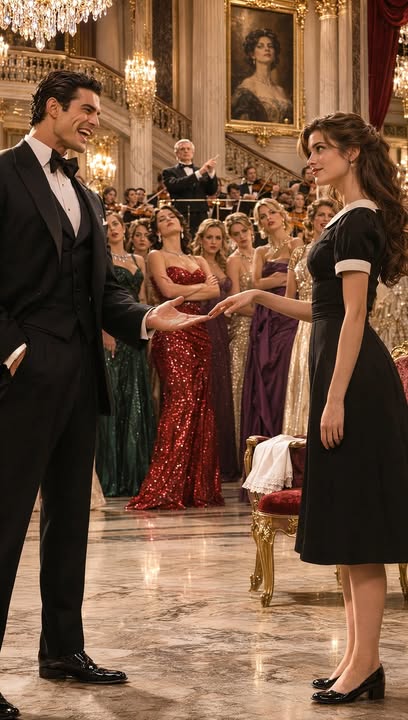
Part 6 – A Dance Without Boundaries
Alexander stared at the signature on the newly uncovered page.
It was his name, written in the firm, deliberate hand he had used for official documents since he was old enough to sign them.
Yet he had no memory of seeing the page, let alone signing it.
Olivia stood beside him, her expression thoughtful rather than accusing.
“Three years ago,” she said. “What would you have been doing then?”
“Approving renovation paperwork, most likely.” He kept his eyes on the date. “There was a period when I signed nearly everything brought to my office.”
“Could someone have placed it among those papers without explaining what it was?”
“Yes.”
The conservator leaned closer to the document without touching it.
“The paper and ink are consistent with the date,” she said. “The signature appears genuine, but I can’t determine who added the sentence below it.”
The sentence had been written in a different hand.
Original credit to Elena Varga to be restored only after the heir completes the crossing.
Alexander read it again, then looked toward the glass floor.
“What does ‘the crossing’ mean?” Olivia asked.
“I don’t know.”
“Does the page say anything else?”
The conservator carefully turned it, revealing a blank reverse.
“No.”
Olivia studied the words beneath Alexander’s signature.
“Perhaps someone wanted you to walk the original path.”
“Why would anyone make your mother’s credit depend on that?”
“I don’t know,” she said. “And I don’t want us to assume the answer is hidden in a riddle just because the sentence sounds mysterious.”
Alexander nodded.
“Then we’ll look for what we can establish.”
The conservator explained that the document had likely been stored with the original plans for a long time, though she could not prove when it had been placed there.
The signature, she emphasized, did not make Alexander the author of the note or the keeper of its meaning.
He heard the distinction, but unease still clung to him.
Someone had asked him to complete a crossing without telling him what it meant.
Someone had also delayed Elena’s credit until that moment.
“Could my father have written this?” he asked.
“The handwriting doesn’t match his,” the conservator said.
Olivia looked down at the page.
“Could it have been Victor?”
“Possibly,” Alexander replied. “But we shouldn’t guess before the investigation is finished.”
They sent the document to the same independent examiner who had authenticated the other records.
The conservator returned the original plans to their case, and the ballroom settled into a quiet that seemed to hold the question with them.
Alexander walked to the edge of the floor.
“I thought the secret was finally behind us,” he said.
“Some secrets take longer to explain than to uncover.”
“I don’t want this to delay Elena’s credit again.”
“It won’t,” Olivia said. “The evidence already shows she made the original design.”
“Then that’s what we’ll publish.”
“And this page?”
“We’ll include it, with the examiner’s findings, and make clear what we know and what we don’t.”
Olivia gave him a slow nod.
It was not an answer to the old sentence, but it was a choice he could make now.
That afternoon, the independent examiner called.
The signature was Alexander’s, and the date matched the records of an administrative review three years earlier.
The sentence beneath it had been added later, probably by someone who had access to the archived papers.
No evidence could establish who wrote it.
The page had not been an instruction with legal force, the examiner explained; it was a private note attached to a record of Alexander’s approval for the restoration project.
The approval itself had authorized a full examination of the ballroom floor.
Alexander remembered signing the paperwork.
He had approved the inspection because the glass panels needed repair, but he had never read the attached restoration notes closely.
A separate notation in the project file showed that the original credit was to be reviewed once the floor’s hidden structure had been examined.
The wording on the newly found page had transformed that ordinary condition into something more symbolic.
The heir completes the crossing.
“It may have been written by someone who knew your father’s wish,” the examiner said. “But there is no way to identify the writer from this page.”
Alexander thanked her and ended the call.
Olivia waited across the table, Elena’s sketchbook open before her.
“So the signature wasn’t a confession,” she said.
“No. I signed permission for the floor to be examined.”
“And the sentence?”
“Someone added it later. We don’t know who.”
“Then we don’t need to invent an answer.”
“No.”
She turned to a drawing of the ballroom and traced the route with her eyes.
“Your father wanted the original pattern preserved,” she said. “Maybe the person who wrote that believed you had to understand it before the credit could be restored.”
“Or believed the floor should be completed first.”
“Either way, the credit is not conditional anymore.”
Alexander looked at her.
“No. It isn’t.”
The board met the next morning.
This time, Alexander brought the full report, the original floor plan, and the independent examiner’s findings.
He presented the evidence without minimizing his father’s choices or turning uncertainty into an accusation against anyone else.
He explained that his signature had approved an inspection but had not been a promise to delay Elena’s recognition.
The note beneath it, he said, would be included in the public record, along with the fact that its author was unknown.
The board listened.
Some members questioned the timing of the public restoration announcement.
Others worried that the continuing inquiry might unsettle the company’s partners.
Alexander answered each concern as plainly as he could.
He also presented a plan to protect staff and preserve the company’s work while the investigation proceeded.
He did not ask the board to approve the truth.
He asked them to help ensure that the people who had done nothing wrong would not bear the cost alone.
After an hour, the board voted to support the independent review and the public correction of the historical record.
One member opposed the statement.
Another abstained.
The rest agreed that the company could not claim to have learned from its past while keeping the evidence private.
Alexander stepped from the meeting room tired but lighter.
The decision did not restore his family’s old reputation.
It did not erase the consequences.
But for the first time, the future of the company would not depend on preserving a convenient silence.
The investigators completed their review over the following weeks.
Victor cooperated fully, providing records and answering questions about his actions.
The evidence confirmed that he had transferred Elena’s design documents to a rival firm while he was a junior employee.
He had done so for personal advancement, believing he could benefit from the transaction without anyone tracing it back to him.
When the documents surfaced, he had allowed suspicion to settle on Elena because her work was already known to the company and because he feared the consequences of admitting what he had done.
Alexander’s father had discovered the altered records later and confronted Victor.
He had stopped the matter from becoming a criminal prosecution against Elena, but he had chosen private containment over a public correction.
That choice had protected the Moretti business and Victor’s position.
It had not restored Elena’s name.
Victor was formally removed from his advisory role and held accountable through the appropriate legal and professional channels.
He did not ask Alexander to save him from the consequences.
In a written statement, he admitted what he had done and acknowledged that his silence had extended the harm.
He also wrote directly to Olivia, without asking her to forgive him.
She read the letter once, then placed it in a folder with the rest of the records.
“He has finally told the truth,” she said.
“Yes,” Alexander replied. “But the truth doesn’t obligate you to make him feel better.”
Olivia looked at him, and a quiet gratitude passed between them.
The company publicly restored Elena’s credit in a statement that did not soften the facts.
It named her as the original designer of the glass floor and acknowledged that the accusation against her had been unsupported and unjust.
It also disclosed that Alexander’s father had possessed evidence that could have corrected the record and had failed to make that correction public.
The statement was difficult for Alexander to sign.
It was more difficult to watch the questions it brought.
Some partners paused negotiations.
The board placed limits on his authority while it reviewed the company’s governance.
Several newspapers examined the family’s older business practices, and not every story was fair or complete.
Alexander did not respond by trying to silence them.
He answered what he could, corrected what was false, and accepted that some consequences would take time to understand.
He also made changes inside the company.
Records were transferred to an independent archive.
Historical claims were reviewed by outside auditors.
Employees were given a clear way to raise concerns without fear that protecting the company mattered more than telling the truth.
The work was neither swift nor glamorous.
It required patience, difficult conversations, and a willingness to hear things that made Alexander uncomfortable.
He discovered that rebuilding could be quieter than control and more demanding than command.
During that time, Olivia remained in the mansion, but she did not resume her old duties.
Alexander made no assumption that she would.
Instead, he asked her to meet with the restoration committee and explain what Elena’s drawings revealed about the original design.
Olivia accepted only after the committee agreed that she would be paid as an independent consultant, with authority over how her mother’s work was displayed and with no obligation to serve as a public representative for the Moretti family.
“I don’t want to be chosen because of what happened between us,” she told Alexander.
“You won’t be.”
“And I don’t want the job to become a way of saying the company has made everything right.”
“It can’t make everything right.”
“Then we agree.”
They shook hands over the terms.
It was a practical beginning, and Olivia preferred it that way.
Over the next several months, she worked with conservators, architects, and the restoration committee to plan the floor’s repair.
She insisted that the original design be shown beside the finished floor, so visitors could see both Elena’s first conception and the changes that had been made after her dismissal.
The brass mark beneath the glass was preserved.
A small plaque near the ballroom entrance explained that it was Elena’s personal mark, not a decorative feature added by the Morettis.
Olivia also asked that the history of the accusation be included.
The committee’s first draft made the story sound tidy.
She sent it back.
“Don’t call this a misunderstanding,” she said at the meeting. “A misunderstanding suggests no one chose to let it continue.”
The final text named the choices that had been made, as well as the evidence that corrected them.
It did not make Elena’s life a tragedy or turn her into a symbol.
It described her work, her skill, her dismissal, and the fact that she had continued drawing long after the company closed its doors to her.
When the restoration began, the glass panels were lifted one by one.
The work revealed the structure beneath the floor, including the original guides that Elena had drawn into her design.
The route was more generous than the version Alexander had used for his challenge.
It gave dancers room to pause, change direction, and find one another again.
Olivia stood beside the conservators on the first morning the original pattern came into view.
For a while, she said nothing.
Then she looked at the path her mother had designed.
“She made it easier to move together,” she said.
Alexander stood a few steps away, careful not to intrude on the moment.
“I thought the challenge was about perfect steps.”
“What do you think now?”
“I think I wanted everyone to prove they could follow my rules.”
“And did they?”
“They tried.”
“And you?”
He looked at the lines beneath the glass.
“I changed the rhythm to catch people out.”
“You did.”
“I’m sorry.”
Olivia met his eyes.
This apology was not about the company’s history, or the letter, or the public record.
It was about the ballroom and the night he had used marriage as a prize in front of a crowd.
“I made the challenge sound like a promise,” he continued. “It was a spectacle, and I put you in the middle of it without considering what that might mean for you.”
“You did.”
“I’m sorry, Olivia.”
She studied him for a moment.
“Thank you for saying it plainly.”
“I should have said it sooner.”
“Yes.”
He accepted the correction.
“But I don’t regret dancing,” she added. “I regret that you thought you could turn a life-changing decision into a game.”
“I understand.”
“Do you?”
“I do now.”
The floor was closed for several more weeks.
While the work continued, Alexander and Olivia saw one another often, but neither tried to hurry what had not yet been decided.
He stopped bringing her gifts that came with no explanation.
She stopped wondering whether every kindness carried a hidden expectation.
They spoke about ordinary things as often as they spoke about the past.
Alexander told her about the long hours at the company and the uncertainty of the board’s review.
Olivia told him about a bridge Elena had once sketched and how, as a child, she had thought the drawing looked like two hands meeting across a river.
Sometimes they disagreed.
Sometimes a conversation paused before either knew how to continue.
Alexander learned not to fill every silence with a solution.
Olivia learned that she could ask him a difficult question without preparing to defend herself against his answer.
Their affection grew in that unhurried space, not as a reward for what Alexander had done, but as a possibility they both chose to explore.
When the restoration was complete, the mansion held a small opening for the ballroom.
There were no crowds of heiresses, no press, and no grand announcement of a future bride.
The guests were the conservators, the restoration team, a handful of company employees, and people who had worked on the original construction records.
A portrait of Elena had been placed near the entrance, beside a reproduction of her first floor plan.
The brass mark beneath the glass shone faintly in the restored light.
Olivia stood before the portrait for a long time.
Alexander approached but did not speak until she turned toward him.
“She would have liked the window light,” she said.
“I’m glad.”
“She would have asked why the plaque used so many words.”
He smiled.
“Did she dislike long explanations?”
“She believed a drawing should do its share of the talking.”
“Then we’ll shorten it.”
Olivia gave a soft laugh.
It was the first time Alexander had heard her laugh in the ballroom.
The sound made the grand room feel less like a stage.
That evening, after the guests had gone, Alexander met Olivia at the edge of the glass floor.
The restored gold lines glimmered under the chandeliers, but they no longer seemed like boundaries waiting to catch a careless step.
“What happens now?” Olivia asked.
“I don’t know,” he said. “But I don’t want to decide for you.”
“Good.”
He took a breath.
“I need to apologize for the challenge itself, not only for how it ended. I put a promise where there should have been a question. I made marriage sound like a prize someone could win by performing well in front of me.”
Olivia held his gaze.
“You did.”
“I don’t want you to marry me because of that night, or because I chose to tell the truth, or because you think I’ve earned a particular ending.”
“What do you want?”
“I want to ask you to choose me, if you want to. Not as your employer, not as the man who owns this house, and not as someone who can offer you a position or protection.”
He paused, giving the words room to remain what they were.
“I want to build a life with you as an equal. But I won’t ask you to answer tonight.”
Olivia looked across the floor.
In the glass, their reflections stood side by side, separated by a narrow gold line.
“You don’t have to make the answer easy for me,” she said.
“I don’t want to.”
“And you don’t have to make yourself look perfect.”
“I know I’m not.”
“Good.”
She reached for his hand, but did not take it yet.
“Tell me what you think the floor was made for.”
Alexander considered the question.
“To give people somewhere to move together.”
“And what do you think marriage should be?”
“Something chosen every day,” he said. “A promise made without an audience, and kept without pretending it will always be simple.”
Olivia’s fingers settled into his palm.
“That sounds more honest than your challenge.”
“I hope so.”
She stepped onto the glass.
“Will you dance with me?”
“If you want.”
“I do.”
The music began softly, played by a single pianist in the adjoining room.
Alexander offered his hand, and Olivia accepted.
He did not lead her toward the hardest route.
He did not change the rhythm to test her.
They moved slowly across Elena’s restored design, making turns when they wished and pausing when the music asked for it.
Olivia kept her eyes on him, not because she had promised not to look down, but because she wanted to.
They crossed the old pattern together, then stopped at the western edge where Elena’s brass mark rested beneath the glass.
“I used to think this place had been designed to remember my family,” Alexander said.
“It was designed by my mother.”
“Yes,” he replied. “And it can remember her now.”
Olivia leaned her head against his shoulder.
For a while, they stood without moving.
Alexander did not ask her to forgive his family.
Olivia did not offer forgiveness as a condition for loving him.
They let the truth remain what it was: painful, incomplete in some ways, and finally no longer hidden.
Months later, when the board completed its review, Alexander agreed to restructure the company and share authority with an independent leadership council.
The change cost him control he had once believed he could never give up.
It also gave the business a chance to become something more honest than the legacy he had inherited.
Olivia continued overseeing the mansion’s restoration on her own terms.
She chose which parts of the house to preserve, which to change, and which stories deserved a place in its history.
She kept her apartment and her independence.
She did not move into the mansion because Alexander expected it.
She moved in much later, after they had spoken carefully about what they wanted and how they meant to protect the parts of themselves that were not defined by the house.
When Alexander asked her to marry him, he did it quietly in the garden, with no guests waiting to applaud and no challenge attached.
He told her she could take all the time she needed.
Olivia looked at him and saw not the man who had once used a ballroom to make marriage a spectacle, but the man who had let the truth cost him something and had not asked her to pay the rest.
She said yes because she wanted a life with him.
She said yes because he had learned that love did not require her to prove herself.
She said yes because when the truth threatened to take away the future he had imagined, he had chosen to build a different one.
On the day of their wedding, they danced again across Elena’s glass floor.
There were no gold lines they were forbidden to touch, no timer, and no audience waiting to decide whether either of them had succeeded.
They moved at their own pace, following the path Olivia’s mother had drawn.
At the western edge, Olivia looked down at the small brass mark beneath the glass.
“She wanted someone to know this was hers,” she said.
“Now they will.”
“And she wanted me to know silence didn’t mean she agreed.”
“I know.”
Olivia looked up at him.
“Then let’s remember both.”
Alexander kissed her hand, and they continued across the floor, not perfectly, but together.
For the first time, the crossing asked nothing of them except that they keep choosing the same direction.
**–THE END–PLEASE
Share your thoughts or feedback to motivate us to create more stories ♥️
* * *
[PREVIOUS: PART 5](https://storyly.idolsgift.com/blog/part-5-the-mark-beneath-the-glass-069)
✓ Lynn R. Adams
Part 6 – A Dance Without Boundaries Alexander stared at the signature on the newly uncovered page. It was his name, written in the firm, deliberate hand he had used for official documents since he w…