PART 6 (THE END): The Mark Beneath the Frame 046
Part 6 – A Choice Made Together
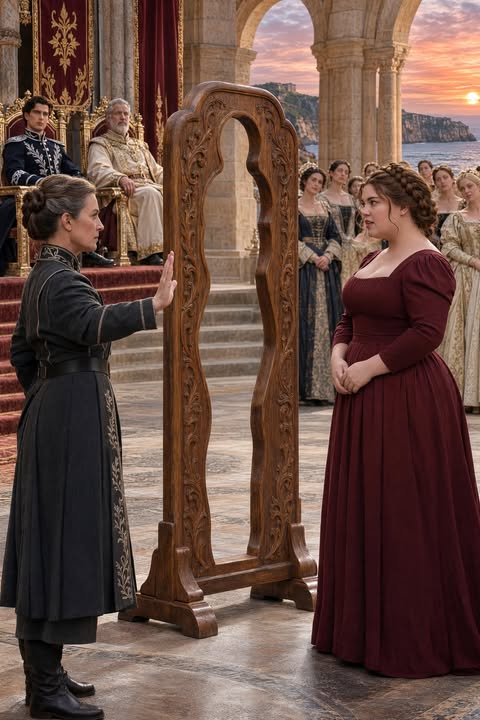
I looked at the court, then at the frame beside the king.
For a moment, my mother’s letter seemed to weigh more than the paper could bear.
“I’ll tell you what I know,” I said. “But I won’t pretend to know what I don’t.”
Lord Harrow lowered the document.
“That is all anyone can ask,” he replied.
It was a reasonable answer, and I found I was grateful for it.
“My mother has confirmed that Eleanor Carter was her mother,” I continued. “Eleanor built this frame, and the late queen helped her leave after she refused a marriage the court had arranged for her.”
A murmur moved around the chamber.
I kept my voice steady.
“My mother did not tell me the story before I came here. She wanted me to meet Alexander without her past deciding what I thought of him, or what the palace thought of me.”
King William’s eyes lowered briefly.
“She also told me that Eleanor’s initials are the maker’s mark,” I said. “They are not my mother’s signature. I recognized the shape of the letter because the two of them shared it.”
The adviser’s document remained on the table between us.
“Did your mother know the purpose of the test?” Lord Harrow asked.
“She knew that Eleanor built the frame and that the queen helped her escape the court’s plans. She did not know the full story.”
“Did Eleanor ever tell her what candidates were meant to notice?”
“No.”
“Then you had no knowledge of the test?”
“Not before I entered the throne hall.”
Lord Harrow nodded slowly.
“Thank you for answering.”
I looked around the chamber at the candidates who had gathered near the doors, the council members, and the king.
“I want to say one more thing,” I said. “Knowing who built the frame did not tell me what to do when it was moved. I saw the attendant reset it, but I did not understand why. I asked questions because the rule seemed unclear, not because I knew what the test was.”
Alexander’s expression was open and attentive.
I could have looked to him for reassurance, but I did not need to.
The words were mine.
“If a queen is expected to judge fairly,” I continued, “she should be allowed to ask how a decision was made. If a rule can be changed without explanation, then the people affected by it should be able to question it. That is what I believe, whether or not I remain in this competition.”
The room had gone quiet.
Not the tense quiet of the throne hall when I first stepped through the frame, but a listening quiet, uncertain and sincere.
King William rose.
“The council has reviewed the evidence,” he said. “The test was not conducted according to the purpose preserved in the late queen’s note. The frame was moved between candidates, and the candidates were not told why. That compromised the test.”
He turned toward Lord Harrow.
“Your proposed statement would have described the movement as a safety adjustment. We had no evidence to support that explanation.”
“I accept that,” Lord Harrow said.
His voice held no defiance.
“I thought I was preserving a familiar process,” he continued. “I did not ask why the frame had been made, or why it mattered to the late queen. I should have asked.”
The king regarded him for a moment.
“Your intention does not erase the consequences of what you did.”
“No, Your Majesty.”
“But the records do not show that you knew the frame’s original purpose, and you have answered the council’s questions. You will step down as chief adviser while the household reviews how the test was administered and how its history was lost.”
Lord Harrow bowed his head.
“I understand.”
It was not a dramatic sentence, and there was no triumph in hearing it.
I felt only the heaviness of a mistake that had grown larger because so many people had trusted familiar instructions rather than ask what they meant.
King William turned back to the room.
“The competition will not continue in its present form. No candidate will be judged by the frame, and no one will be expected to remain. The process failed to meet the standard of fairness this court should uphold.”
The woman in blue silk, standing beside the arch, let out a quiet breath.
Another candidate reached for her hand.
The king waited until the murmurs faded.
“We will speak with each of you privately about your plans and ensure you are treated with respect, whether you choose to stay in the kingdom or return home.”
I saw the kindness in that promise, but I also heard the acknowledgment beneath it.
The court had made a decision about our lives without asking us enough questions.
This time, it was trying to do better.
Alexander stepped forward.
“My father is right,” he said. “I asked you all to come here because I believed the competition would give me a choice. I did not see how easily it could turn you into answers to a question the court had already decided to ask.”
He looked at the candidates, one by one.
“I am sorry.”
No one applauded.
No one needed to.
The apology rested in the room without demanding that we make him feel better for offering it.
King William looked at his son, and I saw how difficult it was for him to let the moment stand without correcting it or explaining it away.
“I am sorry, too,” he said. “The crown should have asked what the frame meant before using it to judge anyone.”
The council meeting ended quietly.
The candidates were taken to the west sitting room, where the secretary explained that travel arrangements could be made for anyone who wished to leave.
Some had already decided.
The woman in blue silk planned to return home the following week.
The woman with dark curls wanted to stay a few days longer and visit the coastal villages before she left.
No one asked me to make a decision.
That evening, I wrote to my mother again.
I told her I had shared the truth she had given me, and I told her the palace had acknowledged that the test was compromised.
Then I asked if she would come to the kingdom.
I did not ask her to explain everything at once.
I asked only if she would be willing to sit with me, perhaps by the sea, and tell me whatever she wished me to know.
I sent the letter the next morning.
The days that followed were quieter than those before the competition.
The hall remained open, but the frame was removed from the center and placed in the care of the conservator.
The candidates made their choices.
Some returned home; a few stayed as guests until their travel arrangements were complete.
I remained, though each morning I asked myself whether I was staying because I wanted to know Alexander better or because I had become entangled in a story I could not leave unfinished.
The answer was not the same every day.
Alexander never asked me to decide.
He met with the household staff and the archivist, and I heard from the attendant that he had asked for the old test instructions to be reviewed with everyone who worked in the hall.
“He wants us to know the history,” she told me one afternoon. “Not just the orders.”
“Has the new steward agreed?”
“He has. He asked the archivist to prepare a short account for the staff.”
The attendant held her ledger against her chest.
“I’m still sorry I moved the frame.”
“You followed the instruction you were given.”
“I know. I just wish I had asked what the marks were for.”
“Perhaps the important thing is what you ask next time.”
She smiled, and the worry in her face eased.
King William also began meeting with the archivist.
The private papers of the late queen had not been opened in decades, and they revealed more than any of us expected: a few letters in Eleanor’s hand, an account of the frame’s purpose, and a note explaining why the queen had preserved it.
Eleanor had not built the frame to identify a clever candidate.
She had built it to make the court examine itself.
The carved opening was intended to be passable, but not so wide that someone could ignore its shape.
The frame’s feet had been set against marks on the floor so everyone could see whether it had been moved.
The test was meant to ask whether candidates would obey a changed arrangement without asking who had changed it, and why.
The queen had kept it in the hall as a quiet rebuke to the court that had once tried to choose Eleanor’s future for her.
The adviser had revived the old test, but had mistaken its purpose.
He had wanted candidates who could adapt to instructions without disturbing the court.
Eleanor’s work had asked whether they would notice when the court itself had altered the rules.
When the archivist explained this to me, he placed Eleanor’s letters beside the open ledger.
“She was not trying to make the court distrust every rule,” he said. “She wanted it to remember that authority could be mistaken, and that a question was not a failure of loyalty.”
The late queen’s handwriting appeared at the bottom of one page.
A person who asks why is not always resisting the work.
Sometimes she is trying to understand who the work is for.
I read the sentence several times.
It sounded like something my mother might have said.
Perhaps she had heard it from Eleanor.
Perhaps she had found her own way to the same thought.
I placed my hand beside the old ink, not touching it.
“Does the archive say why Eleanor left?” I asked.
The archivist turned to another letter.
“She wanted to choose her own life. The court had arranged a marriage that would have strengthened an alliance, and she refused it. The late queen believed the court had mistaken duty for ownership.”
“Did Eleanor return to America?”
“The records say her passage was arranged to the coast. After that, we have no palace records of her.”
“Then how did my mother know so much?”
“She may have heard the story from Eleanor. She may have known only a portion.”
I thought of my mother’s letter.
She had inherited the warning, even when she had not known every fact behind it.
For days, I waited for her reply.
The palace seemed to hold its breath with me.
Then, on a clear morning when the sea was bright beneath the sun, a messenger brought word that a visitor had arrived at the harbor.
My mother had come.
I walked down the hill from the palace before anyone could offer to escort me.
The road curved between low stone walls, and the salt wind lifted my hair from my face.
At the harbor, the small passenger boat had already tied up.
A few travelers were stepping onto the quay.
I saw her near the end of the pier, standing with one hand on the railing and a familiar canvas bag at her feet.
For a moment, I could not move.
She looked just as she had when she waved me goodbye at the airport, though the journey had left a little tiredness around her eyes.
Then she saw me.
“Emily.”
I went to her, and she held me tightly enough that all the unanswered questions in my chest fell quiet for a breath.
“I’m glad you came,” I said.
“I’m glad you asked.”
We sat at a small table near the water, where the harbor bells moved softly in the breeze.
My mother watched the palace above the cliffs.
“I haven’t been here before,” she said. “Not once.”
“Eleanor never brought you?”
“She had already left by the time I was born. I grew up with stories of a woman who made things with her hands and refused to let other people decide what she owed them.”
“Did she ever tell you she had built the frame?”
“Not in detail. She told me she had made something for a palace, and that a queen had helped her leave when the court tried to arrange her life.”
My mother traced a small circle on the tabletop.
“She said she wanted me to know that being loved did not mean being owned.”
I looked toward the palace.
“Why didn’t you tell me?”
“I did not know the whole story, and I did not want to give you a version that was only half true.”
“That’s what you warned me about.”
“Yes.” She met my eyes. “I was afraid the palace would discover the family connection and treat it as if it belonged to them. I was afraid they would make your choice about Alexander seem like a continuation of Eleanor’s story instead of your own.”
“I was afraid of that, too.”
“And are you?”
“I don’t know.”
She reached across the table and covered my hand.
“Then you still have time to find out.”
I told her about Alexander’s apology, about King William’s acknowledgment, and about Lord Harrow stepping down while the household reviewed the test.
I told her about the queen’s letter and the line about asking who a rule served.
My mother listened without rushing me.
When I had finished, she leaned back and looked out across the water.
“Eleanor would have liked that the frame finally made someone ask the right questions.”
“I thought you didn’t know what it was meant to do.”
“I didn’t. But I know what she believed.”
“Did she tell you she missed the palace?”
“Never.”
“Did she regret leaving?”
My mother considered this.
“She missed people. She missed a few rooms, I think, and the work she had done with her hands. But she never regretted choosing her life.”
The answer settled inside me.
I had feared that the story would make me feel inherited, as if I had stepped into a place someone else had left unfinished.
Instead, it reminded me that choosing was something a person did again and again.
My mother squeezed my hand.
“You do not owe the court anything because Eleanor made a frame.”
“I know.”
“And you do not owe Alexander a yes because he has become a better listener.”
“I know that, too.”
“Good.”
A smile tugged at her mouth.
“Then we’re doing all right.”
That afternoon, Alexander asked whether I would walk with him along the cliff path.
He waited near the garden gate, dressed simply, without the formal coat he wore when the court expected him to represent it.
“Did you see your mother?” he asked.
“I did.”
“Was it good?”
“It was honest.”
He nodded, as if he understood that the two things could be close.
We walked beyond the palace wall, where the path followed the edge of the cliffs above the water.
The sun broke through a seam in the clouds, brightening the waves.
“I want to tell you what I’m going to do,” Alexander said. “Not ask you to agree with it.”
“All right.”
“I’m ending the competition.”
“You already said the process was compromised.”
“I know. But the court has suggested we replace it with a revised selection process.”
“What would that involve?”
“More interviews. More advice from the council. A public announcement when I choose someone.”
“And would you choose?”
He looked toward the sea.
“I’m not ready to make a marriage decision because the palace is anxious about the future. I want time to know what I want when no one is waiting for me to answer.”
“That seems fair.”
“I’m also asking the council to review how future decisions involving the royal family are made. Not because I think every tradition is wrong, but because I don’t want a familiar process to become a substitute for thought.”
“Your father agreed?”
“He did.”
“That must have been difficult.”
“It was. He asked me to give him time to understand why it mattered.”
“And did you?”
“I did.”
We walked a little farther.
At the bend in the path, the palace appeared below us, its windows bright in the afternoon sun.
Alexander stopped.
“I would like you to stay,” he said. “Not as a candidate. Not as the answer to the kingdom’s needs. I want you to stay because I want more time with you.”
I watched the water beyond his shoulder.
“Would you still want me here if I never became queen?”
“Yes.”
“Would you still want me here if I questioned your decisions?”
“Especially then.”
“Would you let me go home without treating it as a betrayal?”
He took a moment to answer.
“Yes.”
The answer was not eager or polished.
It was careful in the way a sincere answer should be.
“I don’t know if I’m ready to stay forever,” I said.
“I’m not asking forever.”
“I want time with my mother.”
“You should have it.”
“I want to see where we are when there’s no competition, no audience, and no question hanging over every conversation.”
“So do I.”
“And I want the court to earn my trust, not assume it because I’m standing beside you.”
He nodded.
“That is fair.”
“Then I’ll stay for now.”
His face brightened, but he did not reach for me until I offered my hand.
When I did, he held it gently.
The choice felt small enough to be real.
In the weeks that followed, the palace began to change in ways that were not grand but mattered.
The old ledger was copied and preserved.
The story of Eleanor Carter and the frame was added to the palace archive, along with the truth that the late queen had helped her leave.
The court did not describe Eleanor as a failed match or a lost opportunity.
It named her as the craftswoman who built a test to remind the palace that rules could be altered and authority could be questioned.
The frame was restored in the great hall.
Its worn wood was cleaned and repaired, but the conservator left the old marks and scratches visible.
A new brass plate was fitted beside the original one.
It bore Eleanor’s full name and a short explanation of the test she had designed.
The words were simple, and the king insisted that nothing be added to make the story more flattering to the crown.
On the day the frame was unveiled, my mother stood beside me near the front of the hall.
King William addressed the gathered court.
“For years, we kept this object without understanding what it asked of us,” he said. “We treated its presence as tradition and its purpose as unimportant. That was our failure.”
He looked toward the frame.
“Eleanor Carter made it to remind us that a rule can be changed, and that the people affected by it have the right to ask why. The late queen preserved that reminder. We honor them both by telling the truth.”
The new inscription caught the light.
Eleanor Carter, craftswoman and maker of the frame.
Beside it were the words the archivist had helped us choose:
A test for those who would enter by choice, not by obedience.
My mother reached for my hand.
I held it, looking at the name that had led us all here.
After the ceremony, Alexander found us near the open doors.
“Your Majesty,” my mother said, curtsying.
“Please,” King William replied with a warm, almost shy smile. “After everything, I think we can manage something less formal.”
My mother studied him for a moment.
“Then I’ll call you William, if you’ll call me Eleanor’s granddaughter.”
“Gladly.”
For the first time, I saw my mother laugh in the palace.
The sound was bright enough to loosen something in my chest.
That evening, Alexander and I stood before the restored frame.
The hall was nearly empty, lit by the last blue light of day.
The opening was unchanged.
Its edges were smooth, and the old floor marks remained beneath it.
Alexander offered me his hand.
“Would you like to walk through?” he asked.
“Why?”
His smile was quiet.
“Because it belongs to your family, because it has a door in it, and because we can.”
I looked at the frame, then at him.
“Is that the whole reason?”
“No,” he said. “It also seems like a good way to remind ourselves that we can leave whenever we need to.”
I considered his hand.
Then I placed mine in it.
We stepped through side by side, not because anyone had told us to, and not because the court was waiting to judge how we did it.
On the other side, he did not let go.
I did not ask him to.
The frame had once carried Eleanor out of a future she had not chosen.
Now it stood restored, with her name visible at last, and I passed through it beside Alexander because I wanted to.
Our marriage came later, after we had spent enough time together to know the ordinary shape of each other’s days.
We married when we were ready, not when the court was impatient.
My mother stood beside me, and King William walked with his son into the hall.
The attendant was there, too, no longer holding an instruction card but carrying a small bouquet she had helped arrange.
The frame remained in its place, not as a test for the women who passed through, but as a reminder to everyone who entered the hall.
When the ceremony was over, Alexander offered me his hand.
I took it, and together we stepped through the opening by choice.
**–THE END–PLEASE
Share your thoughts or feedback to motivate us to create more stories ♥️
* * *
[PREVIOUS: PART 5](https://echoesofstories.idolsgift.com/blog/part-5-the-mark-beneath-the-frame-046)
✓ Lynn R. Adams
Part 6 – A Choice Made Together I looked at the court, then at the frame beside the king. For a moment, my mother’s letter seemed to weigh more than the paper could bear. “I’ll tell you what I know…