PART 6 (THE END): The Mark Beneath the Crown 057
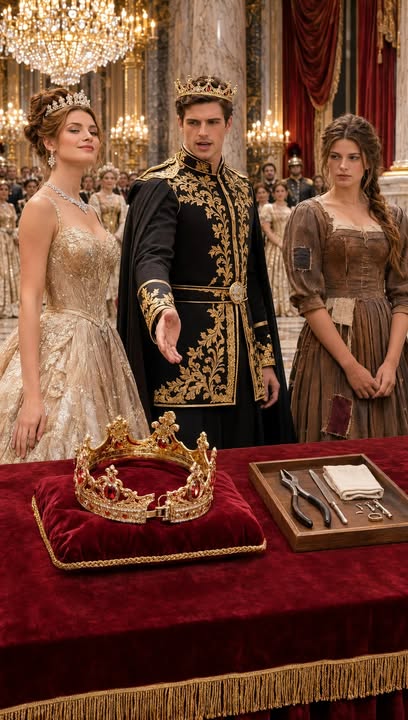
Part 6 – What the Crown Remembered
Adrian went still.
The name belonged not to Lord Haverford, but to the person who had written the letter asking Mara to keep quiet.
Elara felt the old question return, larger now than the page in Adrian’s hands.
Celestine leaned toward the light, her voice barely above a whisper.
“Who asked for the silence?”
Adrian turned the letter so they could read the signature.
It was his grandmother’s.
For several breaths, none of them spoke.
The gallery around them remained full of quiet conversation, the soft shuffle of visitors passing between the displays, and the distant clink of glasses from the reception room.
Yet Elara felt as if the three of them had been placed alone in the hush that came after a door closed.
Adrian read the letter again, slower this time.
“I asked the jeweler to keep Mara’s name from the public account,” he said.
His voice was low, not defensive.
“She had already made that request.”
Elara’s attention sharpened.
“Does it explain why?”
Adrian studied the faded lines.
“It says she did not want the matter to become a scandal about Lord Haverford, and she did not want her work turned into a favor owed by the royal family.”
He looked down at the page.
“She wanted to be paid for the work, thanked in private, and allowed to return to her own life.”
Elara’s fingers curled lightly around the edge of her sleeve.
“Did she say she wanted her name left out forever?”
“No,” Adrian said. “She asked that the repair be recorded under the workshop for the time being, so the ceremony could go ahead without drawing attention to the accident.”
Celestine read the letter once more.
“Then the silence began as a choice made by your mother and grandmother together,” she said.
“And became something else when the record was never corrected,” Adrian replied.
He did not soften the distinction.
The new letter did not erase the omission.
It changed its shape.
Mara had not been simply silenced, nor had she been fully free of the pressures surrounding her.
She had made a practical choice in a moment when a ceremony was at risk, when a nobleman’s mistake could become a story, and when her own work might otherwise be treated as an unpaid favor.
Then the palace had allowed a temporary arrangement to become the version that endured.
Elara looked at her mother’s name on the page.
She felt no sudden triumph.
Instead, a quieter feeling opened inside her, tender and complicated.
Mara had chosen what she could at the time.
She had accepted payment, protected her own future, and kept a private thank-you note.
She had not needed her daughter to turn that choice into a perfect story.
“She wanted to go home,” Elara said.
Adrian looked at her.
“She wanted the work done well, and then she wanted to live her life.”
“Yes,” Elara said.
The words brought a small, aching smile to her face.
“That sounds like her.”
Adrian held the letter carefully, as if its frailty deserved more than the protection of glass.
“We should add this to the record.”
“We should,” Elara replied. “And we should be clear about what it changes.”
“Which is?”
“That my mother asked for the temporary arrangement. Not that she asked to disappear forever.”
Adrian nodded.
“And that my grandmother failed to revisit the account after the reason for the silence had passed.”
Celestine’s eyes moved between them.
“That is a hard thing to write about someone you loved.”
“It is,” Adrian said.
He glanced at the crown.
“But loving someone does not require us to make every choice they made seem right.”
Elara felt the truth of that settle between them.
The old letter would not make her mother a legend, nor Adrian’s grandmother a villain.
It gave them something more human: a moment of negotiation, a choice shaped by circumstance, and a failure of the people who came afterward to ask whether the choice still served anyone.
Adrian turned to the archivist who had brought the portfolio.
“Please make a copy for the archive, and preserve the original with the work order, Mara’s receipt, and my grandmother’s notes.”
The archivist nodded.
“The display label will need to be revised, Your Highness.”
“Yes,” Adrian said. “It should explain that Mara requested the workshop attribution for the ceremony, with the expectation that the matter remain private for then, not forever.”
He paused.
“And it should say the palace regrets allowing that temporary account to stand as the permanent one.”
The archivist wrote the instruction down.
Celestine looked toward the gallery entrance, where her father had been speaking with one of the visiting families.
“Will you add that Lord Haverford mishandled the clasp?” she asked.
Adrian considered the question.
“The letter names him, but his mistake was not the design of the clasp, and he apologized to my grandmother.”
“Then perhaps his name does not need to be displayed,” Elara said.
“Agreed,” Adrian replied. “The correction should explain why the account was kept quiet without making an old accident into a spectacle.”
Celestine gave a small nod.
The answer did not protect the noble family at the cost of the truth.
It simply refused to turn an ordinary mistake into the most memorable part of the story.
The revised label was prepared that evening.
It named Mara as the craftswoman who devised the adjustable clasp and repaired it after the earlier ceremony.
It named the royal jeweler as the supervisor who helped carry out the work.
It explained that Mara had asked for a temporary workshop attribution so the ceremony could proceed without a public scandal, and that the palace had failed to restore her name to the record afterward.
At the end, in a line Adrian insisted should be plain rather than ceremonial, the palace expressed its regret.
The letter from his grandmother, Mara’s receipt, and the original work order were placed together in the archive.
The mending cloth bearing the three-leaf stitch was displayed nearby, not as proof of the crown’s maker by itself, but as a small object connected to a life of careful work.
Elara made sure the label said exactly that.
She would not let a resemblance become certainty merely because it was beautiful.
The crown’s new fastener was tested once more by Master Orin the following morning.
He moved the clasp through its full range, checked the hinge, and watched the band settle into place without catching.
Then he asked Elara to observe the fit.
She leaned close, studying the point where the new gold met the old.
“It moves freely,” she said. “The pin is staying in its channel.”
“Then we are ready,” Master Orin replied.
He placed the crown on its cushion, where it rested with its band open.
The repair was sound, but Elara could still see the faint difference in the gold.
She found she was glad of that.
The crown had been damaged, repaired, and altered over time.
Its history was not made less worthy by showing the places where care had been needed.
Master Orin handed Adrian the final inspection record.
“Your Highness, the crown is safe for display and may be worn again when the household decides it is needed.”
Adrian thanked him, then turned toward Elara.
“I would like you to direct the restoration of the other heirlooms that need careful attention,” he said.
Elara looked at him, cautious.
“As a temporary task?”
“As a position, if you want it.”
He did not step closer or lower his voice as if making the offer more personal might make it harder to refuse.
“The royal collection has objects that require patience, observation, and someone willing to stop when the next step is uncertain,” he continued.
“I would like you to serve as its restoration keeper, working with Master Orin and the archive staff.”
Elara’s gaze moved toward the worktable.
“What would the position involve?”
“Examining each object, recording its condition, recommending repairs, and helping oversee the work.”
“And my usual duties?”
“Mrs. Vale has already agreed to discuss a transition with you, should you choose to accept. She made clear that your work in the household should not simply vanish because the court has noticed you.”
A warmth passed through Elara’s chest.
That mattered.
She had feared the offer might be a beautiful title shaped like a gilded cage, something designed to lift her out of one place only to set her on display in another.
Instead, Adrian had spoken of a real role, real responsibilities, and the people whose consent mattered.
“I would like time to think,” she said.
“Of course.”
He placed the written offer on the table between them.
It included the duties, the salary, and the name of the person she would report to.
Nothing was hidden in the folds.
Elara read it carefully.
The terms were fair.
The work would be meaningful.
And it was offered because of what she could do, not because she was Mara’s daughter, and not because the prince wished to reward her.
“I accept,” she said.
Adrian’s smile came slowly, carrying more relief than celebration.
“I am glad.”
“I will still need the right to say when something cannot safely be repaired.”
“Especially then.”
Master Orin, who had been putting away his tools, glanced over.
“That right will save us both time and trouble.”
Elara laughed, surprised by the sound of it.
The room seemed lighter afterward.
Celestine joined them before the day’s work was finished.
She had returned from a meeting with her father, and the careful set of her shoulders suggested the conversation had not been easy.
“My father will not be pleased about the correction,” she said.
“I am sorry,” Adrian replied.
“Do not be. He is allowed to disagree with the decision.”
She looked down at the crown.
“He also said I should think carefully before withdrawing from the marriage discussions.”
“Do you intend to?” Elara asked.
“I do.”
Celestine spoke without bitterness.
“I once thought being chosen would prove I mattered,” she said. “I have started to suspect that proving it to my father, or to the court, would only leave me with another performance to maintain.”
“What do you want instead?” Adrian asked.
Celestine considered the question.
“I want to learn how to do something that is mine.”
Her eyes rested on the letter beside the crown.
“I have spent years collecting beautiful things and learning how to speak about them. Perhaps it is time I learned what it means to care for them.”
She had already asked the palace steward for a list of positions supporting the archive and the royal collections.
She was not asking for a special appointment.
She wanted to study the work, beginning with the catalogues and the restoration records.
“Would Master Orin consider training an assistant?” she asked.
The goldsmith glanced at Elara.
“If Elara approves the arrangement, and if you are prepared to start with the dull tasks.”
“I expect them,” Celestine replied. “I have spent enough time mistaking an impressive beginning for understanding.”
Master Orin’s expression softened.
“Then you may begin by sorting the old tool records.”
Celestine looked at the stack of papers on the far table.
“That sounds less glamorous than I hoped.”
“It is,” Elara said. “And you may find you like it anyway.”
Celestine’s smile was small, but real.
“I would like that.”
Before leaving, she turned to Elara.
“I also want to apologize for thinking your mother’s connection was a way to gain influence.”
Elara waited.
“You were careful not to claim more than you knew,” Celestine continued. “I noticed it, and I should have trusted what I could see instead of assuming the worst.”
“Thank you,” Elara said. “I accept your apology.”
Celestine let out a quiet breath.
She did not ask whether everything between them was repaired.
Some things, Elara thought, became stronger when no one rushed to close them before they were ready.
The next weeks passed in a rhythm Elara had never known before.
She continued to rise early and help with the household’s morning work, but her afternoons belonged to the royal collection.
She learned how to make condition reports, how to distinguish a loose setting from a weakened one, and how to ask Master Orin questions before touching an object.
He taught her to measure twice, to keep notes precise, and to remember that a beautiful repair was not always a safe one.
Celestine joined them three days each week.
At first, she approached the work with more enthusiasm than skill.
She wanted to polish every tarnished surface and straighten every uneven edge.
Master Orin reminded her that not every mark was damage, and not every old repair should be erased.
Elara watched Celestine learn to pause.
It was not a dramatic change, and it did not make her gentler in every conversation.
She remained proud, quick-witted, and sometimes impatient.
But she became more willing to admit when she did not know something.
The two women found that they could work together without pretending to be alike.
Celestine was good at noticing patterns across old inventories.
Elara was better at seeing where a physical object had been handled, altered, or repaired.
Their different strengths began to fit together like parts of the same mechanism.
One afternoon, while sorting a tray of unlabeled sewing tools from the palace stores, Celestine held up a small brass thimble.
“Do you think this belonged to your mother?”
“I do not know,” Elara said. “We would need a record or a mark.”
Celestine set it down carefully.
“I would have guessed before.”
“So would I, once.”
The thimble was entered into the inventory as unidentified.
They left the question open.
Adrian visited the restoration rooms often, but he never used his position to make Elara’s work more difficult or to demand her attention.
When he wanted to speak with her, he asked.
Sometimes they discussed the crown or the archive.
Sometimes he brought a book he thought she might enjoy, then let her return it without asking whether she had finished.
Their conversations grew beyond the work, gradually and without ceremony.
He told her about his grandmother’s habit of keeping broken household objects in drawers until someone could repair them.
Elara told him about Mara’s kitchen, where no scrap of cloth was thrown away until its useful parts had been found.
He listened when she spoke of the loneliness of losing her mother, without offering to fill the space with royal favors.
She learned that he could laugh at himself, and that he had once wanted to be a mapmaker before his duties swallowed most of his free hours.
A few months after the gallery opened, Adrian asked Elara to walk with him in the palace garden.
The request came at the end of a workday, while Master Orin was locking the tools away.
“Would you like to walk with me?” he asked.
Elara looked up from the inventory she was finishing.
“As a task?”
“No,” Adrian said. “As a walk.”
She studied his face, then closed the ledger.
“Then yes.”
They walked along the garden path, where late sunlight rested on the leaves and the stone fountains murmured softly.
Adrian did not speak at once.
He seemed to be giving her room to decide what the walk meant, rather than defining it for her.
“I would like to court you,” he said at last. “Not because your mother worked on the crown, and not because I owe you a position or a reward.”
Elara kept her pace steady.
“What do you want, then?”
“To know you better, if you want the same.”
“And if I need time?”
“Then I will give you time.”
“And if I say no?”
“Then I will respect that.”
She glanced at him.
There was no challenge in his voice, no expectation that she should be grateful for being chosen.
Only a question he was willing to leave unanswered until she was ready.
“I would like to see where a courtship might lead,” she said.
Adrian’s smile came quietly.
“Then I would be honored.”
They continued along the path.
He did not take her hand until she offered it.
When he did, he held it gently, as if even happiness deserved patience.
The years that followed did not erase the complicated parts of their history.
They made room for them.
Celestine’s father eventually stopped urging her toward a strategic marriage, though he remained unconvinced that working among dusty records was a worthy use of her talents.
Celestine continued anyway.
She became a skilled curator of the royal collection, known for her sharp memory and her growing respect for the people whose names had been lost from its catalogues.
She never pretended that her earlier cruelty toward Elara had been harmless.
Their friendship grew through work, apologies, and the small kindnesses that required no audience.
Master Orin trained Elara in the restoration of goldwork and delicate mechanisms.
She became keeper of the royal heirlooms, a position recognized by the court because she had earned it through skill and care.
When Adrian became king, he asked her to continue her work exactly as before.
He did not ask her to stop restoring objects or to become a symbol of the palace’s goodness.
He asked her what she wanted.
When they married, Elara kept her name in the collection records and insisted that every craftsperson receive credit for the work they performed.
The crown was displayed in the royal archive gallery with its repaired fastener visible and its history recorded beside it.
Mara’s name appeared there, not as a royal favorite or a hidden secret, but as the craftswoman who had devised the adjustable clasp.
The royal jeweler’s role was named too.
The archive preserved the uncertainty around Mara’s original request, along with the letter that explained it.
Visitors often paused longest before the modest mending cloth, with its three stitched leaves.
Some saw only a worn square of linen.
Others recognized the care in its hem, the hand that had made it, and the quiet mark of someone who wanted her work to endure.
Years later, Elara stood beside Adrian in the gallery while their young daughter pressed her hands against the glass and studied the crown.
“Was it broken?” the child asked.
“Once,” Elara said.
“And then someone fixed it?”
“Several people helped.”
The child looked at the tiny line of gold where the new fastener met the old.
“Can you still see?”
“Yes,” Adrian replied. “And that is all right.”
Their daughter considered this, then leaned closer to the glass.
“Who made it fit?”
Elara looked at the name beside the crown.
“Mara,” she said. “My mother.”
The child smiled at the sound of the name.
Beyond the glass, the crown held its shape—not because it had never been damaged, but because people had taken the time to understand it, to tell the truth about it, and to care for what came next.
And beside it, where generations could read, Mara’s name was no longer missing.
**–THE END–PLEASE
Share your thoughts or feedback to motivate us to create more stories ♥️
* * *
[PREVIOUS: PART 5](https://storyly.idolsgift.com/blog/part-5-the-mark-beneath-the-crown-057)
✓ Lynn R. Adams
Part 6 – What the Crown Remembered Adrian went still. The name belonged not to Lord Haverford, but to the person who had written the letter asking Mara to keep quiet. Elara felt the old question re…