PART 6 (THE END): The Mark Beneath the Chair 057
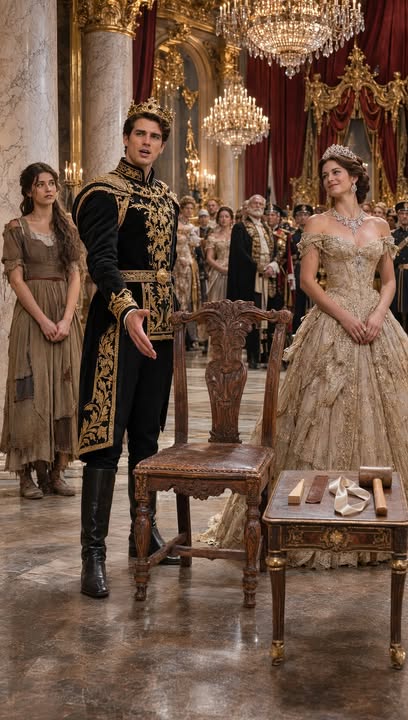
Part 6 – The Floor Beneath the Throne
“Should the court ever wish to understand the chair completely, do not begin with the wood—begin with the floor beneath the royal throne.”
For a moment, the great hall seemed to recede around Mara, leaving only her father’s handwriting and the words he had chosen to leave behind.
Julian read them again, his expression thoughtful rather than alarmed.
“Do you know what he meant?” he asked.
“Not yet,” Mara said, though the words had already stirred a memory she could not quite reach.
The archivist explained that the old measuring bench remained in a disused workshop below the east gallery, where several tools and records had been stored during renovations.
“Would you show us?” Julian asked.
The archivist agreed, and Mara, Eveline, and Julian followed him through a narrow passage that led beneath the palace’s older rooms.
They passed a row of locked cupboards and a windowless storeroom until the archivist stopped before a broad door with a brass latch.
The room beyond was dusty but orderly, its benches covered with protective cloths and its shelves crowded with spare fittings.
At the far end stood an old workbench, its legs darkened by years of use.
Mara recognized it from the stories her father had told, though she had never seen it before.
The measuring gauge in her hand felt suddenly familiar, as if it had been waiting to return to the place where it had first been used.
The archivist searched beneath the bench and found a shallow drawer that resisted his first attempt to open it.
With a careful pull, it slid free.
Inside lay several folded plans, wrapped in waxed cloth, along with a small packet of notes tied with thin cord.
Mara untied the cord.
The first sheet showed the west ballroom floor, marked with measurements and small arrows indicating the places where its boards dipped.
Her father had written observations beside each mark in a neat, steady hand.
The second sheet showed the demonstration chair, with its legs, supports, and joints drawn in precise detail.
A third page contained a simple diagram of the dais and the royal throne.
Eveline leaned closer.
“Why would he measure the floor beneath the throne?”
Mara turned the page over.
Beneath the diagram, her father had written that the dais had been raised over older boards and that the floor there might not rest evenly upon its supports.
Julian’s brow furrowed.
“Was the throne unstable?”
“I don’t know,” Mara replied. “But Father thought the floor beneath it deserved the same care as the ballroom.”
The archivist examined a notation in the margin.
“These measurements are dated several years before the chair demonstration.”
“So he had noticed the problem before the ballroom warning,” Julian said.
Mara read the note again.
Her father had not begun with a single chair or a single uneven patch of marble.
He had been studying how the palace’s floors carried weight, and how hidden weaknesses could make sound things appear faulty.
A smaller paper lay beneath the plans.
It was addressed to the workshop supervisor, asking for permission to inspect the boards beneath the dais before the next royal gathering.
Beside the request was a brief answer in another hand: “Deferred until the stage is cleared.”
There was no signature.
Eveline looked at the paper, then at the diagram.
“Perhaps this is what he meant by the floor beneath the throne,” she said. “Not just the floor under the chair, but the foundation beneath the place where decisions are made.”
Mara felt the words settle into her.
Her father had measured boards and joints, but he had understood more than wood.
He had known that a small imbalance could shift the weight of a whole room, and that people closest to the ground were often the first to feel it.
Julian gathered the plans without folding them.
“Before anything else, we will inspect the dais.”
The building steward was brought from the great hall, and the group returned upstairs.
The gathering had ended, but a few guests remained near the doors, speaking quietly with the archivist.
Julian asked the steward to examine the floor beneath the royal throne before it was used again.
The steward removed the small step at the base of the dais and checked the boards with a level and measuring rod.
After several careful measurements, he found a shallow dip near the rear support.
It was not dangerous, but it had been left unnoticed through years of rearrangements and polishing.
The steward reported that the floor could be reinforced and leveled during the same period as the ballroom repairs.
Julian glanced at Mara.
“Your father was right to ask us to look.”
Mara looked toward the throne, then down at the boards beneath it.
“He asked because he thought someone might be standing there one day, making a decision that affected everyone below.”
Julian’s expression grew quiet.
“Then we should make sure the floor is sound before anyone stands there again.”
The repair was completed before the next formal gathering.
The west ballroom remained closed until the uneven boards had been leveled and inspected, and the dais beneath the throne was strengthened at the same time.
The palace made the inspection records available to its household workers, and the old plans were preserved beside the restored chair’s history.
When the chair returned to the ballroom, its joints had been properly tightened, and its feet stood evenly on the repaired floor.
Beneath the seat, Elias Hart’s name was left clear and uncovered.
A small brass plate beside the chair described how he had built it to demonstrate the ballroom’s uneven floor and how his warning had eventually been confirmed.
The plate did not call him a hero or turn his work into a legend.
It simply recorded what he had done and why it mattered.
Mara stood before it on the morning the ballroom reopened, her siblings beside her.
Thomas read the inscription twice, his finger tracing the words in the air without touching them.
“Father’s name is really there,” he said.
“Yes,” Mara replied.
Nell slipped her hand through Mara’s arm.
“He would have liked the chair standing straight.”
“He would have checked it himself,” Mara said, smiling.
“He would have checked the floor first,” Thomas added.
Their laughter was soft, but it carried through the bright room.
The days that followed brought changes less visible than a brass plate, but no less important.
The palace established paid apprenticeships for workers’ children, with places offered through a clear application process rather than family influence.
Mara helped the workshop create a practical entrance examination where applicants could demonstrate patience, judgment, and care with materials.
She made certain the tasks did not require expensive tools or years of private instruction.
A young apprentice named Sella, whose mother worked in the kitchens, was the first to pass by noticing that a stool’s wobble came from a warped rung rather than a loose leg.
Mara watched Sella check the stool from every side before reaching for a tool.
“Who taught you to look so carefully?” she asked.
“My grandmother,” Sella replied. “She says rushing is expensive.”
Mara smiled.
“That is sound advice.”
Eveline became a regular presence in the workshops, though she came without attendants and never asked to be announced.
At first, she learned to sort records and label tools, then asked the carpenters to teach her how to read a joint and recognize when a repair had been rushed.
She was not naturally patient with sanding, and the first small shelf she helped restore had one corner that sat slightly proud.
When she noticed it, she did not hide it.
She asked the carpenter to show her how to correct it, and then began again.
Mara saw the care in that small choice.
Eveline had once believed that appearing certain made her capable.
Now she was learning to be uncertain without turning away.
Their friendship grew in the ordinary spaces between tasks.
They shared tea beside the workbench, compared notes in the archive, and sometimes walked through the gardens after the day’s work was done.
Eveline told Mara about the expectations her family had placed upon her, and Mara told her about the years when every coin had to be counted before it was spent.
They did not pretend their lives had been alike.
They found that they could still understand one another.
“Do you ever miss the way you used to feel before you knew all this?” Eveline asked one afternoon, as they watched rain gather on the workshop windows.
“I miss not knowing how much could be left unfinished,” Mara replied.
Eveline considered that.
“I miss believing that being admired meant I was understood.”
Mara looked at her.
“Perhaps being understood is better.”
“It is less comfortable.”
“Usually.”
Eveline laughed, and Mara laughed with her.
The offer Julian had made remained open, but he did not remind Mara of it or ask for an answer.
He visited the workshops often enough to see the repairs and speak with the apprentices, yet he never used those visits to place her under scrutiny.
When he wanted to see her, he asked whether she had time.
When she was too busy, he accepted her answer.
That mattered more to Mara than any compliment could have.
One evening, after the new apprentices had gone home, Mara found Julian standing beside the restored chair.
He was studying the brass plate.
“Does it seem right to you?” he asked.
“What does?”
“The way we have remembered your father.”
Mara stood beside him.
“The plate is accurate. The floor is repaired. The records are open. The apprenticeships are real.”
“Do you feel that is enough?”
“Enough for what?”
“To make amends.”
Mara considered the question carefully.
“I don’t think a repaired floor can give Father back the years he lost, or return the choices we had to make after he left the palace.”
Julian lowered his eyes.
“No.”
“But remembering him honestly matters. So does making sure the next worker who notices a problem is heard before someone else is blamed.”
“That is why we are changing the inspection process.”
“And the apprenticeships.”
“And the apprenticeships.”
“Then it is not a perfect repair,” Mara said. “It is a sound beginning.”
Julian turned toward her, his face warmed by the late light.
“You have taught me to trust a sound beginning more than a beautiful promise.”
Mara’s smile was small but genuine.
“That sounds like something Father might have said.”
“I wish I had met him.”
“So do I.”
Julian’s expression softened.
“I have admired you since the night you corrected a room full of people without trying to make any of them feel small.”
“I was trying not to be sent back to the kitchens.”
“I know,” he said, smiling. “That is part of what I admire.”
He did not ask her to become anything for him.
He did not mention the competition or the title that had first brought them into one another’s path.
Instead, he said, “Would you like to walk with me through the gardens after your work is finished?”
Mara heard the openness in the question.
There was no audience waiting for her answer, and no prize attached to it.
“I would,” she said.
They walked together beneath the evening trees, speaking first of practical things: the workshop’s new bench, the repairs still needed in the east gallery, and a young apprentice who wanted to learn carving.
Only later did Julian tell her that he hoped to know her beyond the palace duties and the old records.
“I don’t want a contest to choose my future for me,” he said. “And I don’t want my position to make your answer difficult.”
Mara watched the path beneath their feet, pale stones laid between the green beds.
“Then don’t ask me to decide everything tonight.”
“I won’t.”
“Ask me again when you can hear no without turning it into a disappointment I must repair.”
Julian looked at her, then nodded.
“I will.”
Mara saw no offense in his face, only respect.
That was the moment she understood she could choose him freely.
Not because he was a prince, and not because the palace had offered her a place.
She could choose him because he listened, because he had accepted the truth even when it made the court look imperfect, and because he left her room to remain herself.
“I think,” she said, “that I would like to know you too.”
Julian’s smile was warm and unguarded.
“Then we can begin there.”
Mara accepted the paid position in the royal workshop the following week.
She negotiated her hours so she could continue helping Thomas and Nell, and asked that her work be reviewed by the same standards as everyone else’s.
Her duties included restoring furniture, inspecting old repairs, and training the apprentices to observe before they acted.
She kept her own bench near the broad workshop window.
Her father’s measuring gauge hung above it, its initials visible to everyone who asked about it.
Thomas found work with the palace stores and began learning how to keep an inventory without losing patience with the numbers.
Nell continued sewing, but she also attended the new evening lessons offered to workers’ children and discovered a talent for drawing patterns.
The three of them still lived simply, though their small home no longer carried the same strain of uncertainty.
On the anniversary of the ballroom’s reopening, Mara arrived before the guests.
The chair stood in its place beneath the golden chandeliers, steady on the repaired floor.
Her father’s name rested beneath the seat, no longer concealed.
A new mark had been added beside it: a delicate pair of measuring angles, shaped from brass and set into the small plate.
The mark honored Mara’s contribution, but she had chosen its wording herself.
“Observed and corrected by Mara Hart, who began where the floor met the chair.”
She stood looking at it for a long moment.
Julian entered quietly and stopped beside her.
“Does it say what you wanted?”
“Yes.”
“Are you certain?”
Mara glanced at him.
“I am.”
His hand rested near hers, not touching until she turned her palm toward him.
Then he took it.
The music began beyond the open doors, and the first guests entered the ballroom.
Eveline arrived with Mara’s siblings, carrying a small packet of drawings Nell had made of the chair’s carving.
Thomas greeted Julian with the ease of someone who had decided a prince could be spoken to like a person, provided he behaved like one.
Mara laughed when Julian thanked him for keeping everyone supplied with tools in the stores.
“He is very strict about the inventory,” she said.
“Someone has to be,” Thomas replied.
The ballroom filled with music and conversation.
The chair did not rock.
Beneath it, the repaired floor held firm.
Mara felt her father’s old gauge against her side, warm from the day’s work, and looked toward the brass plate bearing his restored name.
She could not give him back the years in which the palace had failed to listen.
She could carry his lesson forward.
A sound repair began with careful observation.
A fair judgment began the same way.
And beneath the royal throne, beneath the ballroom chair, beneath every polished surface that once seemed certain, the palace had finally learned to look at the ground on which it stood.
**–THE END–PLEASE
Share your thoughts or feedback to motivate us to create more stories ♥️
* * *
[PREVIOUS: PART 5](https://storyly.idolsgift.com/blog/part-5-the-mark-beneath-the-chair-057)
✓ Lynn R. Adams
Part 6 – The Floor Beneath the Throne “Should the court ever wish to understand the chair completely, do not begin with the wood—begin with the floor beneath the royal throne.” For a moment, the gre…