PART 6 (THE END): The Mark Beneath the Carpet 046
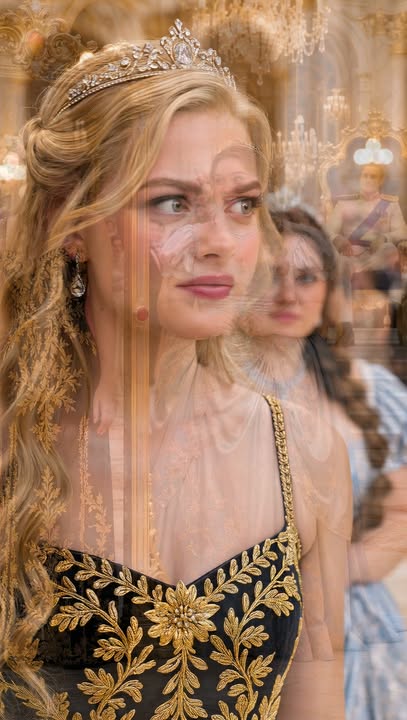
Part 6 – A Door Made for Everyone
The folded paper trembled once in the old woman’s hands, then steadied.
No one in the ballroom spoke.
Adrian looked at his grandmother, his face pale with hurt and disbelief.
“Who persuaded you?” he asked.
She did not answer at once.
Her gaze moved across the assembled guests and settled on the royal official who had reached for the adjustment wheel the night before.
“Mr. Halloway,” she said. “He was my secretary then, a young man with a gift for making a narrow choice sound like the only sensible one.”
The official bowed his head.
“I advised Her Royal Highness that the ceremony would be easier to administer if the frame were fixed,” he said. “I believed uniform measurements would prevent disputes.”
“Did you understand what fixing it would do?” I asked.
His eyes lifted to mine.
“I understood that it would make the results consistent.”
“But not that the frame was never meant to judge anyone.”
“No,” he said after a moment. “I did not understand that.”
His answer was neither a confession of deliberate sabotage nor an excuse.
It was a small, uncomfortable truth, and the room seemed to know it.
Adrian’s grandmother opened the paper and laid it beside the original plans.
The note bore her signature, followed by a second one in a different hand.
“Mr. Halloway,” Adrian said, reading the name beneath hers.
The official looked down at the table.
“I recommended the alteration,” he said. “I did not intend to harm any candidate. I believed we were preserving a useful ceremony.”
“You were preserving a ceremony after changing what it meant,” Vanessa said.
“Yes.”
His voice held no defense.
“I should have asked why the frame had been designed to adjust. I should have read the maker’s notes before advising the princess. Instead, I accepted the court’s convenient interpretation.”
Adrian’s grandmother closed her eyes briefly.
“I accepted it too,” she said. “Your great-grandmother tried to explain the design to me, and I was impatient. I thought the household needed order more than it needed another complication.”
She looked at me.
“Eleanor Wren understood the frame better than I did, and your grandmother understood it better than I did. I have spent many years wishing I had listened.”
The name of my great-grandmother sounded different in the ballroom now.
It was no longer a faded mark on a drawing or a quiet story in my family.
It belonged to a craftswoman who had made something thoughtful, then watched its purpose get lost.
Adrian turned to the older woman.
“Why keep the order?”
“Because I knew I had been wrong.”
She rested her palm beside the paper.
“I told myself I was waiting for the right moment to correct the record. The longer I waited, the harder it became to admit that the silence had been my choice.”
Her voice was gentle, but there was no softness in the truth she offered.
“Tonight, when I saw the original plan, I understood that waiting any longer would only make another excuse.”
Adrian looked at her for a long moment.
“I wish you had told me.”
“So do I.”
There was grief in the space between them, but also something more difficult and more hopeful: the recognition that truth had arrived late, yet had arrived.
Vanessa stepped forward.
“I would like the record to include what happened to my attempt,” she said. “Not as proof that I failed, but as proof that the frame could not have given anyone a fair answer.”
Mr. Bell, standing beside the table, nodded.
“That is appropriate. We can document the indicator’s condition, the adjustment marks, and the uncertainty surrounding the reading.”
“And the frame’s original purpose,” I added.
“And its maker,” Adrian said. “Eleanor Wren’s name will be restored to the household record.”
A quiet murmur moved through the guests.
Some faces showed surprise.
Others seemed ashamed of how easily they had accepted the old story.
My mother rose from her chair and came to stand beside me.
She did not need to say anything.
Her shoulder touched mine, steady as a hand resting at the small of my back.
Adrian faced the room.
“The selection is over,” he said. “There will be no further candidate tested by this frame.”
A few people exchanged glances, but no one challenged him.
“The frame will be repaired according to its original plans, then displayed as a tool made to create space, not as an instrument of judgment.”
He paused before continuing.
“The household will also review the records that describe this ceremony. We cannot restore what was lost by pretending it was never changed. We can begin by telling the truth about it.”
For a heartbeat, the ballroom held the quiet that comes after a door has opened and everyone is deciding whether to walk through.
Then my mother began to clap.
Her hands sounded small beneath the chandeliers.
Vanessa joined her.
So did Mr. Bell, then the attendants, then guests whose applause rose unevenly across the room.
It was not the shining, effortless applause of a court pleased with itself.
It was uncertain, imperfect, and real.
Adrian’s grandmother did not clap.
She came to me instead and held out her hand.
“I cannot ask you to forgive me for what I did not understand,” she said. “I can only tell you I am sorry I did not listen.”
I took her hand.
“You listened tonight.”
Her eyes glistened.
“Tonight should not have been necessary.”
“No,” I said. “It shouldn’t.”
The answer did not erase the past, but it did not close the door either.
Mr. Halloway stepped away from the frame.
“I will provide a full account of my role in the alteration and in last night’s inspection,” he said. “I should have told Prince Adrian that I was approaching the wheel.”
“Why were you reaching for it?” Adrian asked.
Halloway glanced toward the brass column.
“The preliminary inspection team had found that the base was not sitting evenly. I intended to check the wheel against the old locking mark.”
“Without first asking that the frame be tested?”
“Yes.”
“And the scratches?”
“I made one of them when I tried to see whether the wheel would turn. I did not turn it.”
His explanation did not settle every question about the marks beneath the carpet, but it made the moment less mysterious.
The scuffing came from earlier efforts to shift the frame during routine maintenance, Halloway said, though the attendants would verify that account.
His reaching for the wheel had been careless, not proof that he had altered the opening to target me.
The possibility of deliberate sabotage dissolved without disappearing into certainty.
What remained was enough: a tradition had been built on an alteration, and people had continued it without asking what it cost.
“Your position will be reviewed,” Adrian said. “But you will not be treated as guilty of something the records do not prove.”
Halloway bowed.
“Thank you, Your Highness.”
“Do not thank me,” Adrian replied. “Tell the whole truth.”
The official nodded and stepped aside.
The guests began leaving in quiet groups.
Some paused to study the plans before they went.
Others approached my mother with questions about her work as a seamstress, or asked about the craftswoman whose name had been missing from the royal records.
My mother answered them with a composure that made me proud.
For the first time in her life, it seemed the palace wanted to hear about the hands that had made and repaired things, not only the people who wore the finest clothes.
Vanessa remained beside me as the ballroom emptied.
“I thought I would feel relieved when the test ended,” she said.
“Do you?”
“I do.” She considered the question. “And I feel sad for the person I thought I had to become in order to win it.”
I understood.
“I thought I had to prove I could pass through the frame,” I said. “Now I think the more important thing was asking why anyone had to.”
Vanessa smiled, a little ruefully.
“I still want a future that belongs to me.”
“You should have one.”
“So should you.”
She held out her hand.
This time, when I took it, neither of us was asking the other to surrender.
We were simply acknowledging what we had each learned.
“Perhaps one day we can meet without a competition waiting between us,” she said.
“I’d like that.”
“Good. I know a place with excellent tea and no ceremonial measuring devices.”
I laughed.
It was the first unguarded laugh I had managed in the palace.
Adrian came to stand near us.
“Miss Whitmore,” he said, “I owe you an apology too.”
Vanessa’s smile faded, but she kept her voice calm.
“For what?”
“For allowing a test that treated your attempt as a failure without first examining whether the frame was fit to judge it.”
“Thank you,” she said. “I accept.”
She glanced at the plans.
“But I don’t want an apology to turn into a new arrangement.”
“It won’t.”
“Good.”
She turned to me once more, then walked out with her head held high, not as a candidate dismissed by the court, but as a woman who had decided to leave on her own terms.
When the last guests had gone, Adrian asked if I would walk with him through the east gallery.
My mother gave me a look that managed to be both affectionate and amused.
“Take your time,” she said. “I’ll be with the plans.”
The gallery was bright with afternoon light.
Without the crowd, the palace seemed less like a stage and more like a building with many rooms, some grand and some quiet, all made by people who had once carried tools through its halls.
Adrian walked beside me without reaching for my hand.
I appreciated that he did not assume the night had made us something we had not yet chosen to be.
“I wanted to ask you something,” he said.
“Something about the frame?”
“No.”
He stopped beside a window overlooking the gardens.
“I would like to see you again.”
I studied his face.
There was no crown between us in that moment, though his title remained part of the world we lived in.
“Not as a candidate,” he added. “Not as the person who discovered what the court had done. As Mara.”
“What would that look like?”
“Tea, perhaps. A walk, if you like walking. A conversation with no one waiting to decide what it means.”
“That sounds almost ordinary.”
“I have been told ordinary is underrated.”
I leaned against the window ledge.
“I don’t want to become a symbol for a change you need to make.”
“You won’t be.”
“And I don’t want to be chosen because your court owes my family something.”
“You won’t be.”
“Or because my story is useful.”
His expression turned serious.
“Then I will have to meet you without asking you to represent anything.”
“That may be difficult.”
“I expect so.”
I watched him for a moment.
He had not promised to make every problem disappear.
He had not said love would heal the years of judgment or make a palace simple.
He had offered something smaller, and therefore more believable: a chance to know each other without pretending that either of us had already earned the other’s future.
“I would like that,” I said.
Relief crossed his face, warm and unmistakable.
“Then tea?”
“Tea.”
We met again the following week, not in the ballroom or the royal garden, but at a small café just beyond the palace grounds.
Adrian arrived without a procession, though two discreet attendants waited at a distance.
I brought my mother’s sewing basket, which I had been helping her mend after the long week.
He asked about the pale-blue gown she had made for me, and I told him how she had altered the sleeves twice because I wanted to move comfortably.
He listened as if that detail mattered.
Then he told me about growing up in rooms where people praised his future before asking whether he wanted one.
We did not solve each other.
We did not need to.
The court investigation lasted several months.
The records established that Eleanor Wren had designed the frame for the household workrooms, where tailors and craftspeople adjusted it to suit different garments, furnishings, and people.
They also confirmed that, years later, the adjustable base had been locked for royal selections and the indicators had been reinterpreted as signs of failure.
No surviving record showed that my great-grandmother had ever agreed to that change.
My grandmother’s chart was added to the archive beside Eleanor’s original plans.
The inscription in her own hand was preserved exactly as she had written it.
Do not let them say the frame cannot change.
The missing plans were found among a box of old household papers, separated from the catalogue that should have led to them.
No single person had hidden every piece of the truth.
It had been lost through convenience, assumption, and years of people treating repetition as proof.
The household published a corrected account of the frame’s history.
Adrian’s grandmother gave her own statement, admitting that she had approved the locking order without understanding the design.
Mr. Halloway’s role was recorded too: he had advised the change, maintained the ceremony, and later reached for the wheel without first informing the prince.
He was removed from the selection’s administration and assigned to work with the archive and the restoration team, where his knowledge of the records could be used honestly.
He accepted the decision without argument.
When he spoke to me afterward, he did not ask me to make him feel absolved.
“I thought consistency meant fairness,” he said. “I was wrong.”
“I hope you remember that the next time a measurement seems convenient,” I replied.
“I will.”
The frame was restored by a team of palace craftspeople, with several members of my family invited to advise them.
My father came to inspect the wooden platform and the brass fittings.
He examined each joint with the thoughtful patience he brought to every chair and cabinet he repaired.
My mother helped recreate the fabric samples that had once been used to test how garments moved through the opening.
I brought the original measurements and watched as the frame’s base was freed to move again.
For the first time in decades, its columns could widen or narrow as Eleanor Wren had intended.
The red indicator was not discarded.
Instead, it was set outside the opening, beside a small explanatory plaque.
The light had once been used to declare that a person had failed.
Now it served as a reminder that the old interpretation had been wrong.
At the reopening, the ballroom filled with people who had not been invited to compete.
Craftspeople stood alongside court officials.
Families from the surrounding town wandered beneath the chandeliers.
Children passed through the frame in pairs, laughing as the attendants adjusted the opening to make room for wide hats, long coats, and a small wooden cart one of them insisted on bringing through.
No one recorded a result.
No one announced a failure.
The frame stood beneath a new inscription:
Made by Eleanor Wren, craftswoman of the royal household.
Designed to make room for those who use it.
My grandmother’s sketch rested in a glass case beside the plans.
She had been gone for several years by then, but I could almost hear her voice in the quiet of the room, urging me to look closer before I accepted what everyone else believed.
Adrian stood with me as the children moved through the opening.
“Do you think she would have liked this?” he asked.
“My grandmother?”
“Both of them.”
I watched a child duck beneath the crossbar, then return to help his younger sister through.
“I think they would have liked that no one had to ask whether they belonged.”
He nodded.
“I wish I could have known Eleanor.”
“You can know what she believed.”
“And your grandmother?”
“I think she would have liked you better after you stopped calling a tradition harmless.”
His smile was soft.
“I’m glad you told me.”
The crowd shifted around us, but no one pressed us toward a choice.
There was no contest left for me to win.
There was no public promise waiting to be made.
Only a quiet affection growing through conversations, disagreements, shared meals, and the steady work of learning each other.
In time, Adrian asked me to share his life.
He did not ask beneath the chandeliers, and he did not place a ring beside the frame.
He asked me on a walk through the garden, where the hedges had grown a little untidy since the palace gardeners stopped trimming them into perfect shapes.
“Not as a prize,” he said, holding my hands. “Not as a correction to anything the court did wrong. As my equal, and as the person I hope will keep telling me when I am measuring the wrong thing.”
I looked at him and thought of the girl I had been, learning to turn her body sideways before entering a room.
I thought of my mother’s careful stitches, my father’s patient hands, my grandmother’s warning, and the craftswoman whose name had finally been restored.
Then I thought of the man before me, not perfect, but willing to listen, to change, and to choose again.
“Yes,” I said. “But only if you remember that people are not measurements.”
“I promise.”
We began our life together without a contest to prove that we deserved it.
The frame remained in the palace as a reminder of what happens when a useful tool is made to judge the people it was meant to serve.
And whenever a child asked what the old brass wheel was for, the attendants told them the truth.
It was there so the frame could change.
So more people could pass through.
So no one would have to make themselves smaller to belong.
**–THE END–PLEASE
Share your thoughts or feedback to motivate us to create more stories ♥️
* * *
[PREVIOUS: PART 5](https://echoesofstories.idolsgift.com/blog/part-5-the-mark-beneath-the-carpet-046)
✓ Lynn R. Adams
Part 6 – A Door Made for Everyone The folded paper trembled once in the old woman’s hands, then steadied. No one in the ballroom spoke. Adrian looked at his grandmother, his face pale with hurt and…