PART 6 (THE END): The Man at the Rink 041
Part 6 – The Moon Comes Home
The address led to a small apartment above a bakery on the north side of the city, where Isabella had lived with Emma during the last months of her life.
Vincent read Dominic’s note again as the car slowed at the curb.
Margaret sat beside him, one hand resting lightly on Emma’s shoulder.
The child was watching snow gather on the window, unaware that the place ahead held another piece of her mother’s story.
“Dominic said it was where she chose for Emma,” Margaret murmured.
“He may be telling the truth,” Vincent said.
“Or leaving us with one more question.”
“Then we’ll ask it carefully.”
He turned to Emma.
“We’re going to see a place where your mommy lived.”
Emma’s face brightened.
“Mommy’s house?”
“For a little while, yes.”
“Can Grammy come?”
Margaret smiled and squeezed her hand.
“I’m right here.”
The apartment was small, with pale yellow walls and a narrow window overlooking the bakery’s striped awning.
The landlady, an elderly woman named Mrs. Alvarez, recognized Margaret at once.
“Isabella’s little girl,” she said softly, looking at Emma with affection.
Emma hid briefly behind Margaret’s coat, then peeked out.
“Did you know my mommy?”
“I did, sweetheart,” Mrs. Alvarez said. “She was kind, and she always remembered to bring me the first cookie when she baked.”
She led them upstairs and opened the door to the apartment.
The rooms had been emptied after Isabella’s death, but the place still carried the feeling of a life once lived there: a pale mark on the wall where a picture had hung, a small crescent-shaped scratch on the kitchen table, and the faint scent of cinnamon in the cupboard.
Emma walked slowly into the kitchen.
“Mommy made cookies?”
“Sometimes,” Mrs. Alvarez answered. “She said the smell made the room feel like Christmas.”
Margaret turned toward the narrow pantry beside the refrigerator.
“I remember this,” she said. “Isabella used to hide things on the top shelf because she thought Emma would never find them.”
Emma looked up at the shelf.
“Can I see?”
Margaret lifted her carefully.
Behind a stack of empty jars, her fingers found a small tin.
It was painted with blue stars, and a length of faded ribbon had been tied around its lid.
Margaret brought it down.
For a moment, nobody spoke.
Vincent recognized the handwriting on the card tucked beneath the ribbon.
Isabella’s.
“For Emma, when the time is right.”
Emma reached toward it, but Margaret held the tin gently against her palm.
“Let’s sit down first, sweetheart.”
They gathered around the kitchen table.
Margaret untied the ribbon, and Vincent lifted the lid.
Inside lay a folded letter, a tiny pair of silver hair clips shaped like crescent moons, and a photograph of Isabella holding Emma as a baby.
The picture had been taken in this very kitchen.
Isabella looked tired, but her smile was unmistakably bright as she gazed down at her daughter.
Vincent’s breath caught.
He had never seen Emma as a baby.
The photograph made the lost time visible in a way no letter could.
Margaret laid a hand on his wrist.
He nodded once, grateful for the touch.
The letter was addressed to Emma.
Margaret read the first lines aloud, her voice wavering.
“My darling girl, if you have found this, you are old enough to ask about the people who were part of our little family.”
Emma leaned against her.
“Mommy wrote me?”
“She did,” Margaret said. “We can read it together.”
Margaret continued, pausing whenever the words became difficult.
“Your daddy loved me before you were born, and I believe he loved you even before he knew you were coming.”
Vincent lowered his eyes.
“I was told he wanted us to leave, and I believed it because I was afraid and because the messages sounded like the truth.”
Margaret’s hand trembled on the page.
“But I never saw the original letters, and later I found one in his own handwriting that said he wanted to find me.”
Vincent looked up.
The room was quiet except for the faint rumble of the bakery below.
“I tried to reach him,” Margaret read, “but my letter came back, and I was told he had answered by refusing to speak to me.”
She stopped, her voice breaking.
Vincent took the page, but he could not continue immediately.
He stared at Isabella’s words, hearing the uncertainty beneath them, the love she had tried to protect, and the fear that had kept it hidden.
Margaret rested her hand over his.
“Read it,” she whispered.
Vincent drew a breath and continued.
“I did not know who to trust, so I chose a quiet life for us, not because I stopped loving your father, but because I thought that was the safest choice I could make.”
“I was wrong about what he wanted, though I could not prove it in time.”
“If you meet him one day, please let him tell you who he is by the way he treats you.”
“Do not let anyone make you carry the blame for the years we were apart.”
“I loved you every day, and I loved your father, too.”
“Whatever happened between the grown-ups, you were never unwanted.”
Vincent’s voice failed on the last sentence.
Emma reached across the table and touched the photograph.
“Mommy love me.”
“She loved you more than anything,” Margaret said.
Emma looked at Vincent.
“Mommy loved Dada too?”
Vincent swallowed.
“Yes, sweetheart.”
“Then why she go?”
“Someone told her things that weren’t true, and she was scared,” he said gently. “She didn’t know how to find out what was true.”
Emma considered this with the gravity of a child trying to understand a world that was becoming larger than she wanted.
“Is she mad?”
“No,” Vincent said. “Your mother was trying to keep you safe.”
Margaret looked at him, her eyes shining.
“That’s what she believed.”
He did not soften the truth into something easier than it was.
Emma leaned against Margaret’s arm.
“Can we keep Mommy picture?”
“Yes,” Vincent said. “We’ll keep it safe, and when you’re bigger, we’ll read the letter again.”
Emma nodded.
Then she reached for the silver hair clips and held one in each hand.
“Moon bows.”
“Your mother wore those,” Margaret said. “She used to tuck them into your hair when you were small.”
Emma looked at the clips, then at the blue satin bows in her curls.
“Can I wear them when I big?”
“Whenever you want,” Vincent said.
The tin also held a small folded receipt from the bakery, dated just weeks before Isabella’s death.
On its blank side, Isabella had written one sentence in the margin.
*If anything happens to me before I can explain, tell Emma the silence began with a lie—not with a lack of love.*
Vincent closed his eyes.
The final uncertainty had not disappeared.
There were still questions no document could answer: what Isabella had thought during the nights she waited, what she might have said if Vincent had found her in time, how their family would have grown if none of this had happened.
But the central truth was there.
The separation had begun with a lie.
The love beneath it had never been the lie.
On the drive home, Emma fell asleep with the photograph resting safely in Margaret’s lap.
Vincent watched the city pass beyond the window, its winter streets shining beneath the lamps.
He had thought finding the truth would bring relief.
Instead, it brought grief first, and then a quieter feeling, like a door being opened in a house he had believed was sealed.
The next morning, Vincent met with the attorney and the investigators.
He turned over the correspondence, the delivery records, and Dominic’s signed statement.
He also submitted records relating to his own business dealings, knowing they would expose choices he had made and bring consequences he could not control.
Dominic cooperated fully.
His statement confirmed the details of the intercepted letters, the forged replies, and the instructions that had kept future correspondence from reaching either Isabella or Vincent.
The evidence established that Dominic had acted to preserve his influence over Vincent’s business and to prevent Isabella from becoming a source of leverage beyond his control.
He had not acted from sudden anger or a private grudge.
He had made a series of deliberate decisions because he believed that controlling the people around Vincent meant controlling Vincent himself.
The authorities took the matter seriously.
Dominic was charged for his role in the scheme and the related misconduct uncovered by the records.
Vincent was also held accountable for the unlawful business he had built and the choices he had made within it.
The path ahead was neither quick nor easy.
There were meetings, formal statements, restrictions, and weeks when Vincent could not make plans without first asking what the legal process would allow.
He had to step away from the business that had once defined him.
Some people he had trusted turned away.
Others agreed to cooperate with the investigators.
The life he had considered secure began to fall apart, not with a dramatic collapse, but in the slow, difficult work of documents signed, offices closed, and promises kept.
The first time Vincent had to leave Emma for a supervised visit, he explained it to her at the kitchen table.
“Do I have to go?” Emma asked, her fingers wrapped around the silver crescent bracelet.
“No, sweetheart,” he said. “You can stay with Grammy.”
“Are you coming back?”
“Yes.”
“How many sleeps?”
“Three sleeps, then I’ll be here again.”
Emma looked to Margaret.
“Three?”
“Three,” Margaret confirmed. “And I’ll count them with you.”
Vincent knelt beside Emma’s chair.
“I need to answer questions about choices I made before I knew you,” he said. “Some of the grown-ups need to make sure I take responsibility for them.”
“Are you going away because you were bad?”
“I’m going away because I have to be honest about what I did, and because the people deciding what happens next need time.”
Emma’s eyes filled.
“Can I still love you?”
The question broke something open inside him.
He held her small hands in his.
“Always,” he said. “You never have to stop loving me.”
“Even if you go?”
“Especially then. I’ll still be your dad, and I’ll keep my promise to come back.”
Margaret came to stand beside them.
“We’ll make the waiting gentle,” she told Emma. “We’ll read your mommy’s letter, and we’ll put a moon on the calendar for every day.”
Emma thought about it.
“Can I put the moons?”
“Of course.”
She pressed her forehead against Vincent’s.
“Come back after three sleeps.”
“I will.”
He returned when he said he would.
The next visit, and the next, came with calendars marked in blue crayon, stories read over a video call, and small drawings Emma insisted Margaret send with him.
Each time, Vincent left honestly and came back when promised.
The authorities eventually reached an agreement that allowed him to cooperate fully while facing the consequences of his past.
He lost control of the business and accepted restrictions that changed his life in ways he could not reverse.
Some of the people who had worked for him were investigated.
Others were able to leave the old structure and find legitimate work.
Vincent answered every question asked of him, even when the truthful answer made his position harder.
He did not ask Margaret to excuse him.
He did not ask Emma to understand more than she could.
He began again with work that was ordinary and lawful, starting small and accepting that a new life would have to be earned rather than declared.
Margaret remained part of Emma’s family.
She kept the blue-starred tin in a safe place and shared Isabella’s letter a little at a time, whenever Emma was ready.
Vincent never asked Margaret to take Isabella’s place.
He never spoke of Emma as if she belonged to one adult more than another.
Instead, the three of them built a routine around school mornings, warm meals, library books, and the small rituals that helped a child feel certain.
They visited Isabella’s resting place together on her birthday.
Margaret brought white flowers.
Emma brought a drawing of three crescent moons, one for herself, one for her mother, and one for her father.
Vincent placed it beside the flowers.
“I wish she could see you,” he whispered.
Emma slipped her hand into his.
“She sees in my heart,” she said.
“Yes,” he answered. “She does.”
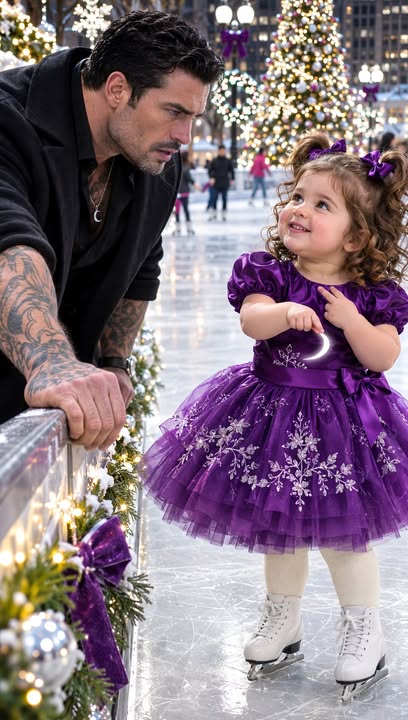
Nearly a year after the Christmas rink, the city was bright with fresh snow again.
Vincent arrived early to help Margaret lace Emma’s skates.
His hands, once known only for signatures and decisions, now worked carefully at a small knot.
“Not too tight,” Emma reminded him.
“I remember.”
“And not too loose.”
“I remember that too.”
Margaret smiled as she adjusted one of the silver crescent hair clips above Emma’s ear.
The little girl had grown taller, though her cheeks remained round and her brown-hazel eyes still seemed capable of making every adult in the room feel seen.
She wore the royal-blue skating dress Isabella had saved for her, altered carefully to fit.
Around her wrist, the crescent bracelet caught the rink lights.
The old arena had hung fresh garlands and strings of stars for the Christmas celebration.
Parents gathered along the boards, their coats bright against the ice.
A small sign beside the entrance announced that Emma would perform a short routine with her instructor.
Vincent stood near the barrier, trying not to look more nervous than Emma.
Margaret took her place beside him.
“You’ll blink and miss it,” she said.
“I’ve learned not to blink.”
“That seems unhealthy.”
“I’ve learned a lot of unhealthy things.”
She laughed softly.
The instructor led Emma onto the ice.
For one brief moment, Emma looked small beneath the high ceiling and the glowing lights.
Then she glanced toward the boards.
Vincent raised one hand.
Margaret waved with the other.
Emma smiled.
The music began, gentle and bright, carrying the familiar notes of a Christmas song across the rink.
Emma moved carefully at first, her skates tracing small arcs through the ice.
She held her arms out for balance and followed the path her instructor had practiced with her.
Halfway around the rink, she turned toward Vincent and Margaret.
She placed two fingers against her heart.
Then she drew a crescent moon in the air.
Vincent’s breath caught.
The gesture was no longer the only thing he had left of Isabella.
It was Emma’s now, a small sign that carried memory forward without asking anyone to remain trapped in the past.
Emma glided toward the boards and reached the gap where the instructor waited.
Vincent stepped onto the ice beside her.
He moved slowly, keeping his balance by instinct and the barrier’s help.
Emma offered him one mittened hand.
“Come on, Dada.”
He took it.
“I’m coming.”
She skated between him and Margaret, making the short, wobbly path seem like a grand journey.
At the far end, she turned and circled back.
Vincent moved beside her.
Margaret walked along the boards, smiling as she kept pace.
For one shining moment, Emma was between the two people who loved her most, with her mother’s memory held gently among them.
When she finished, the small crowd applauded.
Emma bowed with an earnest little flourish that made the adults laugh through their tears.
Later, in the quiet hallway, Vincent took a small box from his coat.
Inside lay the matching bracelet Isabella had worn as a young woman, its silver crescent polished but not altered.
“This was your mother’s,” he said. “She kept it safe for you.”
Emma touched the moon.
“Mommy one?”
“Mommy’s,” Margaret said. “She wanted you to have it when you were old enough to understand what it meant.”
“Can I wear it now?”
“If you’d like,” Vincent said.
Margaret helped fasten it beside Emma’s smaller bracelet.
The two crescents rested together at her wrist, one made for a child, one worn by the woman who had loved her first.
Emma held both against her heart.
“Mommy moon came home.”
Vincent crouched so they were eye to eye.
“Your mother’s love brought us together,” he said. “And every time you carry it with you, she’s part of our family.”
Emma threw her arms around his neck, then reached for Margaret too.
They stayed that way, holding one another in the warm hallway while the Christmas music drifted through the rink.
Outside, snow gathered on the windowsills.
Inside, Emma asked for hot chocolate, Margaret promised to find marshmallows, and Vincent promised to help decorate the tree at home.
There was grief in their family, and there always would be.
There were also letters preserved at last, truths spoken without bargaining, and promises that had been kept.
When they left the rink together, Emma walked between them, one hand in Vincent’s and the other in Margaret’s.
Her silver moons flashed beneath the streetlights as the three of them stepped into the snow.
For the first time, Vincent understood that home was not the life he had lost, nor the power he had once mistaken for safety.
Home was the small hand in his, the woman beside them who had loved Isabella and stayed for Emma, and the child who had drawn a crescent moon through the air to show them all the way back.
**–THE END–PLEASE
Share your thoughts or feedback to motivate us to create more stories ♥️
* * *
[PREVIOUS: PART 5](https://echoesofstories.idolsgift.com/blog/part-5-the-man-at-the-rink-041-1)
✓ Lynn R. Adams
Part 6 – The Moon Comes Home The address led to a small apartment above a bakery on the north side of the city, where Isabella had lived with Emma during the last months of her life. Vincent read Do…