PART 6 (THE END): The Locket Beneath Her Collar 052
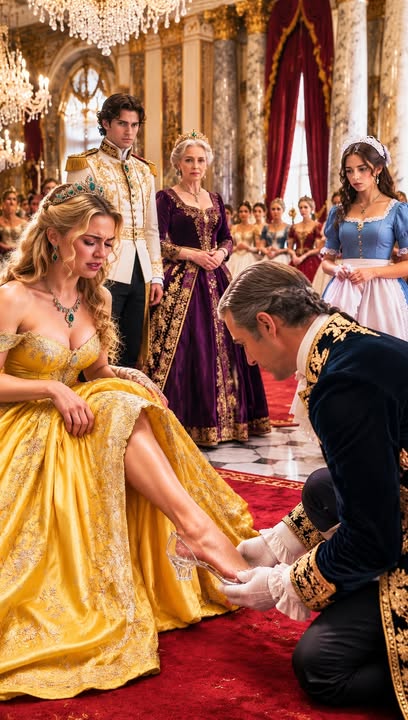
Part 6 – A Home Made of Truth
The keeper’s words seemed to still the corridor around them.
Ella looked toward the old nursery, where the woman who had served the palace for thirty years was waiting with a letter meant for her.
“Does she know what is in it?” Ella asked.
“She said it was left in her care by her mother,” the keeper replied. “She was told to give it to you if the palace ever began asking honest questions.”
Ella glanced at the prince.
He did not offer to answer for her.
“Then I’ll speak with her,” she said.
The prince nodded, and Isolde fell into step beside them.
They went down the quiet passage together, past the tall windows and the portraits of rulers who had once believed their choices would last forever.
At the door of the old nursery, Ella paused.
She had passed it many times in her years at the palace, carrying folded linens or a tray of warm milk, never imagining that the room beyond it held the beginning of her story.
The prince stood a little behind her.
“You can take all the time you need,” he said.
Ella drew one steady breath and opened the door.
The room was smaller than she had expected.
Its walls had been painted pale blue, and the old wooden cradles were gone, replaced by shelves of folded blankets and boxes of nursery records.
A woman in a plain gray dress stood near the window, her hands clasped around a small envelope.
Ella recognized her from the servants’ corridors.
Her name was Anwen, and she had worked in the palace kitchens before moving to the laundry and then the household stores.
She had once shown Ella how to remove a stubborn stain from a linen cuff without damaging the cloth.
“You wanted to speak with me,” Ella said.
Anwen’s eyes were bright with unshed tears.
“I did,” she replied. “Though I have wondered for years whether I would be brave enough when the moment came.”
She looked to the prince and Queen Isolde.
“May I speak with Ella alone?”
The prince glanced at Ella.
She nodded.
He and Isolde stepped into the corridor, leaving the door open.
Anwen held out the envelope.
“My mother was the nurse who carried the second baby away from the palace,” she said. “She kept this letter for me, and I have kept it ever since.”
Ella accepted the envelope with careful hands.
The paper was soft at the folds, its edges worn from years of being held and put away again.
“Why did she give it to you?”
“She said the letter belonged to the truth, but the truth had to wait until it could do more good than harm.”
Anwen lowered her gaze.
“I never knew what that meant. I only knew the palace had once hidden a child, and my mother had helped keep her safe.”
Ella opened the envelope.
Inside was a short letter in a delicate, faded hand.
It was addressed to the woman who had raised Ella.
Mara, if this reaches you, know that I have kept my promise.
The little girl is safe with my sister’s family in the northern village.
They have named her Liora, and they love her as their own.
I cannot tell you where they live, because I do not know whether the danger has truly passed.
But she is alive, and she has grown strong.
If the palace ever comes searching with honest hearts, let her choose whether she wishes to be found.
Ella read the letter a second time.
The other child had lived.
The second baby in the damaged ledger had not been stillborn.
A girl named Liora had been raised in the north, far from the palace and the struggle that had almost claimed both children.
The erased names, the altered entries, the stories of death and theft—all of them had been built to make two children disappear from the records.
“Do you know where Liora is now?” Ella asked.
Anwen nodded.
“My mother wrote to her family after the danger had passed. Liora is alive. She lives with her husband and children in the northern village.”
The words brought a warmth to Ella’s chest that the room could not explain.
A second child had grown up beyond the palace walls, loved and known by another family.
“She has children?” Ella asked.
“Three, last I heard. She chose not to come to court, but she sent word that she would welcome a letter from you.”
Ella looked down at the note.
The letter did not give her a sister in the usual sense.
They had not grown up side by side, shared secrets, or learned one another’s habits.
But they had been born on the same night and separated by a palace’s fear.
That was enough to make her hope they might meet someday.
“Would you tell her that I would like to write?” Ella asked.
“I will.”
Anwen folded her hands again.
“My mother also asked me to tell you something, if we ever met.”
Ella waited.
“She said Mara was the kindest nurse she had ever known, and the bravest person she had ever watched make a terrible choice.”
Ella swallowed.
“I wish Mara had told me.”
“So do I,” Anwen said. “But my mother believed Mara stayed silent because she feared the truth would bring the danger back.”
“That may be true,” Ella replied. “It still hurt.”
Anwen nodded, as if she understood both parts of the answer.
“I think my mother would have agreed with you.”
When Ella stepped back into the corridor, the prince and Isolde were waiting.
She held the letter out so they could read it.
Isolde pressed one hand lightly to her mouth.
“The child survived,” she whispered.
“Yes,” Ella said. “Her name is Liora, and she has a family of her own.”
The prince read the letter carefully, then returned it to Ella.
“Would you like to meet her?”
“Someday, if she wants that too.”
“She has said she would welcome a letter,” Anwen told them. “She wants to know what happened, but she does not want the palace to decide what she owes it.”
“No one should decide that for her,” Ella said.
The prince nodded.
“Then we will write as family, not as court.”
Isolde looked toward the open nursery door.
“Two babies, hidden in the same night, and one woman’s courage carried the truth through all these years.”
“More than one woman,” Ella said. “Mara, the nurse, your grandmother, and everyone who kept part of the story safe.”
Isolde met her gaze.
“I should not be counted among the brave.”
“You should be counted among the people who have finally told the truth.”
For a moment, Isolde could not answer.
Then she bowed her head.
“I will try to deserve that.”
The following weeks were filled with careful work.
The archive keeper compared every surviving register, marking the lines that had been altered and the pages that had been moved.
The retired nurse gave a formal account of what she remembered.
Anwen brought her mother’s old notes, and the family in the north sent a letter confirming Liora’s birth and the years she had spent with them.
None of the evidence came from one perfect document.
It came from a collection of small truths, written in different hands and preserved by people who had not always known when the time would come to speak.
The palace physician’s register confirmed that the royal infant had been born healthy.
The nursery account showed that Mara had been ordered to carry the child from the palace.
The retired nurse remembered seeing her leave through the service passage.
Mara’s letter explained why she had gone, and Isolde admitted that she had helped make the disappearance appear permanent.
The altered ledger had not recorded two deaths, but two surviving children whose names someone had tried to erase.
The council reviewed the evidence in private before agreeing to a public statement.
When the day came, Ella entered the council chamber beside the prince and Queen Isolde.
This time she did not wear her servant uniform.
She wore a simple blue dress made by the palace seamstress from cloth she had chosen herself, with the silver locket resting openly at her throat.
There was no glass slipper on the table.
There was no test to pass.
The prince addressed the council and the gathered court.
“The records and testimony confirm that Ella was born as the royal child whose disappearance was concealed during the nursery fire,” he said. “They also confirm that Mara carried her away under orders intended to protect her from a plot against the succession.”
A murmur moved through the hall.
The prince waited until it faded.
“Mara was accused of stealing the infant, but she did not take Ella for herself. She gave her safety, a home, and years of love.”
Isolde stepped forward.
“I allowed the false accusation to stand,” she said. “I acted from fear, but fear does not excuse the harm my silence caused. Mara’s name should never have been stained for protecting a child.”
She paused, and the quiet deepened around her.
“I ask the court to remember her not as a thief, but as the woman who chose a child’s life over her own peace.”
The queen dowager’s confession did not erase what she had done.
It did, however, give the truth a voice in the place where the lie had lived longest.
The council formally cleared Mara’s name.
The archive keeper entered the correction beside the old accusation, preserving the original record but adding the evidence that had finally explained it.
For the first time, Mara’s story would not end at the word dismissed.
It would include the child she had carried from danger and the life she had given her afterward.
The council then offered Ella the title and place that belonged to her by birth.
The prince stood beside her, but did not answer for her.
Ella looked around the chamber.
She saw the nobles who had once laughed.
She saw the servants who had worked beside her for years.
She saw Queen Isolde, whose face held shame and hope together, and the prince, who waited without expectation.
“I accept the truth of who I am,” Ella said. “I accept the family I have found, and I will take time before I decide what title or duty I want to carry.”
Some of the councilors shifted in their seats.
Ella continued.
“I will not let a crown decide my whole life. If I serve this kingdom, I want to do it because I choose to, and because the people who live here deserve care, honesty, and a voice in their future.”
The prince’s expression warmed.
“That is fair,” he said.
The council agreed to honor her as the royal heir without requiring an immediate coronation.
Ella would learn the work of the court, meet the people whose lives were shaped by its decisions, and choose her place at a pace that belonged to her.
It was not the instant transformation the old stories promised.
It was something better.
It was a future she could enter with her eyes open.
After the council adjourned, Ella found Isolde waiting in the garden where they had once spoken beside the stone basin.
The queen dowager wore no jewels.
A shawl rested over her shoulders, and she held a small bunch of white flowers in one hand.
“These were Mara’s favorite,” she said. “I asked the gardener to grow them near the old nursery.”
Ella accepted the flowers.
“They’re lovely.”
“I wish I had done more for her while she was alive.”
“So do I.”
Isolde looked down.
“I don’t expect you to forgive me.”
“I know.”
“I will keep telling the truth, even when it costs me something. I will help restore Mara’s name wherever the old accusation was written.”
“That is what I need from you.”
Isolde took this in with a solemn nod.
“I can do that.”
Ella thought of the years Isolde had spent carrying the secret alone, and the years Mara had spent raising a child who had not been hers by birth but had been hers in every way that mattered.
Understanding did not erase the hurt.
It did make a path through it.
“Perhaps, one day, I can forgive you,” Ella said. “But I don’t want to promise something just to make this moment easier.”
Isolde’s eyes filled, but she did not look away.
“That is more kindness than I deserve.”
“It is not kindness to pretend.”
“No,” Isolde said. “It isn’t.”
She reached out, then stopped short of touching Ella’s hand.
Ella saw the question in the hesitation.
After a moment, she offered her fingers.
Isolde held them gently, and neither of them tried to call the gesture forgiveness.
It was only a beginning.
The prince found Ella later in the quiet courtyard outside the old nursery.
The glass slipper stood on a small table nearby, brought from the ballroom at her request.
It gleamed in the afternoon light, beautiful and delicate, but no longer seemed powerful.
“You wanted to see it,” he said.
“I did.”
“Do you still want to try it?”
Ella smiled faintly.
“I think I do.”
The prince lifted the slipper from the table and held it out.
She sat on the stone bench, slipped off her plain leather shoe, and rested her foot inside the glass.
It fit.
No one clapped.
No one declared the matter settled.
The prince lowered himself onto one knee so she would not have to look up at him.
“How does it feel?” he asked.
“Cold,” she said, and laughed softly.
He laughed too.
“Nothing like the stories, then.”
“It fits my foot,” Ella said. “It doesn’t know anything else about me.”
“No,” he replied. “It doesn’t.”
He set the slipper aside.
They sat together in the courtyard while the sunlight moved over the old stones.
For a little while, neither of them spoke.
Then the prince said, “I want you to know that I would have liked you even without the locket.”
Ella looked at him.
“And without the slipper?”
“Certainly without the slipper.”
“Without a royal name?”
“Especially without the royal name.”
Her smile grew warmer.
“I like you too,” she said. “But I want us to be slow enough to discover who we are when nobody is asking us to become anything.”
“I would like that.”
He did not reach for her hand until she held it out first.
The months that followed gave them time to learn one another beyond the palace story.
Ella worked with the royal household to improve conditions for the servants, beginning with the small matters she understood from years of experience: fairer schedules, warmer rooms in winter, and the freedom to speak when something was wrong.
She studied the kingdom’s laws and listened to people who had never been invited into the grand council chamber.
The prince joined her in those visits, not as a rescuer, but as a partner willing to hear what he had missed.
They disagreed sometimes.
Ella challenged him when his plans overlooked the people who would have to live with them, and he challenged her when she tried to carry every difficult task alone.
Neither mistook disagreement for disloyalty.
Their affection grew in the ordinary spaces between responsibilities: over shared cups of tea, quiet walks through the garden, and the notes they left one another in the west library when their duties kept them apart.
Ella also wrote to Liora.
Her first letter was careful, with no claim that the two of them had to become sisters simply because they had been born on the same night.
She told Liora the truth as she knew it and asked about the life she had chosen.
Liora replied several weeks later.
She had a family, a home, and a small orchard behind her house.
She was curious about Ella, but she had no wish to come to court.
Ella wrote back that the door would remain open, but there would never be an obligation attached to it.
Their letters continued, slowly and warmly.
Some were full of questions.
Others were only notes about the weather, a new grandchild, or the changing color of the leaves.
Ella came to treasure each one.
On the anniversary of the nursery fire, the palace held a quiet remembrance in the old courtyard.
There were no speeches about destiny, and no display of the glass slipper.
Instead, the court placed two small lanterns on the windowsill of the nursery: one for Ella, and one for Liora.
A third lantern stood beside them for Mara.
Ella set the silver locket beneath the light.
For years, she had thought of it as the one clue that might lead her to a missing past.
Now she understood that it had also been a promise carried through silence: a promise that someone had loved her enough to keep her safe, even when that love demanded a painful distance.
Isolde stood beside her, quiet and steady.
The prince waited a few steps away, giving her room.
Ella touched the locket once, then turned toward them.
She had not been born into the life she expected.
She had not become whole by discovering a crown, nor by fitting her foot into a glass slipper.
She had become whole by learning the truth, choosing what to do with it, and making room for both grief and love.
The palace was still a palace.
The court was still full of old habits, and no happy ending could repair every year that had been lost.
But the corridors no longer seemed made only of secrets.
They held work to be done, letters to be answered, people waiting to be heard, and a family learning how to tell the truth before it was too late.
Years later, when Ella and the prince married, the ceremony was small enough to feel like their own.
The silver locket rested against her heart.
Mara’s name was spoken with honor.
Isolde stood among the family, not as the keeper of an old secret, but as a woman who had accepted responsibility for what she had done and worked to repair it.
Liora sent a letter from the north, and Ella read it before the ceremony, smiling through tears at the warm wishes from a sister she had never known as a child but was beginning to know as an adult.
The prince took Ella’s hand, not because a slipper had chosen her, and not because a bloodline had commanded it.
He took it because they had learned to trust one another, to listen, and to leave room for each other’s choices.
And when Ella looked beyond him toward the palace, she no longer saw a place that had hidden her from the world.
She saw a place that could change.
She saw a home built not by titles or old traditions, but by the people who chose, day after day, to care for one another and tell the truth.
**–THE END–PLEASE
Share your thoughts or feedback to motivate us to create more stories ♥️
* * *
[PREVIOUS: PART 5](https://storyly.idolsgift.com/blog/part-5-the-locket-beneath-her-collar-052-3)
✓ Lynn R. Adams
Part 6 – A Home Made of Truth The keeper’s words seemed to still the corridor around them. Ella looked toward the old nursery, where the woman who had served the palace for thirty years was waiting …