PART 6 (THE END): The Little Flower on His Key Ring 058
Part 6 – The Walk They Shared
The figure behind the second-floor curtains did not appear again.
Rosa watched the dark window until the car turned beyond the iron gates, leaving the mansion’s lights behind them.
Sophia slept through the drive, her cheek nestled against Rosa’s shoulder, while the unopened letter rested in a folder on the seat beside them.
Marco took them to the cottage Dante had promised, a modest place at the edge of a quiet town, with a kitchen warmed by a small stove and daisies nodding beneath the front windows.
Rosa checked every room before she let herself sit down.
She checked the locks, the windows, and the names of the two people assigned to help them, then asked Marco to leave the letter with her.
He did.
Only when the car’s taillights disappeared along the lane did Rosa unfold Carmela’s envelope and set it on the table.
She did not open it.
The words on the outside—For Dante, when he is ready to lose what he thinks he must keep—felt private, like a conversation she had no right to enter.
She left it sealed beside the silver daisy, then lifted Sophia into bed.
“Are we staying here?” Sophia mumbled.
“For tonight,” Rosa whispered.
“Dante come?”
“Not tonight.”
Sophia frowned in her sleep.
“Walk tomorrow?”
Rosa kissed her forehead.
“We’ll see.”
The next morning, Marco brought news before the sun had cleared the hills.
Dante had read the letter.
He had also asked the authorities to review the security records and the circumstances around Carmela’s death, and he had agreed to provide every document he could find.
He had not asked Rosa to return.
He had asked Marco to tell her that the choice remained hers.
Rosa read the message twice, then put it down and stood at the window.
Outside, the town was waking without any awareness of the mansion, the hidden passage, or the years of silence that had gathered there.
A delivery van stopped near the corner shop.
A woman swept her front step.
Somewhere nearby, a child laughed with the careless certainty that the morning belonged to her.
Rosa wanted that kind of ordinary life for Sophia.
She also wanted to know what Carmela had written to Dante.
When she opened the door to ask Marco to take her to the mansion, he was already waiting beside the car.
“Mr. Falcone asked me not to hurry you,” he said.
“I know.”
“Do you want me to tell him you’re coming?”
“Tell him I’m coming to hear what he found.”
Marco nodded.
“He’ll be glad to see you.”
Rosa did not answer.
She was not ready to let anyone else name what she felt.
At the mansion, the front hall was quiet, but not in the old, ritualized way.
Housekeepers crossed the marble without stopping.
A guard spoke softly into his radio near the stairs.
The place was still grand, but it no longer seemed to be holding its breath for four o’clock.
Dante waited in the garden.
He stood beside the white climbing roses, holding Carmela’s opened letter in one hand.
He looked tired, and there was a new steadiness in the way he met Rosa’s eyes.
“Thank you for coming,” he said.
“I wanted to hear what she wrote.”
“So did I.”
He offered her the letter.
Rosa glanced over the first lines, then looked up.
“Would you read it?”
Dante nodded.
He began quietly.
“My love, if you have reached this letter, then the life we planned did not unfold as we hoped, and I am sorry for the silence I left behind.”
His voice caught, but he continued.
“I know the way you hold responsibility. You believe that if you can command every door, you can keep the people you love safe. I used to mistake that fear for strength, because I thought I could meet it with enough courage.”
Rosa stood very still.
Dante’s eyes moved along the page.
“But love is not a locked room, and protection is not the same as keeping someone near you. If the truth about the ambush leads back to our own circle, do not bury it to preserve the life we built. A home that depends on fear is not a home I want you to defend.”
He stopped, took a breath, and read on.
“Tell the truth even if it costs you your name. Let people choose where to stand. And if one day a small voice asks you not to walk alone, listen—not because it will heal what happened, but because grief does not have to be the only thing that remains.”
Dante lowered the letter.
For a while, neither of them spoke.
Rosa watched the garden roses turn in the breeze.
“She knew you,” Rosa said.
“She did.”
“She also knew you could change.”
Dante looked down at the page.
“I hope she was right.”
“What did she say about Anselmo?”
“That he had told her the danger was handled, and she wanted me to ask him what he meant before I decided anything else.”
“Do you believe he caused the ambush?”
“No.”
His answer was measured.
“I believe he failed to pass on a warning, and that he concealed how much he knew afterward. I don’t yet know whether he was protecting someone, protecting himself, or trying to keep the organization from breaking apart.”
“Will you find out?”
“Yes.”
“Even if the answer isn’t the one you expect?”
“Especially then.”
He folded the letter carefully and returned it to its envelope.
“The authorities have taken copies of the report and the security records. Anselmo has agreed to answer their questions. He’s no longer managing the organization, and he won’t have access to you or Sophia.”
“Was he the figure at the window?”
Dante’s face clouded.
“I don’t know. The guard who checked the upstairs rooms found no one. The staff believed it was a reflection from the drive.”
Rosa remembered the silhouette’s hand against the glass.
“Maybe it was.”
“Maybe.”
Dante did not offer a certainty he did not have.
“The inquiry may take time,” he continued. “But I have turned over what I know, and I will testify if they ask me to.”
“What about the rest of your organization?”
“I’ve begun closing it down. The legal businesses will be separated and reviewed. Anything that cannot be made lawful will end.”
“And the men who worked for you?”
“Some have other work already. I’m helping those who want to leave find honest jobs, but I won’t use money or influence to make them stay.”
Rosa heard the difference in that.
For once, he was not describing a command.
“You’ll lose a lot,” she said.
“Yes.”
“Are you frightened?”
“Yes.”
He met her gaze.
“I’m frightened of losing control. I’m frightened the truth will hurt people who trusted me. I’m frightened that I waited too long to understand what Carmela was asking of me.”
“What are you going to do with the fear?”
“Let it be a reason to pay attention, not an excuse to take the choice away from anyone else.”
Rosa’s expression softened.
“That’s a beginning.”
“It is.”
He looked toward the rose trellis.
“I have another place for you to see. Only if you want.”
Rosa thought of the cottage, the open windows, the town beyond it.
Then she thought of the mansion’s locked room and the promise Carmela had hidden inside it.
“I’ll see it.”
Dante led her to a smaller house on the far side of the garden, beyond the old stone fountain.
It had once belonged to the groundskeeper, but it had been empty for years.
The walls were plain, the windows wide, and a patch of garden lay untended beside the back door.
There was nothing grand about it.
That was precisely what made Rosa breathe more easily.
“We could repair it,” Dante said.
“Who is we?”
“If you choose to stay, I’ll pay for the work. You can decide how it’s arranged and who lives here.”
“And if I choose not to?”
“I’ll help you find a home wherever you want one.”
Rosa studied the small rooms.
Sunlight covered the kitchen floor.
A back window looked toward the garden, but the front door opened toward the road beyond the grounds.
It could be a place where Sophia played, where Rosa had her own key, where no one came in simply because Dante had decided to visit.
“What would you do?” she asked.
“I’ll live wherever the authorities allow me to live.”
“That’s not what I asked.”
He considered it.
“I’d like to stay near the garden, if I’m permitted. I’d like to know you and Sophia, if you both want me in your lives. But I won’t make a home for you and call it a choice if you have nowhere else to go.”
Rosa turned toward him.
“Then I won’t decide today.”
“Good.”
“You’re not disappointed?”
“I am,” he admitted. “But my disappointment is mine to carry.”
The honesty in that answer reached her more deeply than a polished promise would have.
She nodded toward the cottage.
“I want to visit for a while before I decide anything permanent.”
“You can.”
“And I want Sophia to have days that don’t belong to your grief or your past.”
“Agreed.”
“I want her to know Carmela as someone who loved her, not as a tragedy we whisper about.”
Dante’s eyes shone, but he kept his voice steady.
“I want that too.”
“And if we stay near you, she will not be expected to become part of your organization.”
“There won’t be an organization for her to inherit.”
“Then she can know you as Dante.”
“I would like that.”
Rosa looked back through the open doorway at the bright, empty kitchen.
For the first time since she had brought Sophia into the mansion, she could picture a future that was not simply a place to hide from the past.
It did not have to be a future with Dante.
It did not have to be without him.
For now, the choice was enough.
“I’ll return to the cottage today,” she said. “And I’ll come back when I’m ready.”
Dante nodded.
“I’ll be here.”
Weeks passed before Rosa made the next decision.
The inquiry continued, and the truth became clearer without becoming simple.
Anselmo had known that the warning about Rosa’s address was real.
He had feared that a report connecting Carmela to a former housekeeper would draw attention from people already searching for weaknesses in the organization.
Instead of telling Dante, he had tried to handle the matter quietly, convincing himself that silence would prevent a larger conflict.
He had been wrong.
The person who ordered the inquiry into Rosa had acted without Anselmo’s permission, hoping to learn whether Carmela had given her help or information.
Anselmo had not arranged the ambush, but he had withheld the warning that might have changed what Carmela knew and what Dante understood afterward.
He had also let Dante believe the attack came entirely from outside their circle because admitting his own failure would have threatened his position.
When the evidence was placed before him, Anselmo did not deny signing the report.
He gave a statement, accepted the consequences of concealing it, and stepped away from the organization.
The authorities pursued the matter through the proper channels.
No one was made a spectacle, and no single conversation could restore what had been lost.
Dante testified.
He turned over records that exposed the structure he had once protected, and he agreed to dismantle it rather than preserve it under a cleaner name.
The work was slow and costly.
Some men resented him.
Others left quietly, grateful to have a chance to begin again.
Dante did not ask anyone to call him brave.
He attended every meeting he was required to attend and answered every question he could answer honestly.
He learned that accountability was not a single confession that made a person new.
It was the unremarkable, repeated choice to tell the truth again the next day.
Rosa and Sophia remained in the cottage outside the city.
Dante visited only when Rosa invited him.
At first, the visits lasted an hour.
Then they lasted through supper.
He brought picture books, small packets of seeds, and once a wooden duck that Sophia insisted was a swan.
He never arrived without asking.
He never spoke about Carmela as if she were a place Rosa or Sophia were expected to fill.
When Sophia asked about her mother, Rosa told her the truth in simple pieces.
Carmela had been kind.
Carmela had planted flowers.
Carmela had wanted Sophia safe.
Dante listened each time, sometimes adding a memory, sometimes saying nothing at all.
The first spring daisy opened in the cottage garden after they had been there nearly two months.
Sophia found it beside the back step and brought it to Rosa with both hands.
“Mama flower,” she said.
Rosa smiled.
“Yes.”
“Give Dante?”
“Would you like to?”
Sophia nodded.
That afternoon, when Dante arrived, she ran to him with the flower held upright.
He crouched to meet her.
“For me?”
“For Carmela,” Sophia said.
Dante’s expression softened with the pain of hearing his wife’s name spoken so freely.
He accepted the daisy without closing his fingers around its stem.
“Then we’ll put it somewhere she can see.”
He planted it in a small clay pot and set it on the kitchen windowsill.
Nothing about the gesture made the grief vanish.
It gave the grief somewhere gentle to rest.
By autumn, Rosa had decided to come back to the mansion grounds.
Not to work there, and not because Dante had asked her to.
She chose the small house beyond the fountain, after walking through it several times and making a list of repairs she wanted done before moving in.
She chose the paint for the walls.
She chose the locks.
She chose who would be allowed to have a key.
Dante listened to every request and changed nothing without her agreement.
He kept a separate room at the cottage until the renovations were finished, so Rosa and Sophia could leave whenever they wished.
When Rosa finally carried their things into the small house, Dante did not call it a beginning.
He called it a home she had chosen.
The locked room remained closed for another month.
Dante had not been ready to open it.
Neither had Rosa.
They knew what waited inside, but knowing was not the same as being ready to touch the past again.
When the day came, they went together.
Sophia walked between them, holding one of Rosa’s hands and one of Dante’s.
Dante carried the key.
He opened the narrow passage first.
The silver daisy was still there, hanging from the keyhole, its tiny engraved letters catching the light.
Rosa touched it once with her fingertip.
“Keep a little light safe,” she whispered.
Dante turned the key.
The hidden room opened onto cedar boxes, old notebooks, and the dust of years.
They moved slowly.
Inside the wooden box, beneath the letters already read, lay a stack of family photographs and several more pages in Carmela’s handwriting.
Some were ordinary things she had saved: a note about the roses, a list of books she meant to read, a sketch of the garden fountain with a daisy drawn beside it.
Others were letters to Dante, unfinished and unsent.
They read them together.
In one, Carmela wrote about the sound of rain against the bedroom windows.
In another, she complained that Dante always pretended not to like sweet tea, then drank hers whenever she left the room.
Rosa laughed when she reached that line.
Dante looked startled by the sound, then found himself smiling too.
The locked room had not been a chamber of terrible revelations.
It had been a room made of the little parts of a life, waiting for someone to remember that love had existed there alongside fear.
On the final page, Carmela had written a sentence in the margin.
A door is not a home unless the people inside can leave it open.
Dante read it twice.
Then he looked at the door behind them.
“Let’s open it,” Rosa said.
Together, they carried the boxes into the garden room.
They removed the old cabinet, opened the curtains, and let the afternoon sun reach the bare walls.
Rosa chose soft green paint.
Sophia chose a yellow rug printed with flowers.
Dante built low shelves for the picture books and brought over a small table where Sophia could draw without anyone worrying about stains.
The old letters and photographs went into a glass-fronted cabinet that Rosa could open whenever she wished.
Beside it, they planted a memorial garden of daisies and white roses.
No one called the room a shrine.
It became a playroom, a reading room, and a place where Carmela’s name could be spoken without every voice turning solemn.
On the first anniversary of the day Sophia had copied Dante’s walk, the late-afternoon sun warmed the marble corridor.
The mansion no longer cleared the halls at .
Housekeepers pushed their carts past the windows.
A guard stopped to answer a question from the cook.
Someone laughed in the kitchen, and no one hurried to silence them.
At four, Dante stepped into the corridor.
He paused by the room that had once been locked.
The door stood open, sunlight falling across the yellow rug inside.
Sophia hurried out of the garden room, her pink shoes replaced by small white sneakers, her daisy dress bright against the light.
She reached for Dante’s hand.
Rosa came behind her, carrying the little silver charm on its chain.
She had put it back around Dante’s neck the day they opened the room, after he asked whether she wanted to keep it.
“It was Carmela’s,” Rosa had said.
“And it was yours,” he replied.
So they had placed it together, neither claiming it alone.
Now it rested against his shirt, bright as a tiny piece of the afternoon.
“Walk?” Sophia asked.
Dante looked at Rosa.
She gave him a small nod.
He took Sophia’s hand, then offered his other hand to Rosa.
She accepted it, not as a promise that grief was gone, but as a choice made freely in the light.
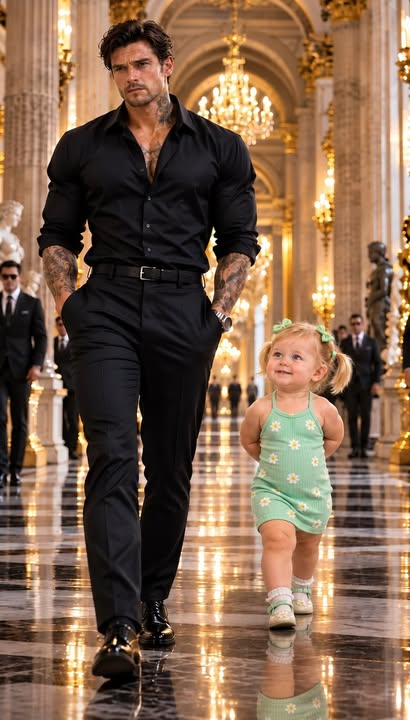
They walked down the corridor together.
Dante’s stride was still long, though he shortened it to match Sophia’s.
She tried to copy his solemn expression and managed something closer to a thoughtful frown.
Rosa smiled.
At the windows, the late sun laid a bright path across the floor.
Sophia stopped and pointed.
“Shiny.”
“Very,” Dante said.
She turned to him, then to Rosa.
“No ’lone,” she declared.
Dante looked at the little girl, at the woman beside him, and at the open door where Carmela’s letters and photographs rested in the warmth.
For the first time in a long while, the sorrow in him had room for something else.
He smiled.
“Not alone,” he said.
**–THE END–PLEASE
Share your thoughts or feedback to motivate us to create more stories ♥️
* * *
[PREVIOUS: PART 5](https://storyly.idolsgift.com/blog/part-5-the-little-flower-on-his-key-ring-058)
✓ Lynn R. Adams
Part 6 – The Walk They Shared The figure behind the second-floor curtains did not appear again. Rosa watched the dark window until the car turned beyond the iron gates, leaving the mansion’s lights …