PART 6 (THE END): The Letters He Never Saw 034
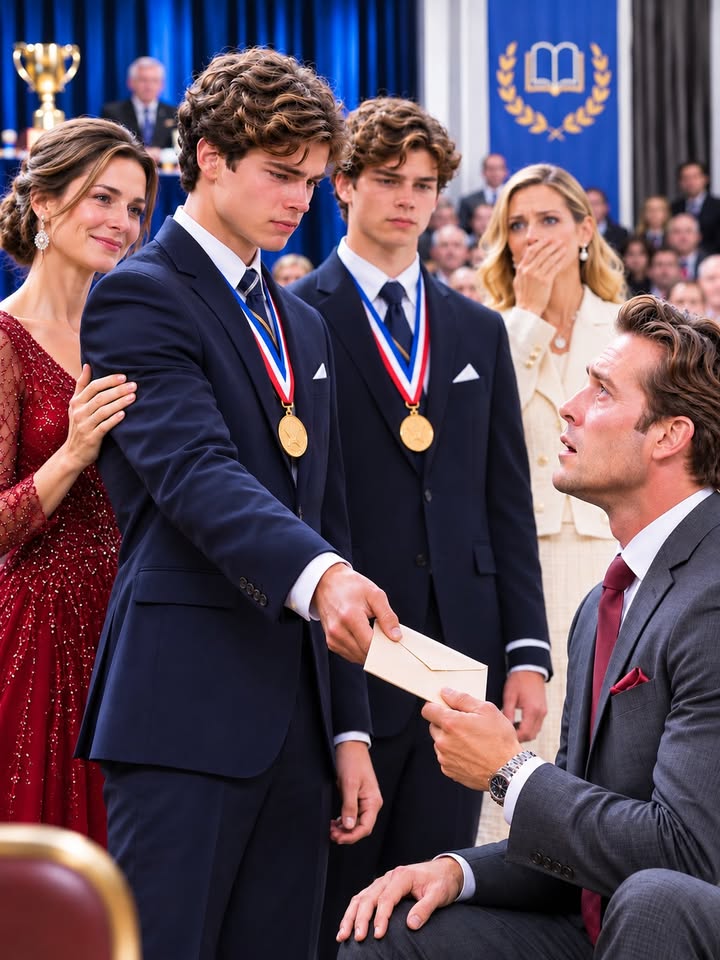
Part 6 – The Picture That Held Us
The phone rang before my older son could sign the invitation.
He looked at the screen, then at his brother.
“Do you want to answer?” he asked.
His twin nodded.
My older son put the call on speaker and set the phone between them.
“Hi, Dad,” the younger one said.
“Hi,” Brian replied, his voice careful. “I’m sorry to call without asking first. I thought you might want to hear this from me directly.”
“We saw your message,” his brother said. “What happened to one of our letters?”
Brian paused, as if choosing not only what to say but how to say it.
“I found the file from the week your letter was returned. There was a note from my lawyer explaining what he did.”
My fingers tightened around the mug in my hand.
“What did he do?” the older twin asked.
“He had received a letter addressed to me in your handwriting. He opened it because he was handling the separation paperwork. He said he was trying to keep communication from making things worse.”
“That wasn’t his choice to make,” my younger son said.
“No,” Brian replied. “It wasn’t.”
The answer was steady, with no attempt to soften what had happened.
“He kept the letter with his files,” Brian continued. “Then he sent me a note saying it was better not to respond because your mother wanted no contact. I accepted that. I didn’t ask to see the letter, and I didn’t check with your mother.”
The kitchen seemed to grow very still.
“Is the letter still there?” my older son asked.
“Yes. It was in a separate sleeve. The sleeve also had a note from the lawyer saying he had mailed the empty envelope back to my old address after removing the letter.”
“Why would he send an empty envelope?” I asked.
“He wrote that he wanted to return the envelope without sending the letter itself. He thought that would keep a record of the correspondence without starting another argument.”
My younger son looked at the invitation on the table.
“So that was the envelope in the box.”
“I think so,” Brian said. “It must have been returned again when I moved, and somehow it ended up with your grandmother.”
I remembered Aunt Ruth’s words: my mother had taken something to the post office, believing she was helping.
The letter she carried might have been the unfinished page I had never sent.
The empty envelope might have passed through her hands afterward, leaving her with a story she could not explain to me.
The mystery had not been one secret carefully guarded by a single person.
It was a succession of small decisions, each made by someone who thought they were preventing pain, each one closing another door.
“Do you have the letter?” the older twin asked.
“I do.”
“Can you tell us what it says?”
“I can read it to you, if you want. Or I can bring it to the celebration and let you decide whether to read it yourselves.”
The boys looked at each other.
“Bring it,” the younger one said. “But don’t read it unless we ask.”
“I won’t.”
“And we still haven’t decided about the invitation,” his brother added.
“I understand.”
The call ended without anyone saying more than they meant.
My sons sat quietly at the table.
The invitation lay between them, Brian’s name written in the open space, waiting for the last signature.
“Do you want to finish it?” the younger one asked.
His brother looked at the paper, then at the wooden box on the counter where the old letters rested.
“I think so,” he said. “But not because he found the letter.”
“Why, then?”
“Because I want him there.”
The younger twin considered this, then nodded.
He signed beneath the name.
They did not rush to call Brian back.
They did not turn their choice into a reward for his decision to stay.
They had invited him because, for that day, they wanted him included.
The distinction mattered to them, and it mattered to me.
When Brian arrived at the scholarship celebration, he carried a slim folder and no expectation that anyone would gather around him.
He wore the same blue sweater he had worn to the park café.
Before entering the school hall, he waited near the doors while the boys approached him.
“You brought the letter?” the older twin asked.
Brian tapped the folder lightly.
“It’s here.”
“Did you read it again?”
“Once.”
“Did it make you feel something?”
“Yes,” Brian said. “But that doesn’t mean you have to feel the same thing.”
The boys seemed to accept that.
“Can we take it home and decide when to read it?”
“Of course.”
“Then come in,” the younger one said.
Inside, the hall was bright with paper decorations and rows of chairs.
The scholarship recipients sat near the front with their families, and my sons chose places for Brian beside them.
I sat on the other side of the aisle.
Not because I was being left out, but because the boys had made a place for him and wanted me close enough to share the moment without directing it.
The ceremony was modest, filled with teachers’ speeches, warm applause, and the soft rustle of programs.
When the twins’ names were announced, they rose together.
Brian stood too.
He clapped with the rest of us, his expression open and proud.
This time, he did not look at them as strangers whose faces resembled his.
He knew how they studied, what made them laugh, which one checked the schedule twice and which one trusted that everything would work out.
He had learned those things slowly, by listening and coming back when he said he would.
When the ceremony ended, the school photographer gathered the students for pictures.
The twins went first, holding their certificates beneath the banner.
Then they came to me and stood on either side of me as they had done all their lives.
Brian remained several paces away, waiting.
The younger boy glanced at him.
“Dad, come stand with us.”
Brian moved closer, but stopped at the edge of the group.
“Here?” he asked.
“Closer,” the older one said.
He took another step.
“Not too close,” his brother added, and the small smile in his voice made the instruction gentle rather than uncertain.
Brian settled beside them.
I stood at the boys’ other side.
For a moment, none of us knew where to put our hands.
Then the older twin linked his arm through mine, while his brother rested one hand against Brian’s shoulder.
The gesture was simple, tentative, and entirely his own.
The photographer raised her camera.
“Are we ready?”
The boys looked at each other.
Their smiles began unevenly, then found the same rhythm.
The camera clicked.
It was not a picture that erased the years before it.
It did not show a childhood Brian had missed, or turn missed birthdays into memories the boys could suddenly claim.
But it held the family they had become: the mother who had carried them through every ordinary day, the father who was learning to show up without demanding that the past be forgiven, and two sons strong enough to choose what they wanted now.
After the photographs, Brian handed the folder to the boys.
They did not open it in the crowded hall.
They took it home and placed it on the kitchen table beside the old wooden box.
My younger son brought out the returned envelope, now protected in a clear sleeve.
The address was faded, but the postal mark remained visible.
My older son set Brian’s letter beside it.
For a while, all four of us sat around the table.
Brian had not been invited to stay for dinner.
He had not asked.
The boys had agreed he could join us for tea before leaving, and he kept his eyes on them as they decided what happened next.
“Do you want to read it together?” I asked.
The older twin looked at his brother.
“Together,” he said.
Brian slid the letter across the table.
The handwriting was small and careful, and the folded page had softened at the creases.
The younger boy opened it.
He scanned the first lines, then handed the page to his brother.
They read silently, shoulder to shoulder.
At last, the older twin passed it to me.
The letter was short.
It was from Brian, written years earlier, after he had asked his lawyer whether the boys were all right.
He had written that he missed them, that he was sorry he had left in anger, and that he hoped someday they might know he had thought about them.
He had asked for one chance to see them, even if only for a little while.
At the bottom, he had written that he would not force his way into their lives if they did not want him there.
The words were sincere.
They were also surrounded by years in which he had not found out whether they had received them.
I folded the page and set it down.
“I wish I’d seen this,” I said.
Brian nodded.
“So do I.”
The boys were quiet.
My younger son traced the edge of the envelope with one finger.
“Why did you stop after the lawyer told you not to contact us?”
“I was afraid I’d make things worse,” Brian said. “I thought keeping away was a way to respect your mother. But I let someone else decide what you needed, and I didn’t check whether he was right.”
“You could have tried again,” the older twin said.
“Yes.”
“You could have written directly.”
“Yes.”
“You could have asked someone who knew us.”
“Yes.”
Brian did not look away.
“I should have. I’m sorry I didn’t.”
The older twin considered him.
The words did not make him smile, and they did not make his shoulders relax.
But he nodded once, accepting that Brian had answered the question without asking the boys to make him feel better.
My younger son leaned back in his chair.
“I don’t think one letter would have fixed everything.”
“No,” Brian said. “It wouldn’t have.”
“But it would have mattered to know you tried.”
“I understand.”
The word came quietly.
It was not a claim that he understood every part of their hurt.
It was a promise to keep listening.
The letter went into the wooden box, not hidden away but placed on top of the childhood pages.
The boys wanted it there with the rest, part of the record rather than an answer that replaced every other one.
Brian looked at the box.
“May I write back to it?”
“Write back to the letter?” the younger one asked.
“If you want me to.”
His brother thought for a moment.
“You can write to us now,” he said. “You don’t have to write to the little kids we used to be.”
Brian lowered his eyes, absorbing the kindness without trying to turn it into something larger.
“All right.”
“And don’t make it perfect,” the younger twin added. “Just tell the truth.”
“I can do that.”
The boys returned the letter to its place.
Then my older son looked at Brian.
“Do you still want to come to the next school event?”
“If I’m invited.”
“We’re not deciding today,” the younger one said.
“I know.”
“But we might.”
“I’ll wait.”
It was the kind of answer Brian had once been unable to live with.
He had wanted certainty before he risked being hurt.
Now he let the boys keep their uncertainty without turning it into a reason to leave.
When he stood to go, he did not ask for a hug.
The younger twin offered him a handshake, then changed his mind halfway through and gave him a brief, awkward embrace.
Brian held still until the boy let go.
The older one offered only his hand.
Brian shook it with care.
“See you next week?” the older twin asked.
“If that still works for you.”
“It does.”
“Then I’ll be here.”
He left when he said he would, without lingering at the door or asking whether anyone had changed their mind.
Afterward, the boys washed the cups while I put the letter back in the box.
The older twin set the returned envelope beside it.
“Do you think Grandma meant to hide everything?” he asked.
“I don’t know,” I said. “I think she was frightened that the boys might keep waiting for a father who wasn’t coming back.”
“Did she know about Brian’s letter?”
“I don’t think so. If she did, she never told me.”
The younger twin dried a cup.
“Everyone thought they were helping.”
“Some of them were,” I said. “Some of them were also afraid. Both things can be true.”
They considered that without asking me to make it simpler.
We did not speak of the past as if it were a puzzle that could now be solved and put away.
We spoke of it as something we finally knew how to carry without guessing at every missing piece.
Months passed.
Brian kept coming on the days he promised.
If he needed to change a time, he told the boys directly and gave them room to say no.
He listened when they spoke about the years apart, and he did not explain his absence before they finished asking.
He met Carla and Evan with the boys’ agreement, first for a brief lunch and later for an afternoon at the park.
Carla did not pretend that she had known nothing.
She told them plainly that Brian had said Hannah wanted no contact, and that she had believed him because she did not know about the letters.
“I wish I’d asked more questions,” she said. “I’m sorry I didn’t.”
The boys accepted her apology in their own time.
Evan was polite and a little nervous, relieved when the twins asked him about the competition rather than expecting him to answer for his parents.
No one tried to make them into instant brothers.
They began with shared snacks, a board game, and the discovery that all three boys disliked the same school cafeteria dessert.
Brian kept his home near us.
He turned down another opportunity that would have required frequent travel, not because the twins had asked him to sacrifice anything, but because he wanted the life he was building to have room for them.
When the boys noticed, he told them they did not owe him gratitude.
They believed him enough to stop testing the promise every time he made it.
Hannah and Brian learned how to speak about schedules, school dates, and practical questions without reopening every old argument.
We were not a couple again, and neither of us tried to pretend that we should be.
We were two parents who had hurt one another, made mistakes, and were learning to speak in a way that made the boys’ lives steadier.
Some conversations remained difficult.
But they no longer had to become battles.
On a clear afternoon late in the year, the twins invited everyone to a small family celebration at the school.
They had been selected for a scholarship program and would begin their next term with new opportunities and too many books to carry.
The boys told us it was not a grand occasion.
Then they spent an entire evening choosing what to wear.
Brian arrived with Carla and Evan, carrying the replies he had written to the childhood letters.
He had filled a small envelope with them, one for each page the boys had allowed him to answer.
The twins read the replies when they wanted.
Some they read privately.
Some they read aloud at the kitchen table.
They had not forgiven every choice Brian had made, and no one asked them to.
But they no longer had to wonder whether their words had been heard.
Before we left for the celebration, my younger son took the original envelope from the wooden box and slipped it into his jacket pocket.
“What’s that for?” I asked.
“I want it there,” he said.
His brother adjusted his tie.
“We’ve carried it long enough.”
At the school, the photographer gathered us in front of a window where the afternoon light fell warmly across the room.
The twins stood in the middle.
I moved to one side, and Brian stood on the other, with Carla and Evan beside him.
For an instant, the group seemed uncertain about where everyone belonged.
Then the older twin reached for my hand.
His brother reached for Brian’s sleeve.
Carla placed a light hand on Evan’s shoulder.
“Everyone in?” the photographer asked.
“Everyone who came,” the younger boy said.
The words made us smile.
The camera lifted.
I looked at my sons and saw the small boys who had once written letters with crooked lines, the teenagers who had won their medals without needing their father’s approval, and the young men they were becoming, able to choose closeness without denying hurt.
Brian looked back at them with no demand in his face.
He was simply there.
The camera clicked.
Later, the twins set the photograph on the mantel.
The wooden box went on the shelf beneath it, no longer tucked away in a closet.
Inside were their childhood letters, the returned envelope, Brian’s old note, my unfinished page, and the replies he had written in the present.
The years apart remained in the box.
So did the first small pieces of what came after.
The picture above it held all of us—not as though nothing had ever been broken, but as people who had finally chosen to stand in the same frame.
**–THE END–PLEASE
Share your thoughts or feedback to motivate us to create more stories ♥️
* * *
[PREVIOUS: PART 5](https://puretales.idolsgift.com/blog/part-5-the-letters-he-never-saw-034)
✓ Lynn R. Adams
Part 6 – The Picture That Held Us The phone rang before my older son could sign the invitation. He looked at the screen, then at his brother. “Do you want to answer?” he asked. His twin nodded. M…