PART 6 (THE END): The Letter Beneath the Silence 046
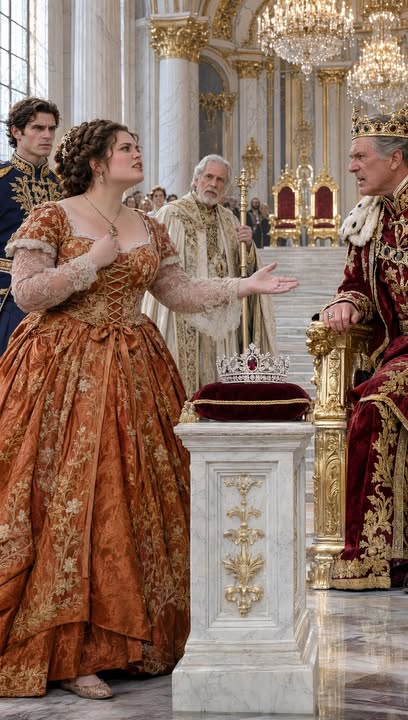
Part 6 – The Light Beside the Crown
“The queen is alive, but she will not return.”
For a moment, the garden seemed to hold its breath around the words.
Eleanor read them again, though they had not changed.
The ink was faded, the paper worn thin along its folds, but Maren Vale’s hand was unmistakable beside the small household mark.
Frederick stared at the note.
William did not look away from it.
Ashcombe’s voice was careful.
“The letter’s date is several months after the carriage fire.”
“Then the queen survived it,” Eleanor said.
“Possibly,” Ashcombe replied. “The note is strong evidence, but it does not tell us where she went or how long she lived afterward.”
Frederick looked up.
“Why would she refuse to return?”
“Perhaps she feared what the court would do if she came back,” William said.
“Perhaps she had lost too much to believe returning would restore anything,” Eleanor added.
She thought of her mother, carried from the palace as an infant, growing up under another name with a pendant and a portrait but no answers.
Perhaps the queen had known that a safe life beyond the palace was the only life left she could give her daughter.
“Does the letter say where she went?” William asked.
Ashcombe shook his head.
“No destination. Only that she would not return.”
Frederick’s shoulders bowed.
“She was alive, and I still let the court believe she had been killed.”
“You did not know she survived,” Eleanor said.
“No. But I knew the story was uncertain, and I chose the version that protected my crown.”
He looked at the note, then at his son.
“I cannot undo that.”
“No,” William said. “But you can stop asking anyone else to carry it for you.”
Frederick’s face tightened with shame, though his voice remained steady.
“I will testify before the commission. I will give them every record I have, including the correspondence I kept in my private cabinet.”
Eleanor looked at him.
“And the letter my mother sent?”
“I will ask the commission to record that it reached me, and that I did not ensure she received an answer.”
“Did you ever write one?”
“I still do not remember. If I find a copy, I will give it to them. If I do not, I will not pretend that I sent it.”
That was not absolution.
It was, Eleanor thought, the first honest answer he had given without trying to protect what it cost him.
William’s gaze rested on his father.
“Thank you.”
Frederick nodded once.
The commission’s work took weeks.
No one tried to hurry it into a verdict, though the court pressed for one every day.
The examiners verified the birth record, the signed order, the correspondence register, and the nurse’s deposition.
They confirmed that the carriage had held no member of the royal family.
No record established who had set the fire, and none showed that Frederick had ordered it.
But the commission also found that his order had made the deception possible, that he had allowed an uncertain disappearance to become a settled story, and that he had stayed silent when disclosure might have restored the rightful line.
The queen’s survival was accepted as likely, not proven beyond doubt.
The child carried away by Maren Vale was identified as the queen’s daughter through the birth record and the matching household references.
That child, raised under another name, was Eleanor’s mother.
The conclusion did not make the past simple.
It made the truth possible to say aloud.
The commission recommended that Frederick surrender the crown and testify before a lawful tribunal, which would determine the consequences of his actions.
It also recommended that Eleanor be recognized as the rightful heir, with the terms of the succession settled openly and in consultation with the kingdom.
When the commission delivered its findings, Frederick did not ask the court to soften them.
He removed the crown from his head and placed it on the table before the assembled judges.
“I believed silence would preserve peace,” he said. “Instead, it preserved my own power and left a family’s story unfinished.”
His gaze turned toward Eleanor.
“I am sorry for the harm my choices caused your mother, and for the burden they have placed upon you.”
Eleanor met his eyes.
“I accept that you are sorry,” she said. “I cannot make the years different.”
“I understand.”
The tribunal would hear his testimony, as the law required.
He would answer for the order he had signed and for the silence he had maintained.
No one called for vengeance.
No one pretended that regret erased responsibility.
William remained beside Eleanor while the judgment was read, though he did not take her hand until she reached for him.
The court then turned to the question it had been asking since the first record was found.
Would Eleanor claim the throne?
She looked at the empty place where Frederick’s crown had rested.
For a long time, she had thought of a crown as the answer to the question of who belonged.
Now she understood that it could also be a burden inherited from people who had mistaken authority for safety.
“I will accept the responsibility of the succession,” she said, “but I will not accept absolute rule.”
The hall stirred.
“I am not asking this kingdom to replace one person’s unchecked power with another’s. The commission has shown us what can happen when one family keeps its history beyond the reach of everyone else.”
She looked toward the representatives of the provinces, the judges, and the members of the court.
“Government must include the people who live under its decisions. The council should have elected representatives, the archives should be protected by independent law, and no monarch should have the power to hide a matter of succession from the court.”
The proposal was met with questions, objections, and long discussions.
It was not settled in an afternoon.
The months that followed were spent in careful negotiation, as difficult and necessary as the investigation itself.
William offered to renounce his own claim beside her.
“I will not have the crown treated as something you must share because I married you,” Eleanor told him.
“I know.”
“Then don’t offer yourself as a solution to a choice that belongs to me.”
“I wasn’t trying to choose for you.”
“I know that too.”
She took his hands.
“I want you beside me, but not above me and not in place of me.”
His eyes softened.
“Then I will stand beside you.”
The settlement established a constitutional monarchy with a council whose members included representatives chosen by the people.
The monarch would retain ceremonial and constitutional duties, but decisions affecting the kingdom would be subject to law, debate, and public record.
The court recognized Eleanor as the rightful heir.
She accepted the crown on those terms, with William as her partner, not as the owner of her claim.
When the day came for the public recognition, the palace hall was filled with people from every part of the kingdom.
The old laughter had disappeared.
In its place was an attentive quiet, the kind that came when people understood the words they were about to hear could shape their lives.
Eleanor wore a gown of deep blue, simply cut, with her mother’s gold pendant resting at her throat.
William stood at her side.
Ashcombe stood near the Crown of the First Empress, holding the verified record in both hands.
The crown was no longer treated as a prize.
It had been placed on a low stand, where every person in the hall could see it clearly.
Eleanor stepped forward.
“My family’s history was hidden for reasons some believed necessary and others found convenient,” she said. “Both things can be true. Fear can begin a silence, and power can keep it alive.”
She looked toward the people gathered before her.
“I cannot promise that knowing the truth will make our past painless. I can promise that this kingdom will not ask its people to live inside a story its rulers refuse to examine.”
The council members took their places.
The judges affirmed the settlement.
The record was read aloud: the name of Queen Isolde, the plea sent to Frederick, the order he had signed, the carriage that held only decoys, and the nurse who had carried the child to safety.
When the clerk reached Maren Vale’s name, Eleanor felt her eyes sting.
“Write her name where people can find it,” she said.
The clerk looked up.
“It will be entered in the permanent record.”
“Not only there,” Eleanor added. “The people should know who carried my mother out of the palace.”
Ashcombe bowed his head.
“It will be done.”
After the recognition, Eleanor asked that the Crown of the First Empress be removed from the throne room.
Frederick had argued, in the early days of the inquiry, that it belonged at the heart of the palace.
Eleanor understood the instinct.
She had once thought the same.
But the crown had held its secrets for too long, and she did not want another generation to mistake hidden authority for sacred truth.
It was placed in the national museum, in a bright gallery with windows looking onto the city.
Beside it were the miniature portrait of Queen Isolde, the verified birth record, and a copy of Maren Vale’s deposition.
A small brass plaque named the nurse and recorded the choice she had made: to carry a child away from danger, then raise her under another name when the queen did not return.
The pendant was displayed beside the records only on special occasions.
Eleanor kept it close.
The museum’s first visitors came on a clear spring morning.
Schoolchildren gathered around the glass case, asking why the crown had a hollow space beneath the ruby.
A guide explained that a hidden compartment had kept the papers safe, though the people who needed them had remained separated from the truth for years.
One child asked whether the queen had ever come home.
Eleanor, who had been listening from a few steps away, approached the group.
“We don’t know,” she said. “The last message we have says she chose not to return.”
“Was she afraid?” the child asked.
“Perhaps,” Eleanor replied. “Or perhaps she believed her daughter would be safer away from the palace.”
“Did the daughter know who she was?”
“Not until much later.”
The child looked at the portrait.
“Was she sad?”
Eleanor considered the question.
“I think she was loved,” she said. “Even when the people who loved her could not tell her everything.”
That evening, Eleanor and William walked through the palace garden.
The paths were newly bright with spring flowers, and the old fountain caught the last light of the day.
For months, the garden had been a place where they came to speak of difficult truths.
Tonight, it belonged to something gentler.
William carried a small velvet box.
Eleanor glanced at it.
“Is that another document?”
“I hope not.”
He opened the box.
Inside lay a simple ring, made from warm gold, with a tiny sunburst engraved along its inner edge.
She looked from the ring to him.
“I wanted to ask you again,” he said. “Not because the court asked us to stand together, and not because our names belong beside each other in a record.”
He took her hand.
“I want to ask as the man who loves you, and who knows that standing beside you means listening, learning, and letting you choose your own path.”
Her eyes filled.
“William, we are already married.”
“I know. But the vows we made then were spoken in a world where I thought I understood what our family was. I would like to make them again, knowing what I know now.”
The answer she gave was a smile first, because the words would not come immediately.
Then she said, “Yes.”
They invited a few close friends, Ashcombe, and the representatives who had helped shape the settlement.
The vows were spoken in the garden, with no throne behind them and no court waiting to judge their worth.
William promised to stand beside Eleanor without asking her to become smaller so he could feel secure.
Eleanor promised to share what frightened her, rather than protect him from every difficult truth.
They promised to keep asking each other what they believed, especially when certainty would have been easier.
When they exchanged rings, Eleanor felt the old pendant against her palm.
After the guests had gone, she and William remained beside the fountain.
She opened the little clasp at the back of the pendant.
Inside was a small, worn portrait of her mother as a young woman.
Eleanor had seen it many times.
Tonight, she placed it gently beside the ring on her hand, holding both close for a quiet moment.
“I wish she could have seen this,” she whispered.
William rested his hand over hers.
“So do I.”
“She spent so much of her life carrying a name she didn’t know.”
“She still gave you a life filled with love.”
“Yes,” Eleanor said. “She did.”
The palace windows glowed behind them, no longer signs of a world keeping its secrets but lights in a home they had chosen to make more open.
Eleanor looked up at the night sky.
The truth had not brought her mother back.
It had not answered every question about Queen Isolde, or given William the chance to ask his mother what she had known.
But the nurse’s name had been restored.
The king had answered to the law.
The crown no longer held the story alone.
And the daughter who had once been hidden beneath another name had a place in the world that did not depend on anyone’s permission.
Eleanor took William’s hand.
Together, they turned toward the lit garden path and walked into the future they had chosen, carrying the past with them at last—not as a secret, but as a truth they could share.
**–THE END–PLEASE
Share your thoughts or feedback to motivate us to create more stories ♥️
* * *
[PREVIOUS: PART 5](https://echoesofstories.idolsgift.com/blog/part-5-the-letter-beneath-the-silence-046)
✓ Lynn R. Adams
Part 6 – The Light Beside the Crown “The queen is alive, but she will not return.” For a moment, the garden seemed to hold its breath around the words. Eleanor read them again, though they had not …