PART 6 (THE END): The Knot That Remembered 069
Part 6 – A Bell for Everyone
The letter lay between the three of them, its final line written in a hand none of them recognized.
Mara did not take the child alone.
Someone from the council helped her leave.
Alexander read the sentence twice, then rested his fingertips on the paper as though steadying something that could not be seen.
“Do we know who wrote this?” Olivia asked.
Mistress Vale shook her head.
“Not yet, but the witness can tell us more.”
Victoria looked from the letter to the window, where morning light fell across the palace roofs.
“If someone on the council helped Mara, the inquiry must be protected from anyone who might have been involved.”
Alexander nodded.
“No private meeting, and no conclusions before the witness has spoken.”
Olivia felt the familiar tug of fear, but it no longer had the power to send her away from the questions.
“Can she meet us somewhere outside the palace?”
“I’ll ask,” Mistress Vale said. “The letter gives an address in the coastal town. We can send word through the courier who delivered it.”
“Ask whether she would be comfortable meeting here or there,” Olivia said. “I don’t want her brought somewhere she doesn’t feel safe.”
Alexander met her eyes and gave a quiet nod.
Mistress Vale sent the reply that morning.
The answer came the following day: the witness would meet them at a small guesthouse beyond the palace gardens, where she had been staying while she awaited their response.
Her name was Sabine Vale—not related to the royal archivist—and she had once served as a nursery attendant to Queen Eleanor.
The meeting took place in a sunlit room with a plain wooden table, a teapot, and a vase of late-season flowers.
Sabine was an elderly woman with silver hair braided over one shoulder and clear, watchful eyes.
She stood when Olivia entered, then paused as if the years between them had placed a question in the doorway.
“You have Queen Eleanor’s eyes,” she said.
Olivia was not sure what to do with that.
“I’m Olivia.”
“I know.” Sabine’s voice softened. “And you are allowed to be Olivia before you are anything else.”
Alexander lowered his head in greeting.
“I’m Alexander.”
“I remember you as a little boy,” Sabine said. “You used to hide under the nursery table when the council came to visit.”
“I don’t remember that.”
“Your mother did.” A gentle smile touched her face. “She always pretended not to know where you were.”
The tenderness in the small memory moved something in Alexander’s expression.
They sat together, with Mistress Vale nearby to record the details and Victoria waiting by the window.
Sabine folded her hands around her teacup.
“Mara was a ropekeeper, but she was also one of the queen’s closest friends,” she began. “They trusted each other. Mara understood the palace’s hidden passages, old mechanisms, and the ways a person could move unseen without causing alarm.”
“Why did my mother need to hide me?” Olivia asked.
Sabine did not rush to answer.
“Queen Eleanor had become concerned that several council members were trying to secure control of the succession through the children,” she said. “They spoke of protection, but they wanted every decision to pass through their hands.”
“Was Lord Bellamy involved?” Alexander asked.
“No,” Sabine said. “He was a child then. His family was not among the people who planned it.”
Alexander absorbed that without relief or disappointment.
“Who was?” Victoria asked.
“Two councilors and a royal secretary, with help from a household officer. They meant to isolate the queen from those she trusted and decide who would have access to her children.”
Sabine looked toward the window, where the garden moved softly in the breeze.
“Queen Eleanor learned of their plan before they could act. She believed Alexander was watched too closely for her to move him without raising suspicion, but Olivia was still an infant. She asked Mara to carry the child away while the palace was distracted by a ceremonial inspection.”
Olivia’s throat tightened.
“Did Mara know where she was taking me?”
“She had a safe place prepared beyond the northern hills. A family there owed her a kindness. She intended to return once the danger had passed.”
“But she never did.”
“No,” Sabine said. “The queen disappeared before Mara could come back.”
Alexander’s hands were still on the table.
“What happened to our mother?”
“I don’t know the whole truth,” Sabine answered. “I was sent away from the palace shortly afterward. I heard rumors, but I never trusted them enough to repeat them as fact.”
“Why was the record hidden?” Mistress Vale asked.
“Because the secretary wanted it destroyed, and Queen Eleanor had prepared another way to preserve it.” Sabine looked at the archivist. “She believed someone who knew the climbing method might one day uncover the message, even if every ordinary record had been taken.”
Olivia thought of the rope beneath the ballroom ceiling, its pocket opened by the shift of her weight.
“Did Mara know there was a token in the rope?”
“Yes. The token was hers to carry, and she knew the method might reveal the pocket. She kept a matching token with her, but she never told Olivia what it meant.”
“She showed it to me once,” Olivia said. “She said I might understand when the right door opened.”
Sabine’s eyes shone.
“She must have hoped you would have a life before the truth found you.”
Olivia looked down at the table.
“Why didn’t she tell me?”
“Because she was trying to give you what the queen wanted for you: a childhood that belonged to you, not to the people who would claim your name.”
It was an answer, not an absolution.
Olivia felt grief for all the years in which she had wondered why Mara had left her beginning blank, and gratitude for the life Mara had built around that blankness.
She could hold both feelings at once.
“Who wrote the note saying someone from the council helped her leave?” Alexander asked.
“I did,” Sabine replied. “The secretary’s assistant, Tomas, helped Mara pass through the east gate. He was not a councilor, but he worked in their offices. He later told me that one council member had ordered the gate opened without recording the reason.”
“Do you know the council member’s name?” Mistress Vale asked.
“I do.”
Sabine gave it, and Mistress Vale wrote it down.
“Is that person still alive?” Victoria asked.
“No. He died many years ago.”
The room grew quiet, not from fear but from the weight of an old design whose makers were gone, while its effects remained.
“Did the faction succeed in taking my mother?” Alexander asked.
Sabine looked at him with sorrow.
“I cannot prove that. I only know Queen Eleanor planned to meet Mara after you were both safe, and she never reached her.”
Alexander’s gaze lowered.
For a moment, Olivia saw the distance between understanding a choice and healing from its cost.
Their mother had protected them, but she had not returned.
No message could make that absence smaller.
“Then we’ll find what records remain,” he said at last. “Not to invent an answer, but to learn what can be known.”
Sabine nodded.
“That is what your mother would have wanted.”
Olivia reached across the table and placed her hand over Alexander’s.
He turned his palm upward, and their fingers met.
Sabine watched them, her eyes bright with the memory of the family she had once served.
“She hoped you would find one another,” she said. “Not because she expected you to mend the past, but because neither of you should have to carry it alone.”
The inquiry began the next week.
Alexander insisted that it be conducted by an independent panel of archivists, legal scholars, and representatives chosen by the council and the royal household together.
Victoria presented the old folio, the catalog references, and Sabine’s testimony.
She did not ask to be praised for it.
When the first meeting was finished, she sat beside Olivia in the gallery and exhaled.
“I thought honesty would feel more triumphant,” she said.
“It feels tiring to me.”
“That too.”
They shared a small, tired smile.
The inquiry uncovered no secret monarch waiting in the wings, no hidden army, and no single villain controlling the palace.
Instead, it found a handful of officials who had once tried to limit the queen’s choices, along with a trail of incomplete records, fearful decisions, and people who had kept quiet because they believed silence would protect someone.
Some of those people had been wrong.
Some had done the best they could with what they knew.
The records confirmed that Olivia had been born to Queen Eleanor shortly before the queen’s disappearance.
Mara had taken her away with royal protection, then raised her under the name Olivia, a name Queen Eleanor herself had chosen.
There was no forgotten royal name waiting to replace it.
Olivia’s name had been hers from the beginning.
The inquiry also established that the council faction had intended to control access to both children, though it could not prove what happened to the queen after she left the palace.
No trace of Eleanor was found.
The report was careful about what it claimed and honest about what remained unknown.
When it was read before the council, Alexander stood beside Olivia.
He did not ask her to take a title.
He did not present her as a solution to the kingdom’s uncertainty.
He simply told the council and the gathered representatives of the provinces what the evidence had established, then asked Olivia whether she wished to speak.
She had spent days considering her answer.
“I am the daughter of Queen Eleanor,” she said. “I am Alexander’s sister. I am also Olivia, raised by Mara, and I will not trade one truth for another.”
The hall was still.
“I am grateful to be recognized by my family,” she continued. “I do not want to be forced into royal duties, a marriage, or a role chosen to reassure other people. I want the freedom to decide how I will serve, if I choose to serve at all.”
No one applauded at first.
Then Victoria rose.
She did not look toward the council for permission.
She looked at Olivia and stood with her.
Alexander rose next.
One by one, others followed: Mistress Vale, Sabine, the household staff who had been invited to hear the inquiry, and eventually the councilors.
It was not a celebration of a crown.
It was the acknowledgment of a person.
The council formally recognized Olivia as the queen’s daughter and Alexander’s younger sister, while accepting that she would hold no royal office unless she chose it.
The marriage contest was suspended.
Alexander addressed the court afterward, without a throne between himself and the people assembled.
“I announced a challenge and treated marriage as its prize,” he said. “I believed I was seeking courage, but I did not ask whether anyone wanted their life turned into a contest.”
He looked toward Victoria.
“I should have considered what that demand meant for every woman who entered the ballroom.”
Then he looked toward Olivia.
“I am sorry.”
Olivia did not rescue him from the apology by saying it was all right.
She let the words remain where they belonged.
“Thank you for saying it,” she replied. “Now make sure the palace remembers.”
“I will.”
He kept that promise in ways more lasting than a speech.
He appointed servants and household workers to a council that reviewed palace rules, wages, working hours, and access to training.
The old ceremonial rooms were opened for apprentices to learn the skills of the ropekeepers, bellmakers, gardeners, and craftspeople who had once kept the palace functioning unseen.
Olivia chose to help shape the program, but she did not accept a ceremonial title.
She continued to wear the deep-rose gown she had worn to the contest, not because it made her a princess, but because it reminded her of the evening she had stepped forward without knowing what waited above her.
Victoria asked to join the reform council.
She listened more than she spoke at first, learning the names of people she had once passed in corridors without knowing their work.
When she and Olivia found themselves alone, Victoria said, “I don’t expect our friendship to begin where my apology ends.”
“It doesn’t,” Olivia replied.
“I know.”
“But you can come have tea with me.”
Victoria smiled, a little uncertainly.
“I’d like that.”
Their friendship grew not from a dramatic promise, but from ordinary acts of attention: shared tea, honest disagreements, and Victoria asking before assuming.
Alexander and Olivia learned one another more slowly still.
They shared meals when their schedules allowed, and he told her about their mother in fragments: the songs she hummed, the questions she asked, the way she never let a polished answer pass for a thoughtful one.
Olivia told him about Mara: the watchtower in the hills, the crooked wooden spoon she insisted was lucky, the patient way she taught a knot until Olivia could tie it with her eyes closed.
They did not call those memories the same.
They did not need to.
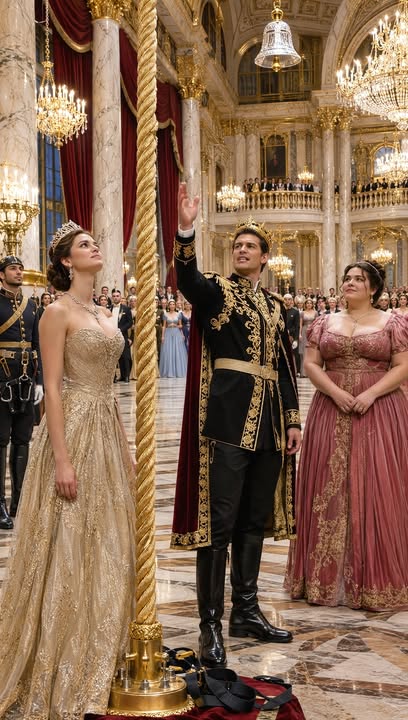
On the first anniversary of the evening Olivia climbed the golden rope, the palace invited the people of the capital into the ballroom.
The rope had been restored, its hidden pocket preserved behind glass so that no one would mistake the secret for a flaw to be discarded.
The crystal bell remained above it, shining beneath the chandeliers.
Beside the ballroom doors, a small plaque bore the names of Queen Eleanor and Mara.
It also carried a line from the queen’s message:
Neither child should be asked to repair the past by surrendering the future.
Olivia stood beneath the rope with Alexander on one side and Victoria on the other.
Sabine sat near the front with Mistress Vale, watching the room fill with palace workers, townspeople, and council members.
No one had been asked to compete for a marriage.
No one was waiting to see which woman could earn the right to be chosen.
The bell would be rung to mark the opening of the palace’s new training rooms, where young people from the city could learn the old crafts and where palace staff would be paid for the knowledge they had long been expected to give freely.
Alexander offered Olivia the small brass token.
“Do you want to climb?” he asked.
She looked up at the rope.
“Not today.”
He nodded.
“Then what would you like?”
“I’d like everyone to ring the bell together.”
The guards lowered the rope enough for the crystal bell’s clapper to be reached from the floor.
Alexander, Olivia, Victoria, Sabine, Mistress Vale, and a palace apprentice each took hold of a ribbon attached to the bell’s pull.
They looked at one another, and then together they drew it down.
The bell rang clear and bright through the ballroom.
Its sound reached the galleries, the courtyard, and the open windows above the city.
For one fleeting moment, Olivia imagined Queen Eleanor hearing it wherever her life had led her.
She imagined Mara beside her, hands folded, proud not of a crown but of the girl who had learned to trust her own footing.
When the note faded, Alexander’s hand found Olivia’s.
She held it.
Victoria stood close enough for their shoulders to touch, while Sabine smiled through her tears.
The crystal bell had once been set above a rope to decide who would become a prince’s bride.
Now its voice welcomed workers into rooms where their skill would be honored, marked a family reunited without being forced to become whole, and celebrated a future no council could choose on someone else’s behalf.
Olivia looked up at the golden strands, remembering how Mara had taught her to move with them rather than fight them.
The rope had kept the memory of every hand that touched it.
At last, the palace had begun to remember the people who had held it.
**–THE END–PLEASE
Share your thoughts or feedback to motivate us to create more stories ♥️
* * *
[PREVIOUS: PART 5](https://storyly.idolsgift.com/blog/part-5-the-knot-that-remembered-069)
✓ Lynn R. Adams
Part 6 – A Bell for Everyone The letter lay between the three of them, its final line written in a hand none of them recognized. Mara did not take the child alone. Someone from the council helped h…