PART 6 (THE END): The Knot That Rang the Bell 058
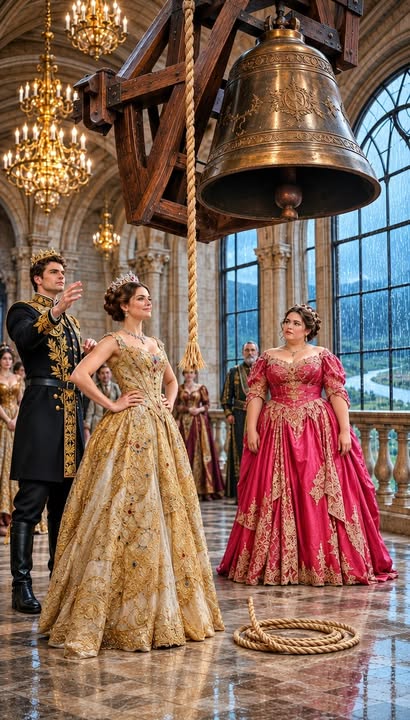
Part 6 – The Bell That Carried
The prince stared at the message, while the rain whispered against the gallery windows and the distant bell fell silent again.
“Where was the file found?” Amara asked.
“Beneath the eastern signal lamp,” the runner said. “Master Ivers is on his way.”
The prince turned the damp sheet over, searching for more, but the back was blank.
“Was anyone with him when he found it?”
“The tower keeper, Your Highness.”
The answer seemed to unsettle the prince more than it should have.
He glanced up toward the shadowed tower, where the old wheel rested against its brace.
“Ask them to bring it here,” he said. “Carefully.”
The runner hurried away.
Lena watched the prince fold the message once, then open it again, as if the words might change under his hand.
“Do you think the seal is genuine?” she asked.
“It looks like my father’s.”
“That doesn’t tell us when it was made.”
“No,” he said. “It doesn’t.”
Amara stood close beside him, her hand still resting on the evacuation list.
“Whatever the file contains, we’ll read it with the records we already have,” she said. “Not as a verdict by itself.”
The prince nodded.
“I don’t want to mistake another fragment for the whole truth.”
“Then we’ll make sure we don’t.”
The answer was simple, but the trust beneath it was not.
A few minutes later, Master Ivers came through the gallery doors, carrying a narrow wooden case against his chest.
The tower keeper followed him, soaked through at the shoulders and breathing hard from the climb.
“I found it inside the signal lamp housing,” the keeper said. “It had been wrapped in oiled cloth and wedged beneath the base.”
“Was the lamp opened recently?” Lena asked.
“Not that I could tell. The casing is old, and the lower panel is loose.”
Master Ivers set the case on the table.
“The file was catalogued as transferred to the tower office,” he said. “I found a space where it may once have sat, but no file.”
“Someone hid it in the lamp?” Amara asked.
“Perhaps,” the archivist replied. “Or it was moved there later, when the tower office was cleared.”
The prince looked at the case without opening it.
“Could the seal be from my father’s private correspondence?”
Master Ivers inspected the wax through the clear wrapping.
“The impression appears genuine, but the paper and ink will tell us more than the seal alone.”
He removed his gloves, washed his hands at the basin, then opened the case.
Inside lay a small bundle of letters tied with a faded blue ribbon.
Beneath them rested a folded sheet bearing the same royal seal shown on the runner’s message.
Master Ivers began with the letters.
The first was dated three days after the flood.
It was addressed to Orlan Venn, the tower keeper.
The archivist read it silently, then set it down for the prince.
The handwriting was unmistakable.
The king’s words were spare and formal, but they acknowledged that the bell had not carried through the rain, and that the keeper had been ordered to wait.
The letter did not excuse the order.
It said only that the king had believed the river was stable, had relied on an inaccurate reading, and had allowed the celebration to take precedence over the keeper’s warning.
The final lines acknowledged that the official report had concealed the failure.
The prince read the letter twice.
His shoulders had been held rigid since the messenger arrived.
Now they lowered a little, though grief remained in his face.
“He admitted it,” he said.
“Partly,” Amara replied. “He named what he did and what the report hid.”
“He did not say what happened in the valley.”
“No,” Lena said. “That still belongs in the public account.”
The prince nodded.
He seemed to understand that an admission was not the same as repair.
Master Ivers opened the next letter.
It was addressed to Amara’s great-grandfather, and its language was more personal.
The king wrote that he knew the supplier had been pressured to sign the final report and that the pressure had been wrong.
He stated that the workers’ contracts would not be canceled, and that no family should lose its livelihood because its employer refused to invent a different account of the flood.
Amara pressed her lips together as she read.
“My great-grandfather was afraid the workers would suffer,” she said.
“Yes,” the prince replied. “And he still signed the report.”
“Both things are true.”
The prince looked at her.
“Both things can be true,” he said.
The words did not absolve her ancestor, nor did they reduce him to the worst thing he had done.
Amara’s face eased, though her eyes glistened.
She touched the edge of the letter, careful not to disturb it.
“He should have told his family,” she whispered.
“Perhaps he could not bear to,” Lena said.
“Perhaps.”
Amara took a slow breath and looked toward the window.
Outside, the lanterns along the lower road continued to move uphill, steady points of gold in the dark.
The prince unfolded the final sheet.
It was a short statement, written in his father’s hand and dated several years after the flood.
The king acknowledged that the palace had failed to repair the bell properly after the incident and that subsequent reports had treated the old bend as a full repair.
He had ordered a proper inspection, but the order had never been completed.
At the bottom, he had written that the records should be kept together and made available to the next keeper of the crown.
The file had not vanished because someone wanted it to disappear.
It had been misplaced, then forgotten, inside the tower’s old signal housing.
The explanation was ordinary in its way, and therefore sadder.
No dramatic hand had come later to erase the past.
People had simply stopped looking.
The prince rested the page on the table.
“My father knew the bell still needed attention,” he said. “He ordered a repair, and it was never done.”
“Then the failure was not only one decision,” Lena replied. “It was what came after.”
He looked at the old rope, hanging quiet beneath the bronze bell.
“Yes.”
The tower keeper examined the mechanism again.
“The wheel shifted during the second note,” he said. “The brace caught most of the movement, but the frame is no longer safe to pull.”
“Was that second note from this bell?” Lena asked.
“I believe so. A gust may have moved the loose wheel enough to let it strike once.”
He shook his head.
“It carried farther than I expected, but we cannot count on it again.”
The prince looked toward the dark valley.
“Then the riders and lamps remain our warning.”
“Until the bell is repaired,” Lena said. “And tested properly.”
He met her gaze.
“Properly,” he agreed.
Another runner entered with the latest river reading.
The water had risen to the lower road, but the evacuation was complete.
The river wardens had confirmed that every household in the threatened area had reached higher ground.
One elderly man had needed help from his neighbors, but he was safe, warm, and already with his family.
The prince read the report and let out a breath that seemed to come from somewhere deeper than his chest.
“Everyone is accounted for?”
“Yes, Your Highness.”
“Then send the same message to the village council. No family is to return until the wardens confirm the road is clear.”
The runner bowed and left.
The people in the gallery did not cheer.
They were tired, wet, and aware that the river had risen close to the homes they knew.
But relief spread among them with the quiet force of something earned.
Amara gathered the names on her list and checked them against the runner’s report.
When she found every household accounted for, she set the page down.
Lena put her hand over Amara’s.
This time neither of them hesitated.
Amara turned her palm upward and held Lena’s fingers.
The touch was small and steady, and it said what neither had yet managed to put into words.
The prince saw them.
His smile was brief, but genuine.
“Master Ivers,” he said, “prepare copies of the letters and report. The valley should see the whole account, including what my father admitted and what he failed to finish.”
“I will.”
“And make clear that the records do not erase the consequences.”
The archivist nodded.
“I’ll include the findings, the uncertainties, and the steps being taken now.”
The prince turned to Amara.
“Your family’s statement should be included if you still wish to make one.”
“I do.”
“Then it will be printed beside the records, not tucked into a note at the end.”
Amara’s eyes met his.
“Thank you.”
He looked to Lena.
“And the bell?”
“Rebuild the support, replace the worn line, and have someone outside the palace test it,” she said. “Then teach the village wardens how to inspect it themselves.”
The tower keeper nodded.
“That is sensible.”
“Not just the bell,” Lena continued. “The entire warning system. Every route, every lamp, every person responsible for passing the message.”
The prince listened without looking away.
“Then that is what we’ll do.”
The first morning light reached the gallery before the rain stopped.
By then, the river had begun to ease back from the lower road.
The families waited at the hill shelter, where palace staff and village volunteers brought blankets, bread, and hot broth.
The prince went there without his crown and listened as residents described what had helped them leave quickly and what had slowed them down.
He did not promise that the river would never rise again.
He promised that the warning routes would be reviewed with the people who used them, and that the records of every test would be public.
The villagers asked hard questions.
He answered them as plainly as he could.
When he did not know something, he said so, then wrote it down.
Amara spoke with the families from the lower lane.
She told them what her great-grandfather had signed and what the new records showed about the pressure put upon him.
She did not ask them to forgive her family.
She did not ask them to distinguish between shame and responsibility before they had heard the whole account.
She simply offered the family’s archives and promised to help make the records accessible.
One older woman listened, then said, “We need the truth more than we need someone to suffer for it.”
Amara’s face changed, as if the words had reached her in a place she had been protecting.
“Thank you,” she said.
The woman shook her head gently.
“Don’t thank me. Help us keep the bell working.”
“I will.”
Lena found her near the shelter doorway afterward.
Amara’s hair had loosened in the damp, and her green sleeves were marked with mud from carrying boxes.
“You look different without the court around you,” Lena said.
“So do you.”
“I look wet.”
“You look useful.”
Lena laughed, and the sound came more easily than it had the day before.
Amara smiled at her.
“I’ve been thinking about the first day,” she said. “I wanted the prince to see that I knew how to be a queen.”
“And now?”
“Now I think I’d rather learn how to be wrong without becoming cruel to myself or anyone else.”
“That sounds more difficult.”
“It is.”
“But better.”
Amara looked down at their hands.
She had taken Lena’s without realizing it, or perhaps had realized and chosen not to let go.
“I’d like to spend more time with you,” she said. “Not only because we are working on the bell.”
Lena felt warmth rise in her face.
“I’d like that too.”
Amara’s fingers tightened gently around hers.
Neither of them tried to turn the moment into a promise larger than it was.
For now, it was enough to choose the next conversation, the next morning, the next task together.
The months that followed were busy with repairs and public meetings.
The old wheel was taken apart and rebuilt by a team that included the tower keeper, local mechanics, and volunteers from the lower valley.
Lena helped inspect the rope and taught the wardens how to identify wear, damp, and slipping turns.
Amara worked beside her, learning the practical craft she had once thought too plain to matter.
Her first knots were clumsy.
The next were serviceable.
In time, she began tying them with a confidence that came not from pretending she had always known how, but from allowing herself to learn.
The prince kept the promise he had made in the west hall.
The old reports were published with the letters that clarified them.
The account named his father’s order, the failed bell, the incomplete repair, and the official report that had concealed what happened.
It also named the pressure placed on Amara’s great-grandfather and the choice he had made under it.
The public inquiry did not treat context as an excuse.
It treated it as part of the record.
New alarms were installed along the river road, and the villages helped decide where they belonged.
Riders were assigned routes, lamps were checked each season, and every test was entered in a public ledger kept both at the palace and the lower valley office.
No single warning would be trusted to carry every life.
The prince remained in public service.
There were people who criticized him for exposing his father’s wrongdoing, and others who said he should have revealed more sooner.
He listened to both.
Some members of the court wanted him to step away from the crown.
The public inquiry found that he had not known about the old cover-up before the bell test, and that he had acted once the records came to light.
He did not insist that this made him blameless in the present.
Instead, he kept working with the valley councils, answering questions and making sure repairs were completed.
The people’s trust did not return as a single grand gesture.
It grew gradually, through open records, dependable warnings, and a prince who no longer mistook silence for steadiness.
In the first spring after the flood, the newly repaired bell was tested before the whole valley.
The ceremony took place in the west gallery, where the ropes had once lain severed across the marble.
No court had been invited to judge anyone.
The doors stood open to residents, workers, families, and children who crowded the courtyard below.
Amara waited beside Lena, dressed in a simple rose-colored gown that moved softly around her as she turned toward the bell.
The color was close to the dress Lena had worn on the day of the trial, though Amara had chosen it herself.
“I’m nervous,” she admitted.
“About the knot?”
“About everyone watching me tie it.”
“You’ve tied it dozens of times.”
“Not with the whole valley watching.”
Lena offered her a coil of rope.
“Then look at the rope instead.”
Amara took it.
Her hands moved carefully, forming the bend and guiding the turns into place.
She paused once to dress the strands, then tested the knot with a measured pull.
The rope held.
The prince stood by the wheel, no crown on his head.
He wore the same black-and-gold uniform he had worn at the first test, though its collar was open and rain had darkened one shoulder.
“Ready?” he asked.
Amara looked at Lena.
“Ready.”
Together, they took hold of the lower rope.
They pulled.
The wheel turned smoothly, the repaired frame holding firm.
The bronze bell rang out over the courtyard, clear and deep.
Its note traveled across the gardens, over the palace walls, and down toward the valley.
A second note followed, then a third.
The sound did not erase the old silence.
It answered it.
Below, the villagers lifted their faces toward the tower.
Some smiled.
One child clapped both hands over her ears, then laughed when her father gently lowered them.
Lena felt Amara’s hand find hers.
The prince came to stand beside them.
For a while, the three of them watched the people in the courtyard listen to the bell.
“I used to think the crown meant you had to know the right answer before you spoke,” the prince said.
“And now?” Amara asked.
“Now I think it means you have to be willing to hear the answer you didn’t want.”
Lena smiled.
“That sounds harder too.”
“It is,” he said. “But it seems to leave more room for other people.”
Amara looked at him, then at Lena.
“I’m glad the trial brought us here.”
“So am I,” Lena said.
The prince’s expression softened.
“And I’m glad neither of you let me mistake a working knot for a repaired system.”
“We had help,” Lena said.
The tower keeper stood nearby, speaking with the river wardens.
Master Ivers was showing two children how to read the new public ledger.
The valley representatives were already discussing where the next signal lamp should be placed.
No one person had fixed the bell.
No one person had made the truth complete.
They had built something safer by letting their different knowledge meet.
The old rope was preserved in a glass case near the gallery entrance.
Its fibers were worn and darkened, the thinner strand looped around the thick hemp in the same practical bend Lena had tied on the first day.
A small plaque beside it described the flood, the concealed report, and the people who had worked to restore the warning system.
It did not call the rope a symbol of disgrace.
It called it the first repair they had made together, and the beginning of a public record that would not be hidden again.
When the bell finished ringing, Lena turned toward Amara.
“Would you like to practice another knot?” she asked.
Amara smiled.
“Only if you’ll let me teach you something in return.”
“What?”
“How to enter a room without thinking every person in it is waiting for you to fail.”
Lena considered that.
“I could use the lesson.”
“I’m still learning it myself.”
“Then we’ll learn together.”
Amara leaned her shoulder gently against Lena’s.
Their closeness no longer felt like a fragile truce.
It had become a friendship shaped by honesty, patience, and the choice to keep returning to the hard work.
The prince joined them, carrying three cups of tea from the long table.
“To the bell,” he said.
“To the people who heard it,” Amara replied.
“And to the people who made sure it would sound again,” Lena added.
They touched their cups together.
Beyond the open doors, the valley shone in the afternoon sun, its river broad and bright between green banks.
The bronze bell rested above them, ready for the next test, its rope firm in the wheel.
For the first time, its silence did not feel like a secret waiting to be discovered.
It felt like a quiet moment between warnings, held by people who had learned to listen.
**–THE END–PLEASE
Share your thoughts or feedback to motivate us to create more stories ♥️
* * *
[PREVIOUS: PART 5](https://storyly.idolsgift.com/blog/part-5-the-knot-that-rang-the-bell-058)
✓ Lynn R. Adams
Part 6 – The Bell That Carried The prince stared at the message, while the rain whispered against the gallery windows and the distant bell fell silent again. “Where was the file found?” Amara asked….