PART 6 (THE END): The Key Her Mother Left Behind 055
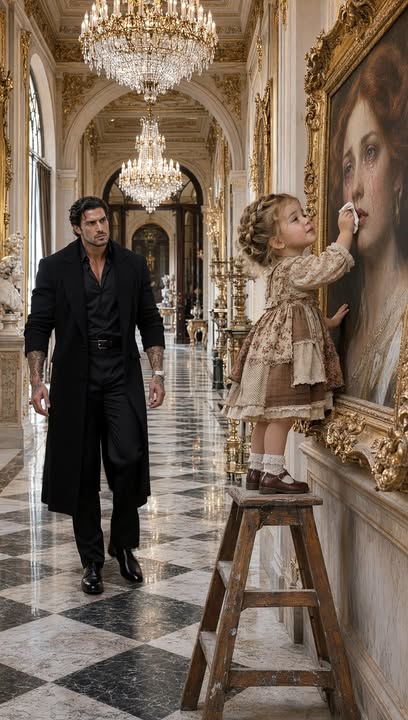
Part 6 – The Light Beyond the Portrait
Gabriel felt the room change around Daniel’s words.
A statement signed by Thomas Reed twenty-two years ago, asking that no one search for him, might have explained why he had vanished.
It did not explain why Richard had signed his discharge papers last week, or why Thomas had chosen an assumed name, or where he had gone now.
Olivia held the back of a chair.
“Could he have written it because he was afraid?” she asked.
“He may have wanted to keep someone safe,” Daniel said. “The statement doesn’t say.”
Gabriel turned to the window, searching the dark garden for an answer the glass could not give him.
“Can the hospital tell us where he was admitted?”
“They can provide the address once the legal request is approved.”
“Then we’ll follow the record, not guess at it.”
Olivia looked down at the photograph on the desk.
“My mother spent all those years waiting for him to come back.”
“Maybe she understood why he couldn’t,” Gabriel said.
“Or maybe she never knew he was still alive.”
The thought entered the room gently and hurt all the same.
Gabriel glanced at Daniel.
“Find out whether the emergency contact information was written by Thomas or added by the hospital.”
“I’ll ask.”
“And make no assumptions about Richard’s reason for signing.”
Daniel nodded.
When he left, Olivia moved closer to Gabriel.
“You told me we’d find him.”
“We will keep looking.”
“What if he doesn’t want to be found?”
“Then we’ll respect that.”
She looked at him for a long moment.
“Even if he’s the only person who can tell us what my mother was trying to protect?”
“Even then.”
Olivia’s shoulders lowered a little.
It was not the answer that promised certainty.
It was the answer that told her she would not have to trade her uncle’s peace for the truth.
The investigation began without speeches or dramatic announcements.
An attorney carried the hospital records to the appropriate authorities, who reopened the review of Katarina’s death and requested the family’s shipping documents.
Gabriel provided access to the company archives, including old manifests and correspondence that had never been examined together.
He also gave investigators the letters found behind the portrait, Margaret’s note, the photograph, and the available pages from the Cedar Lane ledger.
Olivia met with an investigator and described what her mother had told her, then explained what she did not know.
She did not let anyone turn her uncertainty into an accusation.
When she finished, she looked exhausted but lighter, as if some small part of the burden had finally been placed in the hands of people who could carry it with her.
Gabriel waited outside the interview room.
He offered neither praise nor questions when she emerged.
He simply walked beside her to the car.
“Thank you for letting me decide,” she said.
“Thank you for telling what you could.”
“I’m still afraid.”
“So am I.”
She glanced at him, surprised.
“Of the investigation?”
“Of what the truth may ask us to become.”
Olivia slipped her hand into his.
“Then we’ll find out one step at a time.”
In the weeks that followed, the story of Katarina’s final night came into focus not through one grand revelation, but through careful work.
The hospital found a second copy of the missing ledger page in an old administrative file that had been mislabeled decades earlier.
It confirmed that Katarina had arrived conscious, spoken with Margaret, and asked for Thomas.
A medical note recorded that she had been given a drink from a bottle brought into the ward by someone not listed as hospital staff.
The bottle was long gone, and the note did not name who had delivered it.
But the preserved medical record showed that Katarina’s symptoms were inconsistent with the illness described in the official summary.
A specialist reviewing the notes concluded that poisoning was the most likely explanation.
The conclusion was grave, but it was not yet proof of who had done it.
Then investigators found the envelope Margaret had taken from the ward.
She had hidden it inside the lining of an old nursing case, sealed between two layers of cloth and kept in a box of her personal belongings.
Olivia recognized the case from her childhood.
Her mother had used it to store spare buttons and sewing thread.
Inside the envelope were copies of the shipping manifests and a brief note in Katarina’s hand.
It named no killer.
It did, however, say that she had discovered falsified records tied to a deadly accident at the docks, and that she had given supporting documents to Margaret because she feared the originals would be destroyed.
The papers also contained the names of workers whose injuries and deaths had been omitted from the company’s official account.
The company had not caused the accident itself, the investigators found, but Richard had altered the records afterward to conceal the full extent of the harm and the failure to report it.
That finding did not answer every question about Katarina’s death.
It did explain why she had wanted the truth brought into the open.
The final evidence came from Richard’s study.
While sorting documents for the investigators, Gabriel found an old copy of the hospital summary tucked inside a leather folder.
It had been annotated in Richard’s handwriting.
Beside the altered description of Katarina’s condition, he had written a note about which version should be given to the family.
The annotations matched the corrected record, and they showed that Richard had known the official account did not reflect what the hospital staff had observed.
His silver serpent ring had never been proof by itself.
His own careful notes were.
When investigators interviewed him, Richard did not deny the handwriting.
He confirmed that he had helped preserve the false account, first because Gabriel’s father insisted that the family should not be drawn into scandal, and later because he feared the truth would expose the company and everyone who had relied on it.
He denied arranging Katarina’s poisoning.
Investigators found evidence of the falsified records and the cover-up, but not enough to establish that Richard had carried out or ordered the poisoning.
The distinction mattered.
It did not excuse what he had done.
It did prevent the investigation from claiming more than it could prove.
Gabriel sat alone with Richard in the library after the first formal interview.
The old portrait had been taken down to have the moisture device removed and the canvas carefully restored.
Its empty place on the wall seemed less like an absence now and more like a space waiting for something honest to be put back.
Richard’s hands rested on his knees.
The serpent ring was gone.
“I thought that once the records were opened, I would feel relieved,” Richard said.
“Do you?”
“No.”
“Neither do I.”
Richard looked at the empty wall.
“I cannot ask you to believe that I tried to protect you.”
“I believe you wanted to protect me.”
“That isn’t the same as saying I did.”
“No.”
“I made the family’s comfort more important than the truth.”
Gabriel lowered his eyes.
“I know.”
“I should have told you about the hospital.”
“Yes.”
“I should have told you I went to Margaret’s building.”
“Yes.”
“I should have corrected the story about Thomas years ago.”
“Yes.”
Richard’s face held no defense now, only the tiredness of a man finally hearing the weight of his own decisions.
“I am sorry, Gabriel.”
The apology did not make the years return.
It did not restore what had been taken from Katarina, Margaret, or Thomas.
But it was not offered as a key that would unlock forgiveness.
It was simply the truth, spoken at last.
Gabriel leaned back in his chair.
“I don’t know what our relationship will be.”
“I understand.”
“But I don’t want to decide it tonight.”
Richard nodded.
“That is more than I deserve.”
“It’s what I’m able to offer.”
For the first time in a long while, neither man tried to make the silence do the work of an answer.
Richard left the library quietly.
Gabriel remained there, listening to the house, and understood that justice did not always arrive with the satisfaction of a clean ending.
Sometimes it began when people stopped asking the hurt to disappear before they were willing to name it.
Thomas was found because Daniel followed the hospital file to the address where he had been staying.
He was living under a different name in a small town near the lake, in a quiet apartment above a bookshop.
He had gone there after his recent illness, believing no one from his past had learned where he was.
When Gabriel and Olivia reached the address, they waited on the landing while Daniel knocked.
A man opened the door.
His hair had gone silver, his shoulders were narrower than in the photograph, but Olivia knew him before he said a word.
“Uncle Thomas,” she whispered.
For a moment, his face became the young man from the picture: startled, uncertain, and suddenly close to tears.
“Olivia,” he said.
She stepped forward, then stopped, giving him the chance to decide what he could bear.
Thomas opened his arms.
She crossed the small distance between them and held him.
He was frail, but his embrace was steady.
“I thought Margaret had kept you away from all of this,” he said.
“She tried.”
“She should have.”
“She left me a choice.”
Thomas looked at Gabriel.
“I’m sorry,” he said.
“For what?”
“For the way your mother’s death was recorded. For disappearing. For leaving Margaret to carry what I couldn’t.”
Gabriel looked past him into the modest room.
There were shelves of books, a kettle on a small table, and a framed photograph of a woman Gabriel did not know.
“You were ill,” Olivia said. “The hospital record showed you left last week.”
“I was discharged and came here.”
“Why did you use an assumed name?”
“Because the accusation never left me, even after the people who made it were gone.”
He lowered his eyes.
“I thought disappearing was the safest thing I could give my family.”
“Did you know my mother thought you were still alive?” Olivia asked.
“I hoped she did.”
“Did you ever try to contact her?”
“Once, many years ago. Richard helped me leave a message.”
Olivia’s gaze flickered toward Gabriel.
“What did the message say?”
“That I was alive and that I was sorry.”
“My mother never told me she received it.”
“Perhaps she never did.”
Thomas looked troubled.
“Richard said he would deliver it himself.”
Gabriel felt the old uncertainty return, but not as an accusation.
He was learning to let a new fact stand beside an old question without forcing either to pretend it was complete.
“Did Richard help you leave town the night Katarina died?” he asked.
“He did.”
“Why?”
“Because people were searching for the papers I had found.”
“Who?”
“Your father’s associates, mostly. I don’t know who gave the orders. I knew Richard was afraid, but I believed he was trying to keep Margaret and Olivia out of it.”
Thomas’s voice was thin with age, but his words remained clear.
“I signed that statement because I thought that if my name disappeared, the people who were asking questions would stop looking.”
“Did you steal money from the family?” Olivia asked.
“No.”
He did not hesitate.
“I took copies of the manifests. I did not take a dollar.”
“Why didn’t you come back to clear your name?”
“Because I thought coming back would put Margaret in danger. Then years passed, and my silence became a wall I didn’t know how to climb.”
Olivia’s eyes shone.
“My mother waited for you.”
“I know.”
“She kept your letters.”
Thomas looked at the framed photograph of the woman on his table.
“I sent only two. I thought she would understand why I couldn’t say more.”
“She kept them,” Olivia said. “She burned them afterward.”
Thomas closed his eyes.
“Margaret always knew how to keep a secret without letting it make her bitter.”
“She didn’t always manage,” Olivia replied. “She was afraid.”
“So was I.”
They sat together in the small apartment while Thomas told them what he remembered.
He had seen Katarina at the hospital.
She was frightened and weak, but she knew where she was and recognized the people around her.
She had asked him to help Margaret preserve the papers.
She had not told him who she believed was responsible for the falsified manifests, only that she had found evidence someone powerful wanted buried.
Thomas had left the envelope with Margaret before he disappeared.
He never knew that she had hidden it in her nursing case, and he had not known she had kept the hospital ledger.
“I thought I was the only one who had anything,” he said.
“Mother thought she was,” Olivia replied.
“And Katarina trusted both of you,” Gabriel said.
Thomas looked at him with a sorrow that felt older than apology.
“She trusted you, too, though you were only a boy.”
Gabriel’s brows drew together.
“What do you mean?”
“She asked me to tell you one thing if I ever had the chance.”
“What?”
“That she wanted you to grow into someone who could choose what was right without hating everyone who had failed you.”
Gabriel looked down at his hands.
There was no way to know whether Katarina had spoken those exact words or whether Thomas had carried their meaning all these years.
It did not matter.
He could feel her presence in them all the same.
When the investigators met with Thomas, he gave a formal statement and identified the missing corner of the photograph he had kept folded inside an old book.
It matched the torn edge of the family picture exactly.
On the back was the full date and a short note in Katarina’s handwriting.
*For Margaret, who tells the truth gently enough that people can bear to hear it.*
Margaret’s name was not an accidental part of the mystery.
She had been chosen.
She had been trusted.
And she had done what she could to keep that trust alive.
The corner did not prove who poisoned Katarina.
It did something quieter and perhaps more lasting: it restored the photograph to its proper shape and confirmed the tenderness between three people who had refused to let the powerful decide what their memories meant.
The investigation concluded months later.
Richard was charged in connection with falsifying the shipping records and concealing the true scope of the dock accident.
The evidence did not prove that he had poisoned Katarina or ordered anyone else to do so.
The case concerning her death remained open as investigators continued reviewing the medical evidence.
Richard was not treated as the answer to every mystery simply because his ring had appeared in a warning.
He was held accountable for what the records proved.
Thomas was cleared of the accusation of theft after the company’s review found no missing funds connected to him.
The official correction named him as the person who had preserved copies of the shipping records, not the person who had stolen from the family.
When the correction was published, Olivia read it beside her mother’s letter.
She cried quietly, not because the words repaired every loss, but because Thomas’s name no longer had to carry a lie.
The hospital also corrected its account of Katarina’s final admission.
The revised record stated that she had arrived alive and requested Margaret by name, and that the circumstances of her death remained under review.
There was no grand public ceremony.
There was a small gathering at Cedar Lane, where the hospital dedicated a family support room in Margaret’s name.
The room had soft chairs, a play corner for children, and a wide window looking onto a garden.
A brass plaque by the door read: *In honor of Margaret Reed Carter, who believed no one should have to face the truth alone.*
Olivia stood before the plaque with Lily at her side and Thomas beside them.
Gabriel watched from a few steps away.
He had once thought recognition meant a name spoken by important people.
Now he saw the meaning in the way Olivia’s hand rested on the plaque, and in the way Thomas stood beside her without needing to hide.
Lily ran into the play corner and returned carrying a paper flower.
“Grandma would like this room,” she said.
“She would,” Olivia told her.
Gabriel crouched beside Lily.
“What makes you think that?”
“Because people can rest here.”
He smiled.
“That’s a very good reason.”
The investigation had changed the Moretti company.
Gabriel put the profitable but deeply flawed shipping division under independent oversight and redirected a portion of his inheritance to support the injured workers’ families and the hospital.
It cost him money, influence, and the easy respect of people who preferred the old story.
It also relieved him of the need to pretend that wealth was innocent simply because it had been handed down.
The choice was not made in a single dramatic gesture.
It came through months of meetings, legal reviews, difficult letters, and decisions that rarely earned applause.
Daniel helped him build a foundation that funded emergency housing and practical support for families threatened by organized crime or forced to leave unsafe situations.
They called it the Margaret and Katarina Family Fund.
Gabriel wanted the name to honor not only what the women had endured, but what they had given each other.
Olivia joined the work because she chose to.
She was no longer a housekeeper with a hidden mission, nor a daughter following an unfinished instruction without understanding it.
She became a trusted partner who knew how to listen to people frightened of asking for help, and how to tell the difference between protecting someone and taking their choice away.
Gabriel learned from her that care could be steady without being controlling.
Olivia learned from him that trust did not require certainty; it required honesty about what was known and what remained unknown.
Their closeness grew without a promise that erased the difficult parts of their lives.
Some evenings they argued over the foundation’s plans.
Some mornings they shared coffee while Lily painted at the kitchen table.
Gabriel did not ask Olivia to remain because she owed him anything.
She stayed because the life they were building was one she wanted.
Richard wrote to Gabriel from the place where he was awaiting the outcome of his case.
His letters did not ask for forgiveness or offer new explanations.
They described memories: Katarina laughing in the hospital garden, Gabriel as a boy refusing to let anyone tie his shoes, the first time Richard had realized that silence could be mistaken for love.
Gabriel read the letters and replied when he was ready.
Their relationship did not return to what it had been.
It became something more honest, if less certain.
When Richard accepted responsibility for the falsified records, Gabriel acknowledged that choice without pretending it canceled what came before.
He learned that a person could be accountable and still remain human.
That lesson did not make the past smaller.
It made the future less burdened by the need to hate.
A year after the portrait had been opened, Gabriel brought it to the family room at the mansion.
The restored canvas stood upright on a padded easel, its frame cleaned and its hidden compartment removed.
The painted streaks had vanished under the conservator’s careful work.
Katarina’s face remained exactly as it had been, but the portrait no longer looked like a sealed door.
Lily stood beside her mother, holding the paper drawing she had made the morning of the discovery.
She had brought a new one, too.
This picture showed Katarina beneath a yellow sun, with Margaret beside her and Thomas nearby.
All three stood in a green garden.
Nobody was crying.
“Where should it go?” Lily asked.
“Where would you like it?” Gabriel said.
She pointed to a wall in the family room, where the morning light reached in soft bands across the paint.
“Somewhere everyone can see her.”
“That’s a good place.”
They hung the portrait there.
Olivia stepped back to look at it.
“She doesn’t look sad anymore,” Lily said.
Gabriel rested a hand lightly on the edge of the frame.
“She looks remembered.”
Olivia’s eyes met his across the room.
That evening, Thomas came to dinner.
He sat beside Olivia and told Lily a story about the old hospital garden, where Margaret used to bring him tea during their breaks.
He spoke of Katarina as a woman who laughed easily when the world gave her the chance, and of Margaret as someone who could make even a bleak corridor feel like a place to rest.
Lily listened with her chin in her hands.
“Were they scared?” she asked.
“Yes,” Thomas said. “Sometimes.”
“Did they still help each other?”
“They did.”
Lily nodded as if this was the part of the story she needed to keep.
“Then they were brave.”
Thomas smiled.
“Yes,” he said. “They were.”
Later, after the house had settled, Olivia and Gabriel stood together in the hallway beneath the portrait.
The mansion was quieter than it had once been.
Its rooms no longer held the same guarded stillness.
There were photographs on the side tables, fresh flowers in the hall, and the sound of Lily laughing somewhere upstairs.
“Do you ever think about the morning she was crying?” Olivia asked.
“I think about Lily trying to dry the painting with a tissue.”
Olivia smiled.
“And what do you think now?”
“That she noticed what the rest of us had learned not to see.”
Olivia leaned her shoulder against his.
“Your mother’s secret brought us here.”
“Our mothers did.”
“Yes,” she said. “But what happens next belongs to us.”
Gabriel looked at the restored portrait, at Katarina’s clear eyes and the calm line of her mouth.
For twenty-two years, her death had been contained by a story designed to keep the family comfortable.
Now her life could be spoken of without pretending that courage had left no cost, or that love required silence.
The mystery had not ended with every question answered.
It had ended with the people who remained no longer forced to carry the unanswered parts alone.
Gabriel turned toward Olivia.
“Are you happy here?”
She considered the question, then looked toward the stairs where Lily’s night-light made a soft glow beneath her bedroom door.
“I’m safe,” she said. “I’m heard. And I’m here because I choose to be.”
His hand found hers.
“That’s more than I knew how to ask for.”
“It’s more than I knew how to hope for.”
They stood together beneath the portrait, not as people trapped by the past, but as people who had chosen what to do with it.
In the morning, Lily would wake beneath her grandmother’s picture.
The painted tears were gone.
The hidden device was gone.
And the truth, finally, had room to breathe.
**–THE END–PLEASE
Share your thoughts or feedback to motivate us to create more stories ♥️
* * *
[PREVIOUS: PART 5](https://storyly.idolsgift.com/blog/part-5-the-key-her-mother-left-behind-055)
✓ Lynn R. Adams
Part 6 – The Light Beyond the Portrait Gabriel felt the room change around Daniel’s words. A statement signed by Thomas Reed twenty-two years ago, asking that no one search for him, might have expla…