PART 6 (THE END): The Key Beneath the Dust 041
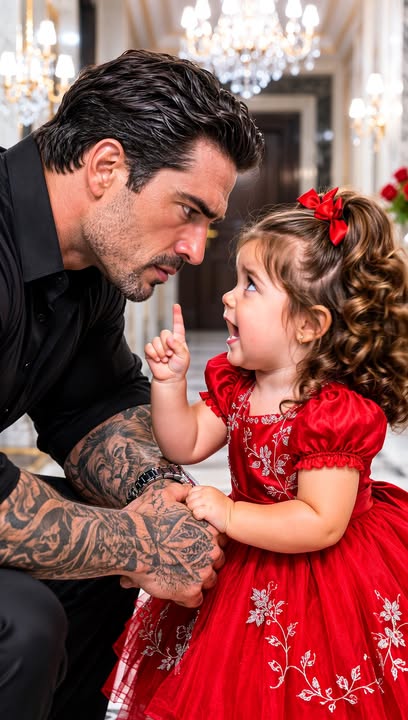
Part 6 – The Door They Opened
“Daddy,” Sophie whispered. “He said, ‘Tell Vincent the fifth door is open.’”
Vincent looked from her drawing to Margaret’s pale face.
“Who told you that, sweetheart?”
“The old man.”
“Did he come inside the house?”
Sophie nodded, then pointed toward the hallway.
“He had a key.”
A cold unease settled over Vincent, but he kept his voice calm.
“Did he talk to you for a long time?”
“No. He sing song.”
“Was he kind?”
Sophie thought carefully.
“He sad.”
Margaret knelt beside her, taking care not to startle her.
“Did the old man look like anyone in this picture?”
She showed Sophie the photograph of Elena and the little boy.
Sophie studied it, then shook her head.
“No. Old.”
“What about this one?” Vincent asked, taking a framed photograph of his father from the side table.
Sophie leaned close.
“Grandpa.”
“Did the old man look like Grandpa?”
She considered, then nodded.
“Same eyes.”
Vincent and Margaret exchanged a glance.
“Matteo Hale,” Margaret murmured. “Your father’s half brother.”
The name sounded different now, no longer a code on an old receipt or a figure in a family story.
It belonged to a person who had stood in Vincent’s home, sung a lullaby, and left Sophie with a message.
Vincent crouched in front of his daughter.
“Did he say when the fifth door would open?”
Sophie shook her head.
“Did he show you a door?”
“No. Just say it.”
“Did you tell anyone?”
“Sad lady.”
“Which sad lady?”
Sophie pointed to Elena’s photograph.
Vincent glanced at Margaret.
“She could mean Elena,” Margaret said. “Or the woman who was in the basement.”
“Margaret, were you ever told about five doors?”
“No.”
“Did my father have a place he called that?”
“Not that I remember.”
Vincent looked again at Sophie’s drawing.
The little marks beneath the old man were uneven, but there were five of them, each carefully made with the concentration of a child who had been told the number mattered.
He called Elena.
When she answered, he told her about Sophie’s memory and the name Matteo.
The line remained quiet for several seconds.
“Did Sophie see him recently?” Elena asked.
“She says it was a long time ago.”
“Did she say he was kind?”
“She did.”
“I’m relieved.”
“You knew he might come to the house?”
“No,” Elena replied. “I never knew where you lived, and I never asked anyone to find you.”
“Did Matteo know?”
“He may have known more than I did.”
“Why would he leave a message about a fifth door?”
“I don’t know.”
“Did your father ever speak of a fifth door?” Vincent asked.
A faint, unsteady breath came through the phone.
“Not a door,” Elena said. “A room.”
“What room?”
“The old family house had a passage with five doors. Your grandfather used the rooms as offices when he was alive.”
“Where was this house?”
“Near the river. It was sold long ago.”
Margaret leaned closer to the phone.
“Was there a room at the end of the passage?”
“Yes,” Elena said. “Your father called it the music room. He used to say it was the only place in the house where nobody talked business.”
Vincent looked at the silver key on the table.
“Could the lockbox key open anything there?”
“I don’t know,” Elena said. “Your father kept that key close.”
“Why would Matteo tell Sophie the fifth door was open?”
“I can’t answer that. But I can tell you this: Matteo loved music. He taught me the lullaby when we were children.”
The discovery did not settle anything, but it changed the shape of the message.
Vincent glanced at Margaret.
“Do you know where the old house is?”
“I know where it was,” she said. “It’s been converted into offices. Your father’s papers may have a record of the sale.”
“Could there still be something in the music room?”
“I don’t know,” Elena said. “But Matteo would have known the house better than anyone.”
Vincent’s hand closed around the phone.
“Do you want to come with us?”
“I’m not strong enough to travel today.”
“Then we’ll wait.”
“No,” Elena said. “If there’s something there, I want to know what it is.”
“Your health comes first.”
“My health has been used as a reason to keep me away from too many things.”
Her words were gentle, but Vincent heard their weight.
“Then we’ll go when your doctor says you can.”
“And Sophie?”
“She’ll come if she wants to.”
On the following afternoon, Elena’s physician approved a short outing with a nurse accompanying her.
Vincent drove them to the old Moretti house, a brick building that had been restored and divided into small professional offices.
The garden wall from the photograph was gone, but a pear tree still stood near the entrance, its branches reaching over the path as if time had passed around it rather than through it.
Elena rested in the back seat beside Sophie.
The girl had brought her drawing and the stuffed rabbit she rarely let out of her sight.
“Is this where you lived?” Sophie asked.
“Yes,” Elena replied. “A long time ago.”
“Did you sing here?”
“I did.”
Sophie leaned against her.
“Sing now?”
Elena smiled.
“On the way back.”
Inside, the current building manager greeted them and led them through the former entrance hall.
The passageway still had five doors.
Most opened into small offices, their walls painted pale cream, their old wood trim carefully preserved.
At the end stood the music room, now used for storage.
The manager unlocked it.
Sunlight reached through a tall window and rested on dust motes above a collection of folded chairs.
The room was quiet, but not empty of memory.
Elena moved to the window and touched the sill.
“I used to sit here with Matteo,” she said. “He was older than me by six years, but he never treated me like a child.”
“What happened to him?” Vincent asked.
“After your father learned he had been involved with dangerous people, they stopped speaking. Matteo left the city. I don’t know where he went.”
“Did he know you were alive?”
“I don’t know.”
The building manager gave them privacy and stepped into the hallway.
Vincent examined the doors, the shelves, and the old fireplace.
Margaret studied the paneling.
“There may have been a built-in cabinet here,” she said, pointing to a section of wall where the woodwork did not quite match.
Vincent followed her gaze.
The narrow panel was almost invisible beneath several coats of paint.
He pressed gently along its edge and found a small catch.
The panel released with a soft click.
Inside was a shallow compartment holding a cloth-wrapped bundle and a sealed envelope.
Elena’s hand rose to her mouth.
Vincent removed the bundle first.
It contained a small music box, its silver surface darkened with age.
Beneath it lay another note, written in a hand none of them recognized from the family records.
Elena unfolded it.
If you have found this, then someone has finally opened the door instead of guarding it.
I could not make your father understand that safety without choice is only another kind of loneliness.
I am sorry I did not find a way to reach Vincent sooner.
The fifth door was never locked.
You only had to decide to open it.
There was no signature, but the final line carried a name.
Matteo.
Elena closed her eyes.
For a moment, grief passed over her face, followed by something quieter.
“He knew,” she whispered. “He knew what your father was doing.”
“He tried to reach us,” Vincent said.
“Maybe.”
“Why didn’t he come himself?”
“I don’t know.”
Margaret looked at the letter.
“Perhaps he was afraid of bringing the danger closer.”
“Or perhaps he believed leaving a message was enough,” Vincent said.
Elena touched the paper.
“People in this family have mistaken distance for kindness for a long time.”
Vincent took her hand.
“We don’t have to keep doing that.”
She turned the music box over.
Its lid had no clasp, only a small keyhole at the side.
Vincent tried the silver key.
It fit.
The lock turned smoothly, and the music box opened.
A gentle melody filled the little room.
The tune was the lullaby Sophie had hummed in fragments, the same one Elena had once sung to Vincent.
Her eyes filled as the notes rose and fell.
Sophie stepped nearer.
“Sleepy song.”
“Yes,” Elena whispered. “It is.”
She sat beside Sophie and sang softly with the music.
The words were simple, old-fashioned, and tender.
Sophie leaned against her shoulder before the song was halfway through.
Vincent stood beside them, listening to a voice that had belonged to his earliest years, even though his memory had kept no clear trace of it.
When the melody ended, Elena held out her hand to him.
He took it.
For a few seconds, neither of them spoke.
Then Elena said, “Your father kept this room for me, I think.”
“Did he?”
“He brought me here once after you were born. He said it was the only place he could imagine us being together without anyone asking what would happen next.”
Vincent looked around the small room.
“Did you come back after he told you to disappear?”
“No.”
“Would you have wanted to?”
“Yes.”
The answer was so quiet that he almost missed it.
He drew a chair closer and sat beside her.
“I can’t give back the years,” he said.
“No,” Elena replied. “But you can give me the next ones.”
“I want to.”
She looked at him with the same eyes he had seen each morning in his own reflection.
“Then we’ll start there.”
The weeks that followed were not effortless, but they were honest.
Elena began visiting Vincent’s home in the afternoons, first for short visits and later for whole meals that stretched past sunset.
She met Sophie at a pace the child chose, answering every question she could and letting the others wait.
Margaret remained close, though the trust between her and Vincent needed time to mend.
She gave investigators everything she had kept, including the coded records and the names of the intermediaries who had handled the care payments.
The documents showed that Vincent’s father had arranged Elena’s life under an assumed name after Matteo warned him that a rival group wanted leverage against the family.
The threat had been real, though its reach had narrowed over the years.
Matteo had left the city after refusing to help those men use Elena as a way to pressure his brother.
He had not been heard from since.
There was no evidence that he had returned to the house when Sophie was small, and no one could determine whether her memory of the old man referred to Matteo or to someone else who had once visited.
The investigators did, however, find the source of the recent danger.
Vanessa had discovered the old payments while searching through the family trust.
She had diverted money for herself, but some transfers had also gone toward people who promised to uncover the hidden records and identify the person behind the name E. Vale.
Her claim that she wanted to expose the secret was only partly true.
The investigators found messages showing she had used the information to pressure Margaret and gain control over more of the trust.
She was arrested and charged with fraud and unlawful confinement, among other offenses.
The case proceeded without spectacle.
Vincent refused to let the family turn it into a private bargain, and he did not ask anyone to hide the truth on his behalf.
Margaret testified honestly about the records she had kept and the questions she had failed to ask.
Her cooperation helped establish that she had not taken part in Vanessa’s scheme.
She had made mistakes, and she did not pretend otherwise, but she had not betrayed Elena or profited from the money.
When the inquiry ended, Margaret was cleared of wrongdoing.
Vincent visited her at home after the final meeting.
“You could have told me sooner,” he said.
“Yes,” she replied.
“You could have trusted me.”
“Yes.”
“I’m still angry about it.”
“I understand.”
“But I don’t want anger to be the only thing we share.”
Margaret’s eyes glistened.
“Neither do I.”
He offered her his hand.
She took it, and the gesture was not forgiveness for everything.
It was a beginning.
As the months passed, Vincent changed parts of the family’s business that had once seemed untouchable.
He replaced opaque trust practices with independent oversight, ended arrangements built on fear and secrecy, and allowed investigators to pursue wrongdoing even when the truth reached back into his father’s time.
Some relatives complained.
A few left the business.
Others stayed and learned that loyalty did not have to mean silence.
Vincent did not make himself gentle overnight.
He still moved through rooms with the steady authority people expected from him, and he still carried the old instincts of a man raised to control every uncertainty.
But when uncertainty belonged to someone he loved, he began to ask before deciding.
He learned to tell Sophie when he was worried instead of pretending nothing could touch him.
He learned to let Elena answer questions in her own time.
He learned that Margaret’s apologies mattered less than what she did after making them.
On a bright Saturday near the end of autumn, Elena came to the house for dinner.
She wore a soft green sweater and carried the old music box in a cloth bag.
Sophie opened the front door before the nanny could reach it.
“Grandma!”
Elena bent carefully, and Sophie ran into her arms.
The girl had become steadier on her feet, though she still seemed to put all her heart into every small step.
“You brought the sleepy song,” Sophie said.
“I did.”
“Sing after dinner?”
“I would love to.”
Vincent watched from the hallway.
For years, the house had felt like a place where everyone knew which rooms not to enter and which questions not to ask.
Now the kitchen held the warmth of food on the stove, the clatter of plates, and Margaret’s laugh as Sophie insisted that every person at the table receive a piece of bread shaped like a star.
Elena sat between Vincent and Sophie.
The old photograph rested in a small frame on the mantel, beside Sophie’s drawing of the four figures.
The silver key hung from a narrow ribbon beneath the frame.
Vincent had once thought of it as a sign that something had been taken from him.
Now it reminded him that a door could open in both directions.
After dinner, Sophie climbed into the space between Vincent and Elena on the sofa.
She leaned against her grandmother, then reached for Vincent’s hand.
“Song,” she requested.
Elena began the lullaby.
Sophie’s eyes grew heavy as the familiar melody filled the room.
Vincent knew the tune now, not only from the music box, but from the quiet years it had crossed to find them.
When Elena reached the final line, her voice trembled.
Vincent rested his other hand over hers.
She looked at him, and the years between them seemed neither erased nor endless.
They were simply there, part of the story they would keep telling honestly.
Sophie fell asleep between them, one small hand curled around Elena’s finger and the other tucked into Vincent’s palm.
For once, no one rushed to carry her away.
Elena stayed close.
Vincent stayed too.
And in the ordinary warmth of the room, with Margaret nearby and the old song still lingering in the air, the family began to feel less like a secret they had inherited and more like a home they were choosing together.
**–THE END–PLEASE
Share your thoughts or feedback to motivate us to create more stories ♥️
* * *
[PREVIOUS: PART 5](https://echoesofstories.idolsgift.com/blog/part-5-the-key-beneath-the-dust-041)
✓ Lynn R. Adams
Part 6 – The Door They Opened “Daddy,” Sophie whispered. “He said, ‘Tell Vincent the fifth door is open.’” Vincent looked from her drawing to Margaret’s pale face. “Who told you that, sweetheart?” …