PART 6 (THE END): The Initials Beneath the Fur 047
Part 6 – The Family They Chose
The envelope lay between them, worn soft at the corners from years beneath the teddy’s lining.
Dante looked at Elena’s handwriting and felt the room narrow around the words she had left for him.
“I do,” he said.
Lena watched him carefully.
“Do you want me to open it?” she asked.
“No,” he replied. “I want you to decide whether it should be opened.”
Her brow creased.
“It was addressed to you.”
“It was kept with something that belonged to your family. And Elena wrote that it should be opened only if the bear returned to your family.”
Lena glanced at Sofia’s mother, who held the old medical record in both hands.
“My mother thinks Elena meant for you to have it.”
“Then I’ll read it,” Dante said. “But only if she’s comfortable.”
Sofia’s mother looked down at the envelope.
“I kept it because Elena asked me to keep the bear safe,” she said. “I didn’t know what was inside, and I didn’t know whether it was meant for you, Dante. I only knew that if the day ever came, I should let the family decide.”
Her eyes moved from Lena to Sofia, then settled on Dante.
“I think the day has come.”
Lena nodded.
“Open it.”
Dante took the envelope, careful with its brittle flap.
Inside was a single sheet folded twice.
The familiar slant of Elena’s handwriting crossed the page, steady and elegant, though the ink had faded at the edges.
Dante read silently at first.
Then his lips parted, but no sound came.
“What does it say?” Lena asked.
He looked up, and for a moment the years between the letter and the room seemed to rest in his eyes.
“She wrote it to me,” he said. “But she also wrote that the truth belongs to the people it touches.”
He lowered the page.
“If you want, I can read it aloud.”
Lena considered, then nodded.
Dante drew a breath.
“Dante,” he began, “if you are reading this, then the secret I believed I had to keep has reached you by a path I could not plan.”
His voice caught once, then steadied.
“I am sorry I let you believe our child was lost. I know what that grief did to you, because it did it to me too.”
The room was still.
“I was told our daughter had not survived. I believed it for a time, and I let you believe it longer because I was afraid that knowing she lived would lead you to search for her.”
Dante’s eyes moved along the page.
“I had watched people notice what mattered to you and use that knowledge to steer your choices. I could not bear the thought of our daughter becoming another thing someone could reach through you.”
He stopped.
Lena’s hands had closed around the edge of the table.
Sofia stood close beside her, quiet and steady.
Dante continued.
“When I learned she was alive, she was already far away, and the danger had not passed. I told myself silence was the last protection I could give her.”
His voice roughened.
“I was wrong to decide that the truth belonged only to me. I was wrong to let you mourn alone, and I was wrong to leave our daughter without the chance to know the people who loved her.”
He looked at Lena but did not ask her to meet his eyes.
“If she has returned to the family, then she should know that the silence was never because she was unwanted. She was wanted before I knew her face, and loved before I knew her name.”
Dante paused to breathe.
“Tell her I am sorry I could not keep her close. Tell her I am grateful she lived. Tell her she owes me nothing, not even the kindness of hearing this letter.”
The last lines blurred beneath his gaze.
“You were the safest home I ever had, Dante. I hope one day you will learn that keeping someone safe is not the same as keeping them near.”
He lowered the paper.
The quiet that followed was not empty.
It held Elena’s regret, Dante’s grief, and the long, careful silence of the people who had waited for a truth no one knew how to carry.
Lena looked at him.
“Did she really want me?”
“Yes,” Dante said. “She did.”
“How can you be sure?”
He turned the letter so Lena could read the final lines herself.
She read them slowly.
When she finished, she did not cry, but her eyes shone in the soft light from the window.
“She loved me before she knew me,” Lena said.
“I believe she did.”
“And you?”
Dante’s answer came without hesitation.
“Yes.”
Lena looked down at the paper.
“That doesn’t mean I know you.”
“No,” he said. “It doesn’t.”
“It doesn’t mean I’m ready to call you my father.”
“I understand.”
“It doesn’t mean I can forgive what happened.”
“I understand that too.”
She studied him, perhaps waiting for disappointment to harden his expression or turn his patience into a request.
He let her see the ache.
He also let her see that he would not make it hers to mend.
“What would you like to happen now?” she asked.
“I’d like to keep seeing you, if you choose that.”
“And if I choose slowly?”
“Then slowly.”
“And if I change my mind?”
“I’ll respect that.”
Lena glanced at Sofia, then at her mother.
Her mother had set the medical record on the table and taken both of Lena’s hands in hers.
“I want to know where you grew up,” Lena said to Dante. “What your life was like before Elena died, and what it has been like since.”
“I can tell you.”
“I want you to tell me the truth, even when it makes you uncomfortable.”
“I will.”
“And I don’t want the kind of protection that means making choices for me.”
“You won’t have that from me.”
Lena held his gaze for a long moment.
“Then we can start with a conversation.”
Dante felt something inside him loosen.
“Whenever you’re ready.”
“I’m ready now.”
She moved to the chair across from him.
It was not a grand gesture.
No embrace followed, no sudden healing swept away the years of absence.
But Lena sat down, and Dante took the chair opposite her, and for the first time they faced one another without a wall of secrecy between them.
Sofia’s mother remained with them, the old photograph beside the letter.
She shared what she remembered of Elena: the woman who had appeared at her door with a bag of baby clothes, who had found a quiet room and a safe journey, and who had insisted that love was sometimes expressed by leaving the road open for someone else.
She also told Lena about the day the bear arrived.
“Elena said it was made for you,” she remembered. “She said a familiar thing might help you feel less alone, even if everything around you was new.”
Lena touched the teddy’s repaired arm.
“I had it for as long as I can remember.”
“Your mother kept it safe until you were old enough to carry it,” Sofia said.
“And I gave it to Mia,” Lena replied, smiling faintly. “She loved it immediately.”
“I still do,” Mia called from the next room.
They turned.
She stood at the doorway with the teddy held against her chest.
Her drawing had left bright streaks of blue and yellow on one small hand.
“Is the meeting finished?” she asked.
“Not quite,” Sofia said.
Mia looked at Dante.
“Are you still going to be my grandpa?”
The room fell quiet.
Lena’s eyes moved to him, not with pressure but with a question of her own.
Dante leaned forward, resting his arms on his knees so he would not loom over the child.
“Only if your mother says that’s all right,” he answered.
Mia turned toward Lena.
“Is it?”
Lena was silent for a breath.
Then she looked at the man who had waited for permission instead of reaching for what he wanted.
“It’s all right,” she said. “We can try.”
Mia crossed the room and set the teddy in Dante’s hands.
“You can hold him,” she said. “But be careful, because he has a repaired arm.”
“I’ll be careful.”
“And don’t let Rex take him.”
“I’ll make sure of it.”
Mia gave a satisfied nod, as though an important matter had been settled.
Dante held the bear gently.
Its fabric was soft with age, the seam under his thumb neatly stitched, and Elena’s initials lay hidden inside the lining where they had been all along.
For years, the bear had carried a secret through separations and false endings.
Now it rested between them, no longer a message that had to be decoded, but a piece of a family willing to speak.
The weeks that followed were not simple, but they were honest.
Lena and Dante met first at the community center, with Sofia nearby and Mia often coloring at the next table.
They spoke about Elena, about the years neither could recover, and about what they might build without pretending that the past had not shaped them.
Dante answered Lena’s questions as plainly as he could.
When he did not know something, he said so.
When she asked about his former life, he did not polish it into a story of brave decisions or necessary compromises.
He told her that he had built power by making himself useful to people who valued control, and that for a long time he had mistaken being feared for being safe.
He did not tell her this to win her sympathy.
He told her because she had asked for the truth.
Then he began stepping away from the parts of that life that made secrecy feel necessary.
He handed over responsibilities that had kept him tied to old expectations, and he stopped sending other people to solve problems for him in ways he would not explain.
The choices were difficult and uneven.
Some people were disappointed.
Others were relieved.
Dante did not demand applause for changing course.
He simply kept showing up at the center, where change looked less like a dramatic declaration and more like a repaired window, an answered question, or a chair pulled up beside a worried parent.
Sofia noticed the difference first in the way he listened.
He still asked sharp questions, but he no longer treated every answer as a challenge to his authority.
He made room for people to disagree with him.
When the center’s evening program needed more funding, he asked the staff what would help instead of announcing what he thought they required.
When Sofia told him that the families wanted a quieter room and later hours, he found a way to make both possible.
“You really came back to the same meeting,” she said one afternoon, watching him revise the budget after hearing her concerns.
“I told you I would.”
“You also used to promise things because you expected people to stop asking.”
“I know.”
“What changed?”
“I started noticing how much the promises cost other people when I didn’t keep them.”
Sofia gave a small nod.
It was not forgiveness for every way the organization had failed her family.
It was recognition of a man trying to accept responsibility without demanding that recognition be enough.
She helped shape the center into a place where families could ask for help without being treated as a report or a number.
Dante made sure she had the authority and resources to lead.
When Sofia worried that the work would become another polished promise, he sat beside her at the welcome desk and let her tell him what still needed fixing.
He came back the next week and asked what had changed.
The first time Lena invited him to meet her mother outside the center, Dante arrived with no gift and no prepared speech.
He listened while she spoke about the years she had carried the belief that her baby had died.
He did not ask her to forgive Elena, the doctor, or him.
When she finished, he said, “I wish someone had trusted you with the truth.”
“So do I,” she replied.
There was no easy answer after that.
There was only the small, difficult work of staying present.
By early spring, Mia had begun asking whether Dante could visit their home.
Lena agreed to a short visit on a Saturday afternoon.
Dante arrived with Rex, who waited at the door until Mia came running down the hallway.
“You have to be gentle,” she reminded him.
Rex lowered his head.
“He remembers,” Dante said.
Mia showed the dog her room, the picture books she had arranged by color, and the blanket her grandmother had made for her bed.
Then she brought out the teddy.
Rex sniffed it once and lay down beside her, leaving enough space for Mia to sit between them.
“See?” she said. “He knows better now.”
“He does,” Dante replied.
Lena stood in the doorway watching them.
Dante noticed her but did not turn the moment into a claim.
He only gave her a quiet smile.
She returned it.
The family did not become whole in a single afternoon.
They became something new by choice, one visit at a time.
At the community center’s spring gathering, the front room was filled with folding chairs, children’s paintings, and the smell of food shared from a dozen kitchens.
The old drafty windows had been repaired.
A reading corner stood beneath the mural, with a soft rug and a shelf of books chosen by the children themselves.
Sofia moved through the room greeting families by name.
Dante stayed near the back for a while, helping carry chairs and making sure the hall remained clear.
He had not come to be announced.
He had come because the center belonged to the people who needed it, and because he had finally learned that being present mattered more than being seen.
Mia found him near the doorway with Rex at his side.
“Come sit with us,” she said.
“Where?”
“At the table with my mom and Sofia.”
Dante looked across the room.
Lena was already seated there, listening to her mother tell Mia a story about Elena’s sewing basket.
Sofia glanced up and made room beside her.
Dante did not move until Lena met his eyes and gave a small nod.
Then he joined them.
Mia placed the teddy on the table between her mother and Dante.
“Today he gets to sit with everybody,” she said.
“He’s had a long journey,” Lena replied.
“He can stay,” Sofia’s mother said. “He has done enough traveling.”
Mia leaned against Lena’s side.
Rex rested his head near Dante’s shoe.
For a while, they listened to the room.
Children called to one another.
Parents laughed.
The sewing group had brought a basket of mending, and one woman was already showing a boy how to thread a needle.
Dante looked around the center and saw what it had been meant to become: not a place where people waited for help in silence, but a refuge where they could be known.
Lena rested one hand on the teddy’s patched arm.
“I used to wonder why my mother kept this,” she said.
“She knew it came from Elena,” Dante replied.
“But she didn’t know what Elena had hidden inside it.”
“No.”
“Maybe she kept it because it was the only thing that made the story feel unfinished.”
Dante considered the bear.
“Maybe.”
Lena looked at him.
“I still don’t know what to call you.”
“You don’t have to choose today.”
“What if I never do?”
“Then I’ll still be grateful for every conversation we have.”
She watched him for a moment, then gave his hand a small, deliberate touch.
“Grandpa,” Mia said, pulling the teddy toward her. “You’re supposed to hold him carefully.”
Dante smiled.
“I am.”
“Then you can hold him again.”
She placed the bear in his hands.
This time, when Dante held the old toy, he did not feel that he was holding a secret he needed to solve.
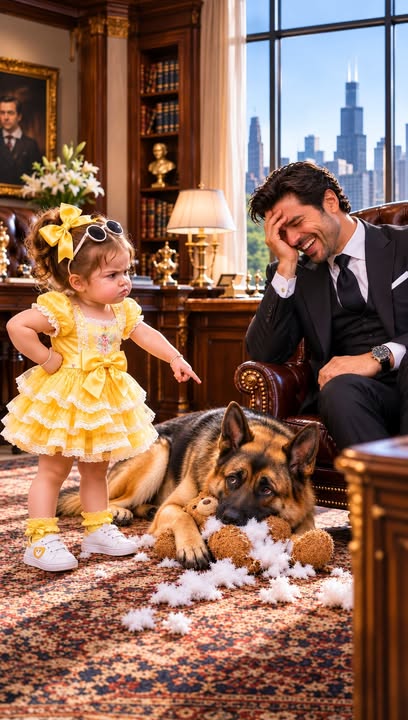
He held a piece of Lena’s childhood, of Elena’s courage and regret, of a grandmother’s love, and of the little girl who had first walked into his office and demanded that a dog apologize.
He looked at Lena, and she looked back.
The years they had lost remained lost.
Nothing could return them.
But the truth had made room for a beginning, and neither of them had to pretend the beginning was the same as the past.
Rex settled beside Mia.
Sofia’s mother reached for her daughter’s hand.
Sofia leaned back in her chair, watching the people gathered around the table she had once feared Dante would never understand.
And Dante, holding the teddy beneath the warm lights of the center, listened to his family speak—not as a man demanding to be heard, but as one who had finally learned how to stay.
**–THE END–PLEASE
Share your thoughts or feedback to motivate us to create more stories ♥️
* * *
[PREVIOUS: PART 5](https://echoesofstories.idolsgift.com/blog/part-5-the-initials-beneath-the-fur-047)
✓ Lynn R. Adams
Part 6 – The Family They Chose The envelope lay between them, worn soft at the corners from years beneath the teddy’s lining. Dante looked at Elena’s handwriting and felt the room narrow around the …