PART 6 (THE END): The Handwriting on the Envelope 029
Part 6 – The Room We Chose
Marianne answered before the second ring had finished.
“I have the authorization form,” I told her, keeping my eyes on Daniel’s message. “It isn’t mine.”
“Do not reply to him,” she said. “I’m contacting the trust administrator now and placing a hold on the distribution.”
“I don’t want the money released to him.”
“It won’t be. I’ll make sure the administrator knows the request is disputed and that the signature is forged.”
Roman stood across from me with his hands at his sides, careful not to step closer than I had invited him.
Elena waited beside the piano, her fingers resting on the keys.
I took a breath that seemed to reach all the way down to the floor.
“Please send the records to the police as well,” I said. “And tell them I’m willing to make a statement.”
Marianne paused just long enough for me to hear the weight of the decision.
“All right,” she said. “I’ll explain the process before anything is filed, and you can review your statement before you sign it.”
“Thank you.”
When I ended the call, Daniel’s message was still on my screen.
*Don’t let Roman make this worse. If you stop the transfer, they’ll know you have the records.*
I read it once more, then placed the phone face down on the table.
“He knows the transfer is being stopped,” Roman said.
“He may have expected me to let it go through.”
“Or he’s trying to make you think you have no choice.”
“He doesn’t get to choose for me anymore.”
The words were quiet, but they seemed to change the air in the room.
Roman lowered his eyes for a moment.
“No,” he said. “He doesn’t.”
Elena looked at me, and her face held no surprise, only a kind of recognition.
“You’re sure?” she asked.
“I’m sure about making the decision myself. I’m not sure what comes after.”
“That’s enough for now.”
I sat down beside her, feeling the old ache in my knee and a new, steadier feeling beneath it.
The next hours were filled with calls, copies, careful questions, and the patient work of establishing what had happened.
Marianne contacted the trust administrator and sent them the forged withdrawal request, the old beneficiary notice, and the papers from Roman’s mother’s folder.
The administrator confirmed that no money would be released while the request was under review.
Samuel Voss sent the trust ledger to Marianne, along with a letter he had kept from Roman’s mother.
In it, she had asked him to make sure I received every distribution directly, without requiring me to know who had paid the original debts.
A note from the administrator showed that the first notices had been mailed to the address Daniel and I shared.
After those notices went unanswered, the trust had recorded the account as inactive.
The first three envelopes of cash had not come from the trust.
Daniel admitted that, too, when Marianne arranged a formal interview with him and an investigator.
He had taken part of the trust money after intercepting the notices, then sent the cash envelopes from what remained, hoping to quiet his guilt without admitting what he had done.
The money he sent was not a plan for my safety.
It was an attempt to manage the consequences of his own choices.
The new envelope was different.
Its sentence came from a note Roman’s mother had written to Samuel Voss years earlier, asking him to remember that the debt had been paid before anyone told me I had to carry it.
Daniel had copied that line from a letter he found among the papers he had kept from our old apartment.
He added the message about Roman and Elena because he wanted me to mistrust the family whose records might reveal what he had taken.
He had believed that if I saw the DeLucas as a threat, I would not ask them for help.
The old note in Elena’s music book had been written by her mother to her, after one of the first days Elena tried to play again following the accident.
It had never been a clue to a conspiracy.
It had been a mother’s private promise: when the accounts were settled, leave the girl her music.
Only later had the words come to mean something more to me.
The truth arrived without a dramatic announcement.
It came through dates that matched, signatures that did not, and records read aloud in a lawyer’s office while rain tapped against the windows.
It came through questions asked carefully and answers that were difficult to give.
It came through Daniel’s admission, which did not undo what he had done, but did make the path ahead visible.
For the first time, my debt was no longer a shadow that could move wherever I went.
The lenders confirmed that Roman’s mother had paid the original balances.
The remaining collection accounts were tied to fees and charges that had continued after those payments were misapplied.
Marianne challenged each claim, and the lenders eventually agreed to remove them from my credit file.
The trust’s accounting showed that Daniel had diverted part of the original distribution into an account he controlled.
The balance, along with the remaining trust funds and the required interest, was restored to me.
Daniel was arrested for fraud and extortion after the records confirmed the forged loans, the intercepted notices, and the false withdrawal request.
There was no spectacle, no crowd waiting outside a courthouse, no triumphant speech from anyone who had been wronged.
There was only a difficult legal process, a series of signatures, and the quiet relief of learning that the story could no longer be rewritten by the person who had hidden it.
When the final notice arrived stating that the debt had been cleared, I read it at Marianne’s office.
Then I read it again.
“You don’t have to keep checking,” she said gently.
“I know.”
I folded the paper and tucked it into my bag.
For years, I had imagined that freedom would feel like a door swinging open.
Instead, it felt like setting down a heavy box and discovering that my hands still remembered its weight.
The first thing I did was put the trust money in an account under my own name, with a financial adviser Marianne recommended.
The second was replace the brace I had been wearing long past the time it needed to be replaced.
The third was call my landlord and ask what a ground-floor apartment would cost.
It was not an extravagant life I was building.
It was a life I could make choices in.
Roman did not offer to pay for it.
He did not ask me to stay at the mansion.
When he learned I was looking for a different apartment, he said, “If you want a reference from me, you can have one.”
“I’ll take that,” I told him.
He wrote a letter describing my work plainly and honestly, without mentioning my friendship with Elena or the envelopes that had brought us together.
That mattered more than he knew.
A week after Daniel’s arrest, Roman asked me to meet him in the library.
A stack of records lay on the desk, all of them copies made for Marianne.
“I want you to have these,” he said. “Every page we found, including the ones we still don’t fully understand.”
I picked up the first folder.
“Is there anything you’re leaving out?”
“No.”
“Anything you’re waiting to tell me until it’s convenient?”
He met my gaze.
“No.”
There was no anger in my question, and no easy forgiveness in his answer.
There was simply the truth between us, offered without decoration.
“Thank you,” I said.
Roman nodded, but did not treat the moment as if it settled everything.
“I’m also making changes,” he said.
“What kind?”
“I’ve started meeting with the attorney who handles the family’s legitimate businesses. I’m separating them from the operations I built outside the law.”
I studied his face.
“You’re leaving that world?”
“I’m trying to.” He glanced toward the window, where the winter light rested against the glass. “I won’t pretend it happens in a week. There are obligations, people, consequences. But I don’t want Elena’s safety, or my own comfort, to be the reason I keep choosing the same life.”
“I’m not going to tell you it will be easy.”
“I wouldn’t trust you if you did.”
“Or tell you that changing makes everything you’ve done all right.”
“I don’t expect you to.”
He lowered his eyes to the records.
“I used to think that if I could control enough of the danger, nothing else could take my family from me.”
“And now?”
“Now I think I made the world smaller for Elena and called it protection.”
He said it without trying to make me comfort him.
That was new, too.
“What do you want from me?” I asked.
“Nothing you don’t freely choose to give.”
I let the words settle.
They did not promise that he would never make a mistake.
They promised that he understood the difference between an offer and a claim.
“That’s a better beginning,” I said.
“I know.”
The months that followed did not erase the things that had happened.
They gave us room to live alongside them.
I continued working at the mansion, but not because I had nowhere else to go.
I spoke with Mrs. Bell about the hours and the pay, and we agreed on a schedule that let me keep my own apartment and take on fewer tasks while my knee recovered.
The new place had a small kitchen, a window that caught the afternoon sun, and a front door whose lock I chose myself.
Elena visited once before I had finished unpacking.
She brought a houseplant in a green ceramic pot and apologized for not knowing whether I liked plants.
“I do,” I said.
“Good. I was prepared to take it home and tell Roman it was a strategic decision.”
“What would the strategy be?”
“To see if you’d let me visit again.”
I laughed, and she smiled with such relief that I understood she had been hoping the question would be easy.
“You never needed a plant to ask.”
“I know. It helps to have something to carry.”
She stayed for tea and did not ask whether I was lonely.
I did not ask whether she was afraid to be alone.
We had both learned that care was not always a question.
Sometimes it was simply being allowed to sit in a room without needing to prove you deserved the chair.
At the mansion, Elena practiced more often.
Some days she played for ten minutes.
Some days she closed the piano after a single phrase and went outside with her brother.
She no longer stopped whenever someone entered the hall.
Roman still had to learn when to knock, and Elena still had to remind him that being invited once did not mean being welcome every time.
But their arguments began to sound less like walls being built and more like doors being tested.
One afternoon, I found her in the music room with a sheet of music spread across her lap.
She had been working on the same song for weeks, shaping it slowly, leaving spaces where her hands grew tired.
“Would you like help turning the pages?” I asked.
“Yes, please.”
She began again.
The first notes came softly, uneven in a way that belonged to her and no one else.
The melody gathered, faltered, and found its way forward.
When she reached the final measure, she stopped before the last note.
“I can’t tell if I should finish it,” she said.
“Do you want to?”
“I think so.”
“Then finish it.”
She looked at me, searching my face for expectation.
I kept my expression open and waited.
Elena pressed the last key.
The note rang out, clear and warm, then faded into the room.
She exhaled.
“That was the first time I played the whole thing since the accident.”
“I’m glad I got to hear it.”
“Me too.”
Her eyes were bright, though she did not look away.
“I used to think that if I finished a song, everyone would want me to be finished grieving.”
“They won’t.”
“No,” she said. “They probably won’t.”
She folded the music and set it carefully on the stand.
“I don’t think I want to make a performance of it yet.”
“You don’t have to.”
“But I might want to play it for someone.”
“Whenever you’re ready.”
She considered the open doorway.
“Not Roman.”
“Not today.”
“Maybe another day.”
I smiled.
“Then another day.”
That spring, Elena decided she was ready.
She asked Roman to invite a few people to the mansion, not a crowd and not a fundraiser, just family friends who had known her before the accident and had been patient enough to keep visiting after.
She asked Mrs. Bell to make coffee.
She asked me to be there.
When Roman came to the music room that evening, he stopped outside the threshold.
“May I come in?” he asked.
Elena glanced at me, then back at him.
“You may.”
He entered and sat in the chair by the wall, leaving the place beside her open.
No one applauded before she began.
No one told her how brave she was.
She played the song as she had practiced it, with the pauses and small corrections that made it hers.
At the end, there was a moment of stillness.
Then the room filled with warm, honest applause.
Elena smiled, but she did not look overwhelmed.
She looked present.
Roman stood only after she reached for him.
He bent to kiss the top of her head, and she rested her hand briefly against his sleeve.
It was a small gesture.
It carried all the years between them without pretending those years had been easy.
After the guests left, Elena wheeled herself to the piano and touched one of the keys.
“Do you think I’ll play it again tomorrow?” she asked.
“Maybe,” I said.
“Maybe is a very respectful answer.”
“I’ve learned.”
She smiled.
Roman remained near the doorway, waiting to see if she wanted him to stay.
Elena turned toward him.
“You can sit down, you know.”
He looked at the open space beside the piano.
“Are you sure?”
“Yes, Roman.”
He walked in and sat on the floor.
This time, Elena laughed before he could say anything.
“You missed the chair again,” she told him.
“I thought the floor was part of the tradition.”
“It is now.”
I leaned against the music stand.
The room held the faint scent of polish, tea, and the flowers Mrs. Bell had placed on the windowsill.
The old piano stood open.
Elena rested her hands in her lap, no longer hiding them.
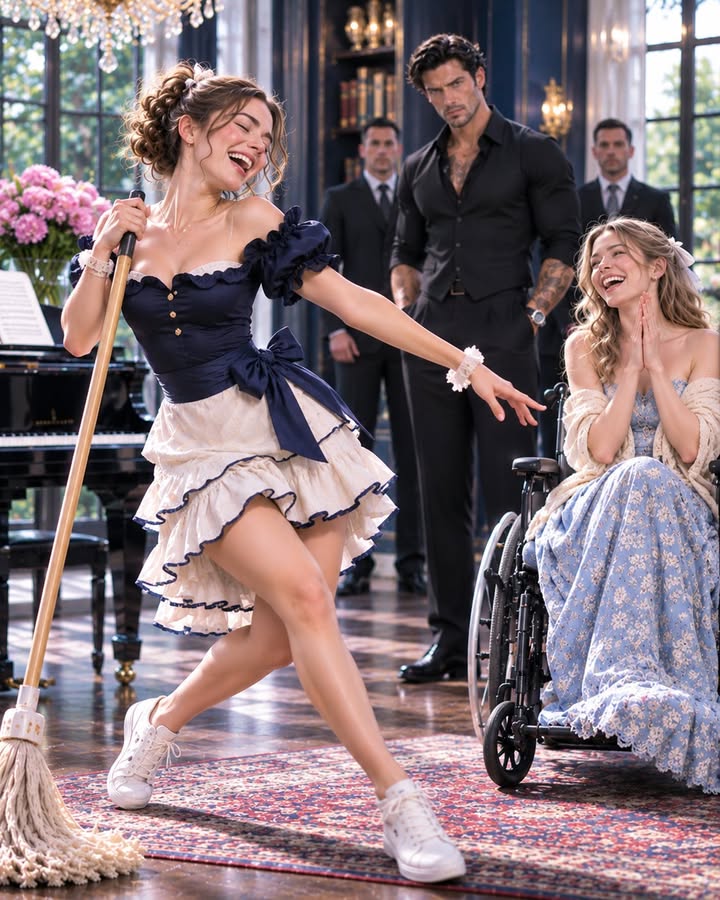
I thought of the first afternoon I had entered the room with a mop, certain that one mistake would end my job.
I thought of Roman in the doorway, severe and impossible to read.
I thought of Elena laughing so hard she had cried.
“You know,” I said, “the mop still has no rhythm.”
Elena’s smile widened.
“He’s improved.”
“Only because I’ve been giving him lessons.”
Roman looked from us to the mop propped beside the wall.
“Should I ask what I missed?”
“You have to ask permission first,” Elena said.
He stood, but did not reach for me.
“Maya, would you like to dance?”
The question rested gently in the room.
I glanced at Elena.
She gave me a small nod.
“Only if the mop leads,” I said.
Roman offered his hand.
I took it.
My knee twinged when I stood, but the pain was manageable, and I no longer tried to hide it.
We moved slowly across the floor.
Elena tapped a rhythm against the arm of her chair, then began to laugh when Roman turned the wrong way and nearly walked us into the piano bench.
The mop tipped sideways.
I caught it with one hand.
“See?” I said. “No rhythm.”
“I was distracted,” Roman replied.
“By the music?”
“By the teacher.”
Elena laughed again, brighter than the room had heard in years.
This time, no one tried to quiet her.
This time, Roman stayed because she wanted him there.
And when Elena held out her hand to invite him closer, he crossed the last few steps without hesitation.
For a little while, the three of us turned in a slow, crooked circle beneath the open music-room window.
The song had ended, but its warmth remained.
The past was not gone.
It had simply stopped being the only thing allowed to speak.
**–THE END–PLEASE
Share your thoughts or feedback to motivate us to create more stories ♥️
* * *
[PREVIOUS: PART 5](https://puretales.idolsgift.com/blog/part-5-the-handwriting-on-the-envelope-029)
✓ Lynn R. Adams
Part 6 – The Room We Chose Marianne answered before the second ring had finished. “I have the authorization form,” I told her, keeping my eyes on Daniel’s message. “It isn’t mine.” “Do not reply to…