PART 6 (THE END): The Handkerchief’s Secret 061
Part 6 – A Family, By Choice
Sophia reached for the envelope.
Her fingers brushed the old paper, but she did not open it at once.
The seal had softened with age, and Eleanor’s handwriting seemed to wait beneath it, familiar and impossibly near.
“Would you rather read it alone?” Alexander asked.
Sophia looked from him to the Queen.
“I think I would like you both to stay.”
Queen Victoria gave a small nod, her eyes already bright.
Sophia broke the seal carefully and unfolded the letter.
The page held only a few lines.
“My dear Sophia,
“If this letter has found you, then you have returned to the palace because you chose to, and not because anyone asked you to prove your loyalty.
“I hope you know how grateful I am for the way you cared for Lily, and for the way you treated me when I was tired and afraid.
“You owe us nothing.
“If you stay, let it be because there is room here for the life you want—not because anyone has decided what your life should be.
“Whatever you choose, I will be glad you were part of ours.
“With love,
“Eleanor.”
Sophia read the letter again, slowly.
Her tears fell without sound, leaving small, dark marks on the paper.
For years she had wondered whether Eleanor had truly meant to keep her close, or whether she had simply been kind in the way she was kind to everyone.
Now she understood that the princess had seen her clearly: not as a servant who could be assigned a place, but as a person with the right to choose one.
“She wrote this for me,” Sophia whispered.
“She did,” Queen Victoria said. “And she trusted you enough to leave the choice in your hands.”
Sophia folded the letter and held it against her heart.
Alexander did not reach for her or ask her to stay.
He stood beside her, quiet and patient, letting the words belong to her first.
That restraint touched her more deeply than any promise could have.
“I want to stay for Lily,” Sophia said at last. “And I want to know whether I can make a life here without losing the one I already have.”
“Then we will make room for both,” the Queen replied.
“Not as a favor,” Sophia said. “As an agreement.”
“As an agreement,” Victoria promised.
Alexander nodded.
“You will have your own rooms, your own work, and the right to leave whenever you wish.”
“And my mother’s care will be arranged without making her dependent on a royal gift.”
“We can help you find a physician and pay him for his work,” he said. “You may decide whether that arrangement suits her. Nothing will be done without your consent.”
Sophia studied him.
The words were careful, but what mattered was that he had not called her gratitude a duty.
“I will come tomorrow,” she said. “And the day after, if Lily still wants me near.”
“She will,” Alexander said, then corrected himself with a faint, rueful smile. “But you are right. It must be your choice too.”
Sophia’s smile answered his.
It was not a promise of marriage, nor an answer to every question waiting between them.
It was a beginning she could enter without surrendering herself.
In the weeks that followed, the palace changed in small, steady ways.
Sophia visited Lily each morning, sometimes joining the princess’s nurse at breakfast and sometimes taking the baby into the garden when the weather was mild.
She returned home each evening to her mother, whose health had been helped by a doctor Sophia chose herself.
The palace paid the physician’s fee, but Sophia kept her own work and made every decision about her family’s care.
Queen Victoria insisted that the arrangement be written down, not because she doubted Sophia, but because she wanted the promise to survive beyond the warmth of a single conversation.
Alexander never asked Sophia to be Lily’s mother.
He invited her to share stories, walks, and quiet cups of tea.
He listened when she spoke about the village, her work, and the life she had built after leaving the palace.
In return, Sophia learned the shape of his grief.
He told her how Eleanor had laughed when the rain spoiled a garden party, how she had once danced barefoot across the nursery floor, and how he still sometimes turned to tell her something before remembering she was gone.
Sophia did not try to fill those silences.
She learned that the memories belonged to him, and that being trusted with them was not the same as being asked to replace their owner.
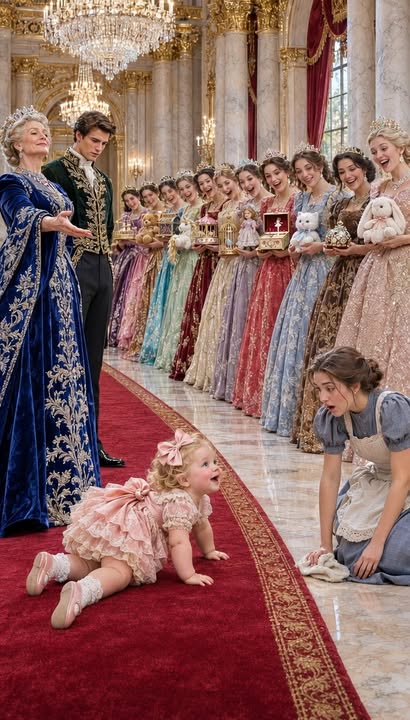
The princesses departed with courtesy.
Some were disappointed, and some were relieved that the strange contest had ended without anyone being asked to repeat Lily’s crawl.
Before leaving, Princess Charlotte approached Sophia in the palace garden.
“I hope you know I did not mean to make you feel unwelcome,” she said. “I was embarrassed, and I thought the rules had changed around us.”
“I understand,” Sophia replied.
Charlotte looked toward Lily, who was sitting on a blanket between her father and grandmother.
“I came prepared to impress a child with a jeweled toy,” she admitted. “I had not thought much about what she might actually need.”
“Most of us learn care by being with someone,” Sophia said. “Not by preparing for it.”
Charlotte’s smile was thoughtful.
“Perhaps I learned something after all.”
They parted without bitterness.
The Queen, meanwhile, continued to examine the old records.
The archivist compared the entries in the nursery ledger with household registers, staff orders, and correspondence from the weeks after Eleanor’s death.
At last, he found a letter from Mrs. Pritchard to the household steward.
It explained that Sophia had been moved to the linen rooms because the nursery staff had been reduced during the rearrangement of the palace apartments.
The letter did not accuse Sophia of taking the handkerchief.
It did, however, show that Mrs. Pritchard had heard the cloth was missing and worried that the changes in the nursery might lead to further confusion.
She had told Sophia it would be better to leave quietly because she thought the young maid would be spared questions while the household was in mourning.
She had meant to avoid trouble.
Instead, her decision had left Sophia believing she had been dismissed because no one trusted her.
When Queen Victoria met with Mrs. Pritchard, the former supervisor was elderly and deeply shaken to learn what had followed.
She remembered Sophia as a quiet, capable girl.
She remembered the hurried move and the missing handkerchief.
She also remembered telling Sophia that it might be best to leave, though she had not understood how final those words would feel to someone so young.
“I thought I was protecting her from the confusion,” Mrs. Pritchard said. “I never thought she would carry the shame of it for years.”
“The harm was not what you intended,” Victoria replied. “But Sophia deserved to be heard.”
Mrs. Pritchard agreed.
She wrote Sophia a letter of apology in her own hand.
Sophia accepted it without anger.
“I know you were trying to manage too much at once,” she told her when they met. “I only wish we had spoken plainly.”
“So do I,” Mrs. Pritchard said.
Neither woman pretended the past could be restored.
But the truth, at last spoken aloud, no longer belonged to rumor or fear.
Queen Victoria then invited the palace household and a small gathering of families to the ballroom.
She did not announce a bride for her son.
She did not present Sophia as the answer to a contest.
Instead, she told them the truth.
The handkerchief had been entrusted to Sophia by Princess Eleanor.
Sophia had cared for Lily during her earliest days, at Eleanor’s request.
After Eleanor’s death, a rushed change in the household and a failure to ask careful questions had led Sophia to leave the palace under a cloud of misunderstanding.
The Queen acknowledged that the responsibility for that failure rested with the palace, not with Sophia.
“I should have asked what happened,” she said. “I did not, and I am sorry.”
Then, before the assembled guests, she cleared Sophia’s name.
No one applauded at first.
The truth deserved more than a performance.
Then the household steward bowed to Sophia, and one by one the people in the room followed.
Sophia stood in her simple blue dress, hands folded before her, while the honor she had lost was returned without asking her to become anything other than herself.
Alexander stood beside her, not ahead of her.
When the gathering was over, he walked with her into the garden.
“I have been thinking about the first day you came back,” he said.
“So have I.”
“I wanted to ask you to stay because Lily reached for you, because Eleanor trusted you, and because I could see how much you meant to both of them.”
Sophia waited.
“But I did not know you,” he continued. “Not then. I knew a story about you.”
“And now?”
“Now I know the woman who sits with my daughter and lets her choose whether she wants to be held. I know someone who tells me the truth even when it would be easier to give me the answer I want. I know someone who can disagree with the Queen and still speak with kindness.”
Sophia’s eyes softened.
“That is a generous description.”
“It is an incomplete one.”
They reached the old rose garden, where the last blooms of the season leaned over the stone path.
Alexander stopped beneath the archway.
“I love you,” he said.
He did not kneel.
He did not produce a ring or summon witnesses.
He gave the words to her plainly, without wrapping them in duty or royal expectation.
Sophia looked at him for a long time.
“Do you love me because Eleanor trusted me?”
“No.”
“Because Lily feels safe with me?”
“No.”
“Because you think I can make the palace feel like a family again?”
He shook his head.
“I love you because you are yourself, even when the whole world is trying to decide what you should be.”
Sophia’s composure trembled.
“What if I still don’t know whether I want to be a princess?”
“Then you don’t have to answer that today.”
“What if I want to keep working?”
“Then keep working.”
“What if I want to visit my mother every week and make my own choices, even when they are inconvenient?”
“Then I will make space for them.”
“And what if I say no?”
His face showed the hurt, but he did not hide from it or try to turn it into a reason she should agree.
“Then I will still be grateful you came back for Lily,” he said. “And I will still be glad I got to know you.”
Sophia lowered her eyes, smiling through her tears.
For so long, she had believed that love meant being needed enough that no one would send her away.
Alexander was offering something different: a life in which she could stay without being trapped, and leave without losing his respect.
“I love you too,” she said. “But I want a little more time before I answer anything else.”
“You may have all the time you need.”
She reached for his hand.
“That sounds like an answer I can trust.”
Months passed.
Their affection grew in the ordinary hours, where promises were tested by small decisions.
Alexander learned to take advice without hearing it as doubt.
Sophia learned that accepting help did not always mean surrendering control.
They argued about how many blankets Lily needed in the garden, whether the palace kitchens should keep the village children’s favorite jam in stock, and how early a child should be allowed to wake everyone on a Sunday morning.
They apologized when they were wrong.
They laughed more often than either of them had expected.
Lily grew from a solemn baby into a lively toddler who carried a wooden rabbit everywhere and insisted on bringing it to the Queen’s morning tea.
She called Alexander Papa.
She called Queen Victoria Grandmama.
She called Sophia by her name for a long time, and no one tried to teach her a different word.
Then, one morning, as Sophia fastened Lily’s coat before a walk, the child looked up at her and said, “Mama Soph.”
Sophia went still.
Alexander, standing nearby, met her eyes.
Neither of them corrected Lily.
Sophia touched the child’s cheek.
“You can call me whatever feels right to you, sweetheart.”
Lily pressed her forehead briefly against Sophia’s shoulder, then wriggled free to chase the wooden rabbit across the nursery rug.
There was no ceremony in the moment.
No one treated it as a decision made for the adults.
It was simply a child offering a name, and the people who loved her allowing it to be hers.
The wedding took place the following spring in a small chapel overlooking the palace gardens.
There were no grand processions, no crowded ballroom, and no contest waiting at the end of the aisle.
Queen Victoria sat in the front row, holding Eleanor’s letter in a small velvet case.
Sophia’s mother sat beside her, well enough to smile through the ceremony.
The twelve princesses were not all present, but Princess Charlotte sent flowers from her family garden, with a note wishing them joy.
Alexander waited at the chapel doors until Sophia was ready.
When she entered, he looked at her as though he were seeing no one else.
She wore a simple ivory dress, and a sprig of pale pink flowers rested at her wrist.
Her past had not disappeared.
It had become part of the person walking toward him.
Lily stood between them, solemn in a little blue dress, holding the ivory handkerchief with its delicate pink embroidery.
The cloth had been cleaned and carefully mended where the old folds had begun to weaken.
The embroidered name was still visible.
Before the vows, Lily handed the handkerchief to Sophia.
Sophia knelt and kissed her forehead.
“Your mother made this for you,” she whispered.
Lily nodded, though she was too young to understand every word.
“She loved you before she ever held you,” Sophia continued. “And she will always be part of your story.”
Alexander took Sophia’s hands.
“I promise to be your partner, not your keeper,” he said. “I will love you as yourself, and I will never ask you to take anyone’s place.”
Sophia looked at him, remembering the frightened young maid she had once been, clutching the handkerchief and waiting to be judged.
“I promise to choose this life freely,” she replied. “And to keep choosing it, as long as we make room for one another to remain ourselves.”
The Queen’s tears shone in the candlelight.
When Alexander kissed Sophia, Lily clapped once, delighted by the sound of the guests laughing softly around her.
Later, as the family gathered beneath the spring trees, the handkerchief rested in Lily’s small hands.
It had crossed a nursery, a hurried move, years of silence, and the distance between a frightened girl and a home she never expected to find again.
It did not erase Eleanor.
It did not ask Sophia to become her.
It was simply a token of love passed carefully from one life to another.
And in the family they made together, there was room for all of it: the mother they remembered, the child they cherished, and the love they had chosen for themselves.
**–THE END–PLEASE
Share your thoughts or feedback to motivate us to create more stories ♥️
* * *
[PREVIOUS: PART 5](https://storyly.idolsgift.com/blog/part-5-the-handkerchief-s-secret-061)
✓ Lynn R. Adams
Part 6 – A Family, By Choice Sophia reached for the envelope. Her fingers brushed the old paper, but she did not open it at once. The seal had softened with age, and Eleanor’s handwriting seemed to…