PART 6 (THE END): The Handkerchief’s First Secret 055
Part 6 – A Place for Every Memory
The Queen’s request brought Mrs. Morrow back to the palace before the day was out.
She arrived without the composure she had worn during their first meeting, carrying a small leather case clasped in both hands.
“I have something I should have brought before,” she said.
Alexander stood beside the Queen in the same sitting room where Eleanor’s letter had been read.
The old medical books remained on the table, their pages guarded beneath a sheet of glass.
Mrs. Morrow looked at the case, then at the prince.
“I kept the letter,” she said. “And I kept another message that came from the nursery.”
“Why?” Victoria asked.
Mrs. Morrow’s eyes lowered.
“Because I was ashamed. I had given Princess Eleanor the wrong amount of her medicine. I thought I could correct the mistake before anyone learned of it.”
“You could not correct what had already happened,” Alexander said, but his voice held more sorrow than anger.
“No,” Mrs. Morrow replied. “I couldn’t.”
She opened the case and removed a folded sheet of paper, its edges softened by years of handling.
“This was meant for the physician. I took it from Sophia before she could deliver it.”
Alexander felt his fingers curl against his palm.
“What did it say?”
Mrs. Morrow offered the paper to Queen Victoria.
“I never read it.”
The Queen unfolded it carefully.
The message was brief, written in Sophia’s hand.
It said that Princess Eleanor felt dizzy and weak after taking the altered medicine, and that she had asked the physician to check whether the dose was correct.
At the bottom, Eleanor had added a few words in her own hand.
Please tell him I am more frightened than I let Alexander see.
The room seemed to draw in around the small page.
Alexander read the words twice.
He could almost hear Eleanor saying them, her voice quiet and steady, trying to spare him worry even while fear had begun to reach her.
“When Sophia brought this to me,” Mrs. Morrow said, “I had just realized the bottle’s label did not match the physician’s written instructions.”
“Why didn’t you send the message?” Victoria asked.
“I was afraid the physician would discover I had given the larger dose without checking it. I told myself I would speak with him as soon as I had worked out what happened.”
“And you dismissed Sophia,” Alexander said.
“I thought if she left, the matter would stay quiet until I could make it right.”
The former nurse’s voice shook.
“I told myself I was protecting the princess from needless alarm. I was protecting myself.”
She looked directly at him then, and the honesty in her eyes was more difficult to bear than any excuse.
“I am sorry, Your Highness. I cannot bring Eleanor back. I cannot give you the chance to hear her warning in time. I can only tell you what I did.”
Alexander looked at the message.
He thought of Sophia waiting in a corridor, told that the physician had gone, then sent away while Eleanor’s request remained folded in someone else’s hands.
He thought, too, of Mrs. Morrow’s years of service, the confidence placed in her, and the frightened choice she had made when she realized she had failed.
“You should have told us then,” he said.
“Yes.”
“You should have let the physician decide what to do.”
“Yes.”
“And Sophia should not have been made to carry the blame.”
“No,” Mrs. Morrow whispered. “She should not.”
Victoria folded the message again.
“What happened to the original letter after the physician received it?”
“I kept it from him at first,” Mrs. Morrow said. “When I realized the princess’s condition was worsening, I sent it to his house with a note. I did not include the message from Sophia.”
“Why did you write, ‘I kept the original’?”
“To make sure he knew I still had it. I was afraid he would discard it, or ask questions before I was ready to answer them.”
“Then someone came to his house after his death,” Alexander said. “The housekeeper says they asked for the papers from that week.”
Mrs. Morrow shook her head.
“It was not me.”
“Do you know who it was?”
“I don’t.”
The secretary, who had been present when the housekeeper spoke, stepped forward.
“Could it have been a member of the physician’s family?”
“Possibly,” the Queen said. “But we have no reason to assume anything more.”
The remaining pages of the physician’s correspondence register were found several days later among his private effects, kept separately from the household papers.
They showed that he had received Eleanor’s letter after her death, along with a note from Mrs. Morrow saying that Sophia had been sent away and the medicine had been administered according to a label she believed had been approved.
There was no record of anyone trying to hide the letter after that.
The person who had visited the physician’s home had been a clerk settling his papers, not a palace official.
He had asked for documents relating to the final week of Eleanor’s care because the physician’s family wished to organize them before the house was sold.
The mystery had not concealed a second conspiracy.
It had been made larger by fear, grief, and gaps in the records—each person imagining the worst where no one had been willing to ask plainly.
The truth was painful enough without adding a villain to it.
Mrs. Morrow was formally held accountable for failing to verify the dosage, delaying Eleanor’s warning, and dismissing Sophia without a fair inquiry.
She did not return to the nursery, and the palace reviewed her pension in light of the findings.
Alexander did not demand that she be publicly disgraced.
He insisted only that the record be corrected, that Sophia’s name be cleared, and that no one confuse a preventable error with a deliberate act.
The Queen appointed a new medical supervisor for the household and required that every prescription be recorded twice, checked by a second trained person, and matched to the correct patient before it was administered.
No medicine could be transferred to another bottle without a label bearing the patient’s name, the dose, and the physician’s signature.
The reforms were not celebrated as though rules could repair a death.
They were put in place because another family should not lose someone to a mistake that care and honesty might have prevented.
When the findings were made public, Alexander stood before the palace’s assembled household and read the statement himself.
He acknowledged that Princess Eleanor’s medicine had been administered in a dose larger than the one recorded by her physician.
He said that the resulting reaction might have contributed to her decline, though the surviving evidence could not prove that it had caused her death.
He explained that Sophia had been chosen by Eleanor to carry a warning and had been prevented from delivering it.
He also made clear that Sophia had stolen nothing.
There was no attempt to turn the truth into a polished story of perfect people and simple answers.
The palace had failed Eleanor, he said, and would not hide that failure behind her memory.
Afterward, some people expressed sympathy.
Others asked questions the records could not answer.
Alexander did not pretend that he knew more than he did.
For the first time since Eleanor’s death, he found that telling the truth did not diminish her.
It made her feel closer.
In the months that followed, Sophia settled into her new role as Lily’s companion.
She lived near the nursery, worked beside the nurses, and continued to use the lavender soap the staff had once shared.
The handkerchief remained with her, as Eleanor had intended.
The Queen had suggested placing it in the family’s collection, where it could be kept safely behind glass.
Sophia had refused, not out of defiance, but because she remembered Eleanor asking her to keep it.
Alexander agreed that the choice should remain Sophia’s.
So the handkerchief stayed folded in a small wooden box in Sophia’s room, taken out only when Lily was old enough to understand why it mattered.
Alexander learned to ask before drawing conclusions.
Sophia learned that she could speak plainly to him without having to soften every difficult truth.
Neither change came quickly.
There were still days when Alexander found himself measuring Sophia against an absence he could not fill, and days when she sensed the comparison in his silence and stepped back.
When that happened, he tried to name what was happening instead of allowing suspicion to grow in the space between them.
“I’m thinking of Eleanor,” he told her once, after a quiet evening in the nursery.
Sophia nodded.
“You’re allowed to.”
“I know. I’m learning not to act as if remembering her means I must keep everyone else at a distance.”
Sophia looked toward Lily, who was asleep with one hand curled around the edge of her blanket.
“She would have wanted Lily to be loved,” Sophia said.
“Yes.”
“Not instead of her.”
“Never instead of her.”
Their trust grew in such moments—not as a sudden answer to grief, but as something built by patience, honest words, and the repeated choice to remain kind.
As Lily grew older, her questions came in small pieces.
She asked why the Queen kept an old letter in a drawer beside her desk.
She asked why her father sometimes grew quiet when he looked at the portrait of a dark-haired woman above the nursery mantel.
She asked why the ivory handkerchief had pink flowers and her name sewn into one corner.
Alexander answered each question as simply and truthfully as he could.
“That was your mother’s handkerchief,” he told her. “She embroidered your name because she loved you and wanted you to have something made by her own hands.”
“Did she give it to Sophia?”
“She did. Sophia helped care for you when you were very small, and your mother trusted her.”
“Was Mama sick?”
The question made him pause.
“Yes,” he said. “The medicine she was given was not measured correctly. The people caring for her did not understand the mistake in time.”
“Did she know she was going to die?”
“We don’t know exactly what she understood. But she knew she loved you, and she wanted us to take care of you.”
Lily considered this with the grave attention of a child trying to make the world large enough to hold a difficult truth.
Then she climbed into his lap and rested her cheek against his chest.
Alexander held her and let the quiet be enough.
He did not tell her that Eleanor had been perfect.
He told her that she had been brave, funny, thoughtful, and sometimes tired.
He told her that she had asked the palace to listen when she felt unwell.
He told her that Sophia had tried to carry her message.
And he told her that love did not disappear when someone died, though it changed the way it could be felt.
Years passed.
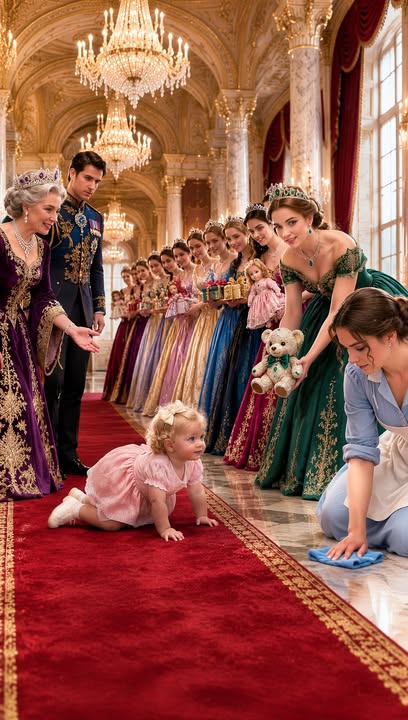
Lily grew from a baby who crawled across a crimson carpet into a girl who could race through the palace gardens, read beside the Queen, and ask her father questions that left him speechless.
She called Sophia by her name for a long time.
Then, one rainy afternoon, she came into the library carrying the wooden box that held Eleanor’s handkerchief.
Sophia was reading near the window while Alexander reviewed letters at the desk.
“Will you show me the flowers again?” Lily asked.
Sophia set her book aside.
“Of course.”
She opened the box and lifted the ivory cloth carefully.
Lily traced the pink embroidery with one finger, stopping at the name stitched in the corner.
“Grandmother says Mama made this when I was a baby.”
“She did,” Sophia said. “She wanted something of her own making to stay with you.”
“Were you there when she made it?”
“No. She gave it to me later, after I helped settle you one night.”
“Did she know you would keep it?”
“I think she hoped I would.”
Lily looked at Sophia with thoughtful eyes.
“Did you know me before I could talk?”
“I knew you when you were very small.”
“Then you took care of me before I knew how to ask.”
Sophia’s eyes filled.
“I was lucky to be there.”
Lily leaned into her, resting her head against Sophia’s shoulder.
Then, with a certainty no ceremony could have arranged, she said, “Thank you, Mama.”
Sophia closed her eyes.
Alexander set down his letters.
No one hurried to turn the word into a promise or a title.
It had come from Lily, freely offered, carrying all the meaning she had given it herself.
Sophia put one arm around her.
Alexander crossed the room and knelt beside them.
Lily held the handkerchief between them, its embroidered flowers bright against her small hands.
“Your mother would have been glad you had people to love,” he said.
Lily glanced up at him.
“Do you miss her?”
“Every day.”
“Does loving Sophia make you miss her less?”
“No,” he answered. “It makes my life larger, but it does not make my love for your mother smaller.”
Lily seemed satisfied.
She leaned against Sophia again, and Alexander rested his hand over both of theirs.
The years brought no grand transformation, only a slow, steady closeness.
Sophia became the person Alexander sought when Lily’s laughter filled the gardens, and the person who sat with him on evenings when Eleanor’s absence came back sharply.
He came to love Sophia for the life she had built beside them, not for any resemblance to the woman he had lost.
Sophia loved him for the way he learned to listen, for the father he had been from the beginning, and for the man he became when he stopped mistaking grief for a duty to remain alone.
When he finally asked her to marry him, it was not in the ballroom where Lily had first reached for her.
He asked in the garden beneath the old pear tree, with Lily nearby, pretending very badly not to watch.
“I want to build a life with you,” he said. “Not because Eleanor’s place needs filling, and not because Lily needs someone to call her mother. I want it because I love you, and I want us to choose one another as we are.”
Sophia looked at him for a long moment.
“Then I will say yes as myself,” she replied. “Not as anyone’s replacement.”
“As yourself,” he promised.
She accepted.
Their wedding was held in the palace chapel on a bright spring morning.
Queen Victoria sat in the front row, her eyes shining as Lily carried Eleanor’s ivory handkerchief down the aisle.
The pink flowers caught the sunlight each time the cloth moved.
Lily did not carry it as a relic of sorrow or a secret passed between adults.
She carried it because it belonged to her mother, and because she understood that remembering Eleanor was part of loving the family she had now.
At the chapel doors, Alexander waited for Sophia.
She walked toward him without hurry, her face calm and open.
When he took her hand, he did not feel that one story had ended so another could begin.
He felt the two stories held together, each with its own place.
Queen Victoria watched Lily approach with the handkerchief, then watched her son and Sophia stand beside each other.
For a year after Eleanor’s death, the palace had tried to protect itself by keeping the difficult truth quiet.
Now the truth had been spoken, and the family had learned that remembrance could hold sorrow without being ruled by it.
Lily reached her father and Sophia, and Sophia bent to kiss the child’s forehead before taking her place beside Alexander.
The handkerchief rested between them, ivory cloth, pink flowers, a small name stitched with love.
And in the bright hush of the chapel, with Eleanor remembered and the future welcomed, they began their new life together.
**–THE END–PLEASE
Share your thoughts or feedback to motivate us to create more stories ♥️
* * *
[PREVIOUS: PART 5](https://storyly.idolsgift.com/blog/part-5-the-handkerchief-s-first-secret-055-1)
✓ Lynn R. Adams
Part 6 – A Place for Every Memory The Queen’s request brought Mrs. Morrow back to the palace before the day was out. She arrived without the composure she had worn during their first meeting, carryi…