PART 6 (THE END): The Hand That Reached Inside His Coat15 026
Part 6 – The Moon We Share
The doorbell rang a second time.
Margaret’s hand tightened around the edge of the hallway table, while I kept my body between the door and Emma, who slept beneath her blanket with one hand curled around her drawing.
Luca stood beside the kitchen table, pale beneath the warm light.
The lawyer remained on the phone.
“Don’t open the door until the investigator arrives,” he said. “Peter agreed to meet under supervision.”
“Then he can wait.”
I ended the call and motioned for Margaret to stay with Emma.
The bell did not ring again.
Through the frosted glass, the man on the porch lowered the parcel and held it against his chest, as though its weight had grown heavier while he waited.
I opened the door only after headlights swept across the front window and the investigator’s car pulled to the curb.
“Mr. Doran?” I asked.
“Yes,” he said. “I’m sorry to arrive so late.”
He was older than I remembered from the office, his hair white at the temples and his shoulders slightly bent.
He carried no air of authority, only the wary, tired expression of someone who had spent a long time rehearsing what he meant to say.
The investigator introduced herself and explained that she would remain present while he spoke.
Peter nodded.
“I understand.”
I let them into the living room, where Emma slept.
Margaret stepped quietly into the hall and closed the door to the spare room behind her, keeping Emma’s rest undisturbed.
Peter placed the parcel on the coffee table.
Inside was an original letter, sealed in an old envelope bearing Isabella’s handwriting.
My name was written across the front.
For a moment, I could not bring myself to touch it.
“Where did you get this?” Luca asked.
Peter looked at him, then back at me.
“Your partner gave it to me to destroy.”
The investigator began taking notes.
“Did you destroy it?” she asked.
“No.”
“Why not?”
Peter lowered his eyes.
“Because the letter didn’t belong to me, and I knew it.”
“Why keep it all this time?”
“Fear, at first,” he said. “Then shame. Later, I told myself that holding onto it meant I hadn’t gone through with what I’d been ordered to do.”
He looked at me.
“I know that wasn’t enough.”
“No,” I said. “It wasn’t.”
He accepted my answer without trying to defend himself.
“Is this the only letter?” I asked.
“It’s the only original I kept. There were other pages in the file, but I was told to return them to the office.”
“Did you know what the letter said?”
“I did not read it until years later.”
“Why now?”
“I heard that the records were going to the authorities. I also heard Isabella’s daughter was with you.”
His voice caught slightly on the word daughter.
“I thought she deserved to receive this from her father.”
I looked at the envelope again.
Every person who had handled Isabella’s words had made a different choice.
Some had hidden them.
Some had lied about them.
Peter had kept one when ordered to destroy it, but his decision had not found its way to me in time.
“I can’t undo what I did,” he said. “I can only give you this and tell the investigators everything I remember.”
The investigator asked him to describe the instructions he had received and the people who had access to the office.
Peter answered carefully, and when he did not know something, he said so.
His account matched the records we had found.
It did not answer every question, but it confirmed that my former partner had directed the letters to be held and that a message had been sent to Isabella falsely claiming I knew she was safe.
When the interview was over, Peter stood.
“I’m sorry,” he said again.
I believed he was.
I also knew that regret could not return the years.
“Thank you for bringing it,” I said.
He left with the investigator, and the door shut gently behind them.
The house settled into quiet.
Luca remained near the kitchen, while Margaret returned to Emma’s side.
I carried the envelope to the table.
My hands had stopped shaking, but I could feel each beat of my heart in my fingertips.
“Would you like us to leave?” Margaret asked.
“No.”
“Would you like to read it alone?”
I looked toward the living room.
“No,” I said. “But Emma shouldn’t wake up to all of us talking about her mother’s letters.”
Margaret nodded.
She poured tea, though none of us drank it.
I opened the envelope.
Inside was one letter, written in Isabella’s careful hand, with a date from the winter after Emma was born.
*Vincent,*
*I don’t know whether this will reach you, but I need to write it, even if no one ever reads it.*
*I told myself I could leave and make a life for Emma without looking back, but I still listen for your voice in every crowded room.*
*Luca told me you know we are safe. I want to believe him. I want to believe you are giving us space because you think it is what I need.*
*If that is true, I will respect it, even though it hurts.*
*If it is not true, then please understand that I am trying to find a way to come home without putting our daughter at risk.*
*I do not want Emma to grow up afraid of the people who love her.*
*I do not want her to learn that love means staying silent.*
*If you ever read this, know that I still love you. I am not asking you to forgive me for leaving. I am asking you to believe that I did it because I thought I had to.*
*Please keep the crescent I gave you.*
*It reminds me that even when we cannot see the whole moon, it is still there.*
*Isabella*
I reached the last line and stopped.
Margaret had covered her mouth.
Luca looked down at his hands.
I folded the letter along its old creases and held it against my chest.
Isabella had been trying to find a safe way home while believing I had chosen silence.
My partner’s lie had closed the path before either of us could reach it.
There was grief in the letter, but there was no accusation.
That hurt more than anger would have.
For a long time, I had imagined Isabella standing somewhere far away, deciding I was no longer worth the risk.
Now I understood that she had spent those years believing she was respecting a choice I had never made.
“I wish I’d received it,” I said.
“So do I,” Margaret replied.
Luca’s voice was rough.
“So do I.”
I looked at him.
He did not ask for forgiveness.
He did not pretend that his regret could change what had happened.
“I hope one day you can see that I’m more than the worst choice I made,” he said.
“I hope you become more than that choice.”
His eyes lifted to mine.
“That’s fair.”
I placed the letter in its envelope and handed it to Margaret.
“Keep it with Isabella’s things,” I said. “When Emma is ready, we’ll read it together.”
Margaret accepted it with both hands.
The following weeks were full of practical steps that felt less dramatic than the years behind us and more difficult than I had expected.
I met with the investigators and answered their questions.
Luca gave his statement about the letters, the forwarding records, and the instructions he had followed.
He did not hide his own part in the harm, even when the truth made him look worse.
The surviving evidence helped establish how my former partner had used private correspondence to control people around him, but it also exposed the structure I had inherited and continued to lead.
I cooperated fully.
The authorities froze the old accounts, secured the remaining records, and began sorting out which decisions belonged to my former partner and which belonged to me.
Some of my choices had consequences.
I accepted them.
I stepped away from the leadership and surrendered what was required while the investigators examined the rest.
The lawyers explained that my cooperation mattered, but it did not erase the years I had spent building a life around power.
I did not expect it to.
The old offices were closed.
The people who had worked under the former arrangement were questioned, and several agreed to help establish what had happened.
Among them was a retired bookkeeper who remembered a series of payments made to keep Isabella’s locations private.
Those payments had not been intended to help her.
They had been used to track where she stayed and ensure that no one in my circle could contact her without approval.
The bookkeeper also found a note explaining why.
My former partner had feared that Isabella might become a witness to a financial arrangement he had concealed from both families.
Keeping her away from me had not begun as a romantic betrayal.
It had begun as an effort to control what she might know and whom she might tell.
Once he had separated us, he kept the separation alive because it gave him influence over me and removed someone he could not control from the center of our lives.
He had turned private fear into a system and made other people carry it forward.
Luca had helped that system work.
But he had also risked his own safety to get Isabella out of the Wabash apartment when he learned that her location had been discovered.
Margaret’s careful decision to take Isabella and Emma to another city had given them a chance to disappear from the network.
None of those truths made the years apart less painful.
They gave the pain a shape.
We learned that Isabella’s illness had been a serious heart condition, worsened by years of strain and by a lack of consistent care.
She had died in a hospital outside Chicago, after being admitted under the name Mercer.
The death had not been caused by anyone’s hand.
It had been the result of an illness she had tried to manage while moving from place to place, afraid that seeking help might reveal where she was.
The hospital records had been requested by someone using my former partner’s office, then withheld from the people who might have told me.
I visited the hospital archive with Margaret and sat with the documents until I could read each line without searching for a different ending.
When I finished, I carried the records outside and sat on a bench beneath bare winter branches.
Margaret sat beside me.
“She didn’t die because you didn’t love her,” she said.
“I know.”
“She died while believing you had asked her to stay away.”
I closed my eyes.
“Yes.”
“That is a terrible truth.”
“It is.”
“But it isn’t the same as you choosing to abandon her.”
“No.”
Margaret put her hand over mine.
“We can grieve what happened without making you the cause of every piece of it.”
I held her hand, grateful for the words and not yet able to believe all of them.
When Emma asked where her mother was, we answered her as honestly as we could.
We told her Isabella’s heart had become very sick, and the doctors had tried to help.
We told her that adults had hidden important information and made decisions that were not fair to her mother.
We told her that her mother had loved her and had never stopped loving me.
We did not tell her every detail.
We answered what she asked, then let her return to her drawings and her small, ordinary life.
She kept Isabella’s tin close, but she began letting me sit beside her while she opened it.
One afternoon, she found the photograph of Isabella with Luca and asked him to explain it.
He came to the house with Margaret’s permission and sat across from Emma at the kitchen table.
“I was helping your mother get you somewhere safe,” he said.
“Were you bad then?”
“I was making some bad choices.”
“Did Mommy know?”
“She knew I had done some things that hurt her.”
“Did you say sorry?”
“Yes.”
“Did she say it was okay?”
Luca paused.
“She said she was glad I had helped her, but that did not make everything okay.”
Emma considered this.
“That sounds right.”
“It does,” Luca said.
“Are you still bad?”
“I’m trying to do better.”
“Do you still take letters?”
“No.”
“Do you tell people what they should think?”
“I’m trying not to.”
Emma nodded as if those were reasonable things to work on.
Then she returned to her coloring.
It was not forgiveness, and none of us called it that.
It was a child allowing a man to sit at the table while she decided who he might become.
Luca kept his promise to testify, even when it meant answering difficult questions about his work and the choices he had made.
The process took months.
During that time, I saw Emma on a schedule approved by the people overseeing my case and by Margaret, who remained careful and steady.
I never asked her to choose between loving me and remembering her mother.
I never asked her to call me anything she did not want to say.
Some days she called me Vincent.
Some days she called me Daddy.
Each time, I received the word as a gift, not a claim.
Margaret and I grew closer in the slow, unremarkable spaces between the larger events.
She showed me how Isabella liked her tea, where she kept the spare buttons, and which old songs made Emma laugh because her mother used to sing the wrong lyrics on purpose.
I told Margaret stories of Isabella before she left: the way she danced barefoot in the kitchen, the way she could not leave a book unfinished, the way she pressed two fingers to her heart before touching my cheek.
We did not try to make our memories identical.
We let them meet.
By the time the legal process allowed me to begin a new chapter, the old title I had carried no longer meant anything.
I had lost the office, the organization, and the certainty that I could command a room simply by entering it.
What remained was smaller and more honest.
I rented a modest house with a little garden and a kitchen large enough for all of us to sit around the same table.
Margaret helped choose the curtains.
Emma chose a yellow bowl shaped like a crescent moon.
We planted herbs beside the back steps, though I had to ask Margaret how often to water them and Emma had to remind us both that the mint needed its own pot.
The first night we ate there, the three of us sat with paper plates and takeout because the table had arrived before the chairs.
Emma looked around the room.
“It feels quiet,” she said.
“Good quiet or bad quiet?” I asked.
“Good quiet.”
Margaret smiled.
“Then we did well.”
After a while, Emma asked whether we could visit her mother’s grave.
We went on a clear morning in early spring.
Margaret carried flowers, and Emma brought the yellow snowflake she had once given Luca, folded carefully inside her coat pocket.
The cemetery was small and peaceful, with trees beginning to show the first signs of green.
Isabella’s stone was simple.
Her full name was there, along with the dates that marked her life, and below them a small crescent moon.
Emma stood beside me, her mittened hand in mine.
“Is Mommy up there?” she asked, looking at the pale sky.
“I don’t know,” I said. “But I know she’s here with us in the stories, and in the things she taught us, and in the way we love her.”
Emma nodded.
“Can I tell her something?”
“Of course.”
She stepped closer to the stone.
“I found Daddy,” she whispered. “He came back.”
My throat tightened.
Margaret rested a hand on Emma’s shoulder.
After a moment, Emma turned and held out her hand to me.
“Can we do Mommy’s moon?”
We pressed two fingers to our hearts and traced a crescent in the air.
Margaret joined us.
For a breath, the gesture belonged to all three of us, not as a secret passed between the living and the lost, but as a promise to remember without hiding.
I took out Isabella’s letter.
I had brought it in a protective sleeve, the paper kept safe from the wind.
Emma watched as I held it beside the stone.
“Would you like to read one part?” I asked.
“Yes.”
I read the line about the crescent she had given me, about how a moon could still be there even when we could not see all of it.
Emma touched her own chest.
“Like Mommy?”
“Like Mommy,” I said.
“And like our family?”
I looked at Margaret, then at Emma.
“Yes. Like our family.”
The months that followed brought more ordinary beginnings.
Emma learned to skate without holding the boards.
I learned to pack her lunch, braid her hair badly, and recognize which bedtime story she wanted from the way she arranged her stuffed animals.
Margaret taught me that being a father was not a single declaration made at a rink.
It was showing up the next morning.
It was remembering the little things.
It was listening when Emma changed her mind.
It was staying gentle when my own grief made me impatient.
The life I had built before no longer had a place in our home.
I continued to cooperate with the authorities and accepted the limits placed on me as part of leaving that life behind.
Luca’s testimony helped the investigators understand the old system and bring the remaining threat to a close.
He faced consequences for his own choices, and he did not ask me to shield him from them.
When he was able to visit again, Emma decided whether she wanted him there.
Sometimes she did.
Sometimes she did not.
He accepted both answers.
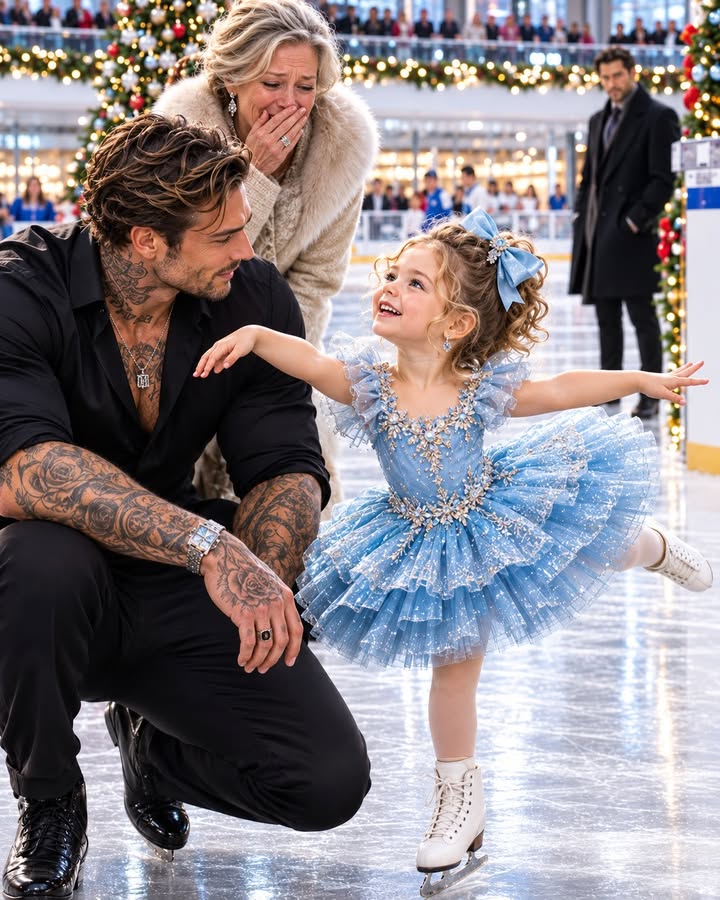
One winter evening, nearly a year after the first time Emma had found me at the rink, we returned to the same ice.
The colored lights still circled the ceiling, and the holiday music still sounded slightly tinny over the speakers.
Emma wore a blue dress beneath her coat, with her chestnut curls tied back by two ribbons.
She was taller now, but only just.
“Do you remember the first time we came here?” I asked.
“I remember you were very tall.”
“That’s what you remember?”
“And your hands had lots of pictures.”
I laughed.
“What else?”
“You asked who taught me the moon.”
“I did.”
“Then I thought you were the bad man.”
“I know.”
“Were you mad?”
“I was scared,” I said. “And sad.”
“Were you mad at Mommy?”
“No.”
“Were you mad at Luca?”
“I was.”
“Are you now?”
“Sometimes I remember what he did and feel angry. But I don’t let that decide everything about who he is.”
Emma considered this as we stepped onto the ice.
“Mommy was sad.”
“Yes.”
“But she loved you.”
“Yes.”
“And you loved her.”
“Yes.”
She held my hand and began to glide.
“I love you too,” she said.
The words were quiet, as if she had been carrying them around and had finally decided where to set them.
I slowed, afraid that one careless movement might make the moment too small.
“I love you too, Emma.”
She looked up at me.
“Can I call you Daddy?”
The question was tender and brave, and it seemed to gather every lost year into one small space between us.
“Yes,” I said, my voice breaking. “Whenever you want.”
“Daddy,” she said.
I bent down, and she wrapped her arms around my neck.
Margaret watched from beside the boards, tears shining in her eyes.
When Emma was ready, she took my hand again.
Together we moved into the circle of the rink.
She pressed two fingers against her heart and traced the crescent moon in the air.
I answered with the same gesture.
And this time, when she called me Daddy, there was no secret waiting to break us apart, only the small bright sound of my daughter, the steady scrape of our skates, and the knowledge that love had not erased what we lost.
It had given us the courage to begin again.
**–THE END–PLEASE
Share your thoughts or feedback to motivate us to create more stories ♥️
* * *
[PREVIOUS: PART 5](https://puretales.idolsgift.com/blog/part-5-the-hand-that-reached-inside-his-coat15-026)
✓ Lynn R. Adams
Part 6 – The Moon We Share The doorbell rang a second time. Margaret’s hand tightened around the edge of the hallway table, while I kept my body between the door and Emma, who slept beneath her blan…