PART 6 (THE END): The Girl Who Called Him Daddy 047
Part 6 – The Home They Chose
“You did,” the archivist repeated.
Vincent held the receiver tightly, but his voice remained measured.
“Explain what you mean.”
“The final recording includes a message addressed to you,” the archivist said.
“It was filed this morning, along with a signed statement.”
“Can you tell me who signed it?”
A pause followed, filled by the faint rustle of papers at the other end.
“Your former adviser, Sal.”
Vincent looked toward the garden room, where Emily stood with Rosie in her arms.
The child’s red road lay across the little table, leading to three crooked figures.
“What does the recording say?” Vincent asked.
“The recording itself is with the evidence team.”
“But the statement says Sal arranged tonight’s meeting, using Luca’s name and an old authorization.”
“Why?”
“He says he intended to force you into surrendering the records before they became public.”
“Did Luca know?”
“According to Sal, no.”
The answer did not make Vincent feel safer.
It only revealed another way in which the truth had been bent to suit someone’s plans.
“Where is Sal now?”
“The officers have been searching for him since the dockside message arrived.”
“Tell them I’ll cooperate with anything they need.”
“I will.”
Vincent hung up and turned to the attorney.
“He says I arranged the meeting.”
The attorney’s expression sharpened.
“Sal is claiming you?”
“Not exactly.”
Vincent explained what the archivist had said.
The attorney listened without interrupting, then looked to the investigators waiting by the entrance.
“We should verify the statement before anyone makes assumptions,” she said.
“Agreed.”
One of the investigators spoke quietly into her phone.
The other opened a notebook and asked Vincent to remain available while they confirmed the details.
Grant stood beside the sealed evidence case.
“Then Luca may not be the one who sent the dockside message,” he said.
“Sal may have sent it using Luca’s name,” the attorney replied.
“Either way, the meeting was meant to put pressure on me.”
“And to recover the recording,” Vincent said.
Emily had reached the doorway, Rosie resting against her shoulder.
“Then don’t go,” she said.
“I’m not.”
She searched his face, perhaps looking for the old instinct to take control and decide that a dangerous meeting was his burden alone.
He stayed where he was.
“I won’t go anywhere without the investigators,” he said.
“And I won’t hide the evidence.”
Emily nodded, holding his gaze.
“Good.”
Rosie wriggled down from her mother’s arms and hurried to Vincent, her little shoes tapping against the floor.
“Daddy stay?”
“I’m staying here for now.”
“Here here?”
He crouched so they were eye to eye.
“Right here.”
Rosie threw both arms around his neck.
He closed his eyes briefly, holding her with a care that no longer felt like a promise he could make lightly.
It felt like a promise he would have to keep through every ordinary day that followed.
The officers arrived before dusk.
They did not come with flashing lights or raised voices, but with a warrant, a calm request, and the quiet seriousness of people who had already spent hours following the evidence.
Sal was found at a downtown office, where he had been waiting for a response to the message he believed would bring Vincent to the docks.
He had not expected Vincent to contact the authorities.
He had not expected them to have the recording, the archive, the access logs, and his signed statement.
By the time they brought him in for questioning, the first pieces of his account had begun to confirm what the records showed.
He had forged messages in Vincent’s name.
He had used old access credentials to manipulate the mansion’s security system.
He had helped Luca preserve a hidden network after the crash, then kept the secret even when Luca became a danger to everyone around him.
He had warned Emily away from Vincent, telling himself that separation would protect them both.
When Emily left, Sal told himself the matter had ended.
When the messages continued, he told himself the fear kept her safe.
When Vincent dismissed her warning, Sal said nothing.
The choices had become a wall, each one easier to defend than the one before it.
Luca had been alive, but the people around him had kept him hidden, and the network he built had grown beyond the reach of the man who claimed to command it.
The missing shipment had been diverted to conceal records and draw Vincent away from the house.
The meeting at the docks had been arranged to retrieve the evidence before the archive could be opened.
The men who followed Emily had been sent to locate her and Rosie, not by Vincent, but by people acting through Luca’s old contacts.
The authorities found Luca at the docks that night, along with two associates who had helped maintain the hidden network.
They also found records connecting the theft, the forged threats, and the efforts to keep Emily from Vincent.
No exchange took place.
No one went alone.
Vincent remained at the house, giving the investigators the documents and testimony they requested while Grant kept Emily and Rosie in the garden room.
The truth arrived in pieces over the following weeks, and none of it offered an easy way to undo what had happened.
Luca had survived the crash and disappeared because he feared a challenge to Vincent’s control would end with both brothers destroyed.
Instead of telling Vincent, he had built a rival network in secret and recruited people who knew how to exploit the family’s fear and mistrust.
When Emily saw him, Luca had been attempting to reach Vincent through her.
He had not understood how thoroughly his own choices would make her vulnerable.
Sal had known Luca was alive and had chosen to protect the organization before protecting the people within it.
He had used Vincent’s name because he believed his influence would remain unquestioned.
It was not a single betrayal but a series of decisions, each hidden beneath a justification that had sounded sensible at the time.
Vincent listened to every account.
He answered the investigators’ questions truthfully, even when the answers made his own role harder to defend.
He did not ask Grant to keep a name out of a report.
He did not request that the files disappear.
He did not try to make the truth smaller than it was.
When the authorities asked him to surrender the remaining records and step back from the organization, he did so.
The business and its properties were examined.
Assets connected to the criminal operation were seized.
Several people who had depended on Vincent’s authority were interviewed, and the house that had once seemed too guarded to breach became a place where investigators came and went with folders under their arms.
Through it all, Emily remained free to decide what happened next.
She did not move into the apartment immediately.
First, she visited it with the attorney and the nurse, checked the locks herself, and chose the room Rosie would sleep in.
She picked curtains with tiny yellow stars, a low shelf for storybooks, and a small table just big enough for coloring.
Vincent did not suggest a different address.
He did not offer to fill the rooms with expensive things.
He brought only the picture books Rosie had chosen and a small tin of cookies.
Emily thanked him for the books.
She made no promise beyond that.
Vincent began cooperating fully with the investigation.
The evidence showed his role was not the same as Sal’s or Luca’s, but it also showed that he had built a business whose habits depended on silence, loyalty without questions, and decisions made beyond the reach of ordinary law.
He did not excuse that structure by saying he had inherited it.
He did not call himself innocent because he had once meant to protect the people he loved.
At his hearing, he gave a full account of what he knew and what he had permitted.
His cooperation mattered.
So did the fact that he had stopped trying to use power to shape what others would hear.
He received a reduced sentence, but it was still a sentence.
When the date came for him to leave, he did not ask Emily to attend.
He did not want her to mistake his hope for a claim on her time.
He wrote her one letter, short enough to leave room for her answer or her silence.
I’m grateful you let me learn Rosie in small moments.
I’ll keep earning whatever place she chooses to give me.
I won’t ask you to wait.
Emily wrote back several days later.
Rosie asks when you’re coming home.
I told her you’re learning how.
It was not forgiveness.
It was a door left unlocked.
During his sentence, Vincent learned how to live without deciding what everyone else needed before they had said a word.
He worked, read the books Emily sent, and wrote short notes to Rosie about ordinary things: the rain outside his window, the old oak tree in the courtyard, the rabbit in one of her picture books who finally found his missing boot.
Some letters received crayon marks.
Others came back with a cookie drawn in the corner.
Emily’s messages were measured and practical.
Rosie had learned to say “because” and used it to argue for a second bedtime story.
She had outgrown her first pair of red shoes.
She still carried the blue blanket when she was tired.
Vincent answered with care, never asking for more than she had offered.
When Rosie asked whether he was coming home soon, Emily told her the truth in words a child could hold.
“Your father has to finish some things first,” she said.
“He loves you.”
“He’ll come when he can.”
Vincent read those words in Emily’s letter more than once.
He kept them folded inside the book about the rabbit.
By the time his sentence ended, years had passed.
Rosie was bigger now, with long chestnut braids and the same serious brown eyes that had once studied him over the rim of a cookie.
She knew Vincent was her father.
She also knew he had been away, that he had made mistakes, and that he had tried to put those mistakes right.
Emily had never taught her to fear him.
She had never taught her that love erased what a person had done.
She had let Rosie ask questions and given honest answers, even when they were difficult.
The home she chose was a modest one on a quiet street, with a small garden and a kitchen window that looked out toward a row of old trees.
It did not have guards at every entrance.
It had a lock Emily trusted and neighbors who waved when they passed.
On the morning Vincent returned, Emily met him at the front door.
She wore a simple blue sweater and looked exactly like herself, though the years had softened the lines of strain around her eyes.
Vincent held a small overnight bag in one hand.
He had no driver, no entourage, and no expectation that he would be asked inside.
“Hi,” he said.
“Hi.”
They stood there for a moment, neither pretending that time had made the meeting easy.
“Thank you for coming,” Emily said.
“Thank you for asking me.”
“I said Rosie wanted to see you.”
“I heard you.”
He did not step forward until she moved aside.
The house smelled of warm bread and cinnamon.
A shelf of picture books stood near the living room, and the faded blue blanket rested over the back of the sofa.
A child’s drawing was pinned to the refrigerator.
It showed three figures standing beneath a yellow sun, holding hands along a crooked red road.
Rosie appeared at the end of the hallway.
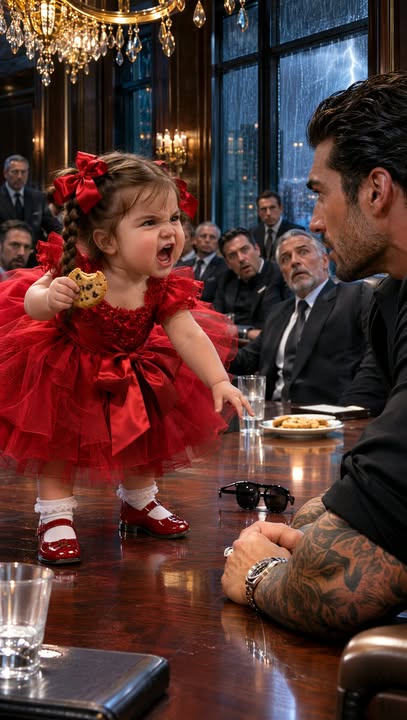
She was no longer the toddler who had climbed onto Vincent’s conference table and declared herself the boss, but her smile was the same.
She looked at him with careful curiosity.
“Daddy?”
Vincent crouched.
“Hi, Rosie.”
She stayed where she was.
“You got old.”
“I did.”
“Your hair has silver.”
“It does.”
“Mommy says it’s from thinking.”
“Your mother may be right.”
Rosie considered him.
“Did you bring a cookie?”
“I did.”
He held up the small tin.
She looked toward Emily.
“Can I?”
“After dinner,” Emily said.
Rosie sighed as if the world had not changed at all.
“Then you can come in.”
Vincent entered.
He set his bag by the wall and the cookies on the kitchen counter, then waited while Rosie showed him the drawing on the refrigerator.
“That’s you,” she said, pointing to a tall figure.
“I can tell.”
“That’s Mommy.”
“Yes.”
“And that’s me.”
“I can tell that, too.”
Rosie traced the red line connecting them.
“This is the road.”
“I remember.”
“Do you?”
“I remember you saying it went to Mommy.”
She looked surprised.
“You remember that?”
“I remember more than you think.”
Rosie led him into the living room, where a picture book sat open on the sofa.
“Will you read this?”
“If you want me to.”
“It’s a new one.”
“Then you’ll have to help me with the parts you already know.”
She sat beside him and opened the book.
Vincent read slowly.
Rosie interrupted to correct him twice and ask three questions about an owl who had misplaced his hat.
Emily watched from the kitchen doorway.
She did not look away when Vincent lost his place and had to start again.
She did not pretend that his return had erased the long years between them.
But she stayed in the room.
After the book, Rosie carried the cookie tin to the table.
“Mommy said after dinner.”
“You haven’t eaten dinner,” Emily reminded her.
“Now after.”
Emily laughed, and the sound was so familiar that Vincent felt it travel through the years.
“One cookie,” she said.
Rosie chose a round one and carried it to Vincent.
He looked at her.
“Are you sure?”
She nodded, then broke it in half.
“Share.”
Vincent accepted the smaller piece.
Rosie placed the other half in his palm, then tucked her own fingers into his.
“Good daddy,” she declared.
The words were simple, as easily given as they had been years before.
This time, Vincent understood they were not a verdict.
They were an invitation to keep showing up.
Emily came to stand beside him.
For a moment, she looked at Rosie, then at Vincent.
“I don’t know what we’ll be,” she said.
“Neither do I.”
“I’m still learning whether I can trust you.”
“I’ll keep learning how to deserve it.”
She studied his face, searching for a demand hidden inside the answer.
When she found none, she took his free hand.
The gesture was small.
It held no promise of a perfect future, no erasure of the past, no guarantee that the work between them would be easy.
It held only a choice made in the present.
Rosie leaned against Vincent’s knee, still holding one of his fingers.
Outside, the late afternoon sun rested softly on the garden, turning the ordinary windows gold.
For once, Vincent did not wonder what he could control, what he might lose, or how to make the world obey.
He sat at a modest table with a cookie in his hand, his daughter beside him, and Emily’s fingers wrapped around his other hand.
The road Rosie had drawn was crooked.
It led home anyway.
**–THE END–PLEASE
Share your thoughts or feedback to motivate us to create more stories ♥️
* * *
[PREVIOUS: PART 5](https://echoesofstories.idolsgift.com/blog/part-5-the-girl-who-called-him-daddy-047-2)
✓ Lynn R. Adams
Part 6 – The Home They Chose “You did,” the archivist repeated. Vincent held the receiver tightly, but his voice remained measured. “Explain what you mean.” “The final recording includes a message…