PART 6 (THE END): The Girl He Thought He Had Lost 057
Part 6 – A Door Left Open
Alexander’s gaze moved to the next line.
The hand that wrote this belonged to Samuel Flores, who found Elena after the fire and asked me to let him raise her until she was strong enough to return.
Alexander read the sentence again, his fingers tightening around the paper.
His mother stood across the desk, pale and silent.
“Samuel Flores,” he said. “Mrs. Flores’s husband.”
Victoria nodded faintly.
“Do you know what happened to him?”
“He died many years ago,” she said. “I knew his name. I did not know he had written this.”
Alexander continued.
The letter explained that Samuel had brought Elena out of the estate after finding her near the west garden, frightened, injured, and unable to speak clearly.
He had recognized the family crest on the key in her pocket and understood she belonged to the household.
He had carried her to his home while other rescuers searched the grounds and cared for Alexander.
The writer said he had sent word to the estate the following morning.
No one had answered.
Later, when a young aide came to the Flores home, Samuel believed the family knew Elena was alive and wanted her to remain with him until the confusion had settled.
The aide had told him that the household would contact him when it was safe to bring her back.
The note ended there, without a name.
Alexander lowered the page.
“Mrs. Flores thought the family had asked her to wait,” he said.
“So did Samuel,” Victoria replied.
“And you thought she was dead.”
“Yes.”
“Everyone was waiting for someone else to speak.”
His mother’s gaze dropped to the letter.
“It seems so.”
Alexander turned the page over.
There was a final paragraph, written in a different hand, dated several weeks after the fire.
It stated that the household had been informed Elena was alive and staying with the Flores family.
Beneath it, the writer had added that no further action should be taken until the revised fire report was filed.
The entry was signed with a single initial.
M.
Alexander did not need to ask whose.
Michael came into the study just as Alexander reached the signature.
He stopped at the sight of the open letter.
“What is it?”
“Read this,” Alexander said.
Michael approached and examined the page.
His expression changed as he recognized the handwriting.
“I wrote that.”
“Do you remember?”
Michael took a long breath.
“I remember going to the Flores home,” he said. “Not the whole visit, but I remember the woman and her husband. I was told Elena had died, then I was told she had been found alive. I thought they had agreed she would stay with them temporarily.”
“Who told you to go?”
“I can’t remember.”
“Why didn’t you bring her back?”
“I was told her family had been notified and that the arrangements were being handled.”
“By whom?”
Michael lowered his eyes.
“I don’t know.”
Alexander looked back at the entry.
“You knew she was alive.”
“I knew someone had found a child believed to be Elena. I did not know what happened after I left.”
“You never told me.”
“I believed you had been told she died because the adults had decided that was the safest explanation until everything was settled.”
“Who decided that?”
“I don’t know.”
The answer had once sounded like evasion.
Now, in the light of the letter, Alexander heard something more painful: Michael had been young, eager to be useful, and willing to mistake instructions for understanding.
It did not absolve him.
It did explain how a single frightened decision could be handed from one person to another until no one seemed responsible for the silence it created.
Michael looked at the signature.
“I should have checked that Elena was returned to the family,” he said. “I should have asked why the report was revised. I should have told you the moment she was found.”
“Yes,” Alexander said.
“I can’t undo it.”
“No.”
“But I can tell the truth now.”
Alexander met his eyes.
“Then tell all of it.”
“I will.”
The independent review began the following week.
The archivist arranged for qualified historians and a fire-safety specialist to examine the records, while the family’s legal office helped identify which documents could be shared publicly without exposing the Flores family’s private correspondence.
Victoria agreed to speak with the reviewers and confirm what she remembered.
Michael gave a full account of his work after the fire, including the visit to Mrs. Flores and the documents he had signed.
He did not try to make his youth an excuse.
Elena was invited to contribute her memories, but she chose to have her statement recorded privately.
She described the smoke, the door, the broken window, and the feeling of being carried away while she was too frightened to understand where she was going.
No one asked her to turn those memories into proof of more than they could establish.
The reviewers found no evidence that the fire had been deliberately set.
The wiring in the west wing had been faulty, and the curtains had caught when the electrical fault ignited them.
They also concluded that the archive door had been secured during the evacuation, apparently on Victoria’s instruction, though she believed the children had already been brought outside.
The door had trapped Alexander behind it.
Elena had broken the window in an attempt to reach him, cutting her hand on the glass.
The review could not establish exactly who carried her to the Flores home, but the correspondence made clear that Samuel had informed the household she was alive.
The information had been mishandled, misunderstood, and left without proper follow-up.
The official report had later been revised to remove the reference to the child’s effects found near the west corridor.
No record identified who requested that alteration.
Victoria accepted responsibility for ordering the archive secured and for failing to ensure that every child had been accounted for before the door was closed.
Michael accepted responsibility for accepting the revised report and failing to question the missing information.
Neither claimed to have intended Elena’s disappearance.
Neither asked the public to mistake good intentions for harmless consequences.
The family released the review’s findings, along with the relevant records, and opened the estate archive to independent public scrutiny.
There were questions, and there was sadness, but there was no spectacle.
The story was not simplified into a villain and a victim.
It was told as it had happened: a fire born of faulty wiring, a frightened duchess who believed the children were safe, a young aide who followed orders without asking enough, and a girl who was carried away from the house where she had been born.
Victoria gave a public statement from the estate’s front steps.
She stood beneath the pale stone archway where generations of her family had been photographed, but she did not speak about preserving their name.
She spoke about Elena.
“I ordered the family records secured because I believed everyone had already been evacuated,” she said. “I was wrong, and that decision trapped Alexander and left Elena in danger. I also failed to make certain that Elena was found and brought back to her family. I am deeply sorry for the harm that followed.”
She paused, letting the quiet remain.
“Good intentions do not erase what happened. I hope, in time, my actions will be judged alongside my remorse, but I do not expect forgiveness to be owed to me.”
Elena watched the statement from the community hall in the town where she had grown up.
Mrs. Flores sat beside her, one of Elena’s hands resting in both of hers.
When Victoria finished, the room remained quiet for several seconds.
Then the local fire chief, who had helped the reviewers understand the old building, stepped forward and spoke about the practical changes the family could make.
That was when the family’s lawyers proposed a new foundation devoted to fire safety, emergency planning, and preserving the history of ordinary people whose names rarely appeared in official records.
Alexander offered the estate’s initial funding.
Victoria added money of her own.
Michael volunteered to serve on the foundation’s records committee, with no special authority over what it chose to publish.
Elena’s name was suggested for the foundation.
She refused.
“I don’t want a monument named after me,” she said. “I want people to know what to do when a building is on fire, and I want doors that open when people need to get out.”
The board accepted her conditions.
The foundation became the Open Door Project, supporting fire-safety improvements in older community buildings and making the estate’s historical records available to the public.
Elena joined its advisory group only after she had considered the offer for several weeks.
She did not want the work to turn her into a symbol.
She agreed because she knew the difference a safe exit could make, and because she wanted her experience to lead to something practical.
Alexander was careful not to treat her decision as a promise to remain near him.
The family council met again after the independent review was complete.
They restored his authority to lead the estate, but Alexander chose not to take it up at once.
Instead, he asked the council to appoint a temporary director while an independent group reviewed the estate’s governance and the responsibilities attached to its title.
He would not accept the position until the family had decided publicly what kind of future it wanted for the estate.
Victoria, standing at his side during the meeting, did not ask him to reconsider.
She had begun to understand that protecting him did not mean keeping him from every consequence.
Months passed.
The Open Door Project helped fund new alarm systems and clear evacuation routes in schools, libraries, and neighborhood halls.
The estate archive opened its first public reading room, where visitors could examine copies of the fire records and learn how the family had failed to keep a complete account.
A small exhibition told the story of the fire without hiding the uncertainty that remained.
It included the brass key, displayed in a clear case only after Elena agreed.
She kept the original.
The little scar on her hand grew less noticeable as the seasons changed, but Alexander never stopped recognizing it.
Elena returned to her town and resumed repairing furniture in the workshop she shared with Mrs. Flores.
The work steadied her.
She sanded old tables, mended chair legs, and restored a battered wooden cabinet that Mrs. Flores had kept for decades.
Sometimes Alexander visited the town for foundation meetings.
He never arrived with a court, a formal announcement, or an expectation that she would set aside her work.
He came because he wanted to see her.
At first, their conversations stayed practical.
They discussed the foundation’s progress, the archive’s new hours, and the careful work of sorting through the remaining boxes from the west wing.
Then, slowly, they began to speak about the lives they had built apart.
Elena told him about the first time she remembered the old estate in a dream.
Alexander told her about the long years when he had believed grief was the same as loyalty.
She told him she had been angry with him for being so easy to find in newspapers and so impossible to reach as a person.
He told her he had been searching for someone who would love him without his title while never thinking that he might need to become a person worth knowing outside it.
They did not pretend childhood had made them inevitable.
They let it be what it was: a beginning, not a claim.
One afternoon, nearly a year after Elena had left the estate, Alexander came to the workshop carrying a small wooden box.
Mrs. Flores was in the back room, sorting a stack of fabric.
Elena was repairing the cabinet when he entered.
“You’re early,” she said.
“The meeting ended sooner than expected.”
“Did they decide whether the archive can open on Sundays?”
“They did. The council was persuaded by the number of families who can only visit on weekends.”
“Good.”
Alexander placed the box on the worktable.
“What’s that?”
“A key.”
Elena put down her cloth and examined the box.
Inside lay a newly made brass key, cut to fit the door of the estate’s restored archive room.
The old passage had been repaired and fitted with modern safety hardware.
Both sides of the door opened easily now.
The original key Elena had carried was no longer needed to enter, but the archive had kept the lock and placed a working replica beside it for visitors to see.
“This one is for you,” Alexander said. “Not as a relic. As a key that opens the room whenever you want to go in.”
Elena looked up at him.
“Why?”
“Because the room belongs to the people whose history is in it.”
“And because you don’t want to decide when I’m allowed inside?”
“That too.”
She turned the key in her fingers.
It was light, smooth, and new.
“You’ve learned something,” she said.
“I hope so.”
“Do you still want to marry me?”
“Yes,” he said. “But I don’t want you to feel that my answer is a question you have to answer in return.”
Elena studied him.
“Good.”
“I know you have a life here.”
“I do.”
“I won’t ask you to leave it for a title.”
“I wouldn’t.”
“I know.”
She smiled at that, and something in his face eased.
“I want a life with you,” he said. “If you want one with me. It can be here, or at the estate, or in both places. We can make decisions together instead of pretending one of us should simply follow the other.”
Elena set the key down on the table.
“I used to think coming back would answer everything,” she said.
“Did it?”
“No. It showed me how much I still had to decide.”
“That sounds right.”
“I don’t want to be chosen because you feel grateful.”
“I’m not asking you because I feel grateful.”
“Or because you want the story to end neatly.”
“I don’t want a neat ending.”
“What do you want?”
“I want to know you as you are now. I want to keep choosing you when there’s no ballroom watching and no question about the past between us.”
Elena looked down at the workbench, at the cabinet she had been restoring.
The old wood had been darkened by time, but its grain was visible again where she had sanded it smooth.
She understood that restoration did not mean returning something to the exact shape it had once had.
It meant making room for what it had become.
“I want that too,” she said.
Alexander did not move.
“Are you sure?”
“I’m sure I want to find out.”
“That’s enough.”
She reached across the worktable and took his hand.
The gesture was different from the one in the ballroom.
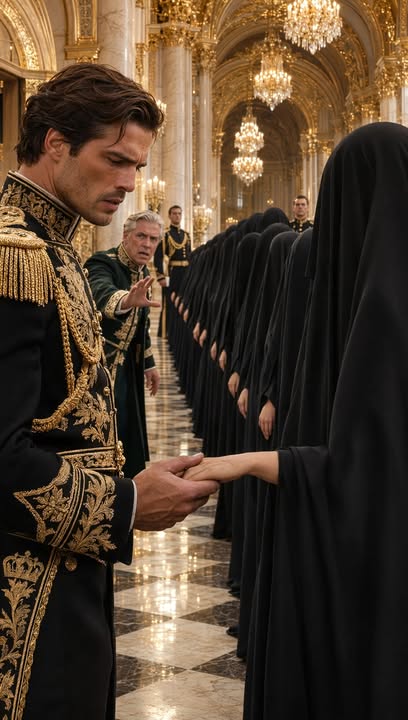
There was no veil, no court, and no audience waiting to decide what her hand meant.
She chose the touch herself.
“I can’t promise I’ll become a princess,” she said.
“I would never ask you to.”
“I can’t promise I’ll live at the estate.”
“Then we won’t assume that.”
“And I may still be angry about the years we lost.”
“I’ll understand.”
She squeezed his hand.
“But I don’t want to lose more years because we’re afraid of what the truth changed.”
Alexander’s eyes brightened.
“Neither do I.”
Mrs. Flores appeared in the doorway, pretending not to have heard more than she had.
“Are you two finished talking?” she asked. “That cabinet isn’t going to repair itself.”
Elena laughed.
It was not the laugh Alexander remembered from their childhood, though he could hear its old shape inside the new one.
He had once believed that finding Elena again would return him to the life he had lost.
Instead, she had shown him that love could not restore the past by force.
It could only make a place for the truth, then ask what the people who survived wanted to build beside it.
The following spring, Alexander and Elena were married in a simple ceremony in the garden of Mrs. Flores’s home.
There were no crystal chandeliers or rows of veiled candidates.
There were only the people who had helped them live through the years between: Mrs. Flores, Victoria, Michael, a handful of close friends, and the neighbors who had come to know Elena as the woman who could mend almost anything.
Victoria wore a plain cream dress and sat in the front row.
Before the ceremony, she spoke with Elena privately.
“I know an apology cannot restore the time we lost,” she said.
“No,” Elena replied.
“But I will keep trying to be honest with you, even when honesty is difficult.”
“That is all I can ask.”
Victoria nodded.
“I hope there may be a day when I can call you family without asking you to forget how you came to stand here.”
Elena considered her for a moment.
“You can call me family when we have made one together.”
Victoria’s eyes filled.
“I would be grateful for that.”
Michael stood with Alexander during the ceremony, not as the adviser who had always stood between the prince and his choices, but as a friend who had learned that loyalty sometimes meant speaking when silence would be easier.
When the officiant asked whether Alexander took Elena as his partner, he answered without glancing toward the assembled guests.
“I do.”
Elena’s hand rested in his.
No diamonds covered it.
The old scar remained near her thumb, small and pale, and he no longer saw it only as a sign of the night she had tried to save him.
It was also the mark of her own life: the people who had raised her, the work she had chosen, the questions she had carried, and the strength it had taken to return without knowing what she would find.
“I do,” she said.
Alexander slipped a simple ring onto her finger.
When they kissed, the guests applauded, but neither of them looked away from the other.
Later, as the celebration softened into conversation and music, they walked beneath the garden trees.
From where they stood, they could see the road leading toward the town and, beyond it, the distant roofline of the old estate.
The brass key rested in Elena’s pocket.
The archive door, once closed by fear and opened by memory, stood open to anyone who came seeking the truth.
Alexander reached for her hand.
Elena placed hers in his.
For the first time, there was no locked door between them, no promise made on their behalf, and no past either of them had to deny in order to choose what came next.
**–THE END–PLEASE
Share your thoughts or feedback to motivate us to create more stories ♥️
* * *
[PREVIOUS: PART 5](https://storyly.idolsgift.com/blog/part-5-the-girl-he-thought-he-had-lost-057)
✓ Lynn R. Adams
Part 6 – A Door Left Open Alexander’s gaze moved to the next line. The hand that wrote this belonged to Samuel Flores, who found Elena after the fire and asked me to let him raise her until she was …