PART 6 (THE END): The Girl He Thought Had Died 058
Part 6 – A Choice Made in the Open
Isabella held the sealed packet while every person in the study watched her.
She had been summoned to meet someone alone, but she had no intention of going anywhere without choosing for herself who would stand beside her.
“Do you recognize the handwriting?” Adrian asked.
“No,” she said. “But I know what it asks.”
Edmund moved nearer, though he did not reach for the letter.
“You don’t have to open it now.”
“I know.”
Her fingers rested against the crescent impressed in the wax.
For years, other people had turned concern into instructions and uncertainty into silence.
This time, the choice was hers.
“I’ll read it,” she said. “Here.”
She broke the seal.
The letter inside was written in a careful, unfamiliar hand.
It said the writer had been a clerk in the late private secretary’s office and had kept a copy of a message sent twelve years earlier.
The private secretary, it continued, had believed the damaged wheel was proof of a plot against the prince.
He had ordered the wheel preserved, but had been afraid to bring the matter before the king without evidence that could withstand the court’s scrutiny.
He had also sent the warning to Duke Edmund, hoping to keep the young witness safe until he could establish who had tampered with the carriage.
The writer had learned that Edmund had received the warning, but had never learned whether the duke had been told why.
The letter ended by naming the clerk: a woman called Elspeth Morrow, who had served as the private secretary’s copyist and now lived in a village south of the capital.
“I know her,” the archive keeper said after reading the page. “She worked in the records office. She retired a few years ago.”
“Could she have sent the warning?” Edmund asked.
“Not as the author,” the king said. “The signature is that of my private secretary, though the letter could have been written at his direction.”
“Or copied by her,” Isabella said.
The archive keeper nodded.
“The hand on this packet is not the secretary’s. It may be Elspeth’s.”
Frederick looked at the message again.
“Then we should ask her to come here.”
“Ask,” Isabella said. “Don’t summon.”
The king met her gaze.
“Ask,” he agreed.
He gave the letter to the archive keeper, who promised to carry the request herself.
As she left the study, Isabella looked once more at the crescent seal.
The message had not resolved the mystery.
It had given the mystery a witness.
Elspeth Morrow arrived the following afternoon, traveling in a modest carriage with no escort beyond a palace driver.
She was a small, round-shouldered woman with white hair and bright, watchful eyes.
When she entered the king’s study, she did not look first at the throne or the court records.
She looked at Isabella.
“I’m sorry it took so long,” she said.
Isabella had expected explanations.
She had not expected an apology.
“Do you know me?”
“I remember the report,” Elspeth replied. “A girl with blood at her temple, soaked to the shoulders, and furious that the physician wanted her to sit still.”
Isabella’s memory stirred.
The smell of wet wool.
A physician’s bag.
Her father speaking sharply to the servants.
She remembered refusing to let anyone cut her hair, although the blood had tangled in it.
“Did I identify Lord Veyne’s carriage?” she asked.
Elspeth’s expression grew grave.
“Not exactly.”
“What did I say?”
“You said the second carriage passed the stream before the guards arrived. You said it had a dark crest on the door, but you couldn’t tell what it showed.”
“Then why does the medical report say I identified the steward’s crest?”
“Because someone wrote that later.”
“Who?”
Elspeth glanced at the king.
“I don’t know who altered the line. I copied the first report, and it said only that the witness saw a carriage leaving the road.”
“Was there a crest?” Adrian asked.
“I never saw one,” Isabella said. “I remember the sound and the shape of the carriage through the snow, but not a crest.”
Elspeth nodded.
“That matches the first copy.”
The king’s hand tightened on the arm of his chair.
“Did my private secretary add the line?”
“I cannot say. He was alarmed by what the physician told him, and he believed the steward might have been connected to the accident. He asked me to preserve every version of the report, including the first.”
“Why didn’t he tell me?” Frederick asked.
“He intended to,” Elspeth said. “But he thought he needed the wheel examined first. The steward had already removed it from the workshop.”
“Did the secretary know where it was?”
“He knew it had been sent to the steward’s private stores. He did not know whether it was still there.”
“And the warning to my estate?” Edmund asked.
Elspeth turned to him.
“The secretary wrote it. I copied it and arranged for it to be delivered by a courier he trusted.”
“Why tell me to keep Isabella hidden without explaining why?”
“I asked him the same question,” she said. “He said he had no proof that the girl had seen anything important, and he did not want her questioned by people who might frighten or influence her.”
“Then why say the court should believe she had not survived?” Isabella asked.
Elspeth lowered her eyes.
“That wording was meant to keep the palace from searching for you. He thought that if the court believed there was no witness, the steward would stop looking for one.”
“Did it work?”
“I don’t know.”
“Did he understand what my father might do with that warning?”
“He understood that Duke Edmund would be cautious. I don’t believe he understood that the veil would become part of your life.”
Edmund stood very still.
“No one explained the warning to me,” he said.
“I know,” Elspeth replied. “The secretary wrote that it was kinder not to burden you with a suspicion he could not prove.”
“Kinder,” Edmund repeated.
“I am not saying he was right.”
The words found the same sore place Isabella had been carrying since the garden.
Elspeth did not defend the secretary with good intentions.
She simply admitted that his caution had caused harm.
“What happened to him?” Adrian asked.
“He died the following year,” Elspeth replied. “Before he could finish his inquiry.”
“And the evidence?”
“I kept the copies he asked me to keep. He wrote that someone should look into the matter when the steward no longer controlled the records.”
Frederick exhaled slowly.
“Why did you wait all these years?”
“Because I was afraid of accusing an honored man without proof,” Elspeth said. “Then because the papers were buried among old files, and each year it became harder to believe anyone would care about a small clerk’s copy.”
She looked at Isabella.
“Yesterday, I saw your name on the king’s request. I recognized it.”
Isabella studied the woman’s face.
“You were not the one who sent the packet?”
“No. I recognized the seal, but I did not write that letter.”
The archive keeper returned with a final document, found among Elspeth’s papers after she had been invited to the palace.
It was a note from the private secretary, dated just weeks before his death.
He had written that the wheel had been removed by order of Lord Veyne, but he could not prove whether the steward had acted to hide evidence or had simply made a reckless decision in the confusion after the accident.
He had recorded that a junior clerk believed the wheel was being kept in a locked storehouse.
No later entry described its return or destruction.
Frederick read the note aloud.
When he finished, the room fell quiet.
“So Lord Veyne did not necessarily cause the accident,” Adrian said.
“No,” Isabella replied. “But he removed the wheel, discouraged questions, and helped turn an uncertain witness into a dead one.”
“Whether through fear or design,” Edmund said, “he used his position to decide what the rest of us were allowed to know.”
The king looked toward the window.
“I will order an independent examination of every surviving record. Lord Veyne will answer for the choices he made, but we will not claim more than the evidence proves.”
Adrian nodded.
“And the person who tampered with the wheel?”
“We may never identify them,” Frederick said. “Not after so many years.”
Isabella looked at the report, the old warning, and the copyist’s letter.
For the first time, she understood that a mystery did not always end with a single villain stepping into the light.
Sometimes it ended with the truth of what could be known, and the courage to stop pretending that uncertainty was the same as innocence.
“The court should correct the record,” she said.
“It will,” the king replied.
“And my name?”
“Your name will be entered as the witness who survived the accident and helped rescue the prince.”
“Not as a rumor. Not as a secret.”
“Not as a secret,” Frederick promised.
The inquiry lasted several weeks.
The records confirmed that Lord Veyne had removed the damaged wheel and delayed the investigation without royal authority.
They could not establish that he had ordered the carriage tampered with, nor that he had known who caused the crash.
They could establish that he had concealed information, allowed an altered report to remain in the official file, and failed to correct the belief that Isabella had died.
He was removed from his duties as steward and barred from handling royal correspondence.
The king’s judgment was measured and public, but not theatrical.
No one was asked to gather in the square to watch him fall from favor.
The palace simply recorded the facts, restored Isabella’s name to the account, and placed the surviving evidence where no single household office could make it disappear again.
The person who had damaged the carriage was never identified.
That part of the past remained unanswered.
But the story the court had told about Isabella was no longer allowed to stand.
Edmund was cleared of knowingly helping any conspiracy.
The warning had frightened him into silence, but the inquiry found no evidence that he had supported the person who caused the accident or understood the danger to Adrian.
The king also made clear that the duke’s fear did not erase the harm his secrecy had caused his daughter.
Edmund accepted the finding without asking that it be softened.
When the report was complete, he asked Isabella to walk with him in the gardens behind the palace chapel.
The old fountain had been cleaned, and rainwater shimmered in its basin.
“I kept telling myself that if I carried the fear alone, you would never have to carry it,” he said.
“You still made me carry the silence.”
“I know.”
“You gave me beautiful clothes and told me the veil was for my protection. Then you let me wonder whether my face was the reason I had to hide.”
Edmund’s eyes filled.
“I am sorry.”
“I believe that you wanted to keep me safe,” she said. “I also need to believe that you will ask me what I want, even when you think you already know.”
“I will ask.”
“And listen?”
“And listen.”
She let the promise rest between them.
“I can’t give you back the years,” he said.
“No.”
“But I can try to be your father differently now.”
“That would matter.”
He offered his arm.
This time, Isabella chose to take it.
They walked slowly beneath the bare branches, no longer bound by a secret neither of them had named.
Adrian came to see Isabella the following day.
He waited in the outer gallery rather than entering her rooms without permission.
When she appeared, he stood and bowed.
“I’d like to ask you something,” he said.
“You may.”
“Will you walk with me?”
“I will.”
They went to the chapel garden, where the air smelled of damp earth and winter rosemary.
For a while, they spoke of the inquiry, of the incomplete evidence, and of the strange relief of knowing that the truth could be complicated without being false.
Then Adrian stopped beside the dry fountain.
“I’ve been thinking about the altar,” he said.
“So have I.”
“I don’t want to tell you that I ran because I was frightened and expect that to make it all right.”
“It doesn’t.”
“I know.”
“I don’t want to marry you because I saved your life.”
“I know that too.”
“Or because our fathers made an alliance.”
“I don’t want that either.”
“Then what do you want?”
He looked at her with none of the desperation he had carried in the garden after the wedding.
“I want the chance to know you, if you want the same.”
“And if I don’t?”
“Then I will respect your answer.”
She searched his face.
He had been afraid, ashamed, and wrong.
He had also listened when she told him not to use guilt as a claim upon her.
He had let her challenge his father and his own assumptions without asking her to make the conversation easier for him.
Those things mattered.
They did not obligate her.
“I want to know you too,” she said. “But I want us to go slowly.”
“I would prefer that.”
“And I want you to speak to me as Isabella, not as the girl who rescued you.”
“Then tell me when I forget.”
“I will.”
He smiled.
“I am almost certain you will.”
She laughed, and the sound surprised them both.
It was not a grand moment.
It was better than one.
They began with letters, because both of them found it easier to be honest when they had time to choose their words.
Adrian wrote about books he had loved as a child and the places he hoped to see beyond the palace walls.
Isabella wrote about the gardens at her father’s estate, the music she liked, and the way people often spoke about her size as though she could not hear them.
He answered without offering easy praise or claiming her appearance made no difference to how the world treated her.
He asked what she wanted from him.
She told him.
He listened.
When they met, they walked without a crowd and talked about small things before returning to the larger ones.
He learned that Isabella was quick-witted, stubborn about fairness, and far more patient than she believed.
She learned that Adrian’s humor was gentler than his reputation, and that he often used silence when he was afraid of saying the wrong thing.
Their trust did not arrive all at once.
It grew in the space between one honest answer and the next.
The wedding remained postponed.
The king insisted that the alliance could wait until Isabella and Adrian were certain they wanted it.
Duke Edmund supported that decision, though he did not again suggest that his daughter’s choice was a matter of duty.
Months passed.
Spring came to the palace gardens.
The frost receded from the stones, and the fountain ran clear again.
One afternoon, Isabella walked into the garden without a veil.
She wore a simple green dress and a warm cloak, with her hair pinned back from the faint scar at her temple.
Some courtiers glanced at her.
One looked too long.
Another began to whisper.
Isabella kept walking.
Adrian, who had joined her at the garden gate, did not reach for her hand until she offered it.
“I thought I might be nervous,” she said.
“Are you?”
“A little.”
“Do you want to leave?”
“No.”
“Then we’ll stay.”
She looked at him.
“You don’t need to stand in front of me.”
“I know.”
“Good.”
He remained beside her, neither shielding her from the court nor asking her to pretend its cruelty did not exist.
She began attending public gatherings uncovered.
At first, people stared.
Some continued to whisper about her size, as if a woman’s body were public property.
Isabella did not pretend it did not hurt.
She also did not let their attention determine whether she entered a room.
With the king’s support, she established a small court committee devoted to hearing complaints from servants, apprentices, and noblewomen who had been dismissed or ridiculed because of their appearance, age, or rank.
She insisted that its members include people who understood what it meant to be spoken about rather than listened to.
The work was not glamorous.
It involved letters, patient meetings, and changing rules that others had accepted for generations.
Isabella found she preferred useful work to ceremony.
Adrian supported her without taking credit for it.
When she disagreed with him, he listened.
When he disagreed with her, he said so plainly.
They learned to apologize without turning every disagreement into a wound and to ask what the other needed before assuming they already knew.
A year after the first wedding had been planned, Adrian asked Isabella to marry him again.
He did not do it at the altar.
He did not do it before the court.
He asked her in the garden beside the fountain, where they had first spoken after the truth began to surface.
“I want to build a life with you,” he said. “Not because you saved me, not because our families expect it, and not because I believe the past has made us belong to each other.”
She held his gaze.
“I want to marry you because you are the person I have come to know, and the person I hope to keep learning.”
He took a breath.
“Will you choose me?”
Isabella looked at the man who had once fled from her face.
She remembered the boy in the stream, frightened and reaching for a hand.
She remembered the prince at the altar, overwhelmed by a memory he did not understand.
She also remembered the man who had waited for her answer, who had never again treated her gratitude as a debt.
“Yes,” she said. “I choose you.”
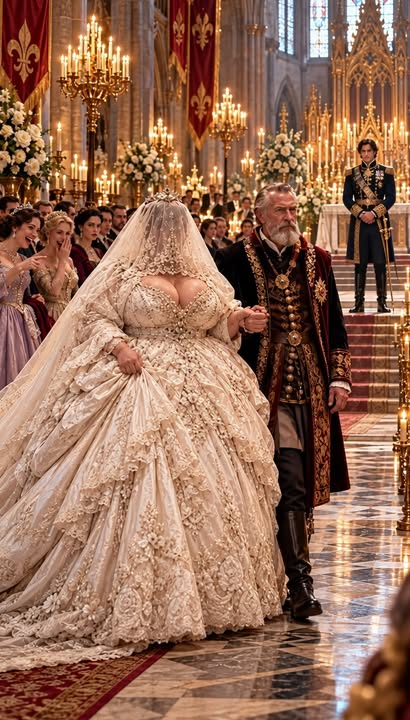
Their wedding was held in the same chapel, but this time there was no political bargain waiting beneath the music.
Edmund walked beside his daughter to the altar.
He did not place her hand into Adrian’s as if it were a transfer of responsibility.
He offered her his arm, and she took it because she wanted to.
No veil covered her face.
The gown was ivory, beautifully made, and designed for her comfort as well as for the ceremony.
Silver stitching caught the light when she moved, and the faint scar near her hairline remained visible.
The court was quiet as she entered.
Not because she demanded silence.
Because the room had learned to listen.
Adrian stood waiting, his eyes bright with feeling.
When she reached him, he did not lift a veil or search her face for a ghost.
He simply smiled at her.
“Hello, Isabella,” he whispered.
“Hello, Adrian.”
The ceremony was small enough for them to hear the promises they made and warm enough for laughter to rise when Edmund, who had prepared a long speech, lost his place and admitted he was too proud to continue.
Afterward, the gardens filled with music.
Isabella danced with her father first.
Edmund held her carefully, and she rested her cheek against his shoulder.
“I am proud of you,” he said.
“I know.”
“I should have told you that without asking you to hide.”
“Yes,” she said. “You should have.”
“I will spend the rest of my life trying to do better.”
“That would be a good start.”
He kissed her forehead, near the pale scar.
Then Adrian offered her his hand.
“May I?”
“You may.”
They stepped into the open space where the musicians were playing.
Adrian did not lead too quickly.
Isabella did not follow merely because he was a prince.
They found the rhythm together.
Around them, the court watched, but the watching no longer decided who she was.
Long afterward, people would tell the story of the prince who ran from the altar when his bride revealed her face.
Some would say the truth had frightened him.
Others would say he had recognized the girl who saved him.
Isabella never corrected every version.
She knew what mattered more.
She had stopped being a secret, and Adrian had learned that love could not be demanded as payment for a rescued life.
They had chosen each other in the open, with no veil between them and no silence standing in for trust.
And when they left the chapel together, it was not because duty had sent them there.
It was because, at last, they had both freely chosen the way forward.
**–THE END–PLEASE
Share your thoughts or feedback to motivate us to create more stories ♥️
* * *
[PREVIOUS: PART 5](https://storyly.idolsgift.com/blog/part-5-the-girl-he-thought-had-died-058-4)
✓ Lynn R. Adams
Part 6 – A Choice Made in the Open Isabella held the sealed packet while every person in the study watched her. She had been summoned to meet someone alone, but she had no intention of going anywher…