PART 6 (THE END): The Girl Beneath the Silver Ribbon 052
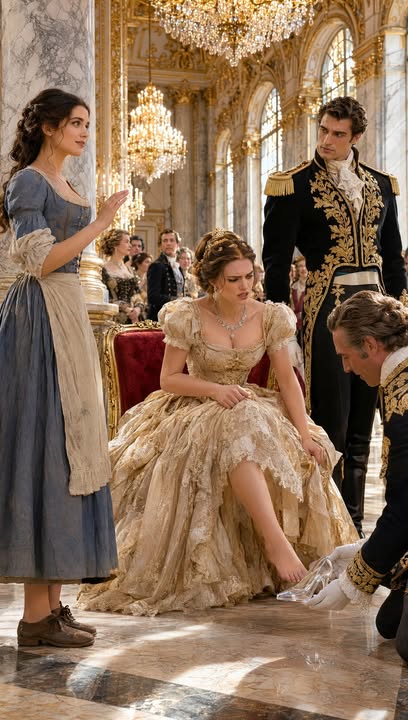
Part 6 – The Choice They Made
“Then tell me,” Clara said. “Was it me you were searching for—or the moment you lost?”
The prince did not answer at once.
For a breath, the market square seemed to narrow around them: the fountain’s soft murmur, the rustle of the awnings, the ordinary lives moving past while an extraordinary question waited between them.
Then he said, “At first, I searched for the moment.”
Clara’s fingers tightened around the note.
Eleanor had stepped away from her mother and was watching them from across the square, the second envelope held in both hands.
The prince continued, “I remembered the music stopping at midnight. I remembered finding the slipper. I told myself that if I found the woman who had left it, the rest would make sense.”
“And when it didn’t?”
“I remembered more. Your voice speaking to the kitchen boy. The way you listened to him. The fact that you left without asking anyone’s permission when your mother needed you.” His eyes held hers. “The moment brought me to you. It did not give me the right to claim you, and it is not why I want to know you now.”
Clara looked down at the note.
It had been written to unsettle her, but the question it asked had been waiting inside her long before the paper arrived.
“I wanted there to be a simple answer,” she said. “Something that would tell me I was safe to choose you.”
“I wish I could give you one.”
“You cannot.”
“No,” he said. “I can only tell you the truth and let you decide what it means.”
That answer did not erase her uncertainty.
It made room for it.
Across the square, Eleanor had begun walking toward them.
Her mother followed, composed but watchful, while Eleanor’s gaze remained fixed on the envelope in her hand.
“I think I know where these messages came from,” she said when she reached them.
Her mother glanced at the prince.
“Eleanor, perhaps we should speak privately.”
“No, Mother. We have kept too much private already.”
There was no anger in her voice, but a new firmness that seemed to surprise even her.
She looked at Clara.
“I found a copy of the same message among the papers in our family solicitor’s office. It was not written to you. It was a draft, meant to be sent if the prince withdrew the alliance.”
Clara unfolded her own note and held it out.
Eleanor read it, then gave a small, troubled nod.
“The wording is the same.”
“Who wrote it?” the prince asked.
“The solicitor says my mother dictated it,” Eleanor replied. “She wanted Clara to doubt the prince’s search and to make the court believe the match could not be trusted.”
Eleanor’s mother’s expression tightened.
“I thought I was protecting my daughter.”
“By making Miss Bell believe she was being deceived?” the prince asked.
“I thought if the prince’s search was only a memory, the court might return to a sensible arrangement.”
“And you believed that arrangement would save your family?”
“I believed it might save our home.”
Eleanor turned toward her mother.
“Why didn’t you tell me the truth about our debts?”
Her mother looked down at the cobblestones.
“Because I thought you would feel responsible.”
“I already did.”
Her voice broke on the final word, and she gathered herself before continuing.
“I wanted you to trust me enough to let me help, but I never gave you the truth you would have needed to choose.”
The older woman’s face softened with regret.
“You are right.”
Eleanor looked at Clara.
“I am sorry. I let my fear make me part of a lie that was meant to guide your choices.”
Clara studied her, remembering the laughter in the ballroom, the apology in the conservatory, and the courage it had taken for Eleanor to speak honestly when the truth might cost her something.
“Thank you for telling us now,” Clara said.
Eleanor’s eyes glistened.
“I don’t expect you to forgive everything at once.”
“I don’t know that there is everything to forgive,” Clara replied. “But there is something to learn from.”
Eleanor nodded, accepting the distinction.
The prince turned to her mother.
“The marriage arrangement is over,” he said. “Your family’s debts will not be settled through an engagement, and no one will be asked to make a promise they do not want.”
“I understand.”
“But the court can still review the family’s accounts and discuss whether any honest assistance is possible,” he continued. “Any help must be based on fair terms, not marriage.”
Eleanor’s mother looked up, wary.
“Would you do that after what I have done?”
“I would not use your mistake to decide whether your tenants deserve fairness,” the prince said. “But the terms must be open, and your family must take responsibility for its own decisions.”
Eleanor stood straighter.
“I will help with the accounts,” she said. “I know the estate records better than anyone. If we need to sell land or reduce expenses, I want to face it honestly.”
Her mother searched her face.
“You would give up the season in the capital?”
“I would rather help save what we can than pretend the old life can continue unchanged.”
The prince’s expression warmed, though he said nothing.
There would be time for the families to mend what had been strained, but it would not happen by a single apology or a royal decree.
For now, truth had been spoken plainly, and each person would have to decide what to do with it.
Eleanor turned toward Clara.
“I hope, one day, we might speak without a contest between us.”
“Perhaps we can,” Clara said. “Not today, perhaps. But perhaps.”
Eleanor gave a small, grateful smile.
Then she went with her mother toward the solicitor’s carriage, carrying the envelope that had once been intended to shape Clara’s choice.
The prince remained beside the fountain.
Clara looked at him, still holding the first note, its paper creased in her palm.
“What do you want me to say?” she asked.
“Nothing you are not ready to say.”
“That is kinder than telling me what you want.”
“I do want you to choose me,” he said. “But I want the choice to belong to you more than I want the answer to be yes.”
The words settled in her heart, not as a command but as an invitation.
Clara watched a child toss a crumb toward the sparrows, then turn away when the birds gathered around it.
She thought of the palace, of its staircases and ceremonies, and of how small she had felt beneath its golden chandeliers.
She thought of her mother’s cottage and the warm table where the queen’s letter had been read.
She thought of the prince’s quiet honesty, and of the way he had listened when she asked for a life beyond the palace walls.
“I will not move into the palace as your bride,” she said.
He nodded, though disappointment briefly crossed his face.
“I understand.”
“Not yet.”
His expression changed.
“Not yet?”
“I would like to know you somewhere neither of us has to pretend that a title can solve everything.”
“I would like that too.”
“You will come to the cottage again, but not with a royal escort.”
“I can come alone.”
“And you will meet my mother as yourself, not as someone who is expected to rescue us.”
“I promise.”
“And if I discover that I love you but cannot live at court?”
“Then we will have to decide what our life can be.”
“Together?”
“Only if you still want it to be together.”
Clara let the note fall to her side.
For the first time since she had stood beside the glass slipper, she felt no crowd pressing a future upon her.
There was only the square, the fountain, and the prince waiting without asking her to hurry.
“Then we can begin with another conversation,” she said.
His smile was quiet, almost disbelieving.
“I would be honored.”
They met the following week in the town square, and the week after that on the path beside the river.
The prince learned how Clara took her tea and which market stall sold the best apples.
Clara learned that he disliked rehearsed speeches, that he kept a small notebook of questions he could never ask during council meetings, and that he sometimes walked through the palace gardens at night because the fountain helped him think.
They spoke about the things that made them hopeful and the things that frightened them.
Sometimes they disagreed.
When they did, the prince did not summon a servant to smooth over the silence, and Clara did not pretend that she agreed merely because he was a prince.
The palace changed slowly, and not always willingly.
The council withdrew the proposed alliance with the Bellweather family, and the royal accounts were reviewed with greater care.
Some advisers continued to object to the prince’s refusal, but he did not ask Clara to defend his decision for him.
Eleanor worked with her family’s solicitor to settle their debts openly.
They sold a country house they could no longer afford and kept the land that supported the tenants and household staff.
It was a hard season, and the family had to change the way it lived, but Eleanor’s honesty gave them a beginning that no marriage bargain could have offered.
She and Clara exchanged a few letters.
Their friendship did not arrive quickly, nor did it need to be called friendship before it had grown into something true.
At the royal archives, Mrs. Wren placed the queen’s letters beside the record of her promise.
She added Clara’s mother’s name to the household history, not as a title or a legend, but as a woman who had once helped another person through a frightening hour.
The silver pin was returned to Clara’s mother.
For a time, she kept it beside the hearth, where the afternoon light touched its tiny etched leaves.
“I used to think that accepting it again would mean accepting a debt,” she told Clara one evening.
“And now?”
“Now I think I can accept gratitude without surrendering my choices.”
Clara took her mother’s hand.
“That sounds like something the queen hoped for.”
“I think she would have liked knowing you understood.”
The slipper remained in the royal archive for several months.
The prince refused requests to display it as proof that the future queen had been found.
When a visiting historian asked what should be written on its record, he answered, “It was worn by Clara Bell, who chose her own life.”
Clara heard of the wording and shook her head.
“You have made it sound like a royal decree.”
“I can ask them to change it.”
“Don’t. Just remember that I was already choosing my life before the slipper fit.”
“I do remember.”
“Good.”
As spring approached, the prince began visiting Clara’s mother’s cottage on Sundays.
He came without an announcement and learned to mend a garden gate, though his first attempt left it hanging at an awkward angle.
Clara laughed when she saw it.
The prince laughed too, and asked her mother to show him how to set the hinge properly.
In that small garden, he was not the man who had stood beneath chandeliers and made an entire ballroom hold its breath.
He was simply a man trying to do a useful task without making it harder for the people around him.
One Sunday, after the gate had finally been set straight, he walked with Clara along the narrow lane.
“I have a question,” he said.
“You have many.”
“This one is important.”
She turned to him.
He had not brought a ring or a court announcement.
He had come in the same plain coat he wore when they met in town, with a dusting of earth still on one sleeve.
“I love you,” he said. “I would like to build a life with you, wherever we can build it honestly. Will you marry me?”
Clara felt the question reach her without the weight of an audience behind it.
She did not answer at once.
Not because she doubted her love, but because she understood what her yes would mean.
It would mean walking into a world that would not always know what to do with her.
It would mean asking the prince to keep choosing honesty when convenience would be easier.
It would mean allowing herself to be loved without believing that love made her the property of a palace.
She looked toward the cottage, where her mother stood in the open doorway, giving them privacy while pretending to be busy with the herb pots.
Then Clara looked back at the prince.
“Yes,” she said. “I will marry you, if we keep choosing each other after the answer.”
“We will.”
“And if we find something difficult, we speak of it.”
“We will.”
“And no one gets to say I became worthy because a slipper fit.”
“No one.”
“Not even you.”
“Not even me.”
Clara smiled, and he took her hands.
Their wedding was held in the palace garden, not in the great ballroom.
The gathering was small enough that Clara could recognize every face, yet large enough to include the people whose care had helped carry them there.
Her mother wore the silver leaf pin at her collar.
Mrs. Wren sat in the front row with her cane resting against her chair.
Mr. Vale stood beside the royal attendant, who had once lifted the glass slipper from its crimson cushion.
Eleanor came with her mother, both dressed simply, their family’s future still uncertain but no longer hidden behind a bargain.
When the prince took Clara’s hands, he did not speak of destiny or a lost slipper.
He spoke of the conversations they had chosen to have, of the truths they had dared to tell, and of the ordinary days they hoped to share.
Clara promised to love him without becoming smaller.
He promised to love her without making her life a royal possession.
Their vows were heard beneath the open sky, with the garden fountain murmuring nearby and spring light resting softly on the silver ribbon around Clara’s wrist.
Afterward, the people of the palace and the town gathered together beneath strings of lanterns.
There were no competing brides, no public test, and no announcement that a shoe had decided anyone’s future.
There was music, shared food, and laughter that did not depend on anyone else’s embarrassment.
The glass slipper was brought from the archive only after the celebration had begun.
It rested on a small table near the garden doors, where guests could see it without being asked to admire it.
Clara paused beside it.
The prince joined her.
“Do you wish we had never found it?” he asked.
“No,” she said. “It helped you recognize me.”
“And what helped you recognize me?”
She considered.
“The way you let me answer for myself.”
He offered his hand.
She took it.
Years later, when people asked how the prince had found his queen, they still told the story of the glass slipper and the girl who had left a royal ball at midnight.
But Clara told them what came afterward: the difficult conversations, the promises that left room for choice, and the quiet work of building a home that did not depend on rank.
The slipper remained in the palace archive, not as proof that fate had chosen them, but as a reminder of where their story began.
Love had brought them to the same room.
They had chosen, freely and again, to remain together.
**–THE END–PLEASE
Share your thoughts or feedback to motivate us to create more stories ♥️
* * *
[PREVIOUS: PART 5](https://storyly.idolsgift.com/blog/part-5-the-girl-beneath-the-silver-ribbon-052-2)
✓ Lynn R. Adams
Part 6 – The Choice They Made “Then tell me,” Clara said. “Was it me you were searching for—or the moment you lost?” The prince did not answer at once. For a breath, the market square seemed to nar…