PART 6 (THE END): The Gate Rose, but Emma Asked for Time 057
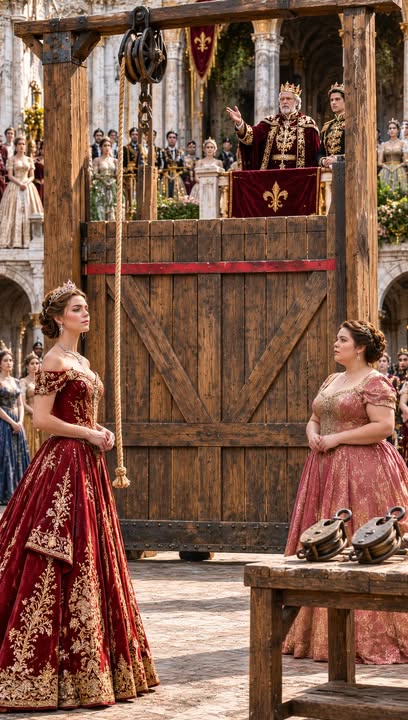
Part 6 – The Gate Opens
The secretary returned just before nightfall, carrying a narrow wooden case sealed with plain blue wax.
“The documents have been delivered,” he said. “Their bearers accepted the panel’s terms. They asked that their names remain private until the records have been verified.”
The king studied the seal before breaking it.
Inside lay several account sheets, a bundle of letters, and a small envelope containing a single folded voucher.
Emma’s breath caught when she saw the familiar heading.
“Is that the original?” she asked.
Mr. Vale, summoned from the archive, examined the paper without touching the ink.
“It appears to be,” he said. “The paper, seal, and entries are consistent with the period.”
The king nodded to him.
“Read it carefully.”
Mr. Vale unfolded the voucher beneath the archival lamp.
It listed the forty-two crowns issued for the west gate repair, item by item: the replacement wheel, an iron pin, chain, and other materials.
Thomas Hale’s signature appeared at the bottom, followed by a separate line confirming that he had returned the unused balance.
The date matched the day after the repair had been inspected.
Emma pressed her fingertips against the edge of the table.
“So he did return it,” she whispered.
“The voucher says he did,” Mr. Vale replied. “And the amount matches the balance recorded in the original repair account.”
Alexander let out a slow breath.
“Then the second payment entry was false.”
“Or deliberately made to appear as a second payment,” said the king. “We must compare it with the accompanying correspondence.”
Mr. Vale opened the first letter.
It was from Edwin Rusk, the former clerk, addressed to the treasurer.
The letter described how he had been instructed to move the repair reimbursement into a separate royal account, then enter the same sum again beside Thomas Hale’s name so the discrepancy would appear to be the worker’s responsibility.
Rusk wrote that he had objected, but the treasurer told him the entry was temporary and would be corrected after an audit.
It never was.
The next letter, written years later, showed that Rusk had eventually asked for the original voucher to be returned to the maintenance archive.
The treasurer refused.
A final note in the bundle instructed Rusk to remove the voucher from the records and keep it with the treasurer’s private papers.
Rusk had obeyed at first.
But before he retired, he had placed it among the papers now delivered to the king, hoping the truth would one day be examined.
The documents did not excuse his part in the concealment.
They did, however, explain how the records had been altered and why the voucher had disappeared.
The former treasurer had been diverting royal funds through false account transfers.
When the late king questioned the west gate expenses, the treasurer concealed his theft by making it appear that Thomas Hale had received the money twice and failed to return it.
The newer marks on the pulley and the gate wheel had been added later by a maintenance clerk at the treasurer’s request, to make the altered account appear connected to the original repair.
The clerk had misunderstood the purpose, believing he was marking equipment for an accounting review.
When he learned that Emma’s father had been blamed, he had stayed silent from fear of losing his position.
The panel’s investigation would establish each person’s responsibility, but the central mystery was no longer uncertain.
Thomas Hale had not stolen royal funds.
He had repaired the gate, accounted for the materials, and returned the unused balance.
Emma sat down slowly.
For years, she had carried the fear that love had made her blind to her father’s faults.
Now the truth did not ask her to pretend he had been perfect.
It showed instead what she had always sensed: he had been careful, honest, and worthy of the work he had done.
Alexander took the chair beside her, leaving his hand open on the table between them.
Emma rested her fingers in his palm.
The king looked at the original voucher for a long moment.
“My father suspected there was a problem,” he said. “He began asking questions, but he did not uncover the full deception before he died.”
“No one can know what he might have found,” Emma replied.
“No,” the king said. “But we can decide what to do with what we know now.”
The inquiry continued for several weeks.
Its panel included two judges, a royal auditor from outside the treasury, and a records scholar chosen jointly by the council and the palace.
Edwin Rusk gave a full account of the entries he had made and the orders he had followed.
He admitted that he should have refused to falsify the ledger and that his silence had allowed an innocent man to bear the blame.
The maintenance clerk who had added the later marks also came forward.
He explained that he had believed the treasurer was tracing old equipment for an accounting review.
His testimony did not erase the effect of his actions, but it helped the panel distinguish between deliberate theft and fearful obedience.
The treasurer’s remaining associates supplied the documents they had kept, and the investigation traced the diverted funds through several royal accounts.
Some officials had knowingly helped conceal the transfers.
Others had signed routine papers without understanding what they contained.
The panel separated those choices carefully, assigning responsibility where the evidence supported it and refusing to condemn people merely because they had worked in the same office.
When the inquiry’s report was completed, the king read it before the council.
The former treasurer had stolen royal funds and altered the accounts to hide the theft.
Thomas Hale had been falsely accused and unjustly dismissed.
The palace had failed to preserve the evidence, and its officials had allowed an unverified charge to damage a worker’s name and displace his family.
The report recommended that the treasury’s books be examined by independent auditors each year, that workers be allowed to review accusations against them, and that no dismissal involving public funds be made without a clear record of the evidence.
The king accepted every recommendation.
He also ordered the public record corrected.
Thomas Hale was formally cleared, his wages and service years restored to the royal register, and a statement of apology delivered to Emma and her mother.
The crown compensated the family for the loss of their home and the years of wages withheld after the dismissal.
Emma and her mother were given the choice of returning to the workers’ cottage or receiving a home elsewhere.
They chose a modest house near the river, with a bright kitchen and a small workshop where Emma could keep her father’s tools.
The money could not restore the years they had lived without his name cleared.
But it gave them room to build a life that no longer depended on the palace’s silence.
On the day the report was announced, the king invited Emma to stand beside him in the courtyard.
She wore the deep-rose dress she had worn for the challenge, carefully mended at the seams.
The courtyard was full again, but this time there were no contestants waiting to prove themselves and no spectators measuring a woman’s worth by her appearance.
There were palace workers, clerks, families from the city, and members of the council.
The king spoke plainly.
“Thomas Hale served this palace with skill and honesty,” he said. “He was accused on the strength of records that had been altered. That accusation was wrong, and the crown accepts responsibility for the harm it caused.”
He announced the reforms and presented Emma with the corrected service record.
The document bore her father’s name beneath the words, “Honest service restored.”
Emma held it with both hands.
For a moment, the crowd seemed to fade around her.
She pictured her father at his workbench, wiping oil from his fingers and telling her that a machine was only a promise someone had made with wood and iron.
She wished he could have stood there to hear the king say his name.
Beside her, Alexander bowed his head.
Emma looked at him, and he understood without asking.
The king then turned toward Victoria, who had been standing among the gathered officials.
She stepped forward carrying a folder of the reforms she had helped prepare.
“I once thought the palace’s appearance was the same as its honor,” Victoria said. “I was wrong.”
Her voice remained steady, though the courtyard was quiet enough for everyone to hear.
“I cannot undo the way I spoke to Emma. I can only acknowledge it and choose what I do next.”
She presented the folder to the council.
Her work proposed a clearer process for palace workers to report lost wages, unsafe equipment, or unfair dismissal without risking their homes.
The council received it for review.
Emma met Victoria’s eyes.
There was no easy forgetting between them, but there was respect now, and the possibility of something more honest.
“Thank you for doing this,” Emma said.
Victoria gave a small, sincere smile.
“Thank you for giving me the chance to try.”
In the weeks that followed, the palace began its reforms.
The old account books were copied and cross-checked.
Workers received written records of their wages and repairs.
The treasury opened its ledgers to yearly independent review.
The king also ordered an inspection of the palace’s gates, lifts, pumps, and service passages, with the people who maintained them invited to advise the council.
Emma did not ask for a position she had not earned.
She did, however, accept the king’s invitation to consult on the repairs.
The first time she returned to the old workshop, the mechanic greeted her with a smile and a clean bench.
Her father’s tools had been returned to her.
The worn file with the small notch in its handle rested beside the calipers, exactly as she remembered it.
Alexander often joined her there after his council duties.
At first they spoke mostly about hinges, old records, and the practical work of making the palace safer.
Then their conversations began to wander.
He learned that Emma loved the quiet hour before dawn, when the city’s bakeries opened and the river mist still lay on the stones.
She learned that Alexander kept a collection of maps he had never shown his tutors because he liked imagining roads that connected villages the palace rarely visited.
He listened when she spoke about the people whose names never appeared in grand histories.
She listened when he spoke about the burden of inheriting decisions made by people long gone.
Their affection grew without announcement, in the small trust of shared work and unhurried conversation.
When the panel’s report was made public, Alexander stood with the king and Emma before the council.
He did not speak of her as a prize or a reward.
He spoke of the need for a kingdom to honor the people whose labor held it together.
Later, in the garden where they had first spoken privately, he asked whether she would walk with him.
The roses had begun to bloom, and their scent lingered in the warm evening air.
“I have been thinking about what I want,” Emma said as they followed the path.
“And what have you decided?” Alexander asked.
“I want a life in which I can keep speaking plainly, even when the truth is inconvenient.”
“I would want that beside me.”
“I want to know that if we disagree, you will not use your title to end the conversation.”
“I would rather hear what you think than win an argument by rank.”
She looked at him, searching his face.
“And I want to be chosen because of who I am, not because I lifted a gate or helped the crown repair its reputation.”
Alexander stopped beneath the climbing roses.
“I am asking because of who you are,” he said. “Because you notice what others overlook, because you are brave enough to question your own hopes, and because you care about people even when no one is watching.”
His voice softened.
“I love you, Emma. I do not expect you to answer because a king once announced a challenge. I would like to build a life with you, if that is what you want too.”
Emma looked beyond him toward the palace courtyard, where the repaired gate stood open to the evening.
She thought of the girl who had entered the palace with a folded notice in her pocket and no certainty anyone would listen.
She thought of her father’s name restored, her mother’s new home, and the records that would no longer be permitted to disappear quietly.
Most of all, she thought of the man beside her, who had stood with her when an easier path was offered and the truth demanded patience.
“I want that,” she said. “But not as a reward for winning.”
“Never as a reward.”
“Then yes, Alexander. I choose you.”
His smile was quiet and unguarded.
He reached for her hand, and she gave it freely.
The king welcomed their decision without ceremony and made it clear that Emma’s place in the palace did not depend on marriage.
When Alexander later asked her before the council whether she would marry him, he spoke of partnership, not possession.
Emma accepted after the king had formally welcomed her on her own merits, and the council approved the life they chose together without tying it to the old challenge.
Their wedding took place in the palace garden the following spring.
The ceremony was attended by the palace workers who had repaired the gate, the families who had helped preserve the old records, and the people of the city who had followed the inquiry.
Victoria stood among the witnesses, wearing a gown of soft blue instead of the brilliant red she had once chosen to command attention.
She congratulated Emma with a warmth that needed no audience.
The royal gate had been repaired by the maintenance crew, its old wheel replaced and its ironwork restored.
At Emma’s request, a simple plaque was fixed beside it.
It honored the workers who had built, repaired, and cared for the palace’s gates through the generations.
The plaque bore no royal boast.
It read: “A kingdom stands because many hands keep its doors open.”
On the morning after the wedding, Emma and Alexander returned to the courtyard together.
The city gathered beyond the gate, waiting to enter for a celebration the king had opened to all.
The mechanic stood beside the lifting rope, while Emma examined the new pulley arrangement one last time.
The two spare wheels had been set aside for the workshop.
The permanent system had been inspected, tested, and repaired by the workers whose names now appeared in the palace records.
“Ready?” Alexander asked.
Emma looked at the gate.
She remembered how it had seemed immovable the first time she stood before it, and how everyone had assumed the answer depended on strength.
She placed her hand on the rope.
“Together,” she said.
They pulled in a steady rhythm.
The wheels turned smoothly, sharing the weight, and the great oak gate rose open.
Sunlight passed beneath its edge and spilled across the courtyard stones.
The people beyond it began to move forward, not as spectators invited to watch royalty, but as neighbors welcomed into their own palace.
Emma looked at Alexander.
He smiled at her, and she smiled back.
Behind them lay a history the crown had finally chosen to face.
Before them opened a future built not on silence or spectacle, but on truth, dignity, and trust.
**–THE END–PLEASE
Share your thoughts or feedback to motivate us to create more stories ♥️
* * *
[PREVIOUS: PART 5](https://storyly.idolsgift.com/blog/part-5-the-gate-rose-but-emma-asked-for-time-057)
✓ Lynn R. Adams
Part 6 – The Gate Opens The secretary returned just before nightfall, carrying a narrow wooden case sealed with plain blue wax. “The documents have been delivered,” he said. “Their bearers accepted …