PART 6 (THE END): The File That Changed Everything 008
Part 6 – The Home We Chose
“He wrote that he needed to know whether the inheritance was real before the baby was born.”
For a moment, I could not answer.
The room seemed to narrow around the phone in my hand, while the old letter and the prenatal appointment card blurred on the table before me.
Gregory had risen, but he did not come closer.
He waited, giving me the space to decide what I needed.
“Send us the document,” I said at last.
“I will,” Elise replied. “And Tessa, we’ll review it carefully before deciding what it means legally.”
“I understand.”
After I ended the call, Gregory lowered himself back into his chair.
“Do you want to talk about it?” he asked.
“Not yet.”
“All right.”
The baby moved beneath my palm, and I rested my hand there as if the touch could steady both of us.
Preston had wanted to know whether an inheritance existed.
He had wanted to know before our daughter was born.
But the old note, the protected placement, and the letter my mother had left behind belonged to a story larger than his ambition, and I had learned not to let any one piece become the whole truth before I knew what it meant.
The document arrived the next morning.
Elise brought it herself, along with a certified copy of the old law firm’s correspondence and a summary of the financial records connected to the supposed trust.
We sat together in the library, where the morning light fell across the table in a pale square.
Gregory remained nearby, but Elise asked me whether I wanted him present before she opened the folder.
I said yes.
The letter from Preston’s grandfather was short and formal.
It confirmed that Mara had arranged for my identity to remain confidential after receiving information about a threat to use her unborn child as leverage in a business dispute involving Gregory’s family.
It did not name the person who had made the threat.
It did establish that the protected placement had been intended to keep me safe, not to conceal an inheritance.
The second document was a note in Preston’s handwriting.
Bring Tessa to me before she learns about Mara’s letter.
I need to know whether the inheritance is real before the baby is born.
I read it twice.
Then I set it down.
“Did he know the letter existed?” I asked.
Elise shook her head.
“The wording suggests he knew there was a letter, but not necessarily what it contained.”
“Why would he want me to come to him?”
“To learn whether the records pointed to money,” Daniel said. “That seems consistent with Bianca’s statement, but we’ll need corroborating evidence if we rely on it in court.”
“Was there ever a trust?”
Elise placed a final document beside the letter.
“There was a small protected fund, established by your mother’s intermediary to cover your care and education,” she said. “It was not a personal inheritance, and it was never controlled by the Sterlings.”
I looked down at the figures.
The amount was modest, but the papers showed that it had paid for some of my early medical expenses and a portion of my schooling.
The remaining balance had been transferred to the agency when I reached adulthood, then used for costs related to my care.
There was no hidden fortune waiting for me.
No secret account that could explain why Preston had married me.
There was only a careful arrangement made by a frightened mother, a caseworker who had kept her promise, and a few people who had misunderstood or misused what they found.
“I don’t know whether I’m relieved or sad,” I said.
“You can be both,” Gregory replied.
I closed the folder.
The mystery of the inheritance had ended not with a fortune, but with proof that my mother had planned for me in the only way she could.
That felt more valuable than money, though it could not pay the rent or replace what I had lost.
For the next several weeks, my life narrowed to what mattered most.
Appointments.
Rest.
The small bag by the guest-suite door.
The soft yellow blanket Mrs. Alvarez had knitted, folded carefully beside the tiny clothes I had chosen.
Gregory never asked to accompany me to the hospital, but he offered to drive whenever I wanted.
Some days I accepted.
Other days I preferred to go with Daniel or Mrs. Alvarez, whose quiet company had begun to feel like its own kind of comfort.
Gregory learned the difference between offering and insisting.
It was a small thing, perhaps, but it changed how I felt when he entered a room.
He also learned the names of the things we needed for a newborn.
The first time he asked whether the baby needed a “travel cot” or a “sleeping basket,” I laughed so hard that my sides hurt.
“What?” he asked, looking genuinely concerned.
“You’ve built an international company, but a baby bed has defeated you.”
“I’m doing my research,” he replied. “There are many kinds.”
“There are too many kinds.”
“Then we’ll choose the safest one and stop reading.”
That became our rule.
When a decision began to feel too large, we returned to the question of what the baby needed, rather than what anyone expected us to buy or prove.
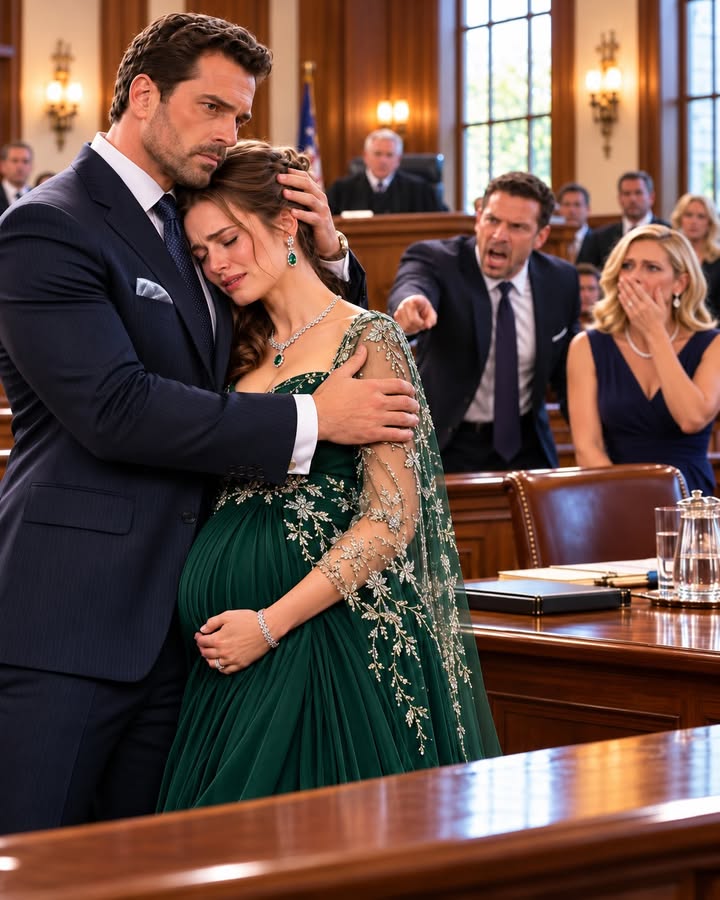
The court hearing on the prenup took place two weeks before my due date.
I wore a dark blue dress that had grown tight across my stomach, and Elise walked beside me through the courthouse hall.
Gregory sat behind us, not at the table with my lawyers, because I wanted the case to be mine.
Preston arrived with his attorney and sat across the room.
He looked tired, but not defeated.
When our eyes met, he gave me a restrained nod.
I returned it.
The hearing lasted most of the day.
Elise presented evidence that Preston had described the prenup as a routine formality, while the document contained terms that left me with almost no financial protection after the marriage.
She showed that I had received it the evening before the wedding, had no independent counsel, and had not been given accurate information about the assets involved.
Bianca testified about what Preston had told her regarding my birth records and the possible trust.
She spoke steadily, acknowledging her own part without trying to make herself seem innocent.
Preston’s lawyer argued that I had signed the agreement willingly and understood what it contained.
I listened without turning toward Gregory, even when I felt the old familiar urge to see whether someone was watching over me.
I had chosen to speak for myself through the law, and I wanted to remain inside that choice.
When the judge asked whether I wished to make a statement, I stood slowly.
I had written my words the night before, but I did not look at the page.
“I signed the agreement because I trusted my husband,” I said.
“I was told it was a routine formality, and I had no lawyer of my own to explain what I was giving up.”
“I am not asking the court to punish Preston or to make his company fail.”
“I am asking for the agreement to be judged fairly, with the circumstances of its signing taken seriously.”
I placed one hand against my stomach.
“I want to be able to care for my daughter without being made dependent on a person who used my trust against me.”
The judge listened without interruption.
When I finished, I sat down.
Preston looked toward me, but I kept my attention on the table.
The ruling did not come that day.
The judge ordered a further review of the financial records and set a decision date after my daughter’s birth.
I left the courthouse tired, but not defeated.
The next morning, Gregory asked whether I wanted to talk about the hearing.
“I want to talk about something else,” I said.
“All right.”
“Tell me about Mara again.”
He chose the story of the mismatched cups.
Mara had collected them from secondhand shops and cafés, he said, because she believed no two people should have to drink from the same dull set of glasses.
“She had a chipped green cup she liked best,” he told me. “She said it held tea better than the expensive ones.”
“That doesn’t make any sense.”
“I know.”
“But you kept it?”
Gregory’s expression softened.
“I did.”
He had kept it in a box of old things, not knowing whether it would ever matter to anyone.
That afternoon, he brought it to my suite.
The cup was small and imperfect, with a green glaze that had faded around the handle.
It fit comfortably in my hands.
“I think she would have liked that you kept it,” I said.
“I hope so.”
We sat by the window while the rain passed over the garden.
The cup held peppermint tea, and the baby rolled beneath the yellow blanket folded on the chair.
Neither of us tried to say what the moment meant.
It was enough to share it.
Three days later, the first contraction woke me before dawn.
At first, I thought it was the same tightness I had felt several times before, but then it came again, stronger and closer together.
I called Dr. Chen, who told me to begin timing them and get ready to go to the hospital.
Gregory was awake before I had finished the call.
He stood in the hall while I gathered my things, trying to appear calm and failing.
“Do you want me to come?” he asked.
“Yes,” I said.
He nodded once.
“Then I’m coming.”
The drive seemed longer than it was.
Mrs. Alvarez rode beside me, and Gregory sat in the front with Daniel, who was driving.
I watched the dark sky give way to the first pale light of morning.
The city moved quietly around us, still half asleep.
At the hospital, everything became voices, forms, and steady hands.
Dr. Chen met us in the delivery room and made sure I understood every choice that was offered to me.
Gregory waited outside until I asked for him.
When he came in, he stood near the wall, his cane resting against a chair.
He looked frightened.
“You don’t have to pretend you’re calm,” I told him between contractions.
“I wasn’t aware I was pretending.”
“You are doing it very badly.”
His laugh came out unsteady.
Then I reached for his hand.
He took it carefully, as if even now he wanted to be sure I had meant what I asked.
Hours later, my daughter arrived with a strong cry and a furrow between her brows.
The sound filled the room more completely than any speech or promise could have done.
Dr. Chen placed her against my chest.
Her skin was warm, her hair damp and dark, and her tiny fingers curled around my thumb.
For several breaths, I could not speak.
Then I looked at her face and began to cry.
Gregory stood beside the bed with tears running freely down his cheeks.
“What is her name?” he asked.
I had considered several.
I had written them on scraps of paper, crossed them out, and read them aloud in the quiet of the guest suite.
But the name that felt right had been there from the beginning.
“Mara,” I said. “Mara Vale.”
Gregory bowed his head.
“That’s beautiful.”
“I want her to know who her grandmother was.”
“She will.”
“And I want her to know that her mother chose to keep her safe.”
“I’ll tell her,” he said.
“No,” I whispered. “We’ll tell her.”
He looked at me, and this time I saw no uncertainty about where he belonged in that moment.
“Yes,” he said. “We will.”
The court issued its decision a month later.
The prenup was set aside after the judge found that the terms had been presented in misleading circumstances and that I had not received a fair opportunity to understand them.
The court awarded me support and security for Mara without making me dependent on Preston’s goodwill.
The ruling was not a punishment.
It was a recognition that my signature had not been the same as a freely informed choice.
Preston’s company entered restructuring soon afterward.
The process was difficult, and some positions were reduced, but the transition fund Meridian had established helped affected employees with training, placement, and temporary assistance.
The company remained operating, smaller and more cautiously managed.
Gregory recused himself from every decision concerning its future.
Preston faced professional consequences for the financial decisions that had placed his company in trouble, and he was required to honor the court’s ruling.
He also sent me a letter.
It did not ask for forgiveness.
He wrote that he had treated my trust as something he could use and my silence as agreement.
He said he was sorry for what he had done, though he understood that the apology did not require a response.
I read it once, then put it away.
I was not ready to answer, and I did not need to be.
Bianca’s statement helped confirm what Preston had told her about the records and the possible trust.
She continued to cooperate with the legal review and later sent me a brief apology.
I accepted that she had taken responsibility, but I did not ask her back into my life.
Some doors could be left closed without hatred.
Gregory and I learned each other gradually.
He made no attempt to fill the years I had missed with gifts or grand gestures.
Instead, he showed up.
He came to the hospital when Mara had her first checkup.
He sat with her while I napped, holding her with the careful concentration of someone entrusted with something precious.
He asked before sharing photographs.
He listened when I told him what it had felt like to grow up without knowing whether anyone would come back.
And when I wanted to hear another memory of Mara Vale, he told me what he could remember, leaving space for the things he did not know.
Months later, I visited the old apartment above the bakery on Mercer Street.
The bakery was still there, though the sign had changed, and the building’s front steps had been repaired.
Gregory came with me, carrying the green cup in a padded box.
He opened the apartment door only after asking whether I wanted to enter first.
The rooms had been renovated, but one wall in the front room remained a faded yellow beneath a newer coat of paint.
I stood there with Mara asleep against my shoulder.
“This was the room?” I asked.
“Yes.”
“Do you think she would have liked it?”
“She would have said it was too bright.”
I smiled.
“Then she would have repainted it pale green.”
“Probably.”
I looked down at my daughter.
“Do you think she would have wanted me to come back here?”
“I think she would have wanted you to choose for yourself.”
I considered those words.
Then I stepped toward the old window and let the afternoon light fall across us.
That year, with Gregory’s help but under my direction, I established the Mara Vale Fund for young people leaving foster care.
It offered practical assistance: application fees, transportation, school supplies, and help securing a safe first apartment.
I chose not to make it a grand foundation with my mother’s face on a building.
I wanted it to answer the small, urgent questions I remembered asking.
Where do I go tonight?
Who can explain this form?
How do I keep moving forward when nobody knows my name?
The first time we welcomed a young person into the program, I thought of all the people who had made a difference in my life without being able to change its whole course.
Lillian Price, who had kept my mother’s promise.
Mrs. Alvarez, who had placed food where I could reach it and never asked me to be grateful.
Elise, who had made the law feel like something I could understand.
Daniel, who had never confused advice with permission.
And Gregory, who had arrived too late to give me back my childhood, but who had finally learned not to demand the part of me that belonged to the present.
One quiet evening, months after Mara’s birth, I sat in the garden with my daughter asleep in my arms.
Gregory was beside me, reading from the same collection of children’s stories he had chosen at the house.
He had gotten better at the character names.
“Do you want to read the next one?” he asked.
“Not tonight.”
“All right.”
He closed the book and looked at the last light settling over the garden.
I leaned back in the chair, feeling Mara’s warm breath against my chest.
For a long time, I had thought belonging meant someone would choose me and never leave.
Now I understood that belonging could also be something built slowly, through truth, through boundaries honored, through the ordinary decision to return when you said you would.
Gregory’s hand rested on the arm of the chair, near mine but not touching.
I moved my fingers until they rested beside his.
He looked down at them, then at me.
I did not need to call him Dad that evening.
I did not need to decide what every tomorrow would hold.
Mara stirred in her sleep, and I drew the yellow blanket more closely around her.
The old fear of being left did not vanish.
But it no longer had the final word.
Around us were the quiet garden, the open book, and the people who had chosen to stay.
And in my arms, my daughter slept safely beneath a sky turning gold.
**–THE END–PLEASE
Share your thoughts or feedback to motivate us to create more stories ♥️
* * *
[PREVIOUS: PART 5](https://puretales.idolsgift.com/blog/part-5-the-file-that-changed-everything-008)
✓ Lynn R. Adams
Part 6 – The Home We Chose “He wrote that he needed to know whether the inheritance was real before the baby was born.” For a moment, I could not answer. The room seemed to narrow around the phone …