PART 6 (THE END): The File in the Greenhouse 047
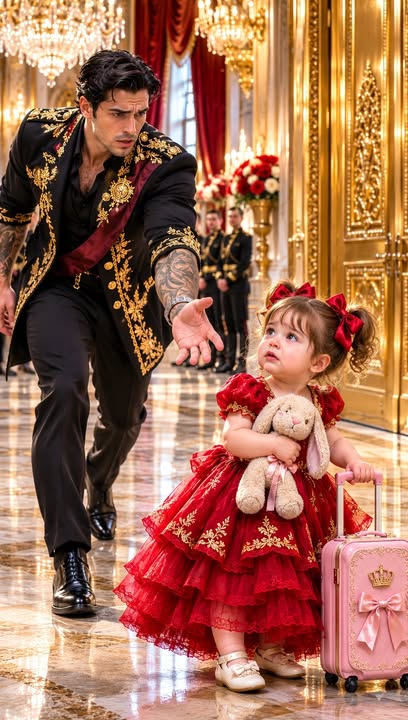
Part 6 – The Place We Choose
“Lily go away before Awessandro lose palace.”
Clara read the note again, her voice barely above a whisper.
For one suspended instant, the garden seemed to hold its breath around us.
Then she clutched the rabbit to her chest and ran toward the gate.
I followed, the folded paper crown in my hand.
“Lily!” Clara called, keeping her voice gentle even as fear sharpened every step.
The eastern path curved between clipped hedges and ended at a small service gate that opened onto the outer garden walk.
It was unlatched.
A faint trail of tiny footprints crossed the damp stone beyond it, leading toward the old fountain.
“She thinks the announcement will cost you everything,” Clara said.
“She thinks my troubles are her fault.”
“She’s two.”
“I know.”
We found her beneath the arch of a dormant rose arbor, where the path turned toward the outer grounds.
Lily stood with her back to us, her red dress vivid against the bare branches, and her small suitcase beside her.
The rabbit she had taken with her rested in the open top.
She was not crying.
That frightened me more than tears would have.
Clara stopped several paces away, giving her room.
“Lily, darling,” she said. “Come here.”
Lily looked over her shoulder.
“Mommy stay,” she said.
“I’m staying with you.”
“Awessandro lose palace.”
I came to a stop beside Clara and lowered myself until I was at Lily’s height.
“My palace might change,” I said. “The king might be upset with me, and people might ask difficult questions.”
Lily’s lower lip trembled.
“Because Lily?”
“No,” I said plainly. “Not because of you.”
She looked at the suitcase.
“You go bye-bye?”
“I might lose my position,” I told her. “That is something the grown-ups will work out.”
“Lose palace?”
“Maybe.”
“Then Lily go.”
“No.”
The word came firmly, but I kept my voice soft.
Lily’s eyes filled.
“Lily make bad.”
“You did not make anything bad happen.”
“But paper say.”
“The paper says I chose to tell the truth.”
I held up the folded crown.
“I signed the statement before you left.”
She stared at it.
“Truth make palace go?”
“Truth may make things difficult for a while,” I said. “But it won’t make you responsible for what happens to me.”
Clara moved closer, still leaving a little space between them.
“You don’t have to protect us by disappearing,” she said. “You are allowed to be small. You are allowed to need us.”
Lily’s face crumpled.
“I want Mommy.”
Clara opened her arms.
Lily ran to her, suitcase abandoned beneath the arbor, and Clara gathered her up with a sound that was half laugh and half sob.
I stayed where I was until Lily reached one hand toward me.
Then I came close enough for her to curl her fingers around mine.
The three of us stood beneath the bare roses while the evening light gathered along the garden walls.
When Clara had steadied her breathing, I crouched to lift the suitcase.
“I’ll take this back,” I said.
“Bunny come,” Lily murmured.
“Both rabbits can come.”
She nestled her cheek against Clara’s shoulder.
“Palace too?”
“If you want to go back,” Clara said, “we’ll go back together.”
Lily considered the choice, then nodded.
“Home.”
On the walk back, she stayed in Clara’s arms and held one of my fingers.
No one hurried her.
At the palace, I carried the suitcase to Clara’s rooms while she settled Lily in the little velvet chair by the window.
The two rabbits sat together on the cushion, their mismatched ears touching.
I placed the crooked crown on the table beside them.
Lily’s eyes had begun to close, but she fought sleep long enough to ask, “Awessandro stay?”
“I’m here,” I told her.
“Not go?”
“Not tonight.”
That seemed to be enough.
Clara tucked a blanket around her, and Lily fell asleep with one hand resting on the rabbit’s back.
For a while, Clara and I stood quietly beside the chair.
Then she turned to me.
“You found her before I did.”
“We found her.”
Her eyes moved to the crown on the table.
“She thought she was saving you.”
“She shouldn’t have had to think about that.”
“No,” Clara said. “She shouldn’t.”
I looked at Lily’s sleeping face and understood that reassurance could not undo the fear my order had planted.
Only the choices that followed could show her she was safe.
“Tomorrow’s statement goes out,” I said.
“Are you certain?”
“I am.”
“Even if the king withdraws his support?”
“I can’t promise what he’ll decide.”
“That isn’t what I asked.”
“Yes,” I said. “I’m certain I won’t ask Daniel to disappear from the truth again.”
Clara studied me.
“And if your position is gone?”
“Then I’ll find another way to make sure the investigation continues.”
“And if your company is questioned?”
“Then it should answer.”
She nodded slowly.
“I’m not staying because you said the right things tonight.”
“I know.”
“I’m not staying because Lily loves this palace.”
“I know.”
“I’m not staying because I owe you.”
“I know.”
Her shoulders eased a fraction.
“I’m staying because I want to see this through, and because Lily should not have to lose her home because adults are afraid of what the truth might cost.”
“That’s enough.”
“It has to be enough.”
“It is.”
The next morning, the palace released the statement.
It did not call Daniel a hero or the palace a villain.
It stated what the authenticated documents showed: that Daniel had entered the uncleared west wing through an old service route during the fire and carried a child to safety; that the official report had described the wing as cleared when it had not been; and that the revised record had wrongly treated his actions as a breach without explaining the circumstances.
The statement also confirmed that the accusations against Clara’s brother were unsupported by the evidence then available, and that an independent inquiry was continuing into the missing security file and the modern breach.
The palace did not name a culprit before the inquiry was complete.
It did not ask the public to accept a convenient conclusion.
It simply opened the record.
For a few days, the household waited beneath a haze of questions.
Some people praised the decision.
Others wondered why the old report had been left uncorrected for so long.
The king’s confidence in me wavered, and the future of my position remained uncertain.
I did not pretend those consequences were harmless.
But the truth had not caused the old harm.
It had only made the harm visible.
The independent inquiry worked carefully, comparing the old movement log with the security file that had gone missing.
An outside document specialist confirmed that the handwritten entry referring to the palace fire had been added recently.
The page had been inserted into the missing file after the original records were assembled, and the new note had been intended to make the modern breach appear connected to the old incident.
The initials on Daniel’s movement log were examined against surviving duty rosters.
The first belonged to the official who had authorized the diversion of the convoy during the fire.
That person had changed the route after learning that staff remained trapped in the west wing, but the order had been given orally during the confusion and never properly recorded.
Daniel had taken the service passage when he could not reach the child by the planned route.
The convoy’s diversion and the altered report were separate events, just as Daniel had written.
The revised report had been prepared later, when the palace sought to protect its reputation and avoid questions about the fire’s emergency response.
A junior secretary had helped prepare the administrative summary from the altered record.
Rinaldi.
He had not changed the original report, the inquiry found, and there was no evidence that he had directed the convoy.
But he had known Daniel disputed the official account.
He had helped keep Daniel’s concerns out of the final summary, believing that preserving the palace’s stability was more important than reopening an old incident.
Years later, as a senior official, he had recognized the old reference in the missing security file and realized it could expose the cover-up.
The new file had been altered to suggest that Clara’s brother had sold confidential information, drawing attention away from the old report and the more recent security breach.
Rinaldi had authorized the alteration to protect the palace from renewed scrutiny.
He had not understood that Daniel’s letter and movement log still existed.
When the inquiry presented its findings, Rinaldi did not deny the choices he had made.
He resigned from his post and agreed to assist the investigation into the modern breach.
He did not ask for his years of service to erase the damage.
The king accepted his resignation, then asked me to remain while the palace reviewed its security arrangements.
I told him I would stay only if the inquiry remained independent and the records remained open to proper scrutiny.
He agreed.
Clara’s brother was found several days later at a small apartment belonging to a friend.
He had been frightened that returning to the palace would make him look guilty, and ashamed that his silence had made the suspicion worse.
The investigators established that he had searched for the missing file because he believed it might clear Daniel’s name.
He had taken no money and sold no information.
When Clara saw him, she held him for a long time before either of them managed to speak.
“You could have called me,” she said at last.
“I thought they would listen to you only if I stayed away.”
“You should have let me decide that.”
“I know.”
She wiped her cheek.
“Next time, let’s both be afraid at home.”
He gave a broken laugh and nodded.
The palace formally corrected Daniel’s record.
His actions were recognized as a deliberate effort to save a child and reach trapped staff when the usual route had failed.
The correction named him plainly.
It did not turn him into a legend or claim that he had acted without fear.
It recorded what he had done, what the palace had misunderstood, and how long it had taken to set the record right.
Clara read the correction in the family library with the old photographs beside her.
She did not smile.
She did not need to.
When she finished, she pressed one hand against the paper.
“He would have hated being called brave,” she said.
“What would he have preferred?”
“He would have wanted the report to say the corridor was still occupied.”
“Then that’s what it says.”
“Yes.”
She looked at the photograph of Daniel beside Matteo, the brass key at his belt.
“I wish he had told me.”
“Perhaps he believed he had time.”
“Perhaps.”
Matteo stood across the room, his gaze fixed on the picture.
“I should have asked more of him,” he said. “And I should have questioned the report.”
Clara rested the photograph on the table.
“You can’t repair the years he spent carrying blame.”
“No.”
“But you can stop asking other people to carry it now.”
“I will.”
Matteo nodded, taking the words as a responsibility rather than absolution.
In the weeks that followed, the palace changed in small, deliberate ways.
The old security records were cataloged by independent archivists.
The family agreed that any future correction to a historical report would require a recorded review by people outside the office responsible for it.
The sealed chamber beneath the archive was opened properly, its contents documented and preserved.
The brass key was never found.
But the records it had been meant to protect were safe, and the missing key no longer held power over anyone’s name.
Clara chose to return to her duties, though she did not resume them on the old terms.
She asked for a written description of her role, the right to refuse assignments outside it, and the freedom to leave the palace without seeking permission.
The household agreed.
She no longer worked as if gratitude were a condition of belonging.
She stayed because she chose the work, because she valued the people she cared for, and because Lily called the palace home.
I did not ask Clara to forgive me.
I learned instead to ask before deciding, to listen when her answer unsettled my plans, and to accept that being trusted was not a prize I could claim after one good choice.
Sometimes, on quiet evenings, Lily still brought her little pink suitcase into the hall.
She no longer packed to leave.
She filled it with crayons, picture books, and whichever rabbit had most recently been chosen as her traveling companion.
One evening, several months after the garden, she dragged the suitcase into my office while I was reviewing security plans.
“Where are you going?” I asked.
“On a trip.”
“Where?”
She pointed to the window.
“Garden.”
“That is a very long trip.”
“Need snacks.”
I closed the folder.
“What kind?”
“Little cakes.”
“Then we’ll need to ask your mother.”
Lily leaned close to my desk and lowered her voice.
“Mommy already say yes.”
“Then you have excellent planning.”
She nodded and pushed the suitcase toward me.
I did not lift her onto my shoulders until she asked.
At the garden, Clara waited beside the old fountain with three cups of lemonade and a plate of small cakes.
The greenhouse had been repaired, its cloudy panes replaced and its door secured.
It no longer looked like a place where secrets could be left to rot.
Lily spread a blanket on the grass and arranged the rabbits on one side, as if they were guests at a very serious meeting.
Matteo joined us a little later, carrying a small tin of seeds.
He had started helping restore the old garden, though he never called the work a tribute.
Lily took the tin from him and inspected it.
“Flowers?”
“Flowers,” he said.
“Good.”
She handed the tin to Clara, who placed it on the blanket.
The late sun laid a warm light along the garden path.
For a while, no one spoke about reports or investigations or the years the palace had spent misunderstanding Daniel.
We talked about the roses, the rabbits, and Lily’s conviction that the fountain would work better if someone gave it a paper crown.
When the evening air cooled, Clara wrapped Lily in her cardigan.
I watched them together and felt the familiar fear of losing what I loved rise in me.
It no longer made me want to command the world into stillness.
It made me want to stay present while the people beside me decided what they needed.
Clara glanced over.
“What are you thinking?”
“That I’m glad you stayed.”
“I’m glad I chose to.”
There was a difference, and I was grateful she had made it clear.
“I’m glad too,” I said.
Lily appeared before us with a paper crown balanced on her head.
It was crooked, as always, with one corner folded too far and a blue crayon star drawn across the front.
She held a second crown in her hand.
“Awessandro, down.”
I bent my knees and lowered myself in front of her.
She placed the crown on my head with great care, adjusting the back until it sat only slightly lopsided.
“Good boy,” she pronounced.
A quiet laugh escaped me.
This time, no one was startled by it.
Clara’s smile appeared slowly, a small, warm thing she did not seem to be trying to hide.
Lily climbed into the space between us and settled against her mother’s side, one rabbit tucked beneath her arm and the other resting in my lap.
She leaned against Clara, then reached across to hold my hand.
The palace stood beyond the garden walls, full of imperfect people and records that still needed tending.
For the first time, I understood that home was not the place where no one could make a mistake.
It was the place where no one had to disappear to make the others safe.
Lily’s eyes began to close.
Clara rested her head lightly against mine, and I stayed still so I would not disturb her.
Under the fading sky, with our daughter safe between us and her crooked crown warm against my hair, the silence felt nothing like a secret.
It felt like peace we had chosen together.
**–THE END–PLEASE
Share your thoughts or feedback to motivate us to create more stories ♥️
* * *
[PREVIOUS: PART 5](https://echoesofstories.idolsgift.com/blog/part-5-the-file-in-the-greenhouse-047)
✓ Lynn R. Adams
Part 6 – The Place We Choose “Lily go away before Awessandro lose palace.” Clara read the note again, her voice barely above a whisper. For one suspended instant, the garden seemed to hold its brea…