PART 6 (THE END): The Face in the Photograph 047
Part 6 – The Sunshine We Keep
The nurse’s words seemed to drain the warmth from Lorenzo’s room.
Isabella’s hand tightened around mine, while Dr. Shah moved closer to the bed and asked Lorenzo to rest.
But Lorenzo’s gaze remained fixed on me, cloudy with exhaustion and pain.
“Who was with you?” I asked.
His lips parted, but the effort of speaking was too much.
Dr. Shah raised a hand gently.
“Not now, Mr. Moretti.”
Lorenzo’s eyes fluttered shut.
The monitor settled into its steady rhythm, and the room filled again with the sounds of careful, ordinary medicine.
I pressed Emma’s sleeping weight closer to my heart.
“Is he—”
“He’s stable,” Dr. Shah said. “That’s what matters right now.”
Isabella turned toward the nurse.
“Please tell the security chief we’ll speak with him once Lorenzo is settled.”
Then she looked at me.
“I won’t make any decisions for you.”
I could hear the effort in her voice, the restraint she had learned only after learning how often protection could become another form of silence.
“Thank you,” I said.
We waited until Dr. Shah had checked Lorenzo and the nurse had adjusted his blanket.
Only then did Isabella and I step into the hall, carrying our questions with us.
The security chief was waiting outside the bedroom, speaking quietly into his phone.
When he finished, he faced us.
“The person has been identified,” he said. “It’s Martin Vale, the former intermediary mentioned in the recovered files.”
Isabella’s expression changed.
“He worked with Lorenzo?”
“He handled communications between the charity office and several outside organizations,” the chief replied. “He was not a family employee for years, but he remained in contact with Mr. Moretti.”
“Why did he ask about Clara and Emma?” I asked.
“We’re still establishing that. He said he was trying to confirm whether Mr. Moretti had found you.”
“Why?”
“He claims Lorenzo asked him to locate you before the accident.”
I looked through the open bedroom door.
Lorenzo had been trying to find me.
The old photograph, the note, the message draft—all of it had been pointing toward that truth, though no one had yet known what it meant.
“Did he know about Lily?” Isabella asked.
“He says he did,” the security chief replied. “He also says he was the person who told Clara that Lily had chosen to leave.”
My throat tightened.
“Why would he tell me that?”
“He said Lorenzo believed it was the safest thing at the time,” the chief answered. “Mr. Vale says he was following instructions.”
“Did Lily ask him to?”
“No.”
The answer was immediate.
The hallway seemed to narrow around the three of us.
“Did he know where Lily was?” I asked.
“He says he helped arrange the first part of her relocation. After that, Lorenzo handled the contact himself.”
“Did he know she was ill?”
“He says he did not.”
“Do the investigators believe him?”
“They’re checking his statements against the records from the charity office and the messages on Lorenzo’s phone.”
I wanted certainty, but I knew how quickly a confident answer could turn into another lie.
“Is he being held?” I asked.
“No,” the chief said. “He has agreed to speak with the investigators. He has not been accused of taking part in the misuse of information, and there’s no evidence linking him to the crash.”
“Then we don’t treat him as guilty because he was there,” I said.
“No,” Isabella replied. “We let the evidence answer that.”
For a moment, I saw the old version of her, the woman who had expected to know what was safest and act before anyone could object.
Then she looked at me and waited.
“What do you want to do?” she asked.
“I want the investigators to speak with him, and I want a chance to hear what he remembers about Lily.”
“If you want to be there,” the security chief said, “we can arrange a meeting with the investigators present.”
“I do.”
Isabella did not tell me to reconsider.
She only said, “I’ll go with you, if you want me there.”
“I do.”
The next day, the interview took place in a quiet office at the hospital.
Martin Vale was in his late fifties, with silver hair and a tired, careful expression.
He wore no uniform, no sign of authority, and nothing about him looked like the figure I had built from years of unanswered questions.
He stood when we entered.
“Ms. Bennett,” he said. “I’m sorry.”
I sat down before answering.
“I’ve heard that before.”
“I know.”
“Did you tell me Lily had chosen to leave?”
“Yes.”
“Why?”
“Lorenzo asked me to keep you from searching for her. He believed the people she had uncovered could use your connection to her against both of you.”
“Did Lily know you were going to tell me that?”
“No.”
The honesty did not soften the hurt.
“Then you made the choice for her and for me.”
“Yes,” he said. “I did.”
He did not offer a defense.
That mattered, though it could not return the years.
“What happened after she left?” I asked.
“Lorenzo arranged a safe place for her to stay. I helped with some of the first paperwork, but I wasn’t told the address. He wanted as few people as possible to know.”
“Did you ever speak with her again?”
“Once. She called the office line and asked me to pass along that she was safe.”
“Did you tell Lorenzo?”
“I did.”
“Did she ask you to contact me?”
He hesitated.
“She asked whether you were all right.”
My eyes lowered to the table.
“What did you tell her?”
“That you were working, and that you were staying with your mother.”
“Did she ask to speak to me?”
“She did.”
My breath caught.
“What did you say?”
“I told her it wasn’t safe to arrange a call. I believed that was what Lorenzo wanted, and I believed he was right.”
“You believed it, or it was convenient?”
His face tightened.
“Both, perhaps.”
There it was again, that painful overlap between care and control.
“What happened after that?”
“I heard nothing more from her until Lorenzo told me she had died.”
“When?”
“Several months after her last call.”
“Did he tell you where she had been?”
“No.”
“Did he say she had a child?”
Martin looked at Isabella, then back at me.
“He didn’t tell me that. I saw a photograph once, but he took it away before I could ask.”
The baby in Lily’s arms.
“You saw the picture?”
“Yes.”
“Do you know who the child was?”
“No.”
I studied his face, searching for a sign that he was holding something back.
He looked ashamed, but not evasive.
“Did you know about the associate who was taking information from the charity files?”
“I knew there were concerns. I thought they were being investigated.”
“Were they?”
“Not properly.”
He turned his hands over on the table.
“I should have asked more questions. I should have made sure the people seeking help were protected. Instead, I trusted Lorenzo to handle it.”
“Did you tell anyone where Lily was?”
“No.”
“Did anyone ask you?”
“Years later, someone approached me about locating a woman connected to the old charity office. I refused to give them information.”
“Who was it?”
“I couldn’t identify the person. They asked generally, and I thought they were looking for records. I didn’t know they meant Lily or Clara.”
The investigators noted his answer.
There was no proof that his conversation had led to the later inquiry about me and Emma, but it gave them another thread to examine.
When the meeting ended, Martin stood again.
“I’m sorry you were left believing the worst of your sister,” he said.
“I was left to believe what you chose to tell me.”
“Yes.”
“Don’t call it protection.”
He lowered his gaze.
“I won’t.”
Outside the office, I paused by the window.
Isabella waited beside me, saying nothing until I turned.
“I thought I’d feel better after hearing the truth,” I said.
“Does it help?”
“It helps me understand why it happened. It doesn’t give back the years.”
“No,” Isabella replied. “It can’t.”
Her answer did not try to close the wound.
I realized that was becoming one of the reasons I trusted her.
Over the next several weeks, the investigators reviewed the recovered messages and compared them with the old charity records.
The associate Lorenzo had referred to was identified as Nathaniel Price, a former consultant who had helped coordinate the Moretti family’s charitable programs.
The records showed that Price had copied confidential information from people seeking assistance and passed it to others, then used the fear of exposure to pressure several of them into silence.
The investigators also found that he had tried to learn whether Lorenzo had contacted Clara before the accident.
They did not prove that Price caused the crash.
They did find messages showing that he had attempted to interfere with the search for Lily and had kept tabs on people connected to the charity network long after leaving his position.
The information was enough for the authorities to continue their investigation.
It was not a dramatic reckoning.
There were no shouting headlines at the gates, no sudden parade of cameras, and no public spectacle of people being forced to confess.
There were interviews, paperwork, careful verification, and a long wait while the truth became something more solid than suspicion.
Lorenzo’s recovery also came slowly.
Some days he recognized Isabella and could answer a few questions.
Other days he slept through most of the afternoon, and the doctors reminded us that healing rarely followed the clean shape people wanted it to have.
When he was strong enough to remain awake for a longer conversation, I went to his room alone.
I brought Lily’s photograph with me.
He looked thinner than before, and his voice was rough from disuse.
“Clara,” he said.
“I’m here.”
His eyes settled on the picture in my hands.
“Lily.”
“Yes.”
He drew a careful breath.
“I’m sorry.”
I sat beside the bed.
“You told me that she chose to leave.”
“I thought it would protect you.”
“It hurt me.”
“I know.”
“Did Lily ask you not to tell me?”
“No.”
The answer came without hesitation.
“She wanted you safe,” he continued. “She wanted you to know she loved you, but she was afraid the wrong people would use you to reach her.”
“Why didn’t you find a way to tell me that?”
“I thought I had time.”
He closed his eyes for a moment, gathering strength.
“Then she died, and I thought the danger had passed. I should have come to you. I should have told you the truth before you had to find it in a photograph.”
“Yes,” I said. “You should have.”
He opened his eyes again.
“I’m not asking you to forgive me because I meant well.”
I looked at his face.
“I don’t know yet what forgiveness means.”
“That’s fair.”
“I do know that Lily loved you.”
His expression changed, not with relief but with grief.
“I loved her too.”
He swallowed.
“She trusted me with the things she could not carry alone. I failed her at the end.”
“You didn’t make her illness happen.”
“No. But I let you believe she had abandoned you.”
I placed the photograph on the table beside him.
For a while, neither of us spoke.
Then Lorenzo turned his hand palm-up on the blanket.
He did not reach for mine.
He simply left the choice there.
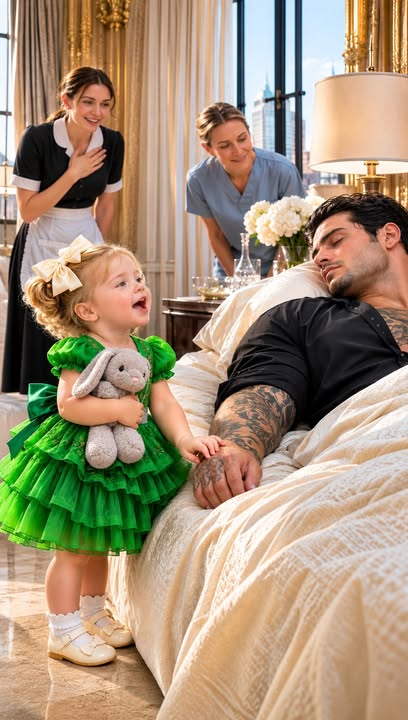
I looked at his hand and thought of Emma’s tiny fingers curled around it, of the first uncertain change on the monitor, and of how easily a simple act of comfort could become a story people wanted to turn into a miracle.
I rested my fingers against his.
“I’m not ready to forget what you kept from me,” I said.
“You shouldn’t have to.”
“But I don’t want Lily’s last act to be remembered only as a secret.”
His eyes glistened.
“Neither do I.”
It was not forgiveness, not yet.
It was the beginning of a conversation we might continue.
A few weeks later, the investigators told us that Price had been formally charged in connection with the misuse of confidential records and related misconduct.
The evidence connected him to attempts to obstruct the inquiry, though it did not establish that he had caused Lorenzo’s crash.
He was taken into custody without spectacle, and the case continued through the proper legal channels.
The staff at the mansion spoke of the news quietly.
Isabella did not celebrate.
Neither did I.
The people Price had frightened and exploited deserved more than a dramatic ending.
They deserved the chance to speak for themselves and to be believed.
Lorenzo returned home after several more weeks of rehabilitation, though his recovery remained far from complete.
The medical team arranged a private care plan, and Isabella made sure he had both professional support and space to rest.
She also asked me what I wanted, rather than assuming the mansion should remain my home.
“I don’t want to live here forever,” I told her. “And I don’t want to be financially dependent on you.”
“I understand.”
“I need a place for Emma and me that belongs to us.”
“Then we’ll help you find one.”
I braced for a condition.
There wasn’t one.
Isabella arranged for an independent adviser to review the options with me, and the help came as part of my compensation and a transition plan, not as a favor I had to repay with loyalty.
I chose a small apartment on a quiet street, close enough for Emma to visit the garden at the estate but far enough that our lives would not be defined by the Moretti name.
When the papers were ready, Isabella handed them to me herself.
“I don’t want you to feel indebted,” she said.
“I don’t.”
“I want you to know the choice is yours.”
I smiled.
“I do.”
She looked relieved, then seemed to realize something.
“Is that what trust feels like?”
“Sometimes,” I said. “Sometimes it feels like being allowed to say no and still being invited back.”
Her eyes softened.
“Then I hope you’ll keep coming back.”
“We will.”
Lorenzo’s lawyer eventually found Lily’s letter in a sealed packet among the personal papers stored at the family’s country house.
The envelope was addressed to him, with my name written beneath his.
Lorenzo asked whether I wanted to read it alone.
“I think I do,” I said. “But I’d like you nearby.”
He nodded.
Isabella sat on the garden bench with him while I opened the letter beneath the late spring sun.
The paper had yellowed at the folds, but Lily’s handwriting was clear.
My dearest Clara,
If this letter reaches you, I have not managed to come back the way I hoped.
I am sorry for every day you spent wondering whether I left because I stopped loving you.
I never stopped.
I left because I was frightened, and because I believed the danger around me might reach you if I stayed close.
I know that may not make sense from where you are, and I know it may not make the hurt smaller.
You deserved the truth.
I should have found a way to give it to you.
I have a daughter, and her name is Rose.
She is too little to understand why we have moved so often, but she has your bright way of looking at the world.
If anything happens to me, I have asked Lorenzo to find you and make sure Rose has the chance to know her family.
Please do not blame yourself for the distance between us.
You were the part of home I carried with me.
Love always,
Lily
I read the letter once.
Then again.
The words blurred before I reached the end, and I pressed the paper to my chest.
“Rose,” I whispered.
Isabella came to sit beside me, careful not to touch the letter.
“Did Lorenzo ever find her?”
“He tried,” she said. “The recent records include a contact through the medical fund, but the trail went quiet.”
The letter had given Lily’s daughter a name, but not a home or a face we could reach.
For a few days, the investigators searched the old records again.
A counselor who had helped Lily in the coastal town remembered the child.
Rose had been placed with a relative after Lily died, then adopted by a family who had kept her identity private.
The adoption records were sealed, and no one involved wanted to violate the family’s privacy.
The investigators confirmed that Rose was safe.
They could not give us her address, and I did not ask them to.
“She’s alive,” I said, after hearing the update.
“Yes.”
“She has a family.”
“Yes.”
“And she’s safe.”
“That’s what they confirmed.”
I closed my eyes.
For the first time, the little girl in the photograph was no longer only a mystery.
She was a person who had been cared for and given a home.
I could want to know her and still respect the life she had built.
Lily had asked Lorenzo to make sure her daughter was safe.
That part of her wish had been fulfilled.
The rest would belong to Rose, if she ever chose to search for us.
Months passed.
Emma learned to climb the low steps in our new apartment and insisted on carrying her bunny everywhere.
I found steady work nearby, and for the first time in years I could plan more than one week ahead.
Isabella visited without bringing a folder or a list of instructions.
She and Emma baked lopsided biscuits together in my small kitchen, and she learned that the toddler liked to stir but did not like to wait.
Lorenzo continued to recover.
He walked first with a frame, then with a cane, and finally with one careful hand resting against the garden rail.
His strength returned unevenly, but his patience grew along with it.
He never asked me to forget what he had done.
He simply kept showing up, listening when I spoke about Lily, and answering every question he could.
One bright afternoon, we gathered in the garden at the Moretti house.
There were no reporters, no formal guests, and no great speech to mark the day.
There was only family, chosen and complicated, gathered beneath the old trees.
Isabella brought a tray of tea.
Lorenzo walked slowly along the stone path, holding Emma’s hand.
She wore her sage-green princess dress, though the hem had gathered a little garden dust.
Her gray bunny was tucked under one arm.
“Careful at the step,” Lorenzo told her.
“I know, sleepy man.”
“You keep calling me that?”
“You were sleepy.”
He looked over at me, and for the first time I saw him smile without sadness shadowing it.
“I suppose I was.”
Emma led him toward the bench where Isabella and I sat.
“Mommy sing sunshine?”
I looked at Lily’s letter, folded safely in my bag, and then at the people around me.
“Would you like to sing it with me?”
“Yes.”
I began softly.
“You are my sunshine, my only sunshine…”
Emma joined in, her voice bright and imperfect.
Isabella hummed beside us.
After a moment, Lorenzo did too, quietly, still finding his breath between lines.
The song did not bring anyone back from the dead.
It did not erase the years of silence or turn a medical recovery into a miracle.
It became something gentler and more lasting: a small family ritual, a way of remembering Lily without letting grief take the whole song.
When we finished, Emma beamed at Lorenzo.
“You woke up, sleepy man.”
He looked down at her, his eyes shining.
“I did, little one.”
Then he took her hand again, and together they walked the garden path while Isabella and I watched.
The sun rested warm on the stones.
For the first time, the past did not feel like a door locked behind us.
It felt like a path we had finally learned how to walk, carrying Lily’s love with us toward the people still beside us.
**–THE END–PLEASE
Share your thoughts or feedback to motivate us to create more stories ♥️
* * *
[PREVIOUS: PART 5](https://echoesofstories.idolsgift.com/blog/part-5-the-face-in-the-photograph-047)
✓ Lynn R. Adams
Part 6 – The Sunshine We Keep The nurse’s words seemed to drain the warmth from Lorenzo’s room. Isabella’s hand tightened around mine, while Dr. Shah moved closer to the bed and asked Lorenzo to res…