PART 6 (THE END): The Door Opens 041
Part 6 – The Name We Choose
“I need to tell you what happened at the east gate,” Margaret said.
Anna rose, still holding Michael’s note.
“What happened?”
Margaret looked from her to me, then back to the address written on the slip.
“Several weeks ago, before the birthday party, a man came to the service entrance asking for me. He said he had once worked with Michael.”
“Did you let him in?” I asked.
“No. I didn’t know him, and he wouldn’t give me a name. He left an envelope and asked me to pass it to Anna.”
“Why didn’t you tell me?” Anna asked.
“Because the envelope was addressed to you, and I thought you should decide what to do with it. I put it in my office, then the house became so busy with the party preparations that I forgot.”
Margaret’s voice trembled with shame, but Anna’s expression softened.
“You didn’t know it mattered,” Anna said.
“I should have remembered.”
“You were trying to respect my privacy.”
Margaret nodded, visibly relieved that Anna had understood the intention, even if the delay had mattered.
I asked her to bring the envelope, and she hurried back toward the main hall.
The investigator was still on the phone.
“Can you tell us who entered the evidence room?” I asked.
“We have a preliminary access log,” she replied. “A records clerk opened the cabinet to retrieve a separate case file, then noticed the appointment ledger was missing.”
“Could it have been misplaced?”
“We’re checking. The room was secured, and the ledger was listed in the inventory before your team arrived.”
I glanced at the closed case in the library.
“Do you think someone took it?”
“I think we need to verify every possibility before drawing conclusions.”
Her measured answer was a relief.
For the first time in days, I understood that uncertainty did not have to be filled with fear.
“Please keep us informed,” I said. “We’ll preserve everything here and wait for your instructions.”
When I ended the call, Anna was studying Michael’s note.
“The man who opened the east gate,” she read softly. “Margaret, or someone else?”
“Michael may have meant the person who opened it for him,” I said.
“Or someone who knew what happened there.”
“Maybe the envelope will tell us.”
Margaret returned carrying a small, cream-colored envelope with Anna’s name written across it.
The writing was unfamiliar to me, but Anna recognized it immediately.
“Michael’s friend, Paul,” she said. “He worked with him on the site.”
Her fingers hovered over the flap.
“You know him?” I asked.
“I met him once. He came to our apartment after Michael died and said he was sorry. I never heard from him again.”
She opened the envelope carefully.
Inside was a short letter, an appointment card, and a folded copy of a site access log.
Anna read the letter first.
Paul wrote that he had discovered Michael’s original safety notes in a locked cabinet at the consultant’s office after Northline’s management changed.
He had taken them home, intending to return them to Michael.
By the time he learned Michael had died, he was frightened of being accused of stealing company property and had hidden the pages in a place he thought no one would look.
He had later left them with the independent safety consultant whose address appeared on Michael’s note.
The consultant, he explained, had closed her office years earlier, but Paul had recently found a way to contact her.
She had confirmed that she still held a sealed copy of the original records and had agreed to meet Anna.
The appointment card was dated for the following morning.
Anna lowered the letter.
“So there may be another copy.”
“And someone who can explain the site records,” I said.
“Someone outside both families,” Salvatore added from the doorway. “That’s exactly what the investigator needs.”
Anna looked again at the folded access log.
The east gate was listed beside a time and a worker’s initials.
The name beside them was Paul’s.
“He let Michael into the records room,” she said. “He was helping him collect copies.”
The note’s meaning had seemed ominous because we expected a hidden enemy.
Instead, it had led to a frightened colleague trying, imperfectly, to do right by a friend.
Anna folded the letter and held it against her chest.
“Michael wasn’t alone,” she said.
“No,” I replied. “He wasn’t.”
The next morning, the investigator came to the mansion with a records specialist and a formal request to secure the remaining documents.
This time, nothing was missing.
The appointment ledger had been located in a neighboring cabinet, filed under an old company number rather than its title.
The clerk had not removed it, and no one had altered its pages.
The investigator apologized for alarming us before the search was complete.
I thanked her for checking carefully.
The ledger confirmed that the independent review had been scheduled and then repeatedly postponed.
One entry recorded the first appointment, which had been canceled after the site files were moved.
Another showed a second date, crossed out in a different hand.
A third carried Adrien’s initials beside the words, “awaiting company records.”
The appointment card from Paul named the engineer who had been assigned to conduct the original review.
Her name was Elise Ward.
She met Anna and the investigator in the library that afternoon.
Elise was a calm, silver-haired woman who carried a canvas folder and spoke plainly, without trying to make the past sound simpler than it was.
She had kept the records because the company had never collected them after the review was canceled.
“I should have pressed harder,” she told Anna. “I was told the project had been closed and the family had settled the matter.”
“Did you see Michael’s notes?” Anna asked.
“I saw copies of two pages. They were clear, specific, and consistent with the site conditions I later reviewed.”
“Do you believe his reports were accurate?”
“Yes,” Elise said. “I believe he was documenting real safety concerns.”
Anna’s fingers tightened around the edge of her chair.
“And the accident?”
“I can’t give a final conclusion without a full examination. But the original records show that a support brace had been flagged for repair, then reported as cleared without a documented repair crew or material delivery.”
The investigator wrote this down.
“Can you tell whether the records were deliberately changed?” she asked.
“I can tell that the original entries and later copies do not match. I can also show that some signatures were reproduced from earlier reports.”
“And who altered them?”
“I cannot identify that from the papers alone.”
The answer was careful and honest.
It gave Anna something more useful than certainty without proof.
The investigation moved forward over the following weeks.
The original records were examined by independent specialists.
The accounts and messages Adrien had provided were authenticated.
Peter Grady, the former operations director, was located and interviewed.
He admitted that he had changed safety entries after receiving payments from Victor’s network, and that he had been told the records had to appear complete before the next inspection.
He did not claim to have known the platform would fail.
He did not claim to have intended Michael’s death.
The evidence showed no direct order from Dante’s father.
It showed that he had requested an independent review and instructed Adrien to preserve the original files.
The review had been allowed to stall, and that failure had helped conceal the truth.
The evidence also showed that Victor’s men had arranged the payments and used the company’s accounts to keep the scheme hidden.
One message, preserved in Adrien’s records, referred to Michael’s copied notes as “a loose thread that must be tied off before the next review.”
The investigator did not treat that phrase as proof by itself.
She treated it as a lead and followed it into the payment records, the messages, and the company’s altered files.
Together, the evidence established that Victor’s associates had sabotaged the site’s safety process to protect their financial scheme.
Michael’s death had been caused by negligence and deliberate concealment rooted in that scheme, though no record showed that Victor had personally ordered the platform to fail.
The distinction mattered.
So did the truth.
Adrien cooperated fully, giving up his own files and answering questions without trying to turn his omissions into good intentions.
He admitted that he had chosen silence after the accident because he feared the investigation would expose Victor’s financial arrangement and weaken the family.
That choice had protected neither the family nor the workers.
It had only delayed accountability.
When the investigator asked whether he wished to make a formal statement, Adrien agreed.
He also agreed to testify about the records he had concealed.
I watched him sign the statement in Salvatore’s office.
When he finished, he sat for a while with his hands flat on the table.
“I thought I could contain it,” he said.
“You thought you could control what people learned,” I replied.
“Yes.”
“And in doing so, you helped the wrong people keep control.”
He looked at the papers.
“Yes.”
I did not tell him that we were brothers and therefore everything could be forgiven.
I did not tell him that one honest confession erased years of silence.
I only told him, “Keep telling the truth, even when it costs you.”
“I will.”
The state investigator’s team secured the evidence and began preparing charges against Victor and the men involved in the scheme.
The arrests came months later, after the case had been built carefully enough that no one could dismiss it as a private feud.
Adrien was arrested on financial and obstruction-related charges arising from his role in concealing records, though his cooperation was taken into account.
Victor was arrested along with two associates connected to the payments and the intimidation of witnesses.
There was no dramatic chase, no public spectacle, no moment in which the city suddenly understood everything the families had hidden.
There were warrants, formal statements, court dates, and many long days for Anna.
The reopened investigation into the construction site found evidence of falsified inspections and deliberate interference with safety procedures.
Michael’s name was cleared of any suggestion that he had failed in his duties.
The official record was corrected.
His work was recognized as the earliest documented warning about the dangerous platform.
Anna received the notice in a plain envelope from the state.
She read it once at the kitchen table, then again, her eyes filling as the words settled into place.
“They wrote his name correctly,” she said.
I sat across from her, careful not to reach for the letter.
“He deserved that.”
“He deserved to come home.”
“Yes.”
The truth could restore his name.
It could not restore the years he had lost with Anna and Mia.
We did not pretend otherwise.
The investigation also widened beyond Northline.
Once my own records were turned over, it became clear that my businesses had inherited arrangements I had never properly questioned.
Some had been legal but exploitative.
Others had been designed to disguise payments and buy silence.
I could have spent years arguing over which choices had been mine and which had been made before I took control.
Instead, I gave the investigators the records, cooperated with the review, and accepted the consequences.
I faced charges connected to the financial structure of my empire and the ways it had been used to exert influence.
I testified publicly about what I had inherited, what I had ignored, and what I had done to dismantle it.
The testimony did not make me noble.
It did not erase the people who had paid for my family’s power.
It gave the authorities a clearer path through the structure I had once believed would protect me forever.
My lawyers challenged what they could challenge.
I accepted responsibility for what was mine.
The empire did not collapse in a single night.
It came apart through bank records, court orders, asset freezes, and the careful work of people who had been waiting for someone inside it to stop protecting it.
I sold legitimate holdings where I could, transferred others to accountable owners, and cooperated in closing the operations that could not be made lawful.
There were consequences, and some of them followed me for years.
I never asked Anna to see those consequences as proof that I had changed.
She had seen enough promises.
She watched what I did when no one was applauding.
For a time, we lived with a deliberate distance between us.
Anna and Mia stayed in a quiet apartment near Margaret’s family, protected by a security arrangement Anna approved and could end whenever she chose.
I visited only when Anna invited me.
Some days that meant a short walk in the park.
Some days it meant reading the same picture book three times while Mia interrupted me to explain what the fox was doing wrong.
Some weeks there was no visit at all.
I respected each one.
The first time Anna brought Mia to see me after I began testifying, Mia ran across the room and reached for my hand.
“Dante.”
I knelt so she could decide whether she wanted to come closer.
She pressed her cheek to my shoulder.
Anna watched from the doorway, one hand resting on the strap of her bag.
“She asks about you,” she said.
“I ask about her every day.”
“That doesn’t mean you’re entitled to see her.”
“I know.”
Her gaze held mine.
“And you’re not trying to make me feel guilty?”
“No.”
“Good.”
She came into the room and sat on the sofa while Mia showed me the new picture she had drawn.
It was a green circle with two uneven lines, a brown scribble, and something that might have been a wolf.
“This is you,” she said, tapping the brown shape.
“Is that so?”
“You big.”
“That part seems accurate.”
“And Mama big too.”
Anna laughed.
“I’m not sure I’m represented by that mark.”
Mia tapped the green circle.
“Cake.”
“Then I hope it’s a good cake,” I said.
“It’s birthday cake,” she explained.
“Then it must be.”
The laughter in the room did not undo the past.
It made room for something that had not been there before.
Months later, on the day Mia turned three, Anna invited me to a small celebration in the garden of her new home.
It was a modest place with a white fence, a patch of grass, and a flowering tree that cast soft shadows over the table.
There were no guards in the room.
A security car waited at the end of the street, where Anna could see it and ask it to leave whenever she wished.
Margaret brought a chocolate cake with three silver candles.
Salvatore came for a short visit and left before the children from next door arrived.
Adrien sent a card from the facility where he was awaiting sentencing.
He had written that he was sorry for the years of silence and that he hoped Mia’s birthday was bright.
Anna read the card, folded it, and placed it in a drawer.
She did not pretend it was enough.
She did not tear it up.
That, too, was a choice.
When the guests had gone and the yard had grown quiet, Mia climbed onto a chair beside me.
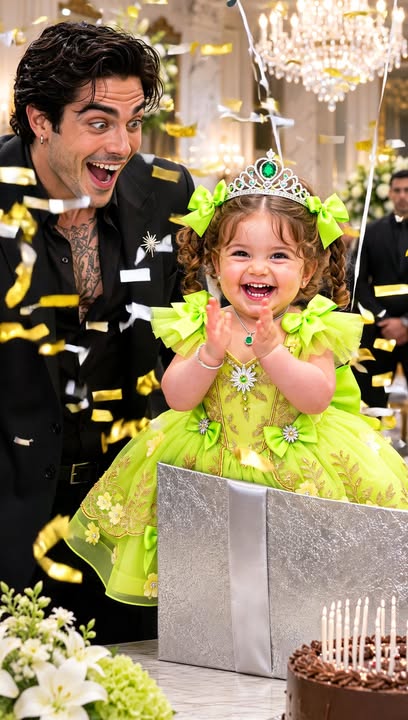
Her green dress was simpler than the princess gown she had worn at my birthday party, though she had insisted on keeping the lime-green bows in her curls.
She held something in both hands.
The small silver wolf pin.
I had kept it safe for her.
“You brought it back,” I said.
“Mine,” she replied.
“It always was.”
She studied my lapel, then reached up and fastened the pin there with great concentration.
Her fingers were careful around the metal.
When she finished, she pressed her palm against the silver wolf.
“Family,” she said.
The word entered me gently and reached the places that fear had kept closed.
I looked at Anna.
She was watching us, her eyes bright, one hand resting on the back of Mia’s chair.
“Only if you want it to mean that,” I told Mia.
She nodded as if she had already decided.
Anna came to stand beside us.
“On our terms,” she said.
“Always,” I replied.
She held my gaze, and this time there was no question hidden behind it.
There was care, earned slowly through choices neither of us could take back.
There was uncertainty about the future, because no honest future came with guarantees.
And there was a small, steady trust.
I touched the silver wolf pin.
For years, I had thought a family was the name on a door, the people who inherited its rooms, and the ones who followed its orders.
Mia had taught me that belonging could begin with a hand held out without fear.
Anna had taught me that love without freedom was only another kind of control.
The truth had not given Michael back to the people who loved him.
It had given them his name, his work, and the story he had tried to leave behind.
It had also given us a choice.
We chose not to inherit his silence.
As the evening light settled over the garden, Mia leaned against Anna, then reached for my hand.
I took it gently.
No one had to command us to stay.
No one had to ask us to be afraid.
For the first time in my life, I understood that a home was not a place where every door was locked.
It was a place where the people inside were free to leave—and chose to remain.
**–THE END–PLEASE
Share your thoughts or feedback to motivate us to create more stories ♥️
* * *
[PREVIOUS: PART 5](https://echoesofstories.idolsgift.com/blog/part-5-the-door-opens-041)
✓ Lynn R. Adams
Part 6 – The Name We Choose “I need to tell you what happened at the east gate,” Margaret said. Anna rose, still holding Michael’s note. “What happened?” Margaret looked from her to me, then back …