PART 6 (THE END): The Door in the Dark 070
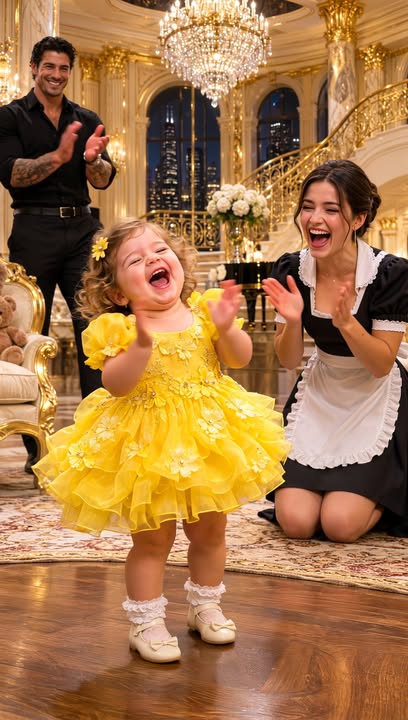
Part 6 – The Dance in Daylight
“My sister’s,” I repeated.
The records officer confirmed it gently, as though she understood that a name could open more than one old wound.
The orderly waited in the doorway, Lily’s transport chair turned toward the corridor.
I kept hold of her hand.
“Is that true?” I asked Elena.
She looked at Lily, then at me.
“I knew Genevieve’s sister had donated blood for the testing,” she said. “I didn’t know she had left a second specimen.”
The name brought back a woman I had not thought about in years: my older sister, Celia, who had died when she was twenty-eight, before I met Genevieve.
She had been the person who taught me to dance without counting under my breath.
At family gatherings, she would take my hand and insist that two left feet were simply feet that had not found their music yet.
“Why didn’t I know about this?” I asked.
Elena’s voice was soft. “You knew Celia had helped Genevieve. I think the rest was meant to be explained in the letter.”
A nurse stepped into the doorway, her eyes asking whether we were ready.
I looked at Lily.
She was watching my face, waiting for the answer she had heard the grown-ups circle around.
“Celia was my sister,” I told her. “Your aunt. She helped your mama with the samples before you were born.”
“Is that the aunt who taught you the dance?”
I swallowed.
“Yes.”
“Did she know about me?”
“She hoped she might meet you someday.”
Lily considered this, then glanced at the necklace on Elena’s palm.
“Can I still go to the other hospital?”
“Yes,” I said. “The doctors are ready for you.”
“And you’ll come?”
“I’ll be right beside you.”
She nodded, accepting the promise as if it were something solid she could carry.
Then the orderly began wheeling her toward the corridor.
I walked beside her, my hand wrapped around hers, while Elena followed close enough that Lily could see her whenever she turned her head.
Mara had arranged a quiet route through the hospital, and the specialist met us at the entrance to the transfer ward.
No one rushed us.
No one promised that the road ahead would be easy.
The doctors explained what would happen next in careful words, and I listened to every one.
The treatment carried risks.
It would require long days, difficult medicines, and constant monitoring.
The sample from Celia was not a cure, but it had given the specialists information they needed to choose a treatment that might help Lily’s body fight the illness.
They could not tell us how quickly it might work, or whether it would work enough.
I looked at Lily, who held my thumb between both of her hands.
“We’re ready,” I said.
The first weeks brought no miracles.
They brought needle marks, nausea, sleepless nights, and mornings when Lily had too little strength to ask for her favorite story.
They brought careful adjustments to the treatment, quiet conversations with doctors, and a chart on the wall that filled with figures I learned to read without believing they could tell me everything.
There were setbacks that frightened us, and small improvements that made us afraid to hope too quickly.
Still, we learned to take each day as it came.
I stopped asking the doctors for a certainty they could not give.
Instead, I asked what Lily needed before the next hour was over.
Sometimes the answer was medicine.
Sometimes it was a favorite blanket or a story about a stubborn yellow bird.
Sometimes it was simply for me to sit beside her and let the room be quiet.
Elena stayed as much as Lily wanted her to, learning the new hospital’s routines with the same patience she had once brought to the nursery.
She never tried to take my place.
She never needed to.
She was there when Lily wanted to hear the story of the yellow bird, and when she wanted someone to help her remember the dance.
I was there when Lily woke frightened in the night, when she asked for her mother, and when she needed to hear that being scared did not make her weak.
We found a way to be beside her together.
One evening, after the first round of treatment, Lily asked me about Celia.
I told her how my sister used to wear bright scarves, how she could make a room feel warmer simply by opening the curtains, and how she never let me give up on a dance before I had tried it twice.
“Was she funny?” Lily asked.
“She thought so,” I said. “And she was right more often than I wanted to admit.”
“Did she know Mama?”
“They were friends before Genevieve and I got married. Celia liked her from the beginning.”
“Did they dance?”
“They danced together at our wedding.”
Lily turned toward Elena.
“Can you show me?”
Elena looked at me, asking permission without words.
I nodded.
She stood beside the bed and moved her shoulders gently, then tapped twice against the chair.
Lily smiled.
It was not the strong, untroubled laugh I had missed, but it was hers.
And for that moment, it was enough.
As Lily’s treatment continued, Mara worked with the hospital and the family’s attorney to review the old records.
The missing consent form, the transfer documents, and the security logs were preserved.
The photograph from the night of the blackout had been sent through Adrian’s account, but the investigation found that he had not been at the terminal when it was exported.
One of the outside technicians had used a temporary access code after his contract ended, hoping to sell private family information.
Mara recovered the access trail and gave the records to the police.
The technician faced legal consequences for the misuse of the system.
Adrian had opened the archive, but the threatening photograph was not his.
The distinction did not erase his choices.
It did, however, separate what he had done from what someone else had done in his name.
For weeks, Adrian kept his distance and cooperated with the review.
He provided every estate file he had, including the clinic correspondence he had held under his account.
The investigation established that he had not destroyed the samples or moved them from the storage unit.
He had kept them there, restricted them without Genevieve’s consent, and failed to tell Lawson what he knew.
That still carried consequences.
He resigned from his role in the family trust and gave up access to its records.
The estate attorney made sure the preserved sample and Lily’s medical files would never again depend on a single person’s permission.
When Adrian came to see me, he did not bring excuses.
“I thought keeping everything in my hands meant I could protect it,” he said. “I see now that I was protecting myself from having to explain what I didn’t understand.”
I looked out through the hospital window at the winter light resting on the rooftops.
“You let me believe Elena didn’t care enough to stay.”
“I did.”
“You could have corrected me.”
“I should have.”
“I don’t know what our relationship looks like now.”
“I don’t either,” he said. “But I’ll accept whatever distance you need.”
There was no dramatic forgiveness, no embrace that made the years disappear.
I told him I would not pretend nothing had happened.
He said he understood.
Then I asked him whether he wanted to see Lily.
“Only if she wants me there,” he said.
I carried that answer back to her.
Lily took a moment to think.
“He can come if he tells me a story about Daddy dancing badly.”
I almost laughed.
“He can tell you the truth,” I said.
Adrian arrived the next afternoon with a small book about a girl who built a garden on a rooftop.
He read slowly, giving the funny voices to the birds.
When Lily asked whether I really danced badly, he said I did at first, then admitted that I still counted sometimes.
“Celia used to count,” I protested.
“She counted for you,” Adrian said.
It was the first time we had spoken about our sister without trying to make her memory serve an argument.
Lily asked Adrian to tap twice against the chair.
He did, gently.
She grinned at him.
That was not the same as forgiveness.
It was a beginning small enough for a child to hold.
The treatment worked gradually.
There were no sudden transformations, no morning when Lily sprang from bed as if illness had been only a bad dream.
Her strength returned in increments.
First she could sit upright through a whole story.
Then she could walk from her bed to the window holding my hand.
Later, she asked to choose her own breakfast and complained that the hospital toast had no imagination.
The doctors watched every test carefully, and the numbers improved a little at a time.
When Dr. Patel called to tell us that Lily’s disease was responding, I sat down before I could answer.
Elena covered her mouth with one hand.
Lily looked between us.
“Is it good news?”
“It’s good news,” I told her, kneeling beside her bed. “The treatment is helping.”
“Am I all better?”
“Not yet,” I said. “You still have more to do, and the doctors will keep watching you closely.”
She nodded, taking the truth as seriously as she had taken the treatment.
“But it’s helping?”
“Yes.”
“Then I can keep trying.”
I pressed my forehead to hers.
“We’ll keep trying together.”
Recovery did not move in a straight line.
Some days were bright, and some brought tiredness, pain, and the fear of another setback.
But Lily kept gathering strength.
She began drawing again, first little circles and then the people she loved.
She drew me with a tie that reached my knees, Elena with a yellow dress, Mara holding a very large flashlight, and Adrian with a book full of birds.
At the center of one picture, she drew Genevieve and Celia, their hands joined above a row of blue flowers.
“Why are the flowers blue?” I asked.
“Because of the necklace,” Lily said. “And because Mama liked them.”
She had never known her mother’s voice or her aunt’s laugh.
Still, through the stories we told and the pieces they had left behind, they were not strangers to her.
The necklace remained with us, no longer a secret passed from hand to hand.
Elena gave it to me once Lily was strong enough to hold it safely.
I offered it back to Elena.
She looked surprised.
“It was Genevieve’s,” I said. “But she trusted you with it.”
“And it belongs to Lily too,” Elena replied.
“Then let’s keep it where she can know what it means.”
We had the stone’s setting secured, leaving the small key in a safe place beside the letter and the blue notebook.
The letter had been sealed inside a plain envelope and addressed to Lily.
We did not open it while she was too young to understand why her mother had written it.
But I kept it on the shelf in my study, where it would not be lost in the same files Adrian had once controlled.
The first time Lily came home, the house felt strange to her.
She paused in the entrance hall, looking at the high ceilings and the windows that carried late-afternoon light across the floor.
I had changed nothing in the nursery, but I had changed the rooms around it.
The house no longer depended on dark corners and locked doors.
Mara arranged a new security system with separate access records and clear limits.
The service passage behind the library remained open.
Lily liked to walk through it with a flashlight, declaring that it was her secret hallway, though she always told us where she was going.
Elena no longer wore a housekeeper’s uniform.
She had returned to the house, but we had agreed on something different.
She would work with Lily’s care team as a family support coordinator, helping with appointments, routines, and the ordinary pieces of recovery that could otherwise disappear beneath paperwork.
Her place was clear, paid, and chosen.
She was not staff hiding in the edges of our grief.
She was part of Lily’s life because Lily loved her, and because I had finally stopped pretending that love needed a job title to be allowed into the room.
“You don’t have to earn your place here,” I told Elena one afternoon.
She stood by the nursery window, watching Lily arrange stuffed animals on the rug.
“I know,” she said. “But I want to be useful.”
“You can be useful without disappearing into what you do.”
She looked at me for a long moment.
Then she smiled.
“I’ll try.”
The months passed.
Lily’s recovery remained careful and demanding, but the doctors grew more hopeful with each checkup.
She still had visits to make and rules to follow.
She still tired more easily than other children her age.
But her laugh began to fill the house again, not every hour, not yet, but often enough that I stopped bracing for the silence after it.
Adrian continued working with the investigators and the estate attorney.
He answered for his part in withholding the records and accepted the legal and financial consequences of misusing his position.
He and I rebuilt our relationship slowly, with no promises that closeness would return exactly as it had been.
When he visited, he asked before entering Lily’s room.
When I asked a question, he answered it without taking the truth into his own hands.
That was not enough to undo what had happened.
It was enough to let us begin again.
One spring morning, Lily stood in the nursery wearing a yellow dress.
The color made me think of the first night Elena had danced with her, of the tiny knee lifts and the catch that kept her from falling.
Elena wore a simple blue dress, the necklace’s stone resting above its collar.
Mara had been invited for breakfast but stayed to watch when Lily announced that the music should be turned on.
I looked toward the speakers, then at my daughter.
“Do you want to dance?”
Lily nodded.
“Everybody.”
So I offered her my hand.
She took it, then reached for Elena with the other.
Mara laughed when Lily beckoned her closer, but Lily would not be refused.
Adrian stood at the doorway, uncertain.
“Uncle Adrian too,” Lily said.
He looked at me.
I gave him a nod.
He came into the room.
The music began softly.
Lily led us in a slow turn around the rug, choosing each step as she went.
When she grew tired, we stopped, and no one tried to coax her into doing more than she wanted.
She stood in the middle of us, breathing hard but smiling.
“Now the ending,” she said.
Elena looked at me.
I understood.
We shifted our shoulders together, slowly, and tapped twice.
Lily answered with two gentle taps of her own.
The daylight lay warm across the floor, and the open doorway framed a room filled with people who had chosen, in different ways, to stay.
I thought of Genevieve’s careful letter, Celia’s hidden gift, Elena’s promise, Mara’s steady vigilance, and even the difficult truth that had forced Adrian to stop confusing control with care.
I thought of the years I could not bring back.
Then Lily took my hand and began the dance again.
This time, I did not stand in the doorway.
I stepped into the light with her.
**–THE END–PLEASE
Share your thoughts or feedback to motivate us to create more stories ♥️
* * *
[PREVIOUS: PART 5](https://storyly.idolsgift.com/blog/part-5-the-door-in-the-dark-070)
✓ Lynn R. Adams
Part 6 – The Dance in Daylight “My sister’s,” I repeated. The records officer confirmed it gently, as though she understood that a name could open more than one old wound. The orderly waited in the…