PART 6 (THE END): The Debt Vincent Never Forgot 053
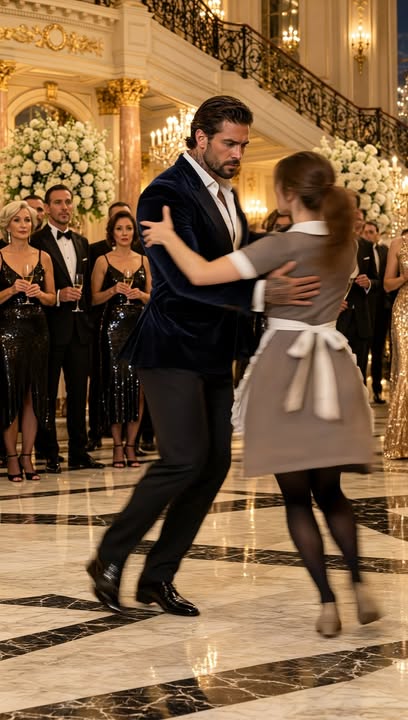
Part 6 – A Dance of Her Own
Emma stared at the photograph, and for a moment the street, the studio, and the people gathered behind her fell away.
Her mother stood beside Anton outside the old storefront, one hand resting on his arm.
She was younger than Emma had ever imagined her, with dark curls caught by the wind and a smile that seemed to hold both tenderness and uncertainty.
“She was here?” Emma asked.
The stranger nodded.
“My name is Daniel Bell,” he said. “Nora’s son. I’m sorry I didn’t explain sooner.”
Emma looked from the photograph to the man holding it.
“You said you had something of my father’s.”
“I do.”
Daniel opened his portfolio and took out a small, flat music book, its cloth cover faded to a soft green.
On the front, Anton had written one word in his precise hand: Mara.
Emma’s throat tightened.
“What did he ask you to give me?”
“Only the photographs and the book,” Daniel replied. “He asked me to wait until the studio might be used again. He thought you’d understand why then.”
“Did he tell you why my mother left?”
Daniel glanced toward Vincent, who had remained across the street, far enough away to leave Emma the choice of whether to bring him closer.
“He told me that she and he loved you,” Daniel said. “And that they were both afraid their different lives would make it impossible to give you what you needed.”
“That’s not the same as knowing why she left.”
“No,” he said gently. “It isn’t.”
Emma turned the photograph over.
On the back, Anton had written: Mara, before the music became complicated.
The phrase brought no answer, only a sharper longing for one.
“Do you know where she is?” she asked.
Daniel shook his head.
“I haven’t heard from her in many years. Your father said she left Chicago when you were very young. He didn’t speak of her with anger.”
Emma held the music book close against her coat.
“Why didn’t he tell me?”
“I can only tell you what he told me,” Daniel said. “He thought you might ask about her when you were older, and he wanted you to have the space to do that in your own time.”
The words settled beside everything else Anton had left her: the letters, the lessons, the choices he had tried to protect.
Emma had spent so long believing silence meant there was nothing more to learn.
Now she understood that her father’s quiet had often been an attempt to leave a door open without pushing her through it.
“Thank you for bringing these to me,” she said.
Daniel nodded.
“If you want, I can tell you what I remember of her. She used to come to the studio when we were children.”
“I’d like that,” Emma replied. “Not today, but someday.”
“Whenever you’re ready.”
He stepped back, leaving the photographs and the book in her hands.
Emma watched him walk toward the community center, then looked across the street at Vincent.
He had not moved.
She raised her hand, inviting him over.
Vincent crossed at an unhurried pace, stopping beside her rather than in front of her.
“What did he bring?” he asked.
“My mother’s photograph. And a music book with her name on it.”
Vincent looked at the image, his expression careful.
“I remember her,” he said. “She came to the studio a few times.”
“You knew my mother?”
“Only a little. She laughed when Anton tried to teach me the waltz.”
Emma looked at the photograph again.
“Did she leave because of you?”
“No.”
The answer was immediate.
“Did my father ever tell you why?”
“Only that they loved you and wanted different things from life. He said he hoped you’d understand that their choices weren’t a measure of how much they loved you.”
Emma drew a slow breath.
“I don’t know what to do with that.”
“You don’t have to do anything with it today.”
She looked at him, and he did not tell her to forgive or forget, did not hurry her toward a tidy understanding.
The restraint gave her room to feel what she felt: grief for the years she had spent wondering, anger that so much had been decided around her, and a small, fragile curiosity about the woman in the photograph.
“I may want to look for her,” Emma said.
“That’s your choice.”
“If I do, I won’t want you to arrange it.”
“I won’t.”
“And I may decide not to.”
“That’s your choice too.”
Emma slipped the photograph into the music book.
Across the street, Mr. Sato had come out of the café, holding his phone.
He approached with an expression of reluctant relief.
“The buyer has withdrawn the offer,” he said.
Emma looked at him.
“Why?”
“They were interested in the broader redevelopment, but they didn’t want to make a community project part of the arrangement. Their representative said they’d rather step aside than complicate the proposal.”
“Did they give a reason beyond that?”
“Only that the timing no longer suited them.”
Emma glanced at Vincent.
He shook his head, speaking before she could ask.
“I didn’t contact them.”
“Levi?” she asked.
“He asked the buyer’s representative for a clear explanation and shared the community meeting’s attendance list only after the families agreed,” Vincent said. “The company decided the project wasn’t a good fit.”
Mr. Sato folded his phone away.
“I’m not certain what changed their minds, but I’m glad I can make my own decision now.”
“And what is that?” Emma asked.
“I’d rather offer the lease to you and the community group. We can begin with a year, with a renewal option if the school is doing well.”
Emma felt the words, but did not let them carry her away before she understood their shape.
“What would the rent be?”
Mr. Sato told her.
It was fair, but it was not small.
The community group had enough pledged support to cover the first months, and several former students had offered to help with repairs, classes, and fundraising.
They would need to write a proper proposal and make a budget.
They would need to work.
The studio would not return to them by magic.
Emma looked through the window at the bare wooden floor, remembering what it had sounded like under her father’s shoes.
“I want to do it,” she said. “But I want the community group on the lease with me, and I want the school to stay open to children whose families can’t afford full fees.”
Mr. Sato nodded.
“That can be written into the agreement.”
“And I don’t want anyone’s name on the door except the school’s.”
Vincent’s gaze rested on her, but he said nothing.
Mr. Sato glanced toward the old storefront.
“Then we’ll call it the Walsh Community Dance School.”
Emma turned to the people gathered behind the studio windows.
Nora stood among them, holding a paper cup of tea.
Mrs. Alvarez raised both hands in a small, delighted applause, and the others joined her.
The sound was not the thunderous applause of the Continental.
It was warmer, closer, made by people who knew what the room could become because they had once depended on it.
Emma smiled through the tightness in her throat.
“I’ll need the agreement in writing,” she said.
“Of course,” Mr. Sato replied.
“And I want a chance to review it before I sign.”
“Of course.”
Nothing had been settled by charm or force.
The door had opened because people had spoken, listened, and chosen to make room for one another.
Later that evening, Emma went to the Continental to tell the staff manager she would be leaving at the end of the month.
The manager listened without interrupting.
“So you’re going to teach,” she said when Emma finished.
“I’m going to try.”
“And the program in Milwaukee?”
“I asked for another week. They offered me a place, but I have to decide whether I can balance it with the studio.”
“Can you?”
“I don’t know yet.”
“Then ask them what flexibility they can offer. You’ve earned the right to ask questions before you answer.”
Emma smiled.
“I think I’m learning that.”
When she brought a tray to Vincent’s private booth, Levi was there, reading through a folder.
Vincent stood as she approached.
“The lease?” he asked.
“Mr. Sato is preparing a draft.”
“That’s good.”
“The community group will be part of it.”
“Good.”
“You sound relieved.”
“I am.”
Emma set down the tray.
“I’m not asking you to pay for it.”
“I know.”
“If we need donations, they’ll go through the community fund, with public records and a committee.”
“Understood.”
“You won’t be on that committee.”
“I wouldn’t expect to be.”
She watched him carefully.
There was no disappointment in his face, only a quiet acceptance that the studio’s future did not belong to him.
“My father wouldn’t have wanted the room to carry your name,” she said.
“No,” Vincent replied. “He wouldn’t.”
“He wanted the children to have it.”
“Then that’s what it should be.”
“And you?”
“What about me?”
“What do you want?”
Vincent glanced toward the empty dance floor.
“I want to find out who I am when I’m not trying to repay a life I was given.”
The answer was not grand, and that made Emma trust it more.
“What would that look like?”
“I don’t know yet.”
“Are you going to keep running the same business?”
“No.”
Levi closed the folder and leaned back.
“We’ve been discussing a transition,” he said. “Vincent has agreed to cooperate with the authorities on the parts of his old work that need to be closed properly. No shortcuts, no hidden arrangements. He wants to leave it behind without asking anyone to pretend it never happened.”
Emma looked at Vincent.
“That will take time.”
“Yes.”
“And it may be difficult.”
“Yes.”
“You can’t make that choice just because you think it will make me trust you.”
“I know.”
“Are you doing it because of my father?”
“Partly,” Vincent said. “But not only because of him.”
He paused, considering his words.
“I don’t want my future to be an extension of the worst decisions I made when I was young. Anton showed me there was another way to live. I kept delaying the choice because I thought I needed to earn the right to make it.”
“And now?”
“Now I think I have to make it because it’s mine to make.”
Emma felt the difference in the words.
He was not offering her a transformation as a gift.
He was choosing his own responsibility.
“That doesn’t mean everything between us is settled,” she said.
“I don’t think it is.”
“It doesn’t mean I’ll stay in Chicago.”
“I know.”
“It doesn’t mean I won’t take the program.”
“I know.”
She looked across the room, where the orchestra was setting up for the night.
“You’re learning to listen.”
“I’m trying.”
“Then listen to this: I don’t want to be your reason for leaving one life unless I’m also free to choose whether I’m part of the next one.”
Vincent met her eyes.
“I understand.”
The words no longer sounded like an attempt to end the conversation.
They sounded like the beginning of a practice.
A week later, the lease was signed.
The agreement named Emma and the Walsh Community Dance School committee as tenants, with reduced fees for families who needed them and open hours for after-school study.
The rent was funded through community pledges, class registrations, and a small grant from the local arts council.
Vincent contributed nothing.
When one former student asked whether he might sponsor the repairs, Emma told her she would rather keep the school’s finances separate from his business.
The woman nodded and offered to organize a neighborhood fundraiser instead.
In time, Vincent donated several of Anton’s old music stands after Emma discovered them in storage.
He did so through Levi, who delivered them without a speech and without asking for his name to be attached.
The studio reopened on a Saturday morning beneath a clean new sign.
Walsh Community Dance School.
The letters were painted in warm blue, a color Emma remembered from the old photograph.
The floor had been repaired, the mirror polished, and the windows cleared so passersby could see the room fill with light.
Parents carried in boxes of fruit and pastries.
Children darted between the folding chairs, their laughter rising above the steady rhythm of the radio.
Nora arrived with Daniel and a framed photograph of Anton, smiling beside the studio entrance.
She placed it on a shelf by the door.
“He’d be pleased,” she said.
Emma adjusted the frame.
“I wish I could ask him.”
“I know.”
Mrs. Alvarez appeared with a stack of forms and declared that someone needed to make sure the children signed in before they took over the room.
For an hour, the studio belonged to everyone.
Emma welcomed new students, answered questions, and showed a little girl how to stand with her shoulders relaxed.
When the girl stepped awkwardly across the floor, Emma smiled.
“There’s no wrong step you can’t learn from.”
The girl glanced toward her mother, uncertain.
Emma offered her a hand.
“Would you like to try again?”
The child nodded.
They began with three simple steps, and soon the girl was grinning.
Near the doorway, Vincent watched without coming closer.
He had arrived alone, carrying no flowers and no announcement, only Anton’s music book wrapped in brown paper.
When Emma had time, she approached him.
“Thank you for bringing this.”
“I thought it belonged here.”
She unwrapped the book.
The pages were still full of Anton’s notes, but Emma had arranged for them to be copied and protected so the students could read the words without damaging the original.
“I’m glad you came,” she said.
“I wasn’t sure you wanted me to.”
“I asked you to.”
“I know.”
“Then you can stop acting as if you’re trespassing.”
A small smile crossed his face.
“I’ll try.”
Emma glanced toward the floor.
“We’re teaching the first waltz after lunch.”
“I remember.”
“Would you like to dance?”
Vincent looked at the children, then at her.
“If you’re asking as my teacher, I’m still terrible.”
“Then you’ll have an advantage. I’m very patient.”
“That’s not what the children say when you make them repeat a step.”
“Children are honest.”
“Then I should prepare.”
The first lesson began with a room full of beginners.
Emma taught the group how to hear the count, how to shift their weight, and how to leave room for their partners.
Vincent stayed at the edge until one of the older students asked him to demonstrate.
He looked at Emma.
“Only if you want me to,” he said.
“I want the students to see that even a good dancer has to listen.”
He stepped onto the floor.
The music began softly.
Emma placed one hand in his, and he rested his other palm lightly at her shoulder blade.
This time, he waited for her to settle.
This time, he listened.
They moved through the first three steps, slowly enough for the students to follow.
Vincent’s lead was gentle, not because he had forgotten how to guide, but because he understood that a partner was not a destination to be reached.
Emma followed, then changed the direction on the next turn.
Vincent adapted without hesitation.
A ripple of laughter traveled through the children as they tried the same movement.
When the song ended, the room applauded.
Vincent smiled, but his eyes were on Emma.
No one in the room saw a debt being repaid.
They saw two people sharing a dance beneath the lights, with the students gathering around them and Anton’s photograph watching over the doorway.
After class, Emma found a letter from Milwaukee in her bag.
The program had offered her a flexible arrangement: she could attend a two-month session, return to Chicago to teach, then decide whether to continue.
It would mean travel, careful planning, and long days.
It would also mean she did not have to choose between her own growth and the studio’s beginning.
She read the offer twice.
Then she went outside and found Vincent standing beneath the blue sign.
“I’ve decided to take the program,” she said.
His face brightened before he could conceal it.
“That’s wonderful.”
“I’ll be away for two months at first.”
“I’m glad you’re going.”
“I’ll be back to teach here when I can.”
“I’ll be here when you return.”
She held his gaze.
“You don’t know that yet.”
“No,” he said. “I don’t know what the future will ask of me. But I know I want to meet it honestly.”
Emma studied the man before her, remembering the boy behind the drainage barrier, the young student at Anton’s studio, and the powerful stranger who had once expected the room to obey his tempo.
He had not become a different person in a single grand gesture.
He was becoming someone else by listening, choosing, and making room for truths he had once tried to carry alone.
“I want to see what happens,” she said.
“So do I.”
“That isn’t a promise.”
“No.”
“It’s a beginning.”
“Yes.”
The evening light slipped through the studio windows and rested on the polished floor.
From inside came the music of the children practicing their steps, their counting uneven and bright.
Emma glanced at the photograph of her father near the door.
For years, she had thought honoring Anton meant holding tightly to what he had left behind.
Now she understood that he had been trying to give her something more generous than a legacy.
He had given her a choice.
She turned back to Vincent and offered her hand.
“Would you dance?”
He took it with a lightness that let her choose the first step.
Together they moved beneath the studio lights, not as a rescuer and someone saved, nor as a debt and its repayment, but as two people learning how to share a rhythm without deciding the other’s path.
And above them, in the doorway, Anton’s photograph held its quiet smile as the music carried them forward.
**–THE END–PLEASE
Share your thoughts or feedback to motivate us to create more stories ♥️
* * *
[PREVIOUS: PART 5](https://storyly.idolsgift.com/blog/part-5-the-debt-vincent-never-forgot-053)
✓ Lynn R. Adams
Part 6 – A Dance of Her Own Emma stared at the photograph, and for a moment the street, the studio, and the people gathered behind her fell away. Her mother stood beside Anton outside the old storef…