PART 6 (THE END): The Date on the Calendar 029
Part 6 – A Key That Opens Nothing
“It says, ‘I think I know where the key is.’”
For a moment, the hallway seemed to narrow around me.
“Ask Erica what she means,” I said.
“She’s on her way here,” Craig replied. “She said she wanted to bring it herself.”
“Then let her.”
“Do you want me to stay?”
I looked through the glass at Melinda, who had gathered the papers into a neat stack and was waiting without interrupting.
“Yes,” I said. “But don’t answer for her.”
“I won’t.”
I returned to the office and finished signing the last page.
The sale was moving forward.
Whatever Erica had found, it could not turn my decision into something I hadn’t chosen.
Still, when I stepped outside, the January air felt sharper against my face.
Craig was waiting beside his car, the envelope in one hand and the old photograph in the other.
He held them out to me.
I turned the photograph over.
The words on its back were written in Erica’s hand.
“I think I know where the key is.”
Below them was a second line.
“I’m sorry I didn’t bring it back when you asked.”
“Where did she find this?” I asked.
“She said it was tucked behind one of the old recipe books in her kitchen.”
I looked up at him.
“Why would the photograph be there?”
“She doesn’t know. She thinks she may have taken it when she borrowed one of your cookbooks last year, then slipped it inside without thinking.”
It was a photograph I remembered.
Dale had taken it on a summer afternoon, years ago, while Craig was standing beside the kitchen doorway.
The picture showed the measuring marks, the ones we had made every birthday, and a boy squinting into the sunlight while his father tried to keep him still.
I had not seen it in years.
“Where does she think the key is?” I asked.
“She said she might know after she talks to us.”
The word us landed gently, but it carried a question.
I did not answer it.
Erica arrived a few minutes later, her coat buttoned to the throat and her hands tucked into her pockets.
She looked first at Craig, then at me.
“I’m sorry I kept the key,” she said.
Her voice held no bright explanation, no hurried attempt to turn the apology into a defense.
“I should have returned it when you asked. I kept telling myself I’d do it later, and then I let the whole thing become something it wasn’t.”
“What did it become?” I asked.
“A way to avoid admitting that I’d made plans with your house without asking you.”
She glanced down at the photograph in my hand.
“I found this inside a cookbook you lent me last spring. I must have put it there when I was sorting recipes, and then forgot.”
“Do you know where the key is?” Craig asked.
Erica nodded, though she looked uncomfortable.
“I think it’s in the side pocket of my old travel bag. I packed it away after New Year’s, when we were clearing out the car.”
“Why didn’t you check before saying you were bringing it?” he asked.
“I did check the drawer where I thought I’d put it. It wasn’t there.” She looked at me. “I remembered the bag after I wrote the note.”
I could hear the honesty in her uncertainty.
It was not a dramatic secret.
It was an ordinary object, misplaced in the disorder of a week she had expected to go her way.
That made the apology matter more, not less.
“Will you bring it to me when you find it?” I asked.
“Yes.”
“And Erica?”
She met my eyes.
“I’m not asking you to delay the sale,” she said. “I wanted to see you before the house was no longer yours, but I know that doesn’t give me a right to ask for anything.”
“Thank you for saying that.”
“I’m sorry,” she said again. “Not because you’re moving, and not because Craig found the messages. I’m sorry because I treated your no like it was a temporary obstacle.”
The words left a stillness around us.
Craig did not step in to soften them or hurry me toward an answer.
I had spent years wishing someone would listen without trying to manage what came next.
So I let the quiet remain.
“I hear you,” I said at last.
Erica’s eyes shone, but she did not look away.
“I want to do better,” she said.
“Then start by asking.”
“I will.”
“And if I say no?”
“I’ll believe you.”
That answer was small, but it was the first one I had received without a qualification.
I nodded.
“I hope you do.”
Craig glanced from Erica to me.
“Could we all go to the house?” he asked. “Just to collect the last things and let Mom see it once more?”
I considered the request.
The buyers’ paperwork was complete, but the house would remain mine until the closing.
There was still time for one last visit, if I wanted it.
“Yes,” I said. “I’d like that.”
We drove separately.
The front door opened onto the same quiet I had found the day the movers left, but it no longer felt like a room waiting for someone else to claim it.
It felt like a place I had chosen to leave.
Craig walked through the dining room slowly.
Erica stayed near the entry until I looked back and motioned her inside.
I carried Dale’s letter in my purse.
The measuring chart was still fixed to the kitchen doorway, and the empty rooms seemed to draw my eyes toward it.
I stopped in front of the marks.
Craig came to stand beside me.
“I forgot how small I was,” he said.
“You weren’t small for long.”
“Dad used to tell me not to stretch.”
“He knew you were doing it anyway.”
A faint smile crossed Craig’s face.
“He said the lines had to be honest.”
“They were.”
I touched the mark beside his eighteenth birthday.
The pencil had faded, but Dale’s careful handwriting remained.
For a long moment, I could almost see the three of us there, crowded into the kitchen, laughing while Dale tried to keep the ruler level.
Erica approached quietly.
“I never knew this was still here,” she said.
“It’s been here since Craig was a boy.”
“I should have asked you about it.”
“Yes,” I said, not unkindly.
She nodded, accepting the correction rather than trying to step around it.
“I’d like to help you take it with you,” Craig said.
“I haven’t decided whether I can.”
“You don’t have to decide now.”
I turned toward him.
The words sounded like his father’s, though he may not have realized it.
“No,” I said. “I don’t.”
We stood together beneath the marks.
I thought of Dale’s letter, and of the sentence he had written: a person can say no and still care deeply.
Maybe that was the truth I had needed all along.
Not that leaving would stop me loving the house.
Not that Craig would never disappoint me.
Not that every relationship could be repaired if I was patient enough.
Only that love did not require me to make myself smaller.
The closing took place two weeks later.
The date had moved by a few days because of paperwork, but the sale went through without complication.
I signed the final documents at Melinda’s office and handed over the keys that belonged to the property.
The brass spare key was not among them.
Erica found it the following morning in the side pocket of her travel bag, exactly where she had suspected.
She brought it to me herself.
We met at the apartment door.
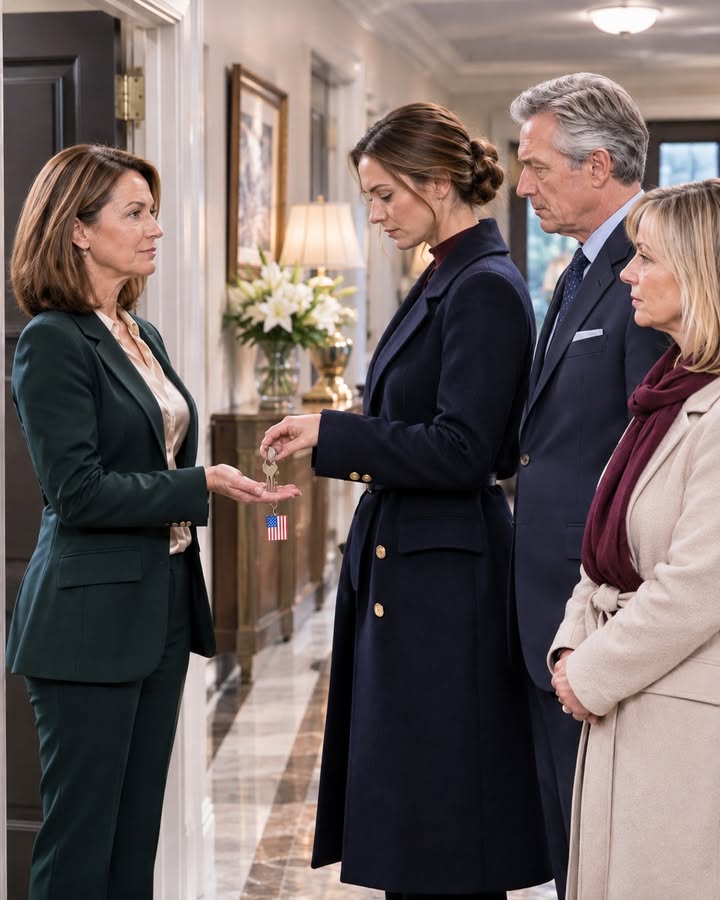
She held the key in her open palm.
“I’m sorry,” she said.
I looked at the familiar brass, worn smooth around the edges.
“Thank you for bringing it back.”
She placed it in my hand.
The key seemed lighter than I expected.
“Would you like to come in?” I asked.
Her face lifted with cautious surprise.
“If you’re sure.”
“I am.”
We sat at the small kitchen table.
Erica told me she had spoken to her parents and corrected what she had told them.
She had explained that I had never offered the house and that I had arranged the cottage because I did not want them stranded.
“I should have told them the truth before you had to,” she said.
“You should have.”
“I know.”
She folded her hands on the table.
“I thought I was keeping the family together by making everything fit. I didn’t notice that I was making you do the fitting.”
I watched her carefully.
“Do you understand that now?”
“I think I do.”
“Thinking isn’t the same as remembering when it’s inconvenient.”
“I know.”
Her eyes moved to the brass key resting beside my cup.
“I don’t expect you to trust me because I apologized.”
“That’s good.”
“I’d like to earn it, if you’ll let me.”
“I’ll let you try.”
Her shoulders lowered slightly, not with relief that everything was solved, but with the knowledge that she had been given an honest beginning.
After she left, I closed my fingers around the key.
It had opened the house for years.
It had also taught me something about the difference between welcome and access.
A few days later, Craig came to help me move into the condo.
He carried boxes without assuming which ones I wanted moved first.
When he was unsure, he asked.
“Where should this go?” he said, holding Dale’s favorite chair near the living room window.
“By the balcony door, if you can get it through.”
He adjusted his grip.
“Is this close enough?”
“Move it a little toward the window.”
He did.
“More?”
“That’s right.”
The chair settled into place beneath the broad glass, facing the lake.
Outside, winter sunlight lay across the water in long silver streaks.
I stood behind it, one hand on the worn wooden arm.
For four years, I had kept the chair near the window because Dale had liked the light.
Now it stood beside a different window, with a different view, and I could almost hear him saying that the chair had never cared where it was.
Craig opened another box.
“Is this the measuring chart?”
I looked toward the doorway between the living room and the small bedroom.
The old wooden strip had been removed carefully, with the marks intact.
Marcus had helped me take it down before the final handover, though he had needed to loosen the trim around it.
I had wrapped it in a blanket and carried it with me.
“I thought I might put it on the wall,” I said.
“Where?”
I showed him the narrow stretch of wall beside the bedroom door.
He held the chart there while I checked the height.
“It’s a little shorter than the old doorway,” he said.
“We don’t have to use the same measurements.”
“That seems right.”
He found the small level in his tool bag.
I held one end while he marked the wall.
For a few minutes, neither of us spoke.
The work itself was quiet and ordinary, and I found that I liked it better than any grand conversation we might have planned.
When the chart was secured, Craig stepped back.
“Eight,” he said, touching the first mark.
“Nine,” I answered.
“Ten.”
He stopped at the last line.
“I forgot how carefully Dad wrote my name.”
“He wanted it to last.”
Craig’s fingertips rested near the mark for eighteen.
“I’m glad you brought it.”
“So am I.”
He turned to me.
“Would it be all right if I came by next weekend?”
“Yes.”
“Just me?”
“Yes.”
He nodded.
“And if Erica wanted to visit sometime?”
“Then she can ask.”
“I’ll tell her.”
“Don’t tell her she has permission.”
“I won’t.”
I saw him absorb the difference.
It was a small thing, but then so were most of the habits that had shaped us.
Before he left, he stood beneath the measuring chart again.
“Dad would have liked this place,” he said.
“He would have liked the view.”
“He would have liked that you chose it.”
I looked out toward the lake.
“I think so.”
A few mornings later, Erica sent me a message.
Would it be all right if I brought breakfast on Saturday?
I replied, Yes. Please call before you leave so I know when to expect you.
She answered, Of course.
When Saturday came, she arrived with a paper bag of rolls and a small container of fruit.
She did not walk into the condo as if she already knew where everything belonged.
She waited while I opened the door.
“Is it still all right?” she asked.
“It is.”
She stepped inside and looked around, taking in the chair, the boxes still waiting to be unpacked, and the wide window facing the lake.
“This is lovely,” she said.
“Thank you.”
“I can see why you chose it.”
I set the kettle on.
We ate at the small table, and the conversation moved carefully at first, like a person walking across a frozen pond.
Then Erica asked about Dale.
“What was he like before Craig was born?”
I smiled despite myself.
“Impatient when a repair took too long, patient when someone else needed him, and convinced that every meal required more onions.”
She laughed.
“He sounds like Craig.”
“Sometimes.”
I told her about the measuring chart, about Dale building the pantry shelves, and about the time he tried to refinish the dining table and covered half the garage in varnish.
Erica listened.
She did not interrupt to say she knew the story already, and she did not hurry me toward the present.
When she left, she asked before hugging me.
I said yes.
The embrace was brief and a little awkward, but it was honest.
We did not become close again in a single morning.
There were still pauses when I wondered whether a request was truly a request.
There were still times when Erica had to stop herself and ask rather than assume.
But I learned that repair did not have to arrive all at once to be real.
Craig came the next weekend.
He brought no agenda and no request.
We sat in Dale’s chair for a while, one at a time, looking at the lake as he told me about work and I told him about the neighbors in the building.
Then I showed him the letter.
He returned it to me after he read it.
“I want to keep a copy,” he said.
“Of course.”
“I think I need to remember what Dad said.”
“So do I.”
He looked toward the measuring chart.
“I wish I’d handled the house differently.”
“I know.”
“I can’t change that.”
“No.”
“But I can do better when you tell me what you want.”
“Yes,” I said. “You can.”
He nodded.
It was not a promise that nothing would ever go wrong again.
It was a willingness to be present when something did.
For our first New Year’s meal by the lake, Roy and Susan came in the afternoon with a small basket of food and a bottle of sparkling cider.
They thanked me again for the cottage.
“You gave us a good beginning to a difficult visit,” Susan said.
“I’m glad the cottage worked out.”
“It gave us time to understand what had happened,” Roy added.
No one tried to turn the meal into a formal family meeting.
We ate soup, warm bread, and a pie Susan had brought from home.
The windows reflected the room around us, and beyond them the lake held the last light of the day.
Erica asked whether I wanted the small table moved closer to the window.
I looked at the table, then at the open space between it and the chair.
“Yes,” I said. “A little closer would be nice.”
She moved it, then stepped back.
“Is that better?”
“It is.”
Craig brought out the old photograph of the kitchen doorway.
He had placed it in a simple frame.
I set it on the shelf beside Dale’s picture.
The two photographs stood together: Dale beside the measuring marks, and the new view of the lake beyond the condo window.
The house was gone now.
Its rooms belonged to someone else.
But the life we had lived there was not lost, and I no longer needed to keep every door exactly where it had been in order to remember it.
As evening settled, Roy and Susan gathered their coats.
Erica helped them find their gloves.
Craig stayed behind to carry the dishes to the sink, and when he finished, he did not ask whether he could return next week.
He waited.
I looked around the bright room, at Dale’s chair, at the measuring chart on the wall, and at the people I loved standing together without anyone presuming what I owed them.
“Come back next Sunday,” I said. “If you’d like to.”
Craig smiled.
“We’d like to.”
Erica met my eyes.
“Thank you for inviting us.”
“You’re welcome.”
After they left, I stood alone by the window.
The spare key lay in the dish beside the door, where I had put it after Erica returned it.
I no longer needed it to hold the house open.
I had a new key now, one that opened a door I had chosen for myself.
Outside, the lake darkened beneath the winter sky.
Behind me, Dale’s chair waited in the warm light, and the old measuring marks stood secure on the wall.
For the first time in years, home did not feel like a place I had to preserve.
It felt like a life I was still allowed to make.
**–THE END–PLEASE
Share your thoughts or feedback to motivate us to create more stories ♥️
* * *
[PREVIOUS: PART 5](https://puretales.idolsgift.com/blog/part-5-the-date-on-the-calendar-029-2)
✓ Lynn R. Adams
Part 6 – A Key That Opens Nothing “It says, ‘I think I know where the key is.’” For a moment, the hallway seemed to narrow around me. “Ask Erica what she means,” I said. “She’s on her way here,” C…