PART 6 (THE END): The Date Beneath the Seal 052
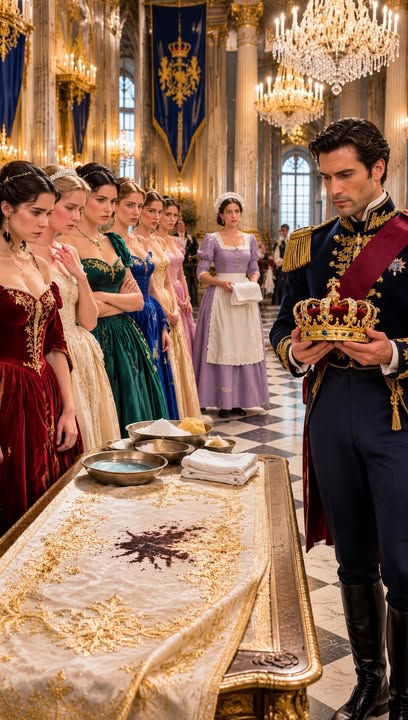
Part 6 – A Crown Freely Chosen
“‘If Adrian has signed this, it means someone has finally told him the truth.’”
The words hung between them, fragile as the thin paper in Elena’s hand.
Adrian looked down at the false receipt bearing his initials, then back at the note.
“My mother believed I had signed it,” he said.
“Or she knew someone would use your name,” Elena replied, carefully keeping her voice steady.
The crown burned bright above her, its golden light reaching the old queen’s letter, the copied accounts, and the faces of everyone waiting in the hall.
Adrian did not reach for the note.
“May I read it?”
Elena gave it to him.
The writing was small and familiar, though hurried, as if Mara had been afraid time would run out before she could finish.
“If Adrian has signed this, it means someone has finally told him the truth,” he read.
“Then tell him what I could not prove: the delivery was never released.”
A ripple of astonishment passed through the court.
The note continued.
“The clerk who changed the account told me the supplies would be sent once the prince confirmed receipt, but no delivery could be confirmed before it arrived.”
Adrian’s hand tightened around the paper, then eased again.
“Mara knew the receipt was false,” he said.
“She knew enough to question it,” Elena replied.
“Why didn’t she say so in the letter she brought me?”
“She may have tried.”
The answer settled over the hall with the weight of all the lost chances that had brought them here.
Adrian turned to the clerk.
“Who had access to these accounts?”
“We will need to compare the office rosters with the names on the route records,” the clerk said. “The receiving clerk and the delivery clerk both had access.”
“Then begin there.”
“I will.”
“And no one is to be accused until the records are examined.”
The clerk bowed.
A council member rose slowly.
“Your Highness, if the delivery was held until you confirmed it, then your initials could have been required before the wagons left.”
“Could have,” Adrian said. “But I did not authorize it.”
“You were presented with a closure bearing your initials.”
“I was. I do not remember seeing it.”
Marcus stepped forward, his face grave.
“I remember a stack of routine closures brought to the council offices that spring.”
Adrian looked at him.
“Did you bring them to me?”
“I brought several. I cannot say whether this one was among them.”
“Would I have signed without reading?”
“You often signed routine account closures after they had been reviewed by the office.”
The answer was not an accusation, but Adrian felt the truth in it.
He had trusted the process because it was easier than reading every line.
“I should have read them,” he said.
“Yes,” Marcus replied.
Elena watched them both.
“Knowing someone used his initials doesn’t mean he knowingly closed the account,” she said.
“No,” Marcus agreed. “But it does mean the system allowed his name to stand where his attention should have been.”
The seamstress from the eastern district rose again.
“Will you find out who held the supplies?”
“Yes,” Adrian answered. “We will trace every wagon and every account.”
“And will the people who were waiting receive what they were promised?”
“They will receive restitution for what was lost, including the medicine that never arrived.”
The woman nodded, not satisfied yet, but willing to hear what came next.
Adrian placed Mara’s note beside the false receipt.
“This inquiry will not end with one person’s name,” he said. “It will end when we know what happened to the supplies, why the record was changed, and what must change so no one is left waiting behind a closed account again.”
He dismissed the court only after ordering that copies of the records be given to the representatives from the eastern district.
The gathering broke apart slowly, with questions following the clerks and councilors into the corridor.
Some people remained to speak with Elena.
Others looked toward Adrian with uncertainty that had not been there the day before.
He let them look.
For once, he did not try to arrange the room until it reflected confidence.
Elena remained beside the table, holding her mother’s note.
“The sentence sounds like her,” she said.
“You knew her handwriting.”
“I knew how she wrote when she wanted to sound braver than she felt.”
Adrian’s expression softened.
“Was she frightened?”
“Sometimes.” Elena turned the note over between her fingers. “She just didn’t believe fear was a reason to stay quiet.”
“And you?”
“I’m still deciding.”
The honesty in her answer made him smile, though it was a quiet, weary smile.
“You don’t have to decide anything today.”
“I know.”
The crown hovered above them, its light less fierce now, but no less present.
Elena glanced up.
“I wish it would stop making every room stare at me.”
“I wish the court would stop staring at you because of it.”
“That may be harder.”
“I suspect you’re right.”
For a moment they stood together amid the thinning crowd, the prince and the maid who had brought the letter, neither of them pretending that the truth had resolved everything.
The investigation had only become more demanding.
But the silence that had surrounded it was broken.
In the weeks that followed, the palace opened its records to the inquiry.
Adrian appointed a review committee with members from the eastern district, the physicians’ office, the royal accounts department, and the palace archive.
They were given full access to the delivery books, charity ledgers, route rosters, and private correspondence relevant to the winter of the shortages.
Elena agreed to serve as a witness and adviser on Mara’s records, but refused any title that would make her answerable to the court before the inquiry was complete.
“I want to help because I know what my mother kept,” she told Adrian. “Not because the crown is hovering over my head.”
“Then that is how the committee will describe your role,” he promised.
She looked at him until he added, “And you may leave whenever you choose.”
“Good.”
Dr. Bell traveled to the eastern district with copies of the accounts and a small team of clerks.
He returned with names, dates, and the memories of people who had waited through the winter for medicine that never came.
Some had received later aid through the royal charity.
Others had relied on neighbors, seed grain saved for spring, or healers who stretched their supplies past what anyone thought possible.
The stories were not identical, and the committee took care not to make them so.
Among the records was a separate list of charity distributions, written in Mara’s hand.
It showed that she had quietly helped the charity reach several families near her village, including the family of Ansel Reed.
Beside some entries, she had marked the ages of children and the medicines they needed.
In the margin, she had written, “Bring what can be spared, but do not let the palace call this account settled.”
Elena read the line twice.
“My mother knew some families were being helped,” she said. “She also knew that help did not repair the promise that had been broken.”
The committee found that Queen Isolde’s diversion had been a genuine emergency measure.
The treasury had been nearly empty, the northern route blocked, and famine conditions spreading through several villages.
The queen had ordered some provisions redirected to families in immediate danger, intending the district’s supplies to be restored when the spring stores came in.
She had also ordered that the decision be explained publicly.
Marcus had received those instructions and had begun preparing the account.
After Isolde’s sudden death, however, he had concealed the plan rather than complete it.
He feared that the court would use the shortage to question the queen’s judgment, and that unrest would spread before the relief system could be repaired.
He had not diverted the supplies for personal gain.
He had not created the famine.
But he had suppressed Mara’s complaints, allowed the false receipt to stand, and kept the queen’s unfinished promise from Adrian.
When the committee traced the route records, they discovered that the spring delivery had been held at the river crossing after the false receipt was entered.
The clerk who changed the record had believed the prince had already confirmed the delivery, because a copied account bearing Adrian’s initials had been placed among the routine closures.
No single person had understood the whole chain of decisions.
That did not make the result less harmful.
The investigation also found that the missing pages had not been destroyed.
They had been removed by the archive clerk who first noticed that the figures did not match, then hidden among a box of obsolete household ledgers when she feared she would be blamed for the discrepancy.
She had died years later without explaining where she had placed them.
The inquiry did not punish her family or treat her fear as proof of a larger conspiracy.
It recorded what she had done, why she had done it, and how a system that allowed one unchecked signature to close a complaint had made the truth easier to lose.
Marcus testified before the committee for three full days.
He answered every question, including the ones that made him look worst.
When asked why he had kept the matter from Adrian, he did not speak of loyalty or the crown’s stability.
“I thought I could repair it before anyone had to know how badly I had failed,” he said. “Instead, I made the failure last longer.”
He resigned as royal adviser after his testimony.
The judgment was fair and public.
Marcus was barred from holding a position with authority over royal accounts, but he was not cast out of the kingdom or made a spectacle for the court.
He accepted responsibility, paid a portion of his remaining salary toward the district’s restitution fund, and agreed to help the new relief office build a system that would leave fewer decisions to one person’s memory or discretion.
When Adrian asked if he wished to contest the judgment, Marcus shook his head.
“No,” he said. “I have had enough time to explain myself.”
“You may still speak honestly in your own defense.”
“I have.”
Marcus looked toward the room where the new ledgers were being arranged.
“Let the work be the defense I should have made years ago.”
The court accepted the judgment without celebration.
Some nobles called it too lenient.
Others feared that admitting the queen’s mistake would weaken the monarchy.
Adrian listened to all of them.
Then he published the inquiry in full, with the names of the families removed unless they had chosen to be identified.
He included his own failure to hear Mara and his habit of signing routine closures without reading every line.
“I cannot ask the kingdom to trust a record I did not examine,” he said before the council. “I will not ask them to trust me without showing what I have done to change it.”
The new relief system required every redirected delivery to carry a written reason, a destination, and a record of receipt confirmed by someone outside the office that issued the order.
Emergency aid remained free to move quickly, but its accounts were reviewed by representatives from the places it served.
The eastern district received restitution in grain, medicine, seed, and funds for the village clinics.
The families who had received charity supplies kept them.
No one was asked to repay food they had eaten or medicine that had helped their children.
When the first restored wagons crossed the river, the district representatives signed for each one themselves.
Elena traveled with the review committee to her village.
She had not been home since her mother’s funeral.
The road seemed narrower than she remembered, and the cottage appeared smaller against the hills, but the doorway still carried the faint mark where Mara had once measured Elena’s height with a strip of blue thread.
Elena stood there a long while before going inside.
Adrian waited outside with Dr. Bell, giving her the privacy she had asked for.
The cottage held the familiar scent of dry herbs and old wood.
Mara’s writing table remained near the window, its surface cleared except for a small wooden box.
Inside lay a set of notes Elena had never seen.
They were not evidence of theft.
They were letters to people in the village, reminders about medicine, lists of families who needed food, and a few tender messages her mother had written for Elena and never sent.
One note read, “If my daughter ever believes the palace is too large for one person to change, remind her that a single honest page can still find its way through.”
Elena sat on the edge of the bed and held the paper against her heart.
When she came outside, the committee had begun unloading the supplies.
Adrian stood among the villagers, listening as the seamstress described which families had been most affected.
He did not speak over her or promise an easy solution.
He asked questions, took notes, and stayed until the final crate had been accounted for.
Elena watched him for a moment.
Then she crossed the yard and stood beside him.
The crown followed, its glow warm in the afternoon sun.
A little girl from the village looked up at it.
“Does it mean she has to be queen?” the child asked.
“No,” Elena said gently.
The girl looked confused.
“What does it mean, then?”
Elena glanced at Adrian.
“I think it means I have a choice,” she replied.
The girl considered this with great seriousness, then returned to the parcel of clean bandages she was helping carry.
That evening, the village held a gathering in the meeting hall.
There was bread on the tables and a pot of soup that had been made with some of the restored grain.
No one called it a royal celebration.
It was simply the first night in a long time when the neighbors had gathered without waiting for news about what the palace would do next.
A small wooden plaque had been set beside the doorway.
It bore Mara’s name and the words: SHE LISTENED, AND SHE KEPT ASKING.
Elena touched the letters with her fingertips.
“My mother would have said this is too grand,” she told Adrian.
“She might have said it deserves a smaller plaque and a larger kitchen garden.”
“That sounds more like her.”
“Would she have liked me?”
Elena looked at him.
“She would have liked the boy you were, and she would have challenged the man you became.”
“Fair.”
“She would have wanted you to keep listening after the story stopped being about her.”
“I will.”
“I know you mean it.”
Adrian waited.
“But meaning it won’t be enough,” she added.
“No. I’ll have to keep doing it.”
The crown’s glow fell across the plaque and the two of them standing beside it.
Elena looked up.
For the first time, she did not seem burdened by its attention.
It was not because she had grown accustomed to being watched.
It was because she had begun to understand that the choice remained hers, whatever the crown might signal.
In the months that followed, the kingdom began to notice the difference.
The new relief office published its accounts every season.
Villages could appeal a delayed delivery without sending a letter through the same office accused of losing it.
The council invited representatives from the districts to speak before decisions about food, medicine, and roads were finalized.
The changes were not perfect.
There were still delays, disagreements, and pages that had to be checked twice.
But people could see where the provisions had gone, and they could ask who had moved them.
Adrian made a point of attending the first public review meeting.
Elena went with him, though she refused the seat reserved for the royal family.
She sat among the district representatives instead.
When a farmer asked whether the new system would remain after the inquiry was forgotten, Adrian answered that it would be written into the law and checked each year.
Elena asked who would make sure the law served the people rather than the palace.
The council appointed a standing committee of villagers, physicians, and accountants to review it.
Adrian learned not to take her questions as opposition.
Sometimes they were the clearest sign she trusted him enough to disagree.
Their closeness grew through work and quiet conversation.
They walked the palace gardens after long meetings, speaking about Mara and Isolde, about the people each had lost, and about the futures neither of them wanted decided for them.
Adrian never asked Elena to accept the crown.
Elena never pretended she had stopped seeing the boy who had driven past her mother.
Instead, she watched how he responded when the next difficult choice arrived.
He listened when an old steward challenged a new plan.
He admitted when he did not know an answer.
He went to the villages without a procession and returned with notes that bore the marks of people’s hands.
One evening, as the palace windows filled with the soft orange light of sunset, Elena found him alone in the great hall.
The ancient crown hovered above the empty space where it had first circled her.
Adrian stood beneath it, holding no ceremony, no book of laws, and no prepared speech.
“It hasn’t chosen anyone else,” she said.
“It has had ample opportunity.”
“Do you still think it knows what it’s doing?”
“I think it knows more about you than I do.”
“That’s not difficult.”
He laughed, and the sound surprised them both.
Then his expression grew serious.
“I don’t want you to accept the crown because the court expects it.”
“I know.”
“I don’t want you beside me because the kingdom needs a symbol.”
“I know.”
“I want you to choose your own life, even if it takes you somewhere beyond this palace.”
Elena watched him carefully.
“Would you let me leave?”
“Yes.”
“Would you be angry?”
“I might be sad.”
“But you wouldn’t call it a betrayal?”
“No.”
She looked at the crown.
For a long time, she had thought the light above her meant everyone else would be allowed to decide what she was worth.
Now she understood that its greatest test might be whether she could say no.
“I won’t become queen because the crown wants me,” she said.
“I wouldn’t ask you to.”
“I won’t become queen because your mother’s secret needs a happy ending.”
“Nor would I.”
“And I won’t become queen to make the court believe it has changed.”
Adrian held her gaze.
“Then why might you?”
Elena looked toward the tall windows, where the city lay beyond the palace walls.
“Because I believe the work matters,” she said. “Because the families who waited deserve a voice in the room where decisions are made. And because I have seen you begin to listen.”
The crown drifted closer, but did not touch her.
“I will only serve beside you as an equal,” Elena continued. “Not as a prize the crown selected, and not as a promise that your mistakes have been forgiven.”
“I would want no less.”
“I need time.”
“As much as you need.”
“And if I change my mind?”
“Then I will respect it.”
Elena studied him, searching for the answer he wanted her to give.
She found no demand in his face.
Only hope, held carefully enough not to become a claim.
“Then I’ll stay,” she said.
The crown gave a soft pulse of gold.
Adrian did not reach for her hand.
Elena did.
Her fingers rested in his, warm and certain.
Their partnership began not with a proclamation, but with a long season of work.
They spoke before the council together, though Elena insisted that her seat remain separate from the throne.
She helped establish a public archive where records could be consulted by anyone with a legitimate question.
The first shelves were named for the districts whose letters had gone unanswered.
Mara’s memorial stood in the eastern village, beside a new clinic that carried her name.
Queen Isolde’s name appeared on the record of the relief order, with the full account of what she had authorized and what she had intended to repair.
Adrian refused to let the court turn either woman into a story without flaws.
Mara had been a clerk, a mother, and a determined witness who had helped families even while the palace failed to hear her.
Isolde had made a difficult choice in a crisis, then delayed the public truth too long in the hope that she could make the harm right first.
Their legacies were remembered honestly, which was the closest thing to peace Adrian could offer them.
Marcus completed his service with the new relief office before retiring from public life.
He spent his remaining years teaching young clerks how to preserve records, verify signatures, and speak up when a number did not match the people it represented.
He never returned to the royal council.
When he visited the eastern district, he did not ask Elena to forgive him.
He sat with the families, answered their questions, and helped them trace the supplies that had finally arrived.
One spring afternoon, he placed a copy of the corrected accounts at Mara’s memorial and bowed his head.
Elena watched from the clinic steps.
“You don’t have to stand here with me,” Adrian said.
“I know.”
“Do you forgive him?”
“I don’t know.”
“That’s fair.”
“Perhaps one day I will.”
She kept her eyes on Marcus.
“Perhaps forgiveness is not the only way to let someone do better.”
The years passed in a way that made the palace seem less like a place of spectacle and more like a home people could enter without lowering their voices.
Elena and Adrian married when she was ready, in a small ceremony attended by the village representatives, the palace staff, and the friends who had helped them rebuild the relief system.
Elena wore a simple gown with the faded blue ribbon from her mother’s sewing box tied at her wrist.
No crown waited on the altar.
After the vows, Adrian asked whether she wanted the enchanted crown brought forward.
Elena looked at the people gathered around them.
She saw the seamstress from the district, the physician who had carried the first accounts, the archive clerk who had kept copies, the servants who had watched the original ceremony, and the elders from her village.
She saw Marcus standing at the back, his expression quiet and hopeful.
Most of all, she saw Adrian looking at her without expectation.
“Yes,” she said. “But only if I may decide what it means.”
The crown was carried into the hall.
It hovered above Elena’s head, its glow filling the room with gentle gold.
She did not bow to it.
She did not reach for it.
Instead, she turned to Adrian and placed her hand in his.
“I choose to serve,” she said. “I choose to stand beside you, and to challenge you when the truth asks it of me.”
“I choose to listen,” Adrian replied. “And to answer when you do.”
Only then did the crown settle on Elena’s head.
It rested lightly, not as a command but as a recognition of the choice she had made.
The hall filled with warmth, though no one cheered until Elena smiled.
Then the servants cheered first, and the nobles followed.
Somewhere in the quiet beyond the palace windows, the first spring rain began to fall.
Elena felt its coolness on her face as she stepped into the courtyard with Adrian beside her.
The crown shone above her brow, but the light no longer seemed to belong to the crown alone.
It fell across the open doors, the waiting clerks, the restored records, and the people who had once been told their letters could not be found.
For the first time, the palace did not seem to be looking down at them.
It seemed to be listening.
**–THE END–PLEASE
Share your thoughts or feedback to motivate us to create more stories ♥️
* * *
[PREVIOUS: PART 5](https://storyly.idolsgift.com/blog/part-5-the-date-beneath-the-seal-052)
✓ Lynn R. Adams
Part 6 – A Crown Freely Chosen “‘If Adrian has signed this, it means someone has finally told him the truth.’” The words hung between them, fragile as the thin paper in Elena’s hand. Adrian looked …