PART 6 (THE END): The Dance That Remembered 070
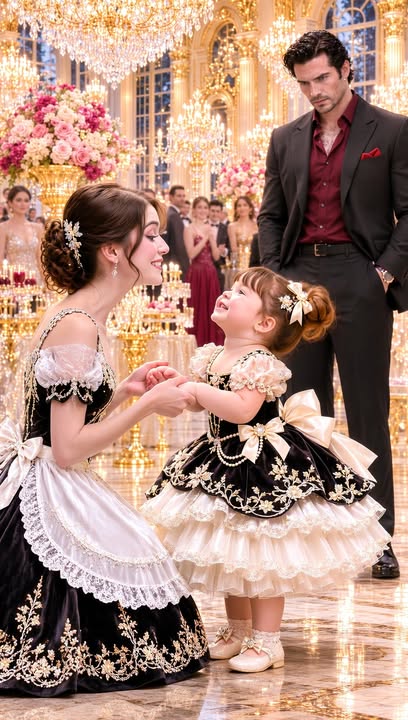
Part 6 – Beneath the Ballroom Lights
“Emily, was there another child in your family?”
Vincent’s question seemed to hover above the kitchen table, caught among the letters and photographs.
I looked down at the name on the tiny scrap of paper.
Ruth.
My mother’s older sister had died before I was born, and I knew her only through a handful of stories and a portrait in my mother’s bedroom.
She had been young, my mother once told me, when a sudden illness took her.
There had never been a child in those stories.
“I don’t think so,” I said. “My mother had one sister, but she died before I was born.”
Sofia’s face softened.
“Could Ruth have been Elena’s friend?”
“I don’t know. My mother wrote the name here, but there’s no explanation.”
Vincent sat again, looking at the paper without reaching for it.
“Perhaps Ruth was the child,” he said. “Or someone connected to her.”
The thought settled over us, not as an answer but as a new direction.
I searched the box again, this time looking for anything that might relate to my aunt.
At the bottom of a folder of old documents, I found a small, folded card addressed to my mother.
The handwriting was unfamiliar, elegant and slanted.
I turned it over.
The sender’s name was Elena.
My fingers tightened around the paper.
“It’s from her,” I said.
Sofia and Vincent leaned closer, but neither hurried me.
I opened the card.
Margaret,
Ruth’s little girl is safe with you, and I am grateful beyond words.
I will come back for her as soon as I can make a safe home for us both.
Please tell her, when she is old enough, that her mother loved her and never stopped looking for a way to return.
The card slipped a little in my hand.
Sofia put her fingers over mine, steadying it.
Vincent read the message over my shoulder.
For a long moment, none of us spoke.
Then I looked again at the name on the scrap.
Ruth.
“My aunt,” I whispered. “The baby was my aunt’s daughter.”
My mother had held a child who was not Elena’s, but Elena had been the one entrusted to care for her.
Ruth had died, leaving an infant without a safe home, and Elena had helped her friend by carrying the child through a dangerous stretch of her life.
The truth did not make the story smaller.
It made it more tender.
Sofia lifted her eyes to me.
“Then the child in the photograph wasn’t Mom.”
“No.”
“And the letter about Elena coming back was about your aunt’s daughter.”
“Yes.”
Vincent exhaled, the breath unsteady at its end.
“The child was never Elena’s,” he said.
“My mother’s note was exact,” I replied. “She belonged to Ruth, and Elena helped bring her safely to my mother.”
“Did Elena find her a home?” Sofia asked.
“I think so.”
I searched the remaining pages until I found another letter, one I had not noticed tucked between two photographs.
It was dated a few months after Elena’s card.
My dear Margaret,
The little girl is with people who love her.
I visited today, and she fell asleep against my shoulder while I hummed the moon turn.
I will not ask to be called her mother.
I only hope she will one day know that many people helped keep her safe.
I read the words aloud, and my voice faltered on the final line.
My mother had never told me the child’s story because it was not hers to claim.
Elena had not been the child’s mother, but she had loved her as a friend’s child and helped protect her until she could be placed with people who would raise her.
The erased name on the note had not been a secret daughter.
It had been my aunt’s name, removed so that the child’s identity would remain private.
Sofia rested her hand on the page.
“So the baby grew up somewhere else.”
“Yes,” I said. “With people who loved her.”
“And your mother carried that promise all those years.”
“She did.”
Vincent looked at the letters, his face lined with grief and admiration.
“Elena trusted her with someone else’s child, and your mother kept that trust.”
“She did.”
“And she taught you the dance without telling you why.”
“I think she wanted me to have the song without inheriting the fear.”
Sofia lowered her gaze.
“That sounds like something a mother would do.”
I thought of the years I had spent believing my mother’s silences were empty spaces.
Now I understood that some silences had been chosen carefully, not to shut me out, but to let me grow beyond a story that did not belong to me.
Vincent looked at the note about the moon turn.
“I was wrong to think Elena had never shared the dance.”
“You believed what she told you,” I said.
“I believed what I could see. I never asked about the lives she had left behind.”
“Maybe she was waiting until the time was right.”
“Maybe.” His eyes met mine. “I wish I had asked with more care.”
Sofia moved closer to him.
“You can’t ask her now.”
“No.”
“But you can listen to what she left.”
He nodded, taking in her words.
“And I can listen to you.”
It was a small promise, spoken without ceremony.
Sofia’s shoulders eased.
I folded Elena’s card and returned it to its envelope.
The truth had finally become clear, but it did not erase the questions that remained.
We still did not know every detail of the winter Elena had disappeared from Vincent’s life.
We did not know exactly what dangers she had feared, or how long she had carried the responsibility alone.
But we knew enough to understand the shape of the secret.
My mother had not been Elena’s hidden child, and I was not secretly connected to the Moretti family by blood.
I was the daughter of a woman who had shared a dance and a friendship with Elena, and who had helped protect a child because a friend had asked.
Sofia had not been the infant in the photograph.
But the humming she remembered belonged to the same song Elena had once used to comfort a frightened little girl, and later passed on to her own daughter.
The music had carried affection across years, even when memory could not.
Vincent gathered the letters into a careful stack.
“These belong to you,” he said. “I won’t take them or make decisions about what should be shared.”
“Thank you.”
“I would like to see them again, if you’re willing.”
“I will show you the ones that concern Elena.”
He accepted the boundary with a quiet nod.
“And the proposal?” I asked.
“I’ve put it away.”
“I can’t accept the money under the conditions you offered.”
“I understand.”
“But if the studio offer is still possible without conditions, I’d like to hear about it.”
Vincent’s expression changed.
“Without conditions?”
“I won’t trade the story for support. But I’d be willing to talk about the teaching program you mentioned, if it can be arranged on fair terms.”
Sofia smiled at me.
“That sounds like a good beginning.”
Vincent considered my words carefully.
“Then let’s make it one,” he said. “We can work with the hotel’s charity foundation to fund the training and rent a small studio for children’s classes. The support will be written as a grant, with no agreement about family matters.”
“That would be fair.”
“And you would be free to decline.”
“I won’t,” I said, and for the first time the answer came without fear.
The weeks that followed did not transform everything overnight.
They changed things in quieter ways.
Vincent and Sofia began speaking about Elena more often, not only as a person they had lost but as a woman who had been young, uncertain, and connected to people beyond their family.
Sofia asked her father about the songs Elena used to hum.
Sometimes he remembered a few notes.
Sometimes he did not.
When his memory failed, he no longer treated it as a door closing.
He let Sofia ask again another day.
I brought the letters to the Moretti home one afternoon, after making copies for myself.
Vincent read them slowly at the dining table.
When he reached Elena’s card, he paused.
“She never told me about Ruth’s daughter,” he said.
“She may have believed it was Ruth’s story to protect.”
“I think she did.”
He looked at the photograph of Elena and my mother.
“I thought the time she was away belonged only to the two of us.”
“Maybe she was trying to care for more than one person at once.”
He gave a faint, sorrowful smile.
“That sounds like her.”
Sofia sat beside him, turning the photograph toward the window so the faded silver bracelets caught the light.
“I wish I could have known my mother as a friend,” she said.
Vincent looked at her.
“You still can, in a way.”
“How?”
“By learning what she loved. By asking about the people she cared for. By letting her be more than the person who left you too soon.”
Sofia leaned against his shoulder.
“I want to remember all of her.”
“Then we’ll make room for all of her.”
After that, our lessons grew into a small ritual.
Sofia came to the studio as soon as it was ready, although at first the studio was only a bright room in a neighborhood arts center with a polished floor and two tall windows.
She brought a notebook.
I brought the steps my mother had taught me.
Vincent sometimes sat along the wall, reading or answering messages, but he always looked up when we began to hum.
We did not try to restore the dance perfectly.
There was no original score, and none of us knew every step Elena had created.
Instead, Sofia and I built it from the pieces we had: the gentle side step, the pause, the turn, and the hand following an imagined path of moonlight.
When we reached the moon turn, Sofia’s movements became quiet and sure.
She no longer searched her memory for proof.
She let the dance be a connection, not a test.
“You’ve changed the ending,” I told her one afternoon.
“I know.”
“Your mother’s version stopped after the turn.”
“I wanted it to continue.”
“How?”
Sofia stepped toward me and placed one hand over her heart before extending it outward.
“Like she was giving the song to someone else.”
I watched the gesture and felt the meaning settle inside me.
“That’s beautiful,” I said.
“It’s yours too,” she replied.
We began offering free lessons for children a few weeks later.
The first students arrived shyly, clutching the hands of their parents or older siblings.
Some rushed through every step.
Some refused to dance until they had watched the room for a while.
I recognized the nervousness in each of them.
I recognized the moment when someone stopped thinking about who might be watching and began listening to the music instead.
Sofia became my helper, patient with the smallest children and quick to laugh when a turn went wrong.
Vincent never tried to direct the classes.
He sat near the door and greeted families as they arrived, his presence calm rather than imposing.
One little girl asked him whether he knew how to dance.
He glanced at Sofia.
“Not very well,” he admitted.
“That’s okay,” the girl said. “You can learn.”
Sofia laughed, and Vincent surprised all of us by standing.
He took his place beside her, awkward at first, his polished shoes catching lightly on the floor.
Sofia showed him the first step.
“One, two, three,” she counted.
He followed.
They moved slowly, smiling when they lost the rhythm and finding it again together.
I watched them from across the room and thought of Elena, not as a mystery but as a presence carried in every gesture she had given away.
The new charity gala came in the spring.
It was held in the same ballroom at the Pierre Hotel, beneath the same chandeliers, with the city glittering beyond the tall windows.
This time, I arrived through the front doors wearing a deep blue dress instead of a waitress’s uniform.
My supervisor hugged me near the entrance.
“You look like you belong here,” she said.
“I used to think belonging meant being invited.”
“And now?”
I looked across the room at Sofia, who was adjusting the small silver moon pinned to her dress.
“Now I think it means knowing why you came.”
The evening’s program included a short performance to raise support for the children’s dance classes.
Sofia had chosen the music herself, a gentle arrangement inspired by the melody Elena used to hum.
Before we went on, she took my hand.
“I’m nervous,” she said.
“Good.”
“Good?”
“It means you care.”
She laughed softly.
“What if I forget the steps?”
“Then we’ll make up new ones.”
“What if Dad gets emotional?”
“He can be emotional and still dance.”
Across the room, Vincent stood watching us.
His eyes were bright, though his expression remained composed.
When Sofia saw him, she reached out with her other hand.
He crossed the floor and took it.
The three of us stood together beneath the warm light of the ballroom.
“This is for Mom,” Sofia said.
“And for Margaret,” Vincent replied.
“And for every person who kept a promise,” I added.
The music began.
Sofia moved first, and I followed.
Vincent joined us a beat later.
He was not graceful, and he did not pretend to be.
He let Sofia guide him through the opening steps, and when the moon turn came, he watched her hand rise and circle in the air.
Something softened in his face.
For one brief moment, I felt my mother beside me—not as a ghost, and not as a secret, but as the kindness she had left in my hands.
The dance carried us through a quiet pause, then into the final movement Sofia had added.
She extended her hand toward the children gathered at the edge of the floor.
A little boy stepped forward.
Then a girl in a green dress.
Soon the children were moving with us, each in their own imperfect rhythm.
The ballroom that had once been filled with watching eyes now seemed to hold only the people willing to join.
When the music ended, Sofia stood between me and her father, breathing hard and smiling.
Vincent leaned over and kissed her forehead.
“You were wonderful.”
“We were,” she corrected.
He looked at me.
“Yes,” he said. “We were.”
Later, after the guests had drifted away and the last notes of the orchestra had faded, the three of us stayed beneath the chandeliers.
Sofia slipped off her shoes and carried them in one hand.
Vincent offered her his arm, though she only hooked hers through it for a few steps before reaching for mine.
“Will you teach me the new ending?” he asked.
“I thought you already learned it.”
“I learned the steps. I’m not sure I understand the ending.”
Sofia looked up at him.
“You don’t have to understand it all at once.”
“I’ve been learning that.”
She squeezed his arm.
I began humming the tune, the lullaby my mother had once carried through an ordinary kitchen.
Sofia joined me.
Vincent listened, then found the notes he remembered and added them quietly.
Together, beneath the ballroom lights, we began the dance again.
The steps were not perfect.
The music was not complete.
But the song had found its way through every silence, carried by friendship, trust, and the choice to let love be shared instead of hidden.
And for the first time, none of us needed to ask who it belonged to.
**–THE END–PLEASE
Share your thoughts or feedback to motivate us to create more stories ♥️
* * *
[PREVIOUS: PART 5](https://storyly.idolsgift.com/blog/part-5-the-dance-that-remembered-070)
✓ Lynn R. Adams
Part 6 – Beneath the Ballroom Lights “Emily, was there another child in your family?” Vincent’s question seemed to hover above the kitchen table, caught among the letters and photographs. I looked …