PART 6 (THE END): The Crown That Wouldn’t Be Chased 058
Part 6 – A Crown Steadied by Truth
He seemed to be searching for the child he had raised, and finding instead a woman who would not offer him an easy answer.
At last, Lord Ashcombe lowered his gaze to the receipt.
“I cannot promise what my grandfather knew,” he said. “But I will not ask you to hide what the paper shows.”
Celestine’s shoulders eased, though the sorrow in her face remained.
“Thank you, Father.”
He reached for her hand, then stopped, waiting.
Celestine saw the small gesture and placed her fingers over his.
The prince looked toward the council.
“Then we have our course.”
The council approved a formal review and authorized the prince to bring the evidence to the king.
By the time the meeting ended, no one had called Elias Rowan guilty.
It was not yet the full vindication Mara had hoped for, but the old accusation had finally been named as uncertain, and the evidence against it could no longer be kept in a drawer.
The prince asked Mara to remain while the councilors departed.
Celestine stayed too, along with her father.
“I will speak with the king now,” the prince said. “I want the proclamation to be complete, and I want the palace to acknowledge its failure plainly.”
“Will he agree?” Mara asked.
“I don’t know.”
It was an honest answer, and she trusted it more than reassurance.
“I’ll come with you,” Celestine said.
Her father looked at her, then nodded.
“So will I.”
The prince gathered the copies of the warning and the old receipt.
“Then we will go together.”
The king received them in a private audience room overlooking the palace gardens.
He was an older man, silver-haired and broad-shouldered, with a quiet manner that made his authority felt without requiring him to raise his voice.
He listened while the prince laid out the records: the warning, the incident register, the queen’s note, and the Ashcombe receipt.
The king read each page himself.
When he reached the line that described the mechanism as properly maintained, he stopped.
“Lord Varrick signed this,” he said.
“Yes, Father.”
“He was trusted by my father.”
“He was trusted by the court,” the prince replied. “But his signature does not make the record true.”
The king set the page down.
“Do we know that my father saw the warning?”
“No,” the prince said. “The queen’s note suggests she knew of it afterward. We cannot prove what the king was told.”
The king glanced at Mara.
“And your father was dismissed.”
“Yes, Your Majesty.”
“Did he ever petition the palace to review the decision?”
“Not that I know of.”
The king’s face softened with regret.
“Perhaps he believed no one would listen.”
Mara thought of her father’s silence in the years after the fire, and of the way her mother had guarded his dignity without letting the village’s rumors settle into their home.
“He had already tried to warn the workshop,” she said. “Twice.”
The king lowered his eyes to the paper.
“Then it was the palace’s duty to listen the first time.”
He turned to the prince.
“What do you propose?”
“That we publish the evidence and correct the record,” the prince said. “We should state that Elias Rowan reported the fault before the fire, that the mechanism remained in use, and that the official account omitted his warning. We should clear his name of responsibility.”
The king was quiet for a long moment.
“Some will say this weakens the crown.”
“Some may,” the prince answered. “But leaving a false record in place would weaken it more.”
The king looked again at the queen’s note.
His expression changed, not with anger, but with the pain of recognizing a familiar hand.
“My mother kept this hidden in the workshop?”
“She ordered that the warning be found before the drum was moved,” the prince said. “We believe she intended the truth to survive, even if she could not bring it forward herself.”
The king ran his thumb along the edge of the page.
“She always believed that a kindness meant little if it required someone else to remain unseen.”
Mara felt the small needle in her pocket, its familiar weight against her palm.
The king looked at her.
“You are Rowan’s daughter.”
“Yes, Your Majesty.”
“I am sorry that the palace left your family with an unanswered accusation.”
“Thank you.”
“Will a public correction be enough?”
“No,” Mara said. “But it is where the repair must begin.”
The king nodded slowly.
“Then we will begin there.”
He authorized the proclamation that afternoon.
The court scribe drafted it carefully, and the prince insisted that it state not only that the record had been incomplete, but why.
Elias Rowan had warned the royal workshop of a faulty stop.
The warning had not been acted upon.
After the fire, the palace had failed to include his warning in the official account and had dismissed him without a fair review.
The evidence did not support the blame placed upon him.
His name was cleared.
The proclamation also acknowledged the palace’s failure to preserve an honest record and announced a review of the queen’s relief accounts, including payments routed through trusted households.
Lord Ashcombe submitted his family’s receipt and agreed to return any funds shown to have been misapplied.
No one could yet prove that his grandfather had knowingly concealed the warning.
The investigation found that he had signed for it and forwarded the household papers to Lord Varrick’s office, as the receipt instructed.
Whether he understood what the warning meant remained uncertain.
Celestine did not try to turn that uncertainty into innocence or guilt.
She testified to what her family had kept, corrected what she had once assumed, and helped the archivists trace the relief payments through the estate records.
When the review was complete, the Ashcombe family returned the portion of the funds that could not be accounted for as relief.
The money was placed in a trust for repairs and food assistance in the villages that had received the queen’s help.
Celestine signed the transfer herself.
She did not do it because she thought a payment could erase her family’s part in the story.
She did it because the money had never belonged to them.
On the day the proclamation was read in the palace courtyard, the sky was clear and bright with early spring.
The court gathered beneath the stone arches, while servants, clerks, and a handful of villagers from Bellmere stood among the guests.
Mara had not expected to see people from her childhood village.
Then she recognized old Tavin, the miller’s widow, and a schoolmaster whose hands had once been stained blue from ink.
Her heart tightened.
They had come to hear what the palace would say about the man some of them had quietly remembered as honest, even when others repeated the old accusation.
The prince stood before them with the king beside him.
He read the proclamation in a voice that carried across the courtyard without becoming grand.
When he spoke her father’s name, he did not rush.
“Elias Rowan warned the royal workshop that its winding mechanism was unsafe,” the prince said. “His warning was disregarded, and after the fire the official record failed to include what he had reported. The evidence shows that he should not have been held responsible.”
He looked up from the page.
“The palace failed him. We acknowledge that failure, and we clear his name.”
For one still moment, the courtyard held silence.
Then Mara heard a woman near the front whisper, “He told us.”
The words were small, but they reached her like a hand placed gently on her shoulder.
Old Tavin bowed his head.
The schoolmaster wiped at his eyes with the back of his hand.
Mara did not cry until the prince finished reading.
Afterward, the king came down from the platform and stood beside her.
“Your father should have heard those words himself,” he said.
“Yes,” Mara replied.
“I cannot give him that.”
“No.”
“But I can make sure the kingdom hears them now.”
Mara looked at the villagers gathered in the courtyard.
“That matters.”
The king inclined his head, accepting that it was not the whole answer.
Celestine joined them a little later.
She wore no diamonds, only a simple blue dress and the small pearl clasp she had worn the night of the contest.
“I spoke with the steward about the account review,” she said. “He has agreed to let me help oversee the village records.”
Mara glanced at her.
“Because you know the estate papers?”
“Because I know what it feels like to discover that a family story is not the whole story.”
Her voice was quiet.
“I’m sorry for the way I treated you that first night.”
“You have apologized before.”
“I know. But I wanted to say it again without hoping the apology would make me feel better.”
Mara considered her.
“Then I accept it.”
Celestine’s eyes glistened.
“Thank you.”
“You needn’t spend the rest of your life trying to repay me.”
“I don’t intend to.” A small smile appeared. “I intend to do the work properly.”
“Then we may get along.”
“We may.”
The two women stood together beneath the arch, watching the crowd begin to disperse.
Celestine had not become gentle in every moment, nor had Mara forgotten the sting of her laughter.
But there was honesty between them now, and it felt more useful than the polished agreement they might once have called friendship.
In the months that followed, the palace established the Queen’s Repair and Relief Fund.
Its purpose was to support village wells, bridges, mills, workshops, and households struck by poor harvests or sudden loss.
The fund’s accounts were made public each year, and the people it served were invited to say what they actually needed before the palace spent a single coin.
Celestine helped oversee the records.
She learned to ask questions without assuming that a careful answer was an insult, and to listen without deciding in advance what the story ought to be.
Mara was asked to advise the workshop staff.
She accepted only after the prince made clear that the position was hers to take or refuse, and that no title or marriage was attached to it.
She helped restore the old winding drum, not to make it work again, but to preserve it safely with the warning and diagram beside it.
The drum remained in the workshop, where visitors could see what had failed and what had been ignored.
A new brass plate was fixed to its frame.
It bore Elias Rowan’s name, the date of his warning, and the truth that had taken so long to reach daylight.
Mara visited the workshop whenever she could.
Sometimes the prince came with her, bringing a book he had meant to read and forgetting to open it while she explained a repair.
He listened more than he spoke.
When he did speak, he asked questions because he wanted to understand, not because he wanted to prove he already knew.
Their closeness grew quietly.
It lived in cups of tea left near her workbench, in long conversations about the queen’s records, and in the ease with which they could sit together without needing to fill every silence.
The prince never again called a contest a way to choose a bride.
And Mara never mistook his kindness for a promise.
One evening, as the last of the summer light fell across the repaired workshop, he found her studying the brass plate beneath the old drum.
“You have made sure no one can forget,” he said.
“We cannot make everyone remember,” Mara replied. “But we can leave the truth where it can be found.”
He leaned against the bench.
“Would you walk with me?”
She set down her cloth and wiped her hands.
“I would.”
They crossed the palace courtyard together as lamps were being lit along the path.
At the garden gate, the prince stopped.
“I have been trying to find the right moment to ask you something,” he said.
Mara turned toward him.
“Is there a wrong moment?”
“There are several. Asking because the court expects me to, for example.”
“That would be a poor moment.”
“Or asking because I think I owe you something.”
“That would be worse.”
He gave a quiet, nervous laugh.
“I thought so.”
The evening breeze stirred the leaves above them.
The prince took a breath.
“I love the way you see a problem before you decide it is hopeless. I love your patience, and your honesty, including when it makes me uncomfortable. I love that you never let my title answer a question I ought to answer myself.”
Mara’s expression softened, though she did not look away.
“I have come to love you,” he continued. “But I will not ask you to accept me because I am a prince, because your father’s name has been cleared, or because anyone thinks you owe the palace a future.”
He held out his hand, palm open.
“Will you choose a life with me, as my equal and partner, if that is what you want?”
Mara looked at his hand.
There was no crown in it, no velvet cushion, no grand audience waiting for her answer.
Only the man who had listened when she asked him to look again.
She remembered her father’s name read aloud before the court.
She remembered Celestine choosing to testify.
She remembered the needle her mother had kept, plain and useful and marked with a quiet act of care.
Then she placed her hand in the prince’s.
“Yes,” she said. “I choose you.”
His smile came slowly, brightening his whole face.
“And I choose you,” he said.
Their wedding was held in the palace garden several weeks later, beneath a flowering arch rather than beneath the high gilded ceiling of the ballroom.
Mara wore an ivory dress with simple embroidery at the cuffs.
Her old maid’s uniform had been washed and carefully folded, not discarded, and placed beside her mother’s needle in a small wooden case.
The prince wore no crown during the ceremony.
He wanted no ornament to stand between them.
Celestine stood beside Mara as her witness, graceful in a pale-blue gown without a single gemstone.
Before the ceremony began, she squeezed Mara’s hand.
“I’m glad we met,” she said.
“Even after the contest?”
“Especially because of what came after.”
Mara smiled.
“You did not enjoy losing.”
“I still don’t,” Celestine said. “But I have learned there are worse things than losing.”
“Such as?”
“Winning by keeping the wrong story.”
Mara squeezed her hand in return.
The king gave the couple his blessing.
The villagers from Bellmere joined the celebration, along with palace workers, courtiers, and families who had received help through the queen’s fund.
There was music, warm bread, and dancing that continued long after the lamps were lit.
No one was asked to prove they deserved a place there.
Later, the prince and Mara slipped away to the ballroom.
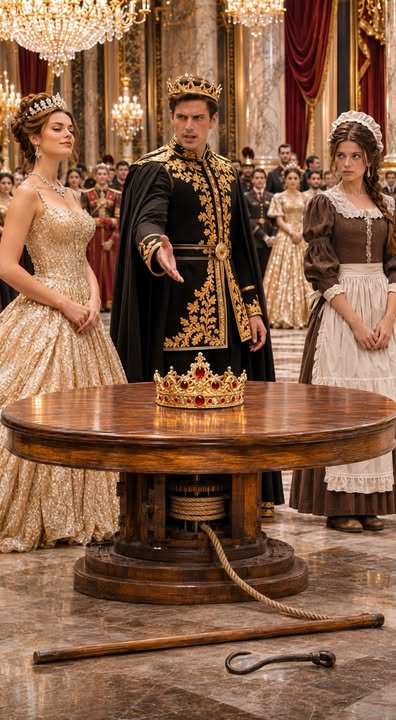
The great circular table had been restored and polished, its wooden surface turning slowly beneath the chandeliers.
It was no longer used for a challenge.
It stood as a reminder that strength did not always mean pushing harder, and that a kingdom could not be made steady by pretending its mistakes had never happened.
Mara set her hand lightly on the table’s fixed brace.
The prince stood beside her.
“Do you remember what you said when you first saw it?” he asked.
“That the answer wasn’t to chase something that was moving.”
“And what would you say now?”
She watched the table turn, the motion smooth and even.
“I would say that patience can guide what force cannot.”
He offered her his hand.
She took it, and together they returned to the music.
Beyond the ballroom windows, the kingdom’s lights shone across the dark gardens and the distant roofs of the city.
The old truth had finally been spoken.
The living had chosen to carry it honestly.
And the crown, no longer resting on a moving table, seemed steadier than it had ever been.
**–THE END–PLEASE
Share your thoughts or feedback to motivate us to create more stories ♥️
* * *
[PREVIOUS: PART 5](https://storyly.idolsgift.com/blog/part-5-the-crown-that-wouldn-t-be-chased-058)
✓ Lynn R. Adams
Part 6 – A Crown Steadied by Truth He seemed to be searching for the child he had raised, and finding instead a woman who would not offer him an easy answer. At last, Lord Ashcombe lowered his gaze …