PART 6 (THE END): The Crest on the Sword 057
Part 6 – A Future Built on Truth
Mara’s fingers hovered above her mother’s letter.
For a moment, she could not bring herself to touch it.
The words at the top seemed to hold all the years she had spent wondering why Eleanor had never spoken plainly about her time at the palace.
The king stepped back from the table, giving her room.
Alexander did the same.
Archivist Bell lowered her eyes, leaving the decision to Mara.
Mara drew a careful breath and lifted the page by its edges.
The paper was thin, but her mother’s handwriting remained steady.
“My dear Mara,” she read silently, then paused as emotion gathered in her throat.
She tried again, this time aloud.
“If you are reading this, then you have found your way to the palace, and the bracelet has brought you closer to the story I could not tell you.”
Mara’s vision blurred.
She blinked and continued.
“I left because I had learned that money meant for families in the villages was being diverted, and because the person responsible had begun to understand that I knew.”
The room remained still around her.
“I had copies of the accounts, but I did not know whom I could trust with them. The queen believed me, and she offered to help, but I feared that if I stayed, the people who had helped me gather the evidence would be questioned too.”
Mara lowered the letter for a moment.
Her mother had not left because she was ashamed.
She had left because she had been trying to protect others, just as the queen’s letter had suggested.
Alexander’s hand rested on the edge of the table, close enough that Mara could feel his presence without being asked to lean on him.
She continued reading.
“I know you may wonder why I never told you. I wanted you to grow up without carrying a story that had not yet been understood. I also wanted to believe that the truth would be found without requiring you to carry it for me.”
A quiet ache opened beneath Mara’s ribs.
Her mother had hoped to spare her.
But she had also hoped, perhaps, that the palace would one day do what it had failed to do when Eleanor was still there.
“I was wrong to think silence would protect you from questions,” the letter continued. “If you have come here, then you are old enough to ask them for yourself.”
Mara rested her thumb beside the next line, careful not to cover the ink.
“The bracelet was given to me by Queen Isolde for my service. I kept it because it reminded me that someone in the palace had seen my work clearly, even when others did not.”
The king closed his eyes.
Mara read on.
“If the king is still there, tell him I never wanted his regret. I wanted him to ask what happened before deciding that the matter was finished.”
The words were gentle.
That made them harder to hear.
Mara looked up at the king.
He had bowed his head, his hands wrapped around the head of his cane.
“I should have asked,” he said.
“Yes,” Mara replied.
He nodded, accepting the answer without reaching for forgiveness.
She returned to the letter.
“If you meet Prince Alexander, remember that he is not responsible for the choices made before he was born. Judge him by what he does when the truth is placed before him.”
Mara looked toward Alexander.
He was watching her, not the letter.
“I hope you will have a life that is your own,” she read. “Whether that life is in a palace or far from one, choose it because it is yours.”
The last lines were written more faintly, but still clear.
“Do not let anyone tell you that you must be grateful for a place you have not freely chosen. You have always belonged wherever your courage and kindness take you.”
Mara lowered the page.
She could almost hear Eleanor speaking beside her, using the calm voice she had used at home when Mara was worried about something she could not yet name.
For years, Mara had wondered what her mother had been protecting.
Now she knew.
Eleanor had been protecting the villagers from being forgotten, the people who had helped her from suspicion, and Mara from inheriting a story that had not been proven.
Yet her silence had left Mara with questions.
It had not been a perfect choice.
It had been a human one.
“Was there anything else in the ledger?” Mara asked.
Archivist Bell turned a page of the regional account book.
“There is a reference to the settlement Eleanor named,” she said. “It was once called Bellweather Ford, though the charter was withdrawn after the winter in question.”
“Why was the charter withdrawn?” Alexander asked.
“The records say the settlement failed to meet its provisions, but the accounts suggest the promised grain never arrived.”
The king’s expression tightened.
“Then the missing payments may have contributed to its decline.”
“They may have,” Archivist Bell said. “We would need to speak with the families and compare their records before stating more.”
Mara looked again at the letter.
Her mother had written that the villagers were owed more than an explanation.
The king seemed to understand what she was thinking.
“We will include Bellweather Ford in the inquiry,” he said. “No family will be left out because its village name changed or its charter disappeared.”
“And the repayment will not depend on whether anyone can prove exactly what each household lost?” Mara asked.
“The surviving records will guide the amounts,” said the king. “Where the evidence is incomplete, we will consult the families and local historians before deciding.”
Mara nodded.
It was not a way to undo the past.
It was a way to take responsibility for what could still be repaired.
The next weeks were long, full of letters, visits, and careful checks against the old accounts.
Mara travelled with Archivist Bell and two local historians to Bellweather Ford, where a small cluster of families still lived along the river.
The village was quieter than the records suggested it had once been, but not empty.
An old stone bridge crossed the water, and beyond it stood a chapel, a schoolhouse, and homes with gardens tucked close to their walls.
Some residents remembered the old name.
Others knew only that their grandparents had spoken of a winter when the promised grain never came.
Mara listened as they told what they had heard, neither asking them to forgive the crown nor promising that history could be mended in a day.
She told them what Eleanor had found.
She told them that the records were being checked.
And she told them that their names had been written down before the palace ever remembered to ask about them.
An elderly woman named Mrs. Fenner held one of the copied lists in both hands.
“My grandmother said they were promised help,” she said. “She said the carts never came, and afterward the palace stopped answering the village letters.”
Mara looked down at the careful column of names.
“Your grandmother was not forgotten here,” she said. “My mother wrote these names so they would not be forgotten at the palace either.”
Mrs. Fenner’s eyes filled.
“She must have cared.”
“She did,” Mara replied. “Very much.”
The first repayment was made several weeks later, after the surviving accounts had been compared and the family lists reviewed.
The crown’s fund was established to support descendants of the affected villages, with payments shaped through consultation rather than imposed from the palace.
Some families chose direct assistance.
Others asked for repairs to the old bridge, the schoolhouse, and the public records that had nearly vanished.
The king agreed to both.
Mara returned to the palace on the morning of the public statement wearing her mother’s bracelet openly.
She did not wear the deep-rose gown from the contest.
Instead, she chose a simple dark green dress, with no jewels except the old silver band at her wrist.
Alexander met her outside the hall.
“How are you feeling?” he asked.
“Nervous.”
“So am I.”
She studied his face.
“You don’t have to stand beside me.”
“I know.”
“Then why are you?”
“Because I want to,” he said. “But I’ll stand wherever you ask.”
The answer warmed her more than a grand declaration would have.
“Beside me is fine.”
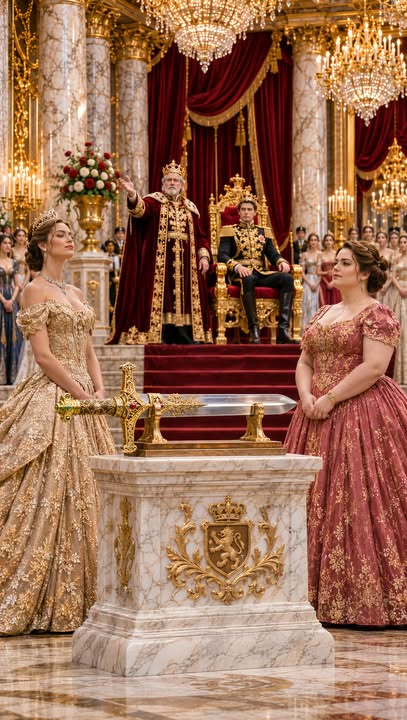
The great hall was full when they entered.
The sword stood on its marble pedestal at the center, but no one had arranged a contest around it.
Instead, beside it lay a display of the verified accounts, the damaged ledger, and copies of the letters Eleanor had left.
The king approached the front of the hall.
He did not begin with Mara’s victory or the promise he had once made.
He began with his own failure.
“Many years ago, Eleanor Vale brought forward concerns about funds intended for struggling villages,” he said. “She was accused of taking a royal seal and dismissed before the accusation was properly investigated.”
A murmur passed through the court.
The king did not wait for it to fade before continuing.
“I accepted the report of a trusted official without asking Eleanor to explain what she knew. The inquiry was deferred, and I allowed the matter to be treated as closed.”
Mara stood beside Alexander, her hands steady at her sides.
“I was wrong,” the king said. “The evidence we have recovered confirms that payments recorded as delivered did not reach several villages. Eleanor’s records helped reveal the discrepancy, and the surviving documents show that she had been trying to protect the families affected.”
The king turned toward Mara.
“Today, the crown clears Eleanor Vale’s name and restores the record of her loyal service.”
He paused.
“This does not erase the years she lived under suspicion, or the families who went without what had been promised. I am sorry to her daughter, to those families, and to all who trusted the crown to act fairly.”
His voice faltered, but he did not look away.
The apology was not followed by a request for acceptance.
That mattered.
Archivist Bell then described what had been confirmed and what remained uncertain.
She spoke carefully about the records, distinguishing evidence from inference.
No one was named as guilty beyond what the surviving documents supported.
Lord Harrow’s part was described through the approvals and orders connected to his office, while the king acknowledged that the full path of the money could not be reconstructed in every detail.
The fund for the affected families was announced.
The descendants of those identified in the accounts would be contacted directly, and further research would continue for any households whose records had not yet been found.
When Archivist Bell finished, the hall remained quiet.
Then a woman near the front began to applaud.
Others joined her.
The sound grew, not with the wild excitement that had followed Mara’s sword lift, but with a steadier warmth.
Mara did not feel victorious.
She felt that, at last, the truth had been spoken where the old accusation once had been.
The king stepped down from the platform and came to stand before her.
“Your mother deserved better,” he said.
“She did.”
“I cannot give her those years back.”
“No.”
“But I can make sure the harm is not hidden again.”
Mara looked at the documents arranged beside the sword.
“Then keep doing that.”
“I will.”
Victoria waited nearby, her expression solemn.
When the hall began to loosen into small groups, she approached Mara.
“I wanted to thank you,” she said.
“For what?”
“For letting me help find the families.” Victoria glanced toward the accounts. “And for making me understand that an apology isn’t the same as being forgiven.”
Mara considered her.
The old hurt had not vanished, but Victoria had made a choice to do more than explain herself.
“You helped bring the truth forward,” Mara said. “That matters.”
Victoria’s eyes shone with relief.
“I’ll keep helping, if you’ll have me.”
“I will.”
Victoria gave a small nod, then turned toward the local representatives, who had travelled to hear the king’s statement.
She began speaking with them without taking over the conversation, letting them explain what their families needed.
Mara watched her for a moment.
Then Alexander came to stand beside her.
“You did something difficult today,” he said.
“So did the king.”
“He did.”
“Do you think he’ll keep his promise?”
“I think he understands now that a promise only matters if it changes what comes after.”
Mara looked at him.
“And what comes after for us?”
Alexander smiled faintly.
“That depends on what you want.”
Months passed.
The records were restored and placed beside the sword in the old gallery, no longer hidden behind loose wood.
The sword itself remained on its pedestal, but its plaque was changed.
It now described not only its ceremonial history, but also the recovery of Eleanor’s letters and the crown’s failure to investigate her accusation.
Visitors could read what had happened without needing to know a rumor first.
The village fund continued its work.
Bellweather Ford received repairs to its bridge and schoolhouse, while families from the other settlements chose how their share would be used.
Some accepted individual support.
Others joined a committee that preserved local histories, determined that the next generation would know why the promised grain had mattered.
Mara visited whenever she could.
She never presented herself as the person who had saved them.
She had only found the path her mother had left behind.
On one visit, Mrs. Fenner gave her a small cloth pouch.
Inside was a smooth river stone with a line carved around its center.
“Our children used to mark these when they crossed the old bridge,” the woman explained. “My grandmother kept one from the winter she was a girl. She said it reminded her that people carried one another through hard seasons.”
Mara accepted it with both hands.
“I’ll keep it.”
“Your mother might have liked it.”
“I think she would have.”
By then, Mara and Alexander had learned how to spend time together without the contest standing between them.
He showed her the quieter corners of the palace gardens, where the rose paths gave way to an orchard and a small pond.
She taught him how to mend a torn sleeve without calling for a servant, and he taught her the names of the stars that could be seen from the northern terrace.
They disagreed about books, laughed over his terrible attempt at baking, and spoke honestly about the parts of their lives that had been shaped by other people’s expectations.
Alexander never asked her to become someone else in order to fit the palace.
Mara never asked him to pretend he had not been raised inside its privileges.
They were learning, slowly, to know each other as people rather than as the prince and the woman who had lifted a sword.
One evening, as autumn leaves drifted across the palace garden, Alexander asked her to walk with him beneath the ash trees.
He carried no velvet cushion, no royal document, and no witnesses.
Only a small wooden box rested in his hand.
Mara glanced at it.
“What is that?”
“Not a crown,” he said. “Not a contract, and not a prize.”
She smiled.
“That’s a promising beginning.”
He opened the box.
Inside lay a simple ring, its silver band set with a small green stone.
“I’ve had a long time to think about what I wanted to ask you,” he said. “And I’ve tried to make sure the question is only about us.”
Mara’s smile faded into attentive quiet.
“Go on.”
“Would you consider marrying me, Mara, because you want a life with me—not because of the contest, my father’s promise, or what anyone expects you to do?”
For a moment, the garden seemed to grow still around them.
The last sunlight rested on the leaves.
Mara touched the bracelet at her wrist, feeling the familiar crest beneath her thumb.
She thought of Eleanor, who had wanted her daughter to choose a life of her own.
She thought of the king, who had finally admitted what his family had failed to do.
She thought of the villagers who now had their names and histories entered into the royal record.
And she thought of Alexander, standing before her without rank to make the answer easier.
“Yes,” she said.
His breath left him in a small, startled laugh.
“Yes?”
“Yes,” Mara repeated. “I want that life with you.”
Alexander slid the ring onto her finger.
It fit.
He did not kiss her until she stepped closer and placed one hand against his cheek.
Then he kissed her gently, beneath the ash trees and the falling leaves, with no court watching and no promise deciding for them.
When they returned to the palace, the king was waiting in the garden hall.
He saw the ring and looked first at Mara.
“Was it your choice?” he asked.
“It was.”
His face softened with a relief that carried no claim of ownership.
“Then I am happy for you.”
“Thank you,” Mara said. “And thank you for making sure my mother’s name was restored before this.”
“I should have done it long ago.”
“Yes,” she said. “You should have.”
The king accepted the truth of that without asking her to soften it.
Then he bowed his head to her, not as a ruler addressing a contestant, but as a man acknowledging a debt that would continue to shape his choices.
Mara and Alexander were married in the palace garden the following spring.
The ceremony was small by royal standards, though people from the villages were invited, along with Archivist Bell and the staff who had helped preserve Eleanor’s letters.
Victoria stood beside Mara, holding the bouquet and smiling with a warmth that had taken time to become sincere.
The king gave no grand speech about destiny.
He spoke briefly about the importance of choosing with honesty and listening before judgment.
Then he stepped aside and let Mara and Alexander speak for themselves.
Mara wore the bracelet her mother had kept through every difficult year.
Its silver had been cleaned, but the tiny crest remained unchanged.
After the ceremony, she placed the river stone from Bellweather Ford beside the wedding flowers in Eleanor’s memorial alcove.
The sword stood nearby, beside the restored records.
It had once been used to measure strength.
Now it reminded the court that courage could be found in a woman who lifted what others said she could not, in a mother who gathered evidence while carrying fear, in a king who finally confessed his failure, and in a prince who waited for a freely given answer.
That evening, as the guests began to leave, Mara and Alexander stood together before the display.
The palace windows glowed gold in the late light.
Mara touched the bracelet.
“She would have liked this,” Alexander said.
“She would have liked that the villages were remembered.”
“And that you chose your own future.”
Mara leaned her shoulder against his.
“I think she would have liked that best.”
Beyond the gallery, the palace carried on around them, its corridors full of footsteps and quiet voices.
But the old silence had been broken.
The records were open, the families had been heard, and the future belonged to those who chose it together.
**–THE END–PLEASE
Share your thoughts or feedback to motivate us to create more stories ♥️
* * *
[PREVIOUS: PART 5](https://storyly.idolsgift.com/blog/part-5-the-crest-on-the-sword-057)
✓ Lynn R. Adams
Part 6 – A Future Built on Truth Mara’s fingers hovered above her mother’s letter. For a moment, she could not bring herself to touch it. The words at the top seemed to hold all the years she had s…