PART 6 (THE END): The Count Beneath the Music 046
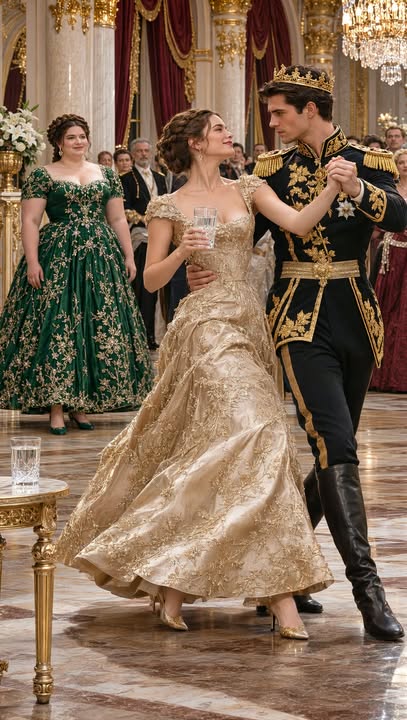
Part 6 – The Dance We Chose
The adviser drew a folded sheet from the inner pocket of his coat.
“It is a note from the king,” he said, “written in the margin of an old household register.”
The prince held out his hand.
For a moment, the adviser hesitated, then passed him the paper.
The prince read it once without moving.
Then he read it again, more slowly.
“What does it say?” I asked.
He looked up at me, and the strain in his face had eased, though the sadness remained.
“My grandfather wrote that Elianor Vale’s letter had reached him unopened,” he said. “He had been told it concerned a rehearsal dispute and believed the private secretary would arrange a response.”
Master Vale lowered his eyes.
The prince continued.
“The note says the king intended to speak with my mother, but the letter was misplaced before he did. By the time he learned the performance had been canceled, he was told the matter had been settled.”
The adviser added, “The king does not claim that this excuses the failure. He asked me to say that he regrets never asking what happened.”
The prince folded the note along its original crease.
“Does it tell us who decided the letter should be held?”
“No,” the adviser said. “The private secretary’s records are incomplete, and my predecessor is no longer able to account for every decision made in that office.”
It was not the neat answer the court might have preferred.
There was no single name to place at the center of the mistake, no simple confession that could make all the years between then and now disappear.
There was a faulty stage, a false public account, an unheard letter, a queen who had objected but not prevailed, and a household that had allowed silence to grow easier than correction.
The truth was larger than one person.
So was the responsibility.
The prince looked toward the gathered teachers.
“I will add the king’s note to the record,” he said. “It establishes what he knew and what he did not. It does not change the fact that the public account blamed the wrong person.”
The adviser bowed.
“I will make certain the archivist receives it.”
“Thank you.”
The adviser stepped away, and the small circle around us loosened.
The prince turned to Master Vale.
“Will you add this to your statement?”
“Yes,” the tutor said. “I will state that the king’s note exists and that we cannot prove who withheld the letter or why.”
“And you will still say that the staging report was ignored?”
“I will.”
Master Vale looked at me.
“I am sorry that my silence helped the false account remain in place.”
I held his gaze.
“I believe you are sorry.”
He nodded, accepting that it was not the same as forgiveness, and that forgiveness was not something he could ask me to provide on a schedule.
“Will you stay through the students’ performance?” I asked.
“If they will have me.”
“I think they would.”
A little uncertainty crossed his face.
Then he gave me a grateful nod.
The prince returned to the lectern and explained the new note in careful, plain language.
He did not let the discovery become a reason to soften the correction.
He said the archive would include every surviving document, including the parts that remained uncertain.
He said the fund would be restored regardless of what the records revealed about the decisions made decades earlier.
And he said Elianor Vale’s contribution to the dance and to the schools would be entered into the official history.
When he finished, there was no grand burst of applause.
Instead, the teachers began asking questions about the fund.
One asked when applications would open.
Another wanted to know whether the royal contribution could cover repairs as well as tuition.
The prince listened, answered what he could, and asked the accounts director to write down the rest.
That was more meaningful than applause.
The evening turned toward the students’ performance.
The young dancers gathered near the low stage, some trying to hide their nerves and others so excited that they could barely stand still.
The girl in the blue rehearsal dress stepped forward to speak with her teacher.
“Are we doing the pause?” I heard her ask.
“If you want to,” the teacher said. “The choice is yours.”
The girl looked across the stage toward the chalkboard.
Then she nodded.
The prince stood beside me as the musicians took their places.
“You used it as a challenge,” I said.
“I did.”
“Did you know it was my mother’s pattern when you chose it?”
“No.” He glanced toward the stage. “I knew only that my mother had loved it.”
“Why that sequence?”
“I remembered the count. I remembered her saying that a pause could tell you as much as a step.”
He looked down at his hands.
“I thought I was testing whether someone could hear a change before it happened.”
“You were.”
“I did not understand why it mattered so much to me.”
I watched the dancers take their places.
“Maybe your mother remembered the dance even after the palace tried to forget it.”
He turned toward me, his expression open and unguarded.
“Perhaps.”
The music began.
The first measures were simple, giving the youngest dancers time to find their footing.
They crossed the stage in pairs, arms raised, their steps careful and bright.
When the unusual count arrived, the music seemed to breathe.
One, two, three—hold.
For a beat, the dancers became still.
Then they turned together.
The movement was not flawless.
One boy turned a fraction too soon, and another dancer corrected with a quick, warm smile.
The audience followed them through the mistake and the recovery, and the children finished the sequence with their hands joined.
The applause rose like sunlight filling a room.
I felt my eyes grow hot.
My mother’s dance had returned, not as proof of what the palace had done, but as a living thing in the hands of children who had never been told it was too difficult for them.
The girl in blue laughed when the music ended.
Her teacher hugged her, and the other dancers gathered around them, talking all at once.
Master Vale stood near the display, his eyes fixed on the stage.
The prince did not look toward the court.
He looked at the students.
After the performance, the evening opened into conversation and dancing.
Teachers spoke with donors.
Families moved through the hall, stopping to read the archive display.
The prince kept his promise to listen before making any further announcements about the fund.
Lady Celeste joined the school directors near the entrance and helped arrange a meeting about transport and rehearsal space.
Her mother watched from a table at the side of the room.
When Celeste approached her, I could not hear what they said.
I saw the older woman’s expression soften as Celeste explained the work she had taken on.
The change was small, but Celeste stood straighter afterward.
She came over to me a few minutes later.
“Mother says she still believes the palace should have announced the fund more grandly,” she said.
“That sounds like her.”
“She also says the schools’ plan is sensible.”
“Is that progress?”
“I’m choosing to think so.”
She glanced toward the dancers, where the girl in blue was demonstrating the turning pattern to two other children.
“My family will help with the travel costs,” Celeste said. “Not because the prince might notice, but because the schools need it.”
“That seems like a good reason.”
“I think I’m beginning to understand the difference.”
She looked toward the prince, who was speaking with one of the teachers.
Then she turned back to me.
“I hope you don’t mind my saying this, but I think you were right to refuse to be a symbol.”
“I was afraid that was all the court would see.”
“Some of them still might.”
“Then I’ll remind them I’m a person.”
Celeste smiled.
“I imagine you will.”
We stood together as the music changed.
Her hand brushed mine, a quiet gesture of goodwill.
There was no claim that we had become close overnight.
There was simply the beginning of a friendship that did not require either of us to pretend we had never hurt one another.
Later, when the hall had grown quieter and the last of the formal speeches were behind us, the prince found me near the old program display.
“May I ask you to dance?” he said.
“Is there a glass involved?”
“No.”
“Then I’ll consider it.”
He waited, his expression attentive.
I placed my hand in his.
The musicians were playing a gentle waltz, not the old pattern, not the challenge sequence.
We moved among the guests without hurry.
His lead was familiar now, but he did not assume I would follow every turn without question.
When the music changed direction, he left room for me to answer.
“You know,” I said, “the first time we danced, I thought you were trying to make me fail.”
“I was trying to find out how you responded.”
“That can feel a lot like trying to make someone fail.”
“I understand that now.”
“Do you?”
“I hope so.”
I studied his face.
There was no courtly smile there, no polished answer meant to reassure me.
Only a man trying to be worthy of the trust he had asked me to consider.
“I don’t want the court deciding what we are,” I said.
“Neither do I.”
“And I don’t want the contest to become the reason we marry.”
“It won’t.”
“I will continue teaching.”
“I would expect you to.”
“I will keep working with the schools, and I will have a say in the decisions that affect them.”
“Then we will make sure you have more than a say.”
I raised an eyebrow.
“That sounds dangerously like a promise.”
“It is a promise about the work. Not a promise that I will always be right.”
“That would be impossible.”
“I suspected as much.”
A smile came to me before I could stop it.
He looked relieved to see it.
The music carried us through another turn.
We were near the middle of the hall when the conductor, having noticed us, signaled to the musicians.
The melody shifted.
The old count began.
One, two, three—hold—five, six, turn.
The prince’s hand rested lightly at my back.
He did not test the pause.
He did not ask me to prove that I could read him.
He simply waited with me, letting the beat open between us.
On the turn, I chose the direction.
He followed.
The surprise in his eyes turned into a smile, and his hand adjusted easily to mine.
Around us, some of the guests recognized the sequence from the students’ performance.
A few teachers joined the pattern from the edge of the floor.
Then two of the older children stepped forward, and their friends came with them.
The dance spread without instruction, not in perfect lines but in a warm circle of people learning the count together.
Lady Celeste offered her hand to Master Vale.
He blinked at her, then laughed softly and accepted.
The tutor moved carefully through the first measure, his cane placed beside the musicians’ stand.
When the pause came, he waited.
Lady Celeste waited with him.
Then they turned, slower than the children, but in time.
The prince looked over my shoulder at them.
“Do you think my mother would have liked this?” he asked.
“I think she would have liked seeing everyone invited.”
His smile turned tender.
“My mother would have liked that, too.”
We danced through the final notes as the hall filled with voices and gentle applause.
When the music ended, I did not feel like a contestant who had passed a test.
I felt like myself: a woman in an emerald gown, standing in a room where her mother’s name had finally been spoken with honesty.
The prince did not kneel or ask for an answer before the gathered court.
He waited until we had stepped beyond the dancers, into a quiet passage beside the open doors.
The night air drifted in from the garden.
“I do not want to ask you to become my bride because the court expects me to choose one,” he said.
“I would never accept for that reason.”
“I know.”
He paused, searching for words that did not turn my decision into another performance.
“I want to build a life with you,” he said. “Not because you passed a challenge, and not because our families might be useful to one another. I want to know you when the room is quiet, when the work is difficult, and when we disagree about the plans.”
“We will disagree.”
“I hope we do.”
“I will keep my work.”
“Yes.”
“I will keep my independence.”
“Yes.”
“My mother’s history will not become a story that belongs to the palace.”
“No,” he said. “It will remain yours to tell, and the records will belong to everyone who needs the truth.”
I looked through the open doors at the ballroom.
The dance continued inside.
Teachers, children, courtiers, and families shared the floor beneath the lights.
“What happens if the court objects?” I asked.
“It may.”
“What happens if they tell you that choosing me costs you influence?”
“I will remind them that influence without honesty is not worth preserving.”
He did not say that it would be easy.
He did not promise that no one would try to make our lives smaller than we wanted.
He offered a partnership in which neither of us would have to pretend.
I thought of my mother’s letter, her refusal to accept a private apology in place of a public correction.
I thought of the prince changing the plans when the hall was inconvenient, of Celeste choosing useful work over an easy display, and of Master Vale telling the truth at last without asking it to erase his silence.
Then I looked back at the man beside me.
“Yes,” I said.
His breath caught softly.
“Yes, I will build that life with you.”
He reached for my hand, then stopped.
“May I?”
I smiled and offered it.
He took my hand in both of his, careful and warm.
His forehead rested briefly against my knuckles, a small gesture away from the audience and the court.
When he looked up again, there was joy in his face, and something steadier beneath it.
“We will do this in our own time,” I said.
“In our own time.”
“And we will keep dancing.”
“Especially when the music is difficult.”
I laughed, and the sound carried into the corridor.
The spring ball did not settle every question about the old palace or the people who had failed my mother.
The archive would continue its work, and the corrected record would include the uncertainty as well as the facts.
The schools fund, however, was no longer a promise waiting for a more convenient year.
The first grants went to repairing floors, replacing worn shoes, and opening lessons to children whose families could not afford them.
Master Vale began visiting the schools with the teachers, listening more than he spoke.
The old rehearsal notes were copied and preserved, along with my mother’s letter.
The palace added a public acknowledgment of her work to its records, not as a favor to the prince or to me, but because it was true.
Lady Celeste continued her work with the charities her family supported, and she and I learned to trust each other in small, honest ways.
Sometimes she joined me at the schools.
Sometimes we disagreed about the best way to help.
Neither of us mistook disagreement for rejection.
The prince and I did not announce our engagement the night of the ball.
We had no wish to turn a hard-won truth into another court spectacle.
We took time to talk, to work, to learn each other beyond the music and the expectations surrounding us.
When we finally stood before the court together, we did so as partners who had chosen one another freely.
The court’s arranged-marriage plan was set aside.
The prince made it clear that no woman would be treated as a prize for winning his attention, and no alliance would be valued above mutual consent.
I kept teaching.
I kept working with the schools.
My family’s history remained part of my life, not a footnote in the palace’s story.
And every year, on the evening the fund celebrated its new students, we danced the turning pattern.
One, two, three—hold—five, six, turn.
The pause was no longer a test.
It was a space we made for one another.
Then came the turn, chosen together.
**–THE END–PLEASE
Share your thoughts or feedback to motivate us to create more stories ♥️
* * *
[PREVIOUS: PART 5](https://echoesofstories.idolsgift.com/blog/part-5-the-count-beneath-the-music-046)
✓ Lynn R. Adams
Part 6 – The Dance We Chose The adviser drew a folded sheet from the inner pocket of his coat. “It is a note from the king,” he said, “written in the margin of an old household register.” The princ…