PART 6 (THE END): The Cord Beneath the Bandage 008
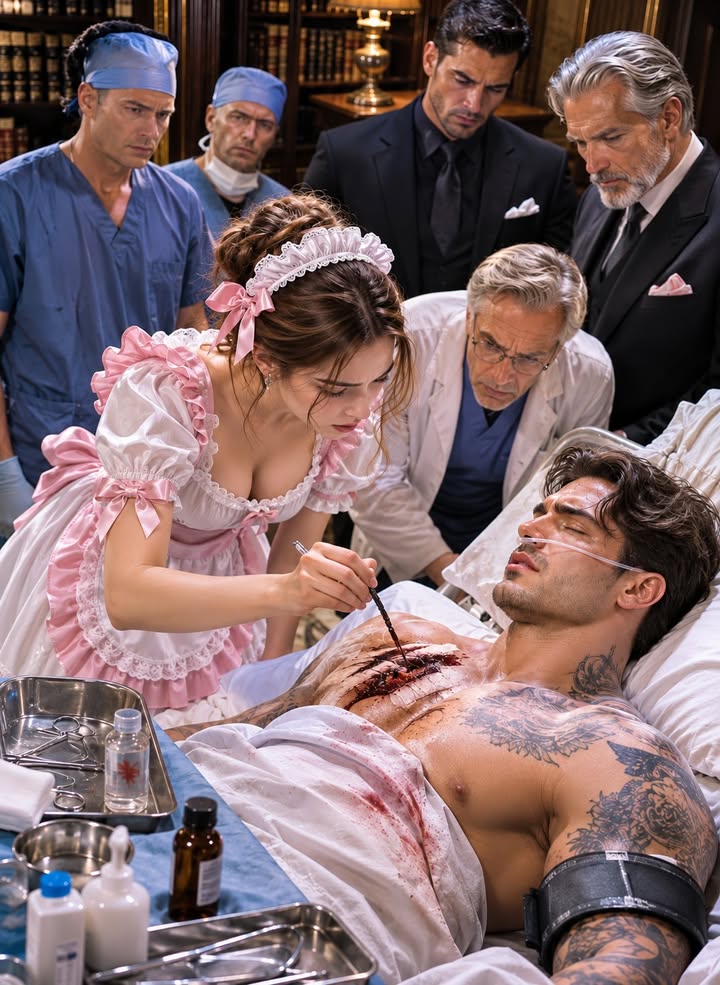
Part 6 – A Door Left Open
The answer was written beneath the final fold.
Adrian read it once, then looked again as if the words might change if he gave them another moment.
“Victor,” he said, his voice worn thin by pain and medication. “It’s addressed to you.”
Victor’s face had gone still.
Daniel came closer, but Adrian held out the paper.
“Read it.”
Victor took the note with careful fingers.
The handwriting slanted sharply across the yellowed strip.
**Victor—If you still have the line, destroy it. I was wrong to keep it. No business, no fear, no family name is worth making another worker pay for our choices. Tell Adrian the truth when he is old enough to understand why I failed to do so. —Elias**
Victor lowered the paper.
For several seconds, the room held only the quiet rhythm of the monitors.
“My brother wrote this?” he asked.
“The archive team believes so,” Daniel said. “We’ll have the handwriting verified.”
“But you knew,” Adrian murmured. “You knew he regretted keeping it.”
Victor looked down at the note.
“I knew he had doubts about the stock. I never saw this.”
“Why didn’t you destroy it?”
“I told myself it might be useful. I thought I could make people step back from a deal without anyone being hurt.” His voice caught. “I made the same mistake he was trying to correct. I treated a dangerous thing as harmless because I believed I could control it.”
Adrian’s eyes closed for a moment.
When he opened them, he looked at Victor without the anger Mara had expected to see.
“You don’t have to become him,” he said. “But you do have to answer for what you did.”
“I will.”
“Tell the investigators everything.”
“I will.”
“And stop deciding that silence protects people.”
Victor nodded, the note trembling slightly in his hand.
“I’m sorry, Adrian.”
Adrian held his gaze.
“I believe that you’re sorry. I don’t know yet what that means for us.”
“That’s fair.”
The surgeon stepped nearer to the bed.
“We need to take him to the operating room now.”
Adrian turned his face toward Mara.
She moved to the bedside, though she did not touch his bandaged arm.
“I’m glad you got to make the choice yourself,” she said.
“So am I.”
His gaze lingered on her for a moment.
“Your mother would have been proud of you.”
The words struck harder than praise from anyone else could have.
Mara tried to answer, but her throat tightened around all the things she had wanted to say since Daniel told her about the anonymous help.
She managed a small nod.
Adrian’s eyes closed as the team began to move him.
The wheeled bed passed through the doorway, the doctors and nurses surrounding it with practiced care.
Mara watched until the room beyond swallowed him from view.
Victor remained beside the empty space where the bed had been.
The note was still in his hand.
Daniel did not offer comfort or condemnation.
He simply stood with him, allowing the truth to remain what it was.
The operation took several hours.
Mara sat in the sitting room with a cup of tea that had gone cold before she remembered to drink it.
Daniel came and went, answering questions from the medical staff and investigators as they arrived.
He gave them his account of the altered records, the security logs, and the private information he had kept on Adrian’s request.
He did not hide his own name from the system audit.
Victor gave a statement too, describing the line he had retained, the reason he had kept it, and what he could and could not remember from the night Adrian was shot.
When the investigators asked him to identify the old stock, he did not soften his answers.
He also agreed to help locate and secure every remaining piece from the warehouse.
None of it erased the harm his choices had caused.
But for the first time, Mara saw him stop trying to control how the story would sound.
He let it be complicated.
He let it make him look imperfect.
The evidence grew clearer as the day wore on.
The batch records matched the braided cord recovered from Adrian’s wound and the frayed piece found in the medical case.
The chemical coating could irritate damaged tissue, while the bacteria on the sample provided another possible route for contamination.
The doctors still could not say that the cord alone had caused Adrian’s infection.
The gunshot wound, the later procedures, and the timing all mattered.
What they could establish was that the material had no place among medical supplies and had been handled at the warehouse before the case came to the mansion.
The original surgeon’s notes showed that he had used standard sterile sutures.
The hospital supply records confirmed that the sutures had come from a verified medical shipment.
Dr. Sloane’s care had not introduced the cord, and the altered warehouse inventory had not been changed by him.
The independent system review found that Daniel’s account had been used from the warehouse terminal during the confusion after the shooting.
The login had been copied from a handwritten emergency access sheet kept in the security office.
Several people had been in that room.
The audit could not establish who had made the alteration, but it showed the change had been entered after the medical case had already left the warehouse.
Daniel had not altered the record.
Still, he accepted that his lax handling of emergency credentials had made the investigation harder.
He changed the system, documented the failure, and gave the investigators the complete review rather than asking them to take his word for it.
Mara’s name was cleared by the same evidence.
The samples had not been accessible to her before the surgery, and the medical timeline placed her nowhere near Adrian’s wound when the cord could have been introduced.
Her knowledge had helped identify the material.
It had not made her responsible for its presence.
By late afternoon, the hospital team asked the people waiting in the mansion to gather in the library.
Dr. Pierce stood beside the window, tired enough that the silver in his hair seemed brighter than before.
“The operation is over,” he said. “We removed the infected tissue we could safely reach and cleaned the wound thoroughly. The infection was more limited than we feared, and Adrian’s arm remains viable.”
Mara pressed both hands over her mouth.
Daniel’s eyes closed in relief.
Victor lowered his head, and for a moment no one said anything.
“Is he going to recover?” Mara asked.
“He is not out of danger,” Dr. Pierce answered. “We’ll continue treatment, monitor him closely, and may need further procedures. But we controlled the worst of the infection, and there is no reason today to remove his arm.”
There was no promise that the road ahead would be simple.
There was, at last, a road.
When Adrian woke that evening, he was still weak, but his eyes were clear enough to recognize the people beside his bed.
Daniel stood near the window.
Victor sat at the foot of the bed, leaving a careful space between them.
Mara remained by the open doorway until Adrian looked toward her.
“You’re still here,” he said.
“I wanted to know how it went.”
“It went better than it could have.”
“That’s a good start.”
A tired smile touched his face.
“It is.”
Dr. Pierce told him that the operation had succeeded in removing the worst of the infection and that his arm had been saved.
Adrian listened without speaking.
Then he looked at the bandage covering his shoulder.
“Will I use it again?”
“We believe so,” Dr. Pierce said. “You’ll need time, treatment, and rehabilitation. We can’t promise how much strength you’ll regain, but the arm is still there to heal.”
Adrian released a long, unsteady breath.
“Then I’ll do the work.”
“You won’t do it alone,” Daniel said.
Adrian turned toward him.
“I know that now.”
Daniel’s expression shifted, carrying both relief and regret.
“I should have told you more sooner.”
“Yes,” Adrian said. “You should have.”
“I’m sorry.”
“I know.”
It was not a quick absolution, but it was a beginning.
Adrian looked at Victor.
“And you?”
“I’ll cooperate with the investigation and accept whatever comes from my choices.”
“You’ll also help find every remaining length of that line.”
“I will.”
“And you’ll support the workers whose injuries were ignored when the stock was first marked for disposal.”
Victor nodded.
“Yes.”
“Not as a way to make this disappear.”
“No.”
“Then we’ll see what happens next.”
Victor’s eyes shone, but he did not ask Adrian to forgive him.
Mara understood that restraint as its own kind of apology.
The investigation continued for months.
The evidence showed that Victor had retained part of the obsolete stock and carried a bundle from the warehouse office to the medical case on the night Adrian was shot.
He could not recall placing the cord there, and the recording did not show what the bundle contained.
The investigators could not prove that he had knowingly put the material into Adrian’s wound supplies.
They could establish that his decision to keep the cord had created a needless danger and that he had failed to disclose what he knew when the medical team began tracing the source.
Victor cooperated fully.
He accepted responsibility for retaining the stock and for concealing his earlier plan to use it as leverage.
He also helped the investigators account for every remaining piece in the warehouse.
The family company funded medical care for the workers who had been exposed to the old coating years earlier and opened its safety records to an independent review.
The changes did not repair everything the company had done.
They did make it harder for the same silence to become someone else’s burden.
Victor faced formal consequences for his part in concealing the material and mishandling company records.
He did not disappear, and he did not ask Adrian to protect the family name.
Instead, he attended the meetings required of him, answered the questions put to him, and began visiting the worker support center the company had helped establish.
Some people accepted his help.
Others did not.
He learned not to mistake either response for forgiveness.
Adrian recovered slowly.
His strength returned in uneven measures, with good mornings followed by afternoons when lifting a cup left his shoulder aching.
He attended rehabilitation appointments, followed the doctors’ instructions, and learned the patience his work had never required of him.
At first, he tried to treat recovery as another task he could master through force of will.
The therapist corrected him whenever he pushed too far.
Daniel corrected him too.
“Resting is not a strategic failure,” Daniel told him one afternoon.
“It feels like one.”
“That doesn’t mean it is.”
Adrian looked at the exercises laid out across the table.
“You’ve become very confident about telling me what I don’t want to hear.”
“I’ve had practice.”
Mara, who had been visiting to deliver a stack of administrative forms, laughed before she could stop herself.
Adrian looked at her.
“You think this is funny?”
“I think Daniel has waited years to say it.”
Daniel’s mouth twitched.
“He has.”
The laughter did not erase what had happened between them, but it loosened the air in the room.
Daniel began making the medical and security records accessible to the people who needed them.
He established clear limits around Adrian’s privacy without turning confidentiality into a wall.
When staff asked how he was doing, they were given the information Adrian had agreed to share.
When investigators needed records, they could obtain them through a documented process instead of a private favor.
Daniel also stopped calling every silence protection.
It took him time to understand that trust was not measured by how little a person knew.
Mara noticed the change in the small things.
He began asking before assigning her extra work.
He showed her where the household records were kept and invited her to correct any errors she found.
When a guest spoke to her as if she were part of the furniture, Daniel did not answer on her behalf.
He waited to see whether she wanted to respond.
More than once, she found she did.
The revelation about her mother’s treatment remained tender between her and Adrian.
When he was well enough to sit in the library for a short visit, he told her why he had arranged the anonymous payments.
“I learned that your mother was missing appointments because the bills had become impossible,” he said. “I knew my father’s company had once relied on the kind of labor she did. I thought paying quietly was the least I could do.”
“It helped her,” Mara said. “It helped me too.”
“I’m glad.”
“But you don’t get to decide that secrecy was always the kindest choice.”
“No,” he said. “I don’t.”
“I wish I’d known while she was alive.”
“So do I.”
She studied him.
“I’m grateful you helped her. I’m also sad she never knew who it was.”
“I understand.”
“Those things can both be true.”
“I’m learning that.”
He did not turn the conversation into a request for thanks or forgiveness.
That mattered to Mara more than any polished apology could have.
A few weeks later, Adrian asked her to meet him in the library.
Daniel was there, along with a woman from a local community foundation and a former nurse who had spent years helping workers navigate medical care.
On the table lay a proposal for a new medical-aid program.
The program would provide emergency support to people who had fallen through the gaps between insurance, public assistance, and the cost of staying healthy.
It would publish its funding records, use an independent board, and let applicants choose whether their names were shared.
Adrian had named it the Clara Bennett Fund.
Mara’s mother’s name sat across the front page.
She stared at it for a long time.
“I don’t know if my mother would have wanted a fund named after her.”
“Then we can change it,” Adrian said. “The name is not the important part.”
“What is?”
“That the program answers to the people it serves, not to me.”
The former nurse nodded.
“We’re building in a community review panel from the beginning. The fund will publish every grant and every expense, with private details removed.”
Mara read the proposal again.
“What do you need from me?”
“Your perspective,” Adrian said. “You understand what it means to be helped without being asked what help you actually want.”
He placed a second document beside the first.
It described a paid position coordinating applications and connecting families with local clinics.
“You’d be qualified for it,” he said. “Your mother’s experience matters, and you’ve already shown how carefully you listen.”
Mara did not touch the offer.
“Would I report to you?”
“No. The program director would answer to the board.”
“Could I refuse?”
“Yes.”
“Could I leave if I decided it wasn’t right for me?”
“Yes.”
“Would you still pay the fund’s bills if I said no?”
“Yes.”
She studied his face, searching for the hidden expectation.
There was none.
The offer felt different from the anonymous payments because it came with the choice he had once withheld from her mother.
“I’ll read everything before I decide,” she said.
“That’s all I’m asking.”
She took the papers home.
For several evenings, they sat beside the sewing machine that had belonged to her mother.
The machine had been silent for more than a year, one of its gears stiff and its leather belt cracked.
Mara began cleaning it.
She removed the dust from the wheel and loosened the screws one at a time.
She found a replacement belt through a repair shop and worked carefully until the mechanism moved again.
The first time the needle rose and fell, the familiar rhythm filled her apartment.
She sat there with one hand resting on the machine’s metal body and cried for her mother, for the bills that had frightened them, for the help that had arrived without a name, and for the small life she was beginning to choose for herself.
A month later, she accepted the position with the medical-aid program.
She negotiated the terms herself.
The role had clear hours, fair pay, and no connection to her duties at the mansion.
She did not become Adrian’s employee.
She became part of a community program with an independent board and a purpose she believed in.
The first time she entered the foundation office, she brought her mother’s repaired sewing machine.
It sat on a table near the window, ready for the workshop the program was planning for local women.
The workshop would offer more than sewing lessons.
It would provide a place for people to repair clothes, share skills, learn about health resources, and earn money from work they already knew how to do.
Mara chose the room’s layout.
She insisted on large windows and sturdy tables, and she made sure no one had to ask permission to use the equipment.
When Adrian came to see the space, he walked slowly, his right arm still supported by a light brace.
He had regained enough strength to lift his hand, though the movement remained stiff.
“This is good work,” he said.
“It isn’t finished.”
“Most important things aren’t.”
She smiled.
“You’re learning to rest, but not patience.”
“I’m still working on that.”
“So am I.”
They stood by the window, looking down at the street where delivery trucks moved through the morning traffic.
“Victor asked whether you’d be willing to see him,” Adrian said.
“I know. He wrote me a letter.”
“Have you decided?”
“Not yet.”
“That’s fair.”
“Do you forgive him?”
Adrian watched the street below.
“Some days I’m angry. Some days I understand why he thought he was protecting me. Neither feeling tells me what the future should be.”
“That sounds honest.”
“I’m trying to make honesty my first instinct instead of my last.”
Mara considered the letter folded in her bag.
“Maybe I’ll meet him when I’m ready.”
“He’ll wait.”
“Will you?”
“I’ll try.”
That afternoon, Adrian invited her to the opening of the workshop.
The invitation was simple, printed on a single card with the date and time.
**If you’d like to come, I’d be glad to open the doors with you.**
There was no request to report to the mansion.
No assumption that she would say yes.
No reminder of the help he had given her family.
Mara looked at the card, then at the old machine beside her.
“I’ll come,” she said. “But I want the women who helped build this to open it with us.”
“Of course.”
“And I want to speak about my mother.”
“You should.”
On opening morning, the workshop smelled of fresh coffee, warm bread, and clean fabric.
Women arrived carrying mending baskets and boxes of donated thread.
Some came with children.
Some came alone.
A retired tailor set out her tools beside Mara’s mother’s machine.
The former nurse arranged health information near the entrance, where anyone could take it without giving their name.
The board members waited until the room was full before asking Mara to speak.
She stood near the window, one hand resting on the machine.
“My mother taught me how to recognize a strong thread,” she began. “She taught me that the twist matters more than the color, and that a material can look sturdy while hiding a weakness.”
The room grew quiet.
“She also taught me that repairing something does not mean pretending it was never damaged. You examine it carefully, you decide what can be saved, and you use the right tools. Sometimes you need help from someone who knows the work. Sometimes you need to start again.”
She looked at the women gathered around the tables.
“This place is here so none of us has to make those decisions alone.”
When she finished, the room filled with warm applause.
Adrian stood at the back, his healed arm resting at his side.
Daniel was beside him, no longer watching every entrance but listening to the people speaking around him.
Victor had come too.
He stood near the doorway, not at the center of the room, and waited until Mara approached on her own.
“I’m glad you came,” she said.
“I’m glad you invited me.”
“I didn’t.”
“No,” Victor said. “You didn’t.”
The honesty made her smile, though only a little.
“I read your letter,” she told him. “I’m not ready to call what happened forgiven.”
“I understand.”
“But I do believe you’re trying to take responsibility.”
“I am.”
“Keep doing that when nobody is watching.”
“I will.”
She offered her hand.
Victor took it gently.
It was not forgiveness.
It was not nothing.
After the opening, the visitors drifted outside into the bright afternoon.
Mara stayed behind to straighten the tables.
Daniel carried a box of thread to the storage shelf and asked before placing it where she had planned to put the fabric.
Adrian waited by the door until the room was nearly empty.
“You could have gone ahead,” Mara said.
“I wanted to ask you something.”
“What is it?”
“The women here are already planning a second workshop. They want to teach repairs and work with the local boatyard on canvas projects.”
“That sounds promising.”
“They asked if you’d help organize it.”
“I’ll have to see the schedule.”
“Of course.”
“And the budget.”
“Of course.”
“And whether they want me, or whether you’ve decided I’m the right person.”
“I don’t get to decide that.”
She watched him for a moment.
“No,” she said. “You don’t.”
He smiled, accepting the correction.
Mara glanced around the workshop.
Her mother’s machine stood near the open window, its needle paused above a piece of blue canvas.
Beyond it, women were talking over coffee, comparing patterns and showing each other repairs they had made.
The room felt alive with hands at work and voices that did not need to lower themselves to be heard.
“I’d like to help,” she said. “If the women want me there.”
“They do.”
“Then I’ll come back.”
Adrian held out the workshop key.
Mara took it.
Not as a servant being assigned a door.
Not as someone repaying a debt.
As a partner trusted with a place she had helped build.
She stepped outside with the key in her pocket and her mother’s machine waiting inside.
The mansion stood several blocks away, its windows bright in the afternoon sun.
For the first time, Mara did not feel that she was leaving something behind.
She was choosing where to go next.
**–THE END–PLEASE
Share your thoughts or feedback to motivate us to create more stories ♥️
* * *
[PREVIOUS: PART 5](https://puretales.idolsgift.com/blog/part-5-the-cord-beneath-the-bandage-008)
✓ Lynn R. Adams
Part 6 – A Door Left Open The answer was written beneath the final fold. Adrian read it once, then looked again as if the words might change if he gave them another moment. “Victor,” he said, his v…