PART 6 (THE END): The Chamber’s True Purpose 041
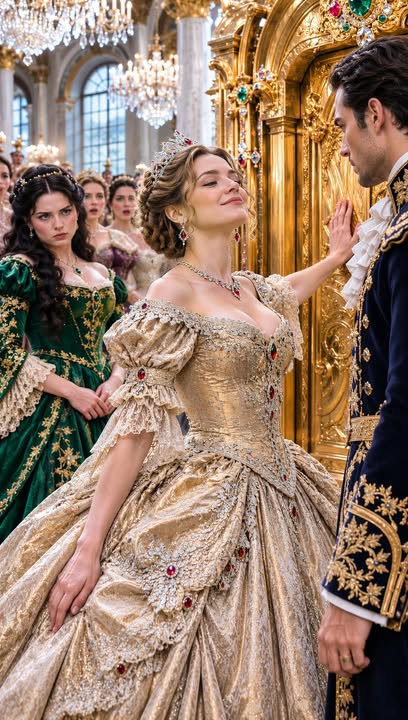
Part 6 – The Light We Choose
The first line read: *The child named Clara was not the only heir carried from the palace during the fire.*
For a moment, the council chamber seemed to lose all its air.
I kept my eyes on the page, though the words blurred beneath the sudden weight of them.
Adrian stood beside me, close enough that our sleeves touched.
No one reached for the letter.
At last, Lord Edric asked, “May I see the hand?”
I passed it to him.
He held the sheet by its edges, studying the faded strokes with the care he had given the birth record.
“This is the same hand,” he said. “Or a very faithful copy.”
“Does it name the other child?” Adrian asked.
Edric read silently, then turned the page toward the window.
“There is more writing on the reverse.”
The council members drew closer, but no one crowded the table.
The old chancellor read the lines aloud.
*The second infant was the son of the queen’s sister, born within days of Princess Isolde’s daughter.*
*The two children were carried from the palace together when the fire made the nursery unsafe.*
*One was placed at Vale House.*
*The other was sent to the care of a household beyond the river, under the protection of a family sworn to keep no claim against the crown.*
Adrian’s brow furrowed.
“Who was the queen’s sister?”
“Lady Elowen,” Edric replied. “She died before your birth. Her son was believed to have died in infancy.”
“Believed?”
“I was told he had not survived the fire.”
“By whom?”
Edric lowered the letter.
“By the physician assigned to the nursery.”
“And you trusted him?”
“I did.”
The chancellor’s voice carried no excuse, only the weariness of a man looking at an old mistake without turning away from it.
“Did you see the second child?” I asked.
“No. I was told there had been two infants in the nursery, but only one survived.”
“Then someone knew the truth and allowed you to believe a false account.”
Edric nodded.
“Yes.”
The revelation settled over the room differently from the first.
It did not point toward another hidden life in danger, but toward a second story that had been buried beneath the first.
The council did not begin speaking all at once.
Instead, each adviser seemed to be waiting for someone else to decide what the letter meant.
Adrian read the page again.
“Does it say where the boy was sent?”
“Only beyond the river,” Edric said. “The rest of the line is damaged.”
My father stood beside the window, his face thoughtful.
“Perhaps the missing register contains the answer.”
“The original register has not been found,” Mistress Vale said, “but the inventory mentioned a household copy.”
“Where?” I asked.
“In the old royal estate books,” she replied. “The river households were recorded each spring.”
Adrian looked toward the council.
“We will search the estate books and verify the letter’s paper and ink before drawing conclusions.”
Lord Pembroke nodded.
“That is prudent.”
The council’s earlier impatience had given way to something more unsettled and more human.
They were no longer weighing a simple succession question.
They were looking at the consequences of a story that had been made incomplete in the name of safety.
Adrian turned to me.
“Would you like to go home while we search?”
The offer came without pressure.
I thought of my father’s library, where the green book and the old records had waited quietly for years.
I thought of the palace library, where the secrets had begun to unfold.
“I would rather stay,” I said. “If the record concerns my family, I want to help find the rest.”
“Then you will,” Adrian replied.
He did not say *I will permit it*.
He said it as though my place beside the work had never been his to grant.
That afternoon, Mistress Vale and I searched the estate books while Adrian and Edric examined the council’s old correspondence.
My father joined us, bringing his careful knowledge of household names and inherited lands.
The task was not swift.
The river district had changed its boundaries twice in the past twenty years, and many family names appeared in different spellings.
We read until our eyes ached, finding only lists of tenants, wedding gifts, and repaired bridges.
Then my father stopped at a page near the end of a book from the year of the fire.
“This family,” he said.
The entry was brief.
*The household of Martin and Elsie Rooke, keepers of the south ferry, received a temporary allowance for the care of a foundling child.*
A note beside it had been added months later.
*Allowance continued under the name Rowan.*
My fingers went still on the page.
“Rowan?”
“Perhaps that was the child’s name,” Mistress Vale said.
“Or the family’s choice,” my father replied.
Adrian came to stand behind us.
“Do we know whether the Rookes still live by the ferry?”
“The old ferry house became a market cottage,” Mistress Vale said. “Their granddaughter may still keep it.”
“If they are willing to speak with us, we should ask,” I said.
Adrian looked to the council clerks.
“Send a respectful inquiry. No guards, no summons. We will not make a family answer more than they choose.”
The messenger left at once.
For the first time since the letter arrived, I felt the tightness in my chest ease.
The other child might be alive.
The thought did not diminish what I had learned about myself or the place I had grown up.
Instead, it opened a small, gentle space beside the truth.
Perhaps the secret had not been made to divide the kingdom.
Perhaps the two children had been hidden so neither could be used to control the other.
That evening, Adrian and I returned to the palace library.
The rain had stopped, and a clear amber light lay across the old shelves.
On the table rested Maeron’s green-bound volume, the chamber sketches open beside it.
“Do you think the second child can change the succession?” I asked.
“Perhaps,” Adrian said. “But I don’t think we should begin by asking what the child can do for the crown.”
“What should we ask?”
“Whether he was loved. Whether he was safe. Whether he wants to know the truth.”
I looked at him.
“That is the right order.”
“I have spent too long believing duty meant deciding for people before they had the chance to choose.”
“You are learning.”
“So are you.”
I smiled faintly.
“Is that a compliment?”
“It is an observation.”
“I’ll accept it as one.”
His quiet laugh mingled with the whisper of leaves against the windows.
For a little while, we sat side by side, reading Maeron’s notes.
The old inventor had written about the chamber’s purpose in a plain, clear passage near the back of the book.
*The vow is made by the crown to those who bear the weight of its decisions.*
*The chamber shall awaken only when a true heir approaches with a heart turned toward the people, not toward the title.*
*It shall not choose a ruler for the kingdom.*
*It shall remind the ruler whom the kingdom is for.*
I read the lines twice.
“So it never meant to crown anyone,” I said.
“No,” Adrian replied. “It meant to ask a question of the person who stood before it.”
“And the court turned the question into a contest.”
“Because contests are easier to understand than responsibility.”
The thought followed me back to the ballroom the next morning.
The chamber stood beneath the chandeliers, still and golden, no longer a device waiting to decide my future.
The court had gathered to hear what we had learned.
Adrian stood beside the chancellor, while my father and Mistress Vale waited near the entrance.
I approached the chamber alone.
The old inscription caught the light.
*Only the worthy shall awaken the crown.*
I did not touch it.
Instead, I turned to face the people watching.
“The chamber does not decide who should rule,” I said. “It does not measure beauty, blood, or favor.”
The room was quiet.
“It asks whether the person who holds authority remembers those who must live with its consequences.”
I saw Lady Victoria near the front, her expression thoughtful.
I saw Lord Pembroke listening without interruption.
I saw Edric’s gaze lowered, carrying the weight of all he had kept hidden and all he had finally chosen to reveal.
“The records found so far suggest that I am the daughter of Princess Isolde,” I continued. “They also suggest that another royal child was carried from the palace during the fire.”
A murmur moved through the room, but Adrian lifted one hand, and it quieted.
“We do not yet know the second child’s wishes or even the full truth of his identity,” I said. “We will not turn him into a symbol before we have met him.”
Lord Pembroke stepped forward.
“And your own claim, Lady Clara?”
I looked at the chamber, then at the faces before me.
“If the records are confirmed, I will accept the authority that is mine to protect this kingdom from those who would use uncertainty for their own advantage.”
I paused.
“But I will not rule alone merely because my name appears on an old page.”
Adrian met my gaze.
“I propose a shared government,” I said. “With the crown accountable to the council and the council answerable to the people. No decision about the succession will be made without verifying the records and hearing the second child’s wishes.”
Some of the advisers exchanged glances.
“You would share authority with Prince Adrian?” Lady Marwen asked.
“If he chooses it freely.”
Adrian stepped forward.
“I do,” he said. “Not because I must preserve the crown for myself, and not because I need to bind Lady Clara to me. I believe she should have the authority her life and the evidence entitle her to claim.”
The words carried clearly through the ballroom.
“And I will serve beside her,” he continued, “as a partner in government, not as the person who decides what she is allowed to become.”
The court remained silent for a moment.
Then Lord Pembroke bowed his head.
“I believe the proposal deserves careful consideration.”
It was not a victory declared with trumpets.
It was better than that.
It was a first step taken in the open, with no one pretending the difficult questions had already been answered.
Before the court dispersed, the chamber’s lowest jewel gave a soft green glow.
The light travelled around the arch, gentle as a breath.
No one cheered.
No one reached for it.
We watched it fade, and for once, no one mistook its quiet answer for a command.
The royal record was examined by three independent scholars over the next two weeks.
The seal, ink, and paper were all consistent with the period of the fire.
The hidden birth record was authentic.
The letter concerning the second child was genuine as well, though its damaged lines could not tell us everything.
The Rooke family received Adrian’s inquiry with caution, then invited us to their cottage by the old ferry.
Their granddaughter, Mara Rooke, met us at the door.
She was a sturdy woman with kind eyes, and she listened to Edric’s explanation without interrupting.
When he finished, she led us to a wooden chest beneath the window.
Inside lay a christening ribbon, a small silver pin shaped like a leaf, and a folded paper signed by the midwife who had brought the infant to her grandparents.
Mara touched the ribbon.
“My grandmother said Rowan came to them during the fire,” she told us. “She said he was loved before anyone knew what name to call him.”
“Do you know where he is now?” I asked.
Mara gave a soft smile.
“He is my uncle. He lives in the north village with his family and teaches children to read.”
The simplicity of the answer moved me.
He had not grown up in a palace, but he had grown up surrounded by ordinary kindness.
He had a home, a name, and a life that belonged to him.
When Adrian met Rowan, he did not bring a royal procession.
He went with me, my father, and Lord Edric, carrying the documents carefully wrapped in cloth.
Rowan was a gentle man with silver at his temples and ink on his fingers.
He heard the story in silence.
When Edric finished, Rowan looked down at the small silver leaf pin.
“I used to wonder why my grandmother kept this,” he said. “She told me it was the only thing that came with me.”
“You may do with the truth whatever you wish,” Adrian told him. “You have no duty to accept a title or a place at court.”
Rowan studied Adrian.
“Would the kingdom be harmed if I refused?”
“No,” I said. “It should not be.”
Rowan’s gaze settled on me.
“And you?”
“I have chosen to serve, but I will not ask you to make the same choice.”
He considered this for a long moment.
“I would like to know the rest of my family’s story,” he said. “But I don’t want to become a ruler.”
“You will not be forced to,” Adrian replied.
Rowan’s shoulders relaxed.
“I am glad.”
The matter of the second heir was settled with care.
Rowan’s lineage was formally recorded, but he declined any claim to the throne.
The council confirmed my identity and recognized my right to govern, while setting limits on royal authority and establishing regular public hearings.
Lord Edric brought forward the names of the faction that had tried to control the succession through secrecy.
Their plans had depended on confusion, not on grand cruelty.
They had hoped to secure influence over whichever heir appeared most convenient.
Once the records were verified, their quiet scheme had nowhere to hide.
They were removed from the council and brought before a lawful inquiry, where they had the chance to answer for their choices.
When the truth became public, there was no spectacle.
There were questions, careful explanations, and an apology from Lord Edric for allowing silence to carry so much weight.
He offered his resignation.
I asked him instead to remain long enough to complete the reforms he had helped conceal.
“Then I will serve,” he said. “But I will not decide what the people are permitted to know.”
“That would be a good beginning,” I replied.
The chamber was opened to the people before the end of the year.
The palace ballroom had always seemed like a place designed for those who already belonged.
We changed it into a public hall with open doors, long tables, and a small gallery where anyone could bring a petition or ask a question.
The golden chamber remained in the center, no longer used as a test.
A simple plaque was placed beneath its arch.
*Worth is shown through courage, kindness, and integrity.*
Lady Victoria helped choose the words.
She had spent the months since the first green light organizing a school for young women whose families could not afford tutors.
When she apologized to me again, the second time there was no excuse in her voice.
“I am learning not to ask a mirror what I should believe about myself,” she said.
“So am I,” I replied.
We became friends slowly, without pretending the past had been different.
My father returned to the palace library as an adviser on manuscripts, though he still preferred his home and its familiar quiet.
He and Mistress Vale spent long afternoons comparing the hidden notes, finding small details in the old records that had escaped everyone else.
Sometimes I visited them and found my father humming while he worked.
It sounded so much like the memory of my mother that I would pause in the doorway, letting the melody fill me before I announced myself.
Adrian and I governed together.
We disagreed often, especially about how quickly to change old customs, but we learned to argue without turning disagreement into a test of loyalty.
When I spoke, he listened.
When he spoke, I challenged him.
And when the court tried to place one of us above the other, we reminded them that leadership was not made stronger by pretending one person could carry every burden alone.
Months passed before Adrian asked to court me.
He did not ask in the ballroom or before the council.
He asked in the library, beneath the high windows where our first careful trust had taken root.
“I want to know you without a court deciding what we are for,” he said. “If you would like to discover whether we might be happy together, I would be honored.”
I looked at the shelves, at the worn green volume on the table, and at the prince who had learned to leave my choices in my own hands.
“Yes,” I said. “I would like that.”
He smiled, and the warmth of it reached me more deeply than any grand declaration could have.
“We will take our time,” he said.
“We will.”
We did.
We walked in the gardens without attendants when the day allowed it.
We read together, sometimes arguing over a passage until the lamps burned low.
We spoke about our mothers, and about the versions of ourselves we had once believed the court required.
When Adrian finally asked me to marry him, he did so with no council waiting outside the door and no crown between us.
I said yes because I loved him.
The people celebrated our wedding in the public hall, where the golden chamber stood open and quiet beneath the morning light.
My father walked beside me.
At the altar, Adrian took my hands and held them as though he understood that love was not a promise to possess, but a promise to keep choosing each other freely.
Years later, children came to the hall to study history, arithmetic, and the stories hidden in old books.
They were taught that the chamber had never measured anyone’s beauty.
It had been made to remind rulers of the people beyond their windows, and it had awakened for Clara because she had asked what the powerful had forgotten.
When sunlight touched the green jewel in its arch, it shone softly.
Not like a command.
Like a remembered promise.
**–THE END–PLEASE
Share your thoughts or feedback to motivate us to create more stories ♥️
* * *
[PREVIOUS: PART 5](https://echoesofstories.idolsgift.com/blog/part-5-the-chamber-s-true-purpose-041)
✓ Lynn R. Adams
Part 6 – The Light We Choose The first line read: *The child named Clara was not the only heir carried from the palace during the fire.* For a moment, the council chamber seemed to lose all its air….